Tuesday, September 30, 2025

Old Man in the Sea.


It's Saturday morning as I write this. Though I am nearing my 68th-spin around the sun, I have, through it all, a lot of little-boy left in me. The world has tried to squoze the boy out of me by now, starting with my harridan of a mutha who beat me ab ovo (that's why I know Latin) but somehow the joy finds a way to reassert itself, at least at times.

I'll admit, there are times I feel very old and ready to hang up my spikes. The current state of fascist intolerant so-called christian amerika. The plutocratic pillaging of the world. The vast economic inequalities. The death of fairness, kindness, enlightenment and more. Not to mention the absolute destruction of the industry I've loved so long by extortionate money-grubbers who strip-mined the world and left behind nothing but poisonous pixelized radio-active slag. 


However, when I am doing what I love, working for clients I like, doing work I believe in, spending moments with friends and my small family, when I am reading and learning, I am as happy as anyone ever has any right to be.

This morning was one of those mornings.

Though I was firmly in the grasp of Dame Morpheus, the sun blazed undeterred through our too-expensive window-treatments. Sparkle, our angel of a golden retriever who just turned two, bounded up the steps and stuck her wet black nose in my mouth. What better way to wake up? 

My wife read the tide charts at a nearby beach. When the tide is out, as it was this morning, the beach is close to half-a-mile wide and dotted with tide pools which the sun has warmed to a Caribbean ambience. The sea is out and you can walk into the surf almost a mile and still not get your shorts wet. 

Sparkle follows along, bounding through the water. She chases a ball I toss, or a branch. I also carry a bagful of apple slices that I hurl into the sea. They float and their sweetness calls to Sparks. She wades after the un-forbidden fruit and smiles as she gulps it down.

On shore on the flats, she sees a small grouping of dogs also playing in the surf. She gallops toward them and they run in long circles as fast as Derby winners, chasing each others' tails and kicking up the fine sand as they do.

It's like the Easter Parade on Fifth Avenue this morning, in what we used to call Indian summer, which I now, with purposeful assholeness call, "First-People's Summer." No one but I finds that funny, or has even tried to unravel its pressing stupidity.

There are small gaggles of human walkers everywhere, most with their canine companions, some with little sandy-bottomed kids running also through the surf, with laughter echoing off the sea walls that can no longer stand up to the sea.

I think, as I often do, of Thayer's lines,

"Somewhere in this favored land,
The sun is shining bright.
The band is playing somewhere,
And somewhere hearts are light.
Somewhere men are laughing
And somewhere children shout..."

Of course, that "Ballad for America" like our current lines has no happy ending. It ends in loss and disappointment and deflated dreams, like amerika itself is ending.

But for this morning, the puppy is tired, I've gotten my miles in, the Sunday Times crossword is on my stone doorstep and my wife even bought fresh bagels from the bagel shop, unlike the store bought ones which have more chemicals than the Gilbert Chemistry sets I had as a boy.

And this, I will say, is not a billion dollars in the bank, or a young blonde wife who defies gravity, or implanted abs they sell to Hollywood stars or a Lamborghini SUV or a house in Mustique between Mick's and Christie's.

This is a dog-tired dog, and better than all of the above.


Monday, September 29, 2025

Naval Gazing.

As I have written in this space so many times before, I don't read business books to learn about the world. I read books about the world and apply their lessons to business. I believe my methodology is infinitely more effective than reading some volume by a business neophyte with a mere gift for aphorism.

About three weeks ago, I read this sentence in a book review in my favorite source for book reviews, the cheery, apologetic, fascist, radical right Wall Street Journal. Despite its politics, the Journal's book section is a joy. Even when polemics enter the critiques, I have enough in my head to be able to deal with their creepy creepiness.

This particular review was by Paul Kennedy, a scholar whom I respect. He's professor of history at Yale University and the author or editor of some 20 books, including “The Rise and Fall of British Naval Mastery” and “The Rise and Fall of the Great Powers.” There is much more value in reading something by the likes of Kennedy than some pablum somebody spouts on some podcast or on Linked In. 

But for most people, the world is TL/DT. Too Long/Didn't Think. There are certain things and people you must find time for, and think about.

Besides, I liked the picture in the review.

Kennedy's review started out with these sentences. They reminded me of "Baseball Annie's" lines from "Bull Durham." "A man will listen to anything if he thinks it's foreplay." That's good writing advice, too. Whether you're writing a commercial, a blog post or a history book. This, for a reader, is more than foreplay. It's five-or-six-play.

Every so often a work of history comes along so substantial in its sheer size, so erudite in its scholarship and so well achieved that it makes others seem minor by comparison. So the appearance of “The Price of Victory,” the third and final volume in N.A.M. Rodger’s massive naval history of Britain, is worth special attention—and not only to readers interested in maritime affairs. For what Mr. Rodger has done here is to use the lens of Britain’s naval story, from Anglo-Saxon times to the close of World War II, to offer a majestic, confidently written sweep of historical scholarship. There is really nothing quite like it, or that comes close to it, in any recent work of military or naval history.

I was in the middle of something else when I read this review. No matter, I hastened through my previous reading and moved "The Price of Victory" up into the on-deck circle.

I'll admit. 

It's been a slog. 

And at 976 small-type pages, there were more than a few moments when I asked the ceiling, "why do you do this to yourself?" Sometimes my reading can feel like voluntary root canal.

Because it ain't easy being an autodidact. I work at it and I persevered. The last 400 pages or so have been more than worth the price of Amazon's monopoly pricing policies. I could hardly care less about the Naval History of Britain, 1815-1945. It's what I'm learning about today that makes it all worthwhile.

As you might expect in a book about war, there's a lot of "Price," that's about technology. After all, in 1815, battles were fought not that differently than were fought in Roman times. Just a century and a third-later, we had jets, nuclear weapons, and rockets and guns that could hit targets they couldn't even see. Not to mention radio, radar, advanced cryptography, encryption and more.

That's a lot in a little.

Additudes about technology, to my eyes, mirror our attitudes today about "big data," AI, Quantum, the singularity and anything else the silicon-imbibers spit out. 

Here are just a few highlights I've selected about tech from "Price."


Determined not to learn from other people's experience...That reminds me of everything and everyone in the agency business and government (a modren oxymoron.)


Half the meetings in client-ville and agency-ville attempt to make work a sure thing.  All will be well if we best practice. We believe now, as we believed then, that we can outsmart risk. No more than you can outsmart chance. Believing you can is that highest of sins, arrogance before the gods.


Emotionally, of course, we want to believe in an AI-propagated Valhalla. One where customers are satisfied, waits are non-existent and service is pleasing and blithe. Wholly at variance with the known facts of the situation.


A zealous quasi-religious faith in technology. No matter what reality shows you.

The companion of that is this. A reminder that we "over-believe" in technology. In almost every aspect of our lives. What's more a companion to the conviction that technology cures all problems is a devaluation of people. 

I have a sense that AI will ultimately prove to be like the bombing of Germany or Vietnam. You can't win without boots on the ground. (People.) People are better at people than machines and math are better at people. And always will be until we're crushed by aliens in silicon ivory towers.

Finally, for me (and I'm not finished with the book yet) is this, my favorite passage:

Yes, this is about a war fought almost one-hundred years ago. But the profundity and the relevance of the wisdom is unmistakable.

What's more, since amerika appears seems at this point to be (mis)led by an autocrat, I promise you as we sink further and further into decay, we'll hear more and more about dream or miracle weapons--the magic that will change everything. You know, kinda like AI.

They never come.
They never work.
They never will.
We never learn.


Friday, September 26, 2025

Differentiation.


Late the other night my cell phone rang and the caller ID told me it was my old teammate from so many years ago, Gulliermo Sisto. Sisto was the oldest player in the Mexican Baseball League when he joined the Seraperos and I was the youngest. But that didn't stop us from becoming as close as Castor and Pollux or Damon and Pythias or Abbott and Costello. 

Sisto served as manager Hector Quesadilla's extra coach, and could fill in, creditably, at any position at any time. He could get behind the plate and don the tools of ignorance. He could take to the hill and close out an inning. He could stop one in the hole or the gap and make the peg. Also, though he was pushing 40 back fifty years ago, he handled the lumber like a coked-up majorette with a flaming baton at home-coming.

Sisto built a small, square cinder-block house just down the cul-de-sac from the home Hector and Teresa invited me into to live when I was ready to leave Saltillo and return to New York. Hector, Teresa and Gulliermo stopped me.

We spent many evenings drinking Teresa's too-sweet lemonade or eating her arroz con pollo and telling stories about the game and the boys who played the game, their rises and mostly, their falls. Like Hector, there wasn't much preliminary about Sisto. When he had something to say, he was out with it.

"Gulliermo," I began. "Teresa is ok. She is well."

"All is good here, Jorge. I wish you and su esposa would visit with us again. It has been too long."

"Too long," I agreed. I've lost many people in my life, and not one of them did I speak to or visit as much as I should have. 

"I was thinking about your business, Jorge."

"There's not much to think about," I coyed. "I write ads for a living. I am not like Señor Hemingway, fighting the white bull that is the blank page."

"I was thinking about you telling me how you help companies find out what makes them different. Everybody has to do that. There's no money in being one of many."

I could hear the squeak of his old rocking chair on the wood flooring of his covered porch. 

"It's no different from how you build a ball team. You look for a guy with a little something extra."

"Yes," said Sisto. "That little extra is why a great player like Espiño never went up to the majors."

Hector had over 500 Mexican League homers and zero in the bigs.

"He might have been born too soon. No people of color in the bigs when Espiño was most Espiño."

"That is true, too, Jorge. But then I thought of a puzzle. A riddle, if you will." 

"A mystery inside a conundrum wrapped in an enigma."

Sisto laughed at that. It was fifty years ago that we played and traveled and ate and laughed and cried together. We still know each other's jokes and how to finish each other's sentences. I still, so many years hence, find myself in a situation asking myself, "what would Hector do? What would Sisto do?"

"My riddle is this. You can use it I think to get more clients."

"I can always use more clients," I answered. "Though I think more than ever about hanging up my spikes. I have creaks now in my brain like I had in my throwing shoulder."

"My riddle is this: In the hundreds of years of baseball. In the thousands and thousands of games. In the millions and millions of pitches and the billions and billions of beers, why has there never been a pitcher nicknamed 'Righty'"?

I laughed.

"A million pitchers named Lefty. Never a Righty."

"There are players called Moose. There are players called Peewee. There are even players called Tubby. There are legions of players called Specs. But there's never a player called 'Average-size.'"

"Being a righty is normal. Being a lefty is different. So players are called Lefty."

"Everybody needs a little Lefty in them. Even if they are a righty."

"Everybody needs a little Sisto, too." I answered.

"That's what makes you different, Jorge. You've got a lot of Sisto in you, and Hector too."

"I am a man blessed with many fathers."

"You are a good son." And he clicked his adios.

Probably right-handed.


And, btw:


Thursday, September 25, 2025

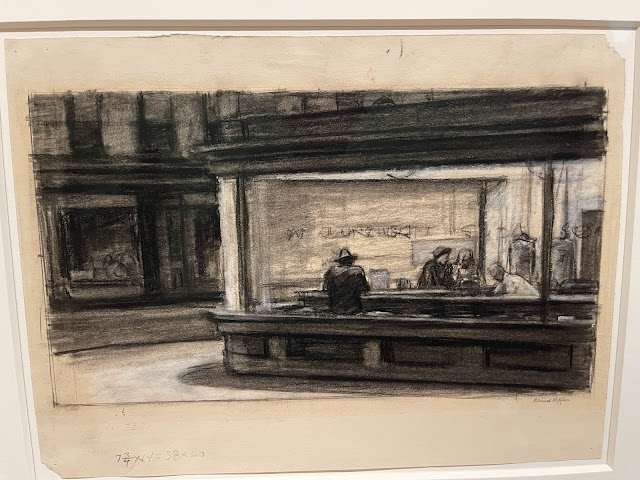
Sketchy.


Hopper showing his work.


In 1992 I was working at an agency that won "Agency of the Decade" for the 80s. Even so, despite their creative elan, they had not kept pace with the onslaught of modernity and technology. In fact, it wasn't until 1992 that a shaggy man came into my office with this thing called a Mac and left it on my table.

Even though we weren't networked, I wasn't hooked up to a printer and we had no internet access, I was told to start writing all my copy on my new mac. 


Previous to this, I'd type my copy on my IBM Selectric II and hand it to my assistant, Francine. She would retype it on a giant Wang computer, give it some sort of identification and store it on a 5 1/4" floppy disc. If I needed to make copy changes, Francine would find that disc and make the changes for me, then re-print the copy and give it to me or account.

No one trained me of course. The machine was just left on my table. I had to figure out filing and folders and organizing and all that shit.

In those days, advertising was a profession and people were treated at professionals. I had an office with a desk and facing my desk, a credenza in case I wanted to work with my back to my door.

I kept my IBM on my desk and my mac on my credenza and I went to work--on my mac.

Immediately, I hated it. 

I quickly understood that writing on a typewriter is very different from writing on a mac.

Mostly because on a typewriter there is no "delete" key.

So, if I was writing an ad for a home-equity line-of-credit, I might type,

"There's money in your home that's just waiting for you to unlock." 

I'd read that and roll the paper down a bit and say, "I wonder if that would be better as a question."

I'd type it this way,

"Is there money in your home that you can unlock?"

Unsatisfied, I'd roll the paper down another turn or two.

"There might be money in you home. The question is, do you know how to get it."

That would go on for about ten renditions until I got to something I liked and then I'd move on to sentence number two.

Often, I'd go back through my versions and find out that my third stab was better than my seventh. Or that hidden in stab number five was a good end line.

All that, because I had no delete key.

Eventually, I started jockeying between my IBM and my mac, swiveling in my seat from one to the other. Soon I learned how to not use the delete key. 

To this day, the first document when I create when I go to work on an assignment, an ad, a pitch, anything is called "client's name running." Here I mark down and save every thought. It's my working work.

One of the things that's lost in our modern world is "showing our work." In my early days I wrote most of my copy on blue, or yellow, or pink scratch paper. That was cheaper paper that was made for drafts. With pride, we'd have client presentation copy typed onto heavier bond, without our agency logo engraved.

My point in all this is that there's a real value when you're vying for business or in presenting and selling work to showing your work. 


There's a real value in showing your thought processes. (If you have them.) Not merely to show how many versions you tried, how many options you thought through, how many variables you tried. Saving those, and having those at the ready--to share with partners, bosses, clients, planner and/or account people is a good way to learn to articulate why you chose to do what you chose to do. 

It's better to show a wall painted green, yellow, blue, pink and purple. And then say, "we looked at green--it felt hospital. Yellow felt like we were trying too hard to be cheerful. Pink was too assertive. And Purple too 'hippie.' That's why we chose this grey with a hint of blue."

I think the evaluateability of how you arrived at an idea, a style, a technique, a word, how you made that decision is of great value in creating and selling work.

I think it forces a consideration of how we arrive at answers. It demands a certain incisive decision-making and articulation.

I think it's why Picasso sketched this.

I think we could learn from it.


Tuesday, September 23, 2025

No. It Isn't.

There's a lot of language used in our business that makes absolutely no sense. However, because we hear it so often, we've not only stopped noticing the absurdity of the words we're hearing, we start using that language ourselves.

Often, I suppose sadly, I'm asked either by an agency I'm working for or a client, to sit in on a meeting with their larger client organization. They ask me so I can lend gravitas to the procedure, or to explain something that writers have a particular POV or expertise about.

I'm on one of those calls right now as I type this. And I've been listening to someone presenting an ad that is smaller than your iPhone--maybe it's two-inches wide by three-inches tall. 


What struck me about this particular ad is that the person presenting this ad kept referring to it as a "thought-leadership ad."

That very phrase send me into a free-fall. It reminded me of how much of the language we use is used absolutely without thought, and worse, without real meaning.

For instance, when the founders of what used to be amerika, the original Declaration of Independence was 28 1/2 x 22 1/2-inches in size. 

The bible has 783,137 words.

The communist manifesto is about 50-70 pages long.

These communications have heft. They might reasonably "lead thought." As might these ads:


This is not a "thought-leadership" ad, no matter what people call it.


You can call this photograph an asset.


This is garbage.


This is a call to action. 
In that the words might make you want to act.


This is wishful thinking.

My point is pretty simple.
If you want to lead thought.
If you want your designs to be regarded as "assets."
If you want your work to get people to act,
it takes more than just doing something small and cheap and repetitive and exclamation-pointy.

It takes stature, it takes risk, it takes size, presence, assertiveness, originality.

There is no cheap way to lead thought, create an asset or impel someone to act.

We can call things by these words, but we should question the language we use.

Saying something doesn't make them so.