Showing posts with label abel.. Show all posts

Monday, February 16, 2026

Yer Out!


When I was a boy, probably not long after I left diapers, my father gave me a Spalding baseball glove of the old style, a regulation size and weight baseball and a small can of neat's-foot oil. The oil, which was to be applied liberally to the baseball glove, would make the leather pliable and suited to my hand. It would allow me to grasp a pop-up or flyball or snag a grounder out of the dirt.

I say the glove was of the old style because it was closer to the gloves of the 1950s than the gloves of the 1960s or '70s. The whole affair was not much bigger than my hand itself and the fingers of the glove were, like mine, short and stubby. 


Still, the deep pocket (I broke the glove in well) was emblazoned with Whitey Ford's signature--and in the shadow of Yankee Stadium where I grew up, such a signature was second only to having a glove with Mickey Mantle's moniker on it.


As I got older and larger, I quickly graduated from my Whitey Ford Spalding into a sleeker, trimmer and more modern Wilson with Ron Santo's signature on it. This, to my ten year old's eyes was not dissimilar to the leather wielded by actual pros. I cherished the glove like an ingenue her diamond ring.


However, my older brother was also at play in the fields of the lords. Fred had moved up to the Mercedes-Benz of gloves. A Brooks Robison Rawlings model with basket-weave webbing that was literally twice the size of my Santo Wilson. Rawlings' slogan was "Finest in the Field," and most wise men believed that.


Brooks and his Orioles of Baltimore, in 1970 when I was twelve, single-glovedly defeated the powerful Cincinnati Reds team, and I just had to have a glove just like my older brother's. The glove cost literally all the money in the world--I think $35--and my father bought one for me on the condition that I would turn my two-year-old Santo model over to my younger sister, Nancy.


Growing up in a family of boys, Nancy took to baseball--to the horror of my mother and the prevailing gender norms of the day--much more readily than she took to Suzy Homemaker kitchens or Easy-Bake ovens.


Whereas Fred and I were fast-growing, Nancy was more earthbound. In those days, the big kids--me and Fred played the corners--first or third--and shrimps, squirts and peewees played the middle infield spots, second and short.

Boys and girls didn't often play sports together in those days. Not against each other, not on the same teams. But in summer camp, when I was 13 and Nancy was 11, I had already emerged as the big baseball cheese while Nancy played shortstop for the girls' camp. I guess once around the end of the summer the girls would play the boys in some sort of exhibition game.

I remember Nancy, built low to the ground and lithe, hoovering up grounders and zinging the ball to cut male batsmen down in this game. Nancy's hands moved like wild birds. With the speed and confidence of a well-honed magician on his way to making the black Queen sally impossibly through the deck and appear against all odds.

That was the last I played with Nancy. 

The genders pulled apart. Girls aged-out of sports. And I moved up to loftier horsehide echelons where we wouldn't be caught dead sharing the diamond with a girl.

Nancy would have been 66, on Saturday, Valentine's Day. She died in a motorcycle crash on Mother's Day in 2007. She was 47. The last time I saw her she lay on a slab in the New York City Medical Examiner's Office on First and 31st. He face was black and blue. Her beauty still there. Her dead smile still beatific. 

I could see her beauty through my tears.
I still can.
I always will.
I can still feel her hand in mine.
I hear her laugh.

Some time later I subwayed out to Brooklyn and cleared out her slovenly ground-floor apartment. It was a depressing wreck of a place and made me think that in someways, Nancy had reached her apotheosis that summer afternoon when she was 11 and showing the boys what for. 

Her old Ron Santo Wilson was in a closet. I scooped it into my bag along with just two or three of her belongings. The rest I Hefty-bagged and dragged to the curb. I have still a set of her motorcycle keys, a pair of her expensive eyeglasses and her glove.

The Santo glove sits in my New York apartment. It still looks well-oiled and ready to go. I suppose I could pass it along to my grandson, Jude who will turn four this summer. He's too young, really, for such an advanced piece of equipment. And he's too young to learn of Nancy, and death, and the sad that comes from life.

I will be heading back to New York from Connecticut tomorrow. My wife has things to do in the City as do I.

I'll check in on the glove while I'm there. I'll look in on it like a father looks in on a sleeping child. I'll think about bringing it up to our country house from Manhattan, so we will be closer--I don't have many artifacts like that old Santo. But I'll leave it where it rests.

It deserves its space. 
It's earned its peace.
It needs to just be.

Nice play, Nancy.
He was out by a mile.

--


Monday, June 16, 2025

A Post Fahdah's Day Repost.


One-hundred years ago this week, Yankel Tannenbaum or Tennenbaum or Tanenbaum or Tenenbaum (everyone in the family spelled our last name differently, part obstinance, part bad translations) my grandfather--my father's father-- stepped off the Hamburg-American liner, SS Leviathan and became the first, however it's spelled, Tannenbaum, to set foot on Amerikansche terra firma, soon to be pronounced in the Queen's Bronxian Latin, terrer firmer.


Yankel, just thirteen at the time, had lied about his age, claiming he was eighteen. He boarded in Hamburg, the SS Leviathan alone--though he called it the SS Limburger, being unfamiliar with Roman letters. He quickly found a hammock in the deck two decks below steerage, the decks well-below the waterline on the ship, where every crash and rattle and belch of the mighty engines, every shovel-full of coal, spewed out a Stygian effluvium of magma-heat onto the rotten rope of his swinging, stinking accommodations amid one-thousand farting men.

Yankel lost ten pounds on the three-week voyage, having eaten nothing but water they called soup and the soup they called water. He hadn't yet learned to get soup last--the bottom of the pot is where the potatoes lay--but as recompense, he stole three suits of clothing from other woebegone passengers and stuffed them all into the single rope-secured bundle that he hoisted on his already-bent Sisyphusian-back and he stumbled down the rickety gangplank and onto the beaten schist of Ellis Island.

He called it Smellis Island.

Appropriately.

Official gentiles with officer's hats and clipboards inspected him, looking at various papers, greasy from wear. They poked at his ears, his eyes and his mouth. They scrunched his scrotum. And then they pointed him to line three, gate four, the longest of the lines of wretched refuse on our teeming shores and Yankel, like a soldier in the Bataan Death March shuffled over under the weight of his bundle.

He saw an official eating an apple, about to drop the asymmetric core to the dusty, grass-deprived grounds and Yankel, always on the lookout for an opportunity or an angle, sensed one.

"Schexschuse Schmee, Your Schexcellency," Yankel spat. "Jew want see wut I can do mit der apple."

The tall, be-whiskered gentile handed Yankel the masticated core. It was already browning in the humid heat of a New York summer a century ago and tiny gnats had already arrived on the core. The air crackled with heat--it was not much cooler then than today, miserable and cornea-cracking.

"Vatch dis," Yankel said. "Jew see dat schmeegull ovah deah on duh piling?"

Yankel had noticed a fat fowl four-hundred feet away standing on one leg on an algaed post. 

"Your Highness," Yankel mustered, "Vatch me bean him."

Yankel had learned a pidgin of Hanglish listening to American sailors down in waterfront bars in Hamburg.

The official smiled and tucked his clipboard under his arm and nodded to Yankel.

"That's gotta be faw-hunnert feet," he mocked. "Like from centa to home at duh new Yankee Stadium up in duh Bronx."

"Yankee Stadium--I'm Yankel Stadium," my ancestor said. He then twirled his licorice thin right arm like the sidewheel of an old Mississippi River boat, lifting his left leg for power and torque and let the apple core fly.

It ran straight like an old Junker aeroplane and knocked the unsuspecting bird's legs out from under him. The bird tumbled into the viscous water, came up for air and screeched in anger. He spread his wings, drying them in the sunshine then flew high and circled over the people below, looking for someone to shit on in retribution. But by that time Yankel and the custom's official were walking arm-in-arm toward the processing center some one-hundred yards away.

"O'Malley," the official said shaking Yankel's calloused paw. "You've got an arm on you like Lefty Grove. And wit da Yankees not six miles away, I gotta getchu in for a tryout. You sticks with me. What did you say your name wuz?"

"Yankel. Yankel Tannenbaum. Schmere didja say you were takin' me, Yankel Stadium? Whas dat, schomewhere duh Jhoose like me-self schmives?"

"Noyadumbbell. Yankee Stadium. It's where dey play baseball, d' American past time. It's up in d' Bronx. D' house that Ruth built?"

"Like Ruth 'n Esther? That Ruth?"

"No, ya' stoopid Yid. Babe Ruth. The Bambino. The Colossus of Clout, the Behemoth of Bam, the Maharajah of Mash, the Mammoth of Maul, the Wizard of Wallop, the Rajah of Rap, the Vizier of Vector, the Caliph of Crash, the...the...the Sultan of Swat."

"Yer onny cornfusing me," Yankel said with barely a spit. "I have no ideer who this Ruth lady is."

"He's only duh greatest baseball player in the forty-eight states. And he plays up in da Bronx for the Bronx Bombers. I think wiff an arm like yers, I can getcha a tryout for d' Yankees. With an arm like yers, you could be making $5000 per annum, easy."

"$5000? Schmy wiff schmoney like dat, I could bring my twenny-nine bruddahs and sistas and aunts and uncles and muddahs and faddahs over. An all twenny-nine of us could share a room anna quarter with a cold-water bath just seven flights up and four blocks ovah."

"Dat's d' ticket, Yankel me boy. And wiff me taking only 125-percent of yer money for me agent's fee, you'll see that the streets in Amerika really iz paved with pickle juice and cel-ray."

"One-hunnert and twenny-five percent of ev'rything I schmake? So, I makes five thousan' and you takes sixty-two-hunnert and fifty dollars? That izza bargain! As soon as I learns t' schmite me name, I'll schmign on duh dotted line."

"Yer right as rain, Yankel, me boy."

And that my friends was how the Tannenbaums came to be in America.


Follow up questions (these may be on the test):

Did Yankel ever make it in amerika?

And what of officer O'Malley's 125% cut?

Were the streets really paved with pickle juice and cel-ray?

Was Yankel able to bring over his "twenny-nine bruddahs and sistas and aunts and uncles and muddahs and faddahs?


Tuesday, March 18, 2025

Priest. And Desist.

Because I read widely and voraciously, and without supervision, or even people to discuss things with, I probably arrive at a lot of stupid conclusions. A result of my limited knowledge, limited intelligence and leaps of logic. That's ok. Sometimes the best starts are false starts. And at least I'm not merely parroting things I've heard some talking head somewhere say.

Lately I've been thinking about language and literacy. I'm thinking about it because in the era of AI, or Quantum, or whatever we want to call it next, the only people the potentates of government and industry will consider literate, or intelligent, are those who can read, write and think in AI.

I suppose we used to say that about HTML. Or English. Or before that, Latin or Greek, Mandarin or Aramaic.

From a long-history point of view, humankind, from our earliest permanent settlements about 12,000 years ago, has always had a priestly caste.

These are people, usually, who can see things, read things, understand things, decipher things that ordinary people can't. Again, 12,000 years ago, they might have been able to tell the populace what a red star in the skies meant, or a two-headed fish, or a white raven. These things were signs that resonated and had to be explained. Often they were used as metaphors for larger predictions. Like the Roman emperors who saw a cross in the sky and quickly said, "In Hoc Signo Vinces." 

In this sign, we will conquer.

We've always had people who could compel us to believe in the power of what they could see and we couldn't. When I was a little boy, Robert McNamara, JFK and LBJ's Secretary of Defense, was able to look at rows of numbers and convince us that we were winning in Vietnam.

The priestly caste is alive and well. 

Today, many of them live in Silicon Valley, have private jets and islands and are helping ru(i)n the country. Their names are Thiel, Zuckerberg, Bezos, Musk, Ellison, Cook.

They're priests.

They have the ear of the gods (technology) and can propitiate the gods--that is, placate them, because they have access to the gods that those of us not in the priestly caste don't.

From their digital pulpits they give their Sermons on the Mount. Their views that they in their enlightenment have and you in your darkness are too dumb to see.

The world has always been led by Priestly classes who have and keep power because they can read languages the rest of us can't. In most of Europe until the Reformation, or the King James Bible, or the Enlightenment, the word of god, the preaching of god was only available to the masses (that's you and me) through priests as conduits. The Christian Bible was written in Latin. And only priests and a few learned people could read Latin. That extra knowledge is how priests stay in power.  The minute knowledge becomes "democratized" they change what knowledge is important.

It's how the priests and the elite stay above the people. Like a banker at Goldman Sachs or a wily baseball coach. They know what moves to make because they see things we can't.

Right now, AI is the language of the gods. It's the language that will reveal the future and make it.

We know this because the people who invented AI tell us this about ten-thousand times a day. In advertising, data is the language of the gods. The few people and agencies who can read the future in the entrails of binary code will win the big pieces of business and become the head of a holding company.

But...Quis custodiet ipsos custodes? Or Quis custodiet ipsos datades? Who will guard the data?


False gods, prophets, leaders always have and always will be with us. The tablets from on high, Mao's Red Book, the Ten Commandments, the Tweets of rump, will be as off as often as they're on.

The uniforms change. The teams really don't.

A lot of people ask me about AI. I was involved in it early on, participating heavily in the launch of IBM Watson. I derive most of my not inconsiderable income from companies selling or using AI. Since those heady IBM/Ogilvy days when it looked like conquering cancer, cleaning air, stopping crime etc etc were just around the corner, new and smarter AIs have been introduced by new and smarter priests. Deep Seek. ("That's not funny, it's seek.")

We're told how great it's all going to be, usually accompanied by a warning that AI could displace us and in some metaphorical way "eat our heads."

When people tell me this, how X will improve Y, how AI will make customer service better and AI-enabled chatbots will ease getting my cable-bill reduced and streamline everything I do (the same sort of things advertising people say about data) I usually get a glassy look on my face. Like Phyllis Diller about twelve-minutes after rigor-mortis takes hold.

Why haven't I seen it, I ask.
Why does everything suck?
Why, never in my life, have I never gotten the right message at the right time right how I want it?

If it's all so splendid, where the fuck is it.

Then I ask the priests, where's the EZ-Pass effect from AI? When EZ-Pass took hold, I kept no more change in my car's ash-tray, no more waiting at toll-booths, no more delays. It made things faster in reality, not just in promise.

Priests, if you're out there, where's mine?

I hear about seamless experiences.
I hear about my needs being anticipated and met before I realize I have a need.
I hear about a veritable heaven on earth.

You get that inside information and have told me so.

Just like Armageddon, or the Elysian Fields, or Valhalla, or tip-toeing through the tulips. It's all gonna be great--any day now.

This is not to say that all priests are false prophets or that no good has come from AI and other advanced technologies. In fact we need advanced tech to help us overcome the problems of advanced tech. And some people, I suppose, spread truth, light and joy--though I suppose all prophets are false prophets to someone. As Jagger pointed out, Every cop is a criminal/And all the sinners saints. Most things good/bad/peanut butter/jelly are open to interpretation.

But look before you leap and leap before you look.

Clip 'n Save (yourself).


Friday, October 18, 2024

A Good Stretch.


When I was just seventeen, so many sad years ago, and playing my one long summer for the Seraperos de Saltillo in the Mexican Baseball League (AA), I didn't much think about Grantland Rice, or the one great Scorekeeper coming to pen my name. 

No one thinks about things like that when they're seventeen, even if they were, like me, born under a lugubrious sign. Even though I was born preternaturally old, I was still a young man, living only for my next at bat or next breast I could feel or next beer I could swallow. I wasn't thinking about much else.

Still, with my stern an Old Testament upbringing I heard Granny's words rung like Big Ben from the highest bell tower, ever reverberating, even though they pealed from quite a distance.

For when the One Great Scorer comes
To mark against your name,
He writes - not that you won or lost -
But How you played the Game.

I suppose as cornball as all that is, there's something in believing in a world, which I don't, presided over by the One Great Scorer. I suppose as cornball as all that is, it would be nice if it mattered How you played the game. I suppose it would be nice if your You were as important as your Do.

I suppose I'm as starry-eyed and stupid today as I was 50 years ago when I ran away from the deafening noise of an empty home where the only sound was hatred, frozen vegetables, dishes crashing when they were thrown, Miltown bottles being opened and gin being swilled.

I once was lost, but then I was found, by Hector Quetzacoatl Padilla, whom I dubbed Hector Quesadilla, just moments after he transmuted my el Norte moniker into Jorge Navidad--an improvement, I believe, to George Tannenbaum, especially given the mostly beered-up fans who would rain bottles down on any ballplayer, especially an American playing in their stadiums, in their cities, in their league.

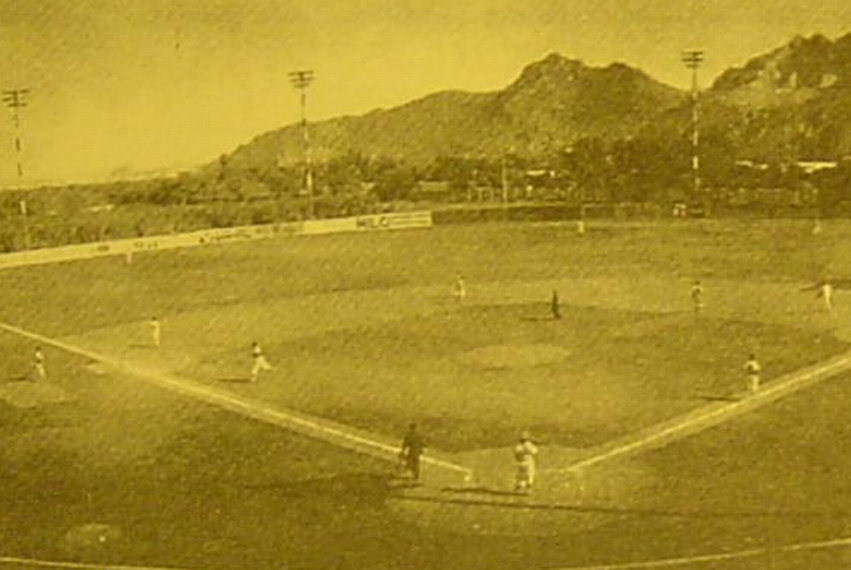
During that long summer so long ago I had the longest stretch of good fortune in my already too long life. It was late in the season and late in a game of no-consequence when a pitch came in on my hands, a screw ball, maybe, that jammed me inside but that I was able to smack short over their second baseman and I found myself safe on first.

On the next pitch of this game of no-consequence I ran on their arm. He was not holding me on and I got a Bob Beaman jump and stole second, sliding in for the dust and drama rather than for the necessity.

Perez-Abreu was up and he text-booked an outside fastball down the right field line. I rounded third, and feigned stopping to draw the throw to the cut-off, then put my head down and charged home, while Perez-Abreu, alertly, took second on the dust up at the plate.

Next, Buentello also went to the opposite field and Perez-Abreu scored from second like I did. Then, seconds later, it happened again. Angel Diablo stroked a single to right and brought in Buentello. Now, instead of being down, we were up. Scratching runs with scratch hits and speed and playing ball like it should be played: heads up and aggressive. 

There are those, of course, who will always admire the long ball. But the best baseball is baseball like this. Where little things lead to big innings. In baseball, and yes, in life, it's the little things that make the big things happen.

We won that game that doesn't matter against it doesn't matter who, by doing the little things while playing the game that do matter. Like going with the pitch, like running with your head up, like outthinking the guys living by rote and doing all that at top-speed.

There was no pep-talk that inspired all that. Just, after a season where a hundred and two bad habits had taken over our days and nights, good habits emerged for a brief happenstance and seemed to take over, like a cloudy day, all at once and unexpectedly becoming clear.

Dowson wrote about it 150 years ago. In a poem, I knew even then, as a 17-year-old,

They are not long, the days of wine and roses:
Out of a misty dream
Our path emerges for a while, then closes
Within a dream.

And that's what happen to us Los Seraperos de Saltillo late in the season, playing a stretch of games under the blister of the sun in El Estadio de Beisbol Francesco I. Madura. 

Our path emerged for a while and we won games like we had never won before. Playing smart, running fast and heads-up.

Our path emerged for a while and then closed. 

That's so many things. So many green lights that turn red just as you step on the accelerator.

Just as we as a team started doing everything right, we started again, doing everything wrong. The boneheadedness of mediocrity reinvigorated itself and had its way with us.

As a manager, three or thirteen things pissed Hector off. One was taking a called third strike--especially if there are men on. Second is missing a cut-off with a throw, or failing to back someone up on a play. And last was bunting one straight up so it would be an easy out.

Those things and a dozen more were back. And so was our griping and our grumbling and all the things bad teams do to make themselves worse.

In the forty-nine years since that summer when I had four games or five where my path emerged for a while before it closed, I'm not sure I ever had a longer skein of things going just right. That bad fortune wasn't for lack of effort or my bovine stupidity. It's just the cosmic law of entropy that rules what's left of a disordered, decaying and entropic universe.

Sea Peoples

There's a belief in history, that about 4000 years ago, the great ancient civilizations of Crete, Assyria, Knossos, Babylonia and one-hundred more were destroyed by the sudden and unexpected descent of an unknown people called the Sea People. 


Where they came from, how they came, and why they came, no one knows. But they did come, the theory goes, and they destroyed all civilization, society and progress in their way. And then, just as abruptly as they arrived, they vanished. Leaving not a shred of papyrus, a broken shard of pottery or the hull of an ancient ship.

For me, all those years ago, it might have been in Saltillo a season under the spell of the Sea People. Except for one week when, for no reason at all, they left the benighted land I had arrived in, and for that one week, the seas without the Sea People were flat and calm and the fish abundant and easy to spear.

Or as Porfirio Diaz, dictator/president of Mexico for nearly thirty years is said to have said, “Pobre México! Tan lejos de Dios y tan cerca de los Estados Unidos.” Poor Mexico. So far from God. So close to the United States.

Maybe the One Great Scorer sent the Sea People aweigh and away. Or maybe the Sea People and the Scorer are one and the same. 

Either way, that misty dream was all too short. And it all too easily slipped through my fingers.


Wednesday, October 6, 2010

Delayed gratification.

Almost 12 months ago I started freelancing at the agency that now employs me full-time. I was brought in to do a couple of what seemed to be fairly simple tasks. One was to write a capabilities brochure--that assignment wrapped in late January. The other was to write a brand book. That piece was just delivered yesterday.

It's not atypical for an advertising assignment that should take a few months to take a dozen or more. There are more tiers in client organizations than there were in the Tower of Babel. Everybody gets a shot of input and then another and another.

There are literally scores of rounds of revisions. Scores after "final" approval.

I have no more to say other than this is work today. You have to be like a diesel engine not a jet engine. The chuggers win.

After 11 months I got my copy of the client's brand book yesterday. Yes, it was excruciating. Yes, there was too much rigamarole. Yes, there were too many stupid and capricious changes.

But you know what? You see this shit through and don't give up on the big stuff.

My brand book arrived yesterday.

It's among the best work I've ever produced.