I got to eight.
George Tannenbaum on the future of advertising, the decline of the English Language and other frivolities. 100% jargon free. A Business Insider "Most Influential" blog.
Tuesday, June 28, 2022
Scorpions.
I got to eight.
Monday, June 27, 2022
Dinosaur Thinking.
I finished reading a strange book late last week, just a day or two before the Supreme Court decided that domain over a person's body doesn't belong to that person if that person is a woman.
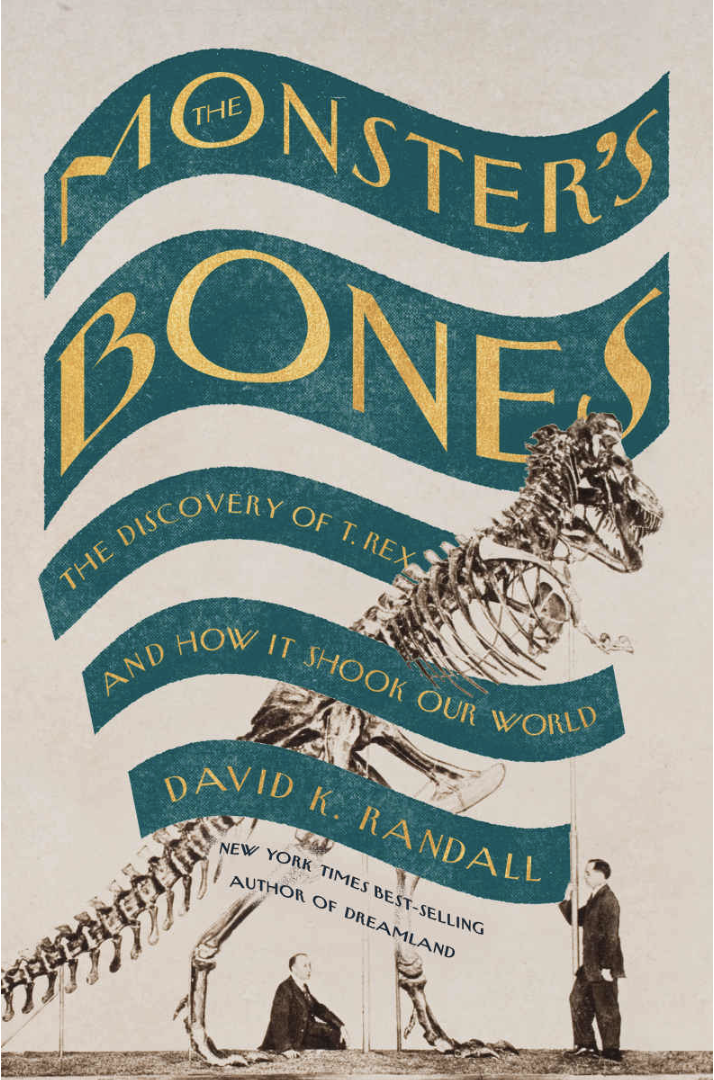
The book was called The Monster's Bones and you can order it here.While the book was interesting on many levels, most interesting--and most high-level--from my point of view was its look at a world when major new evidence emerges that upsets how the mass of people have thought of that world and what they believed for millennia.
That may encapsulate the period we're living through now. New learning, new evidence, new conclusions have been revealed. That newness upsets the dominant complacency. Therefore a good portion of our planet rebels against it.
I'll try to clarify that.
Strange as it seems to us now, there was no conception in the world of dinosaurs until about the early 19th Century. The world as we westerners knew it was a world defined by a book of myths and legends and propaganda we call the Bible.
That Bible said, man (not hu-man) had dominion over Earth. That man was created in god's image. And that man, therefore was perfect. God, being perfect made man perfect. God wouldn't have made creatures before man and they wouldn't have died out, because as Einstein said, and I misuse it here, "God does not play dice with the universe." That is, why would god create something, only to kill it off?"
Around 1830, miners in the United Kingdom and farmers in the peat bogs began uncovering giant bones of never-before-seen creatures. Were they dragons? Giant forerunners of the ox? What were the skeletons of sea creatures doing hundreds of miles from the sea?
A reappraisal was coming.
We knew nothing, 200 years ago, about plate tectonics, continental drift, and we determined the age of our planet (to the exact day) by following hints in the Bible. The best thinkers believed our planet was about 10,000 years old. They were off by a factor of 4.5 million.
In fact, the very word dinosaur wasn't coined more than 175 years ago. Because they simply didn't exist.
Soon, finding those bones, led to more bones. And those led to more bones. Paleo-paleontologists reconstructed the bones. Giant statuary made it to the Crystal Pavillion in London. Natural History museums in the great cities of the western world were on an arms race--or a femur's race--competing for bones that would attract viewers to their exhibits.
Along the way, Darwin raised his hand. We weren't divinely created, he showed. We evolved.
As seminal as Copernicus supplanting the thinking of Ptolemy, mankind's place in the universe had the rug pulled out from it. We were no longer First, Only, Best. We were just next.
That's mind-blowing.
Much of our world still hasn't adjusted to all this non-bible, science stuff. They want their orderly universe back. White European men on top. Everyone else making those men rich.
The point for me and you to think about is how as a species we react to new ideas.
Imagine if you were digging in your garden one morning and found a basketball-sized glowing orb. You take it to a university. There, scientists discern that it's made of elements they've never seen before and they date it to ten-billion years ago. How would you take the un-trueing of everything you've ever known? How would you take finding out humans are just one more set of sentient beings in the universe?
That's what we're dealing with now.
Much of our world doesn't accept that they are no longer preeminent.
A giant swath of the world who believes, still, that most of the world was ordained by god, according to press-releases written by agents of god (the apostles.) They set things up millennia ago as TRUE. And the final and irrevocable word.
For many in the United States, that final and irrevocable word comes from the Bible or the Constitution. Nothing we've learned in the intervening years can undo the wisdom of those texts. To not abide by god's word is the devil's work.
That's what we're dealing with now.
People who want the comfort of old absolutes against the frenzy of modern, and constant, discovery.
There are many today who regard The Flintstones as historically accurate. There were many, not long ago, who ratiocinated the death of the dinosaurs by saying 'they were so large, Noah couldn't get them on the Ark.'
The great scientist, university professor and writer Vaclav Smil wrote something I read the other day. I have the intellectual hubris to expand upon it.
I'm not an optimist or a pessimist. I'm a scientist.
I'm not a conservative or a liberal. I'm fact-based.
I'm not set. I am fluid. I decided based on science and facts.
That, I think, is enlightenment thinking.
Not theocratic thought, based on the illusion of a deity.
It's I think, therefore I am.
Not, I'm told, therefore I believe.
Friday, June 24, 2022
Copywriters in the Machine Age.
Not too many years ago when the agency called Ogilvy was still in business, there was a corps of writers who worked under the aegis of Chief Creative Officer, Steve Simpson, on IBM.
I say corps, but it was really just me and another writer, a friend, called Tom Bagot. Tom died from pancreatic cancer a few years back, leaving a wife and three kids behind. In so many ways the world is poorer for that loss.
Tom and I and Steve, too, were writers of the very old school. While the rest of the agency was as empty as herschel walker's head, we were at our desks, usually by 7:30 AM, and either talking about the work we were doing, or more often doing it. You could hear the clack of our keyboards like the sound of a hundred lab rats gobbling down their kibble.
In the best of relationships, whether they're professional or amorous, a certain kind of competition exists. You know the person sitting or lying alongside you is superior in some manner and you, therefore, redouble your efforts just to keep from sinking.
Tom and I were often charged by Simpson "to figure things out." Doe-eyed planners or account people would sneak up to us and tell us about some problem the client was having that no one could figure out. They would usually email us terabytes--or even yottabytes--of nearly cuneiform deckage--with no commentary whatsoever and then back slowly away from us like a 1950s vacuum-cleaner salesman who's poured soot on your white living room carpet.
That was the copywriter equivalent of the gun going off at one of those late 19th Century eight-day-bicycle races. Tom and I were friends. We helped each other. We answered questions for each other. We'd even run out and pick up breakfast for each other.
But we were also two gold miners in 1850s California. We were both looking for a vein and we knew that our finding it meant we could only be so amenable to the other guy.
That's not macho posturing or male-meanness. I know the current of today preaches collaboration--many times, collaboration above unique quality. But, as the Soviets may or may not have learned as they tried to propagate the millenarian idea of reconstructing human motivation for the betterment of all, from each according to their abilities, to each according to their needs, legislating kindness or amity is often a race to a dark-pool of lassitude.
Tom would often say to me, after three of four hours of cranking when we'd emerge for air--each of us with 50 headlines and one-thousand words of copy, "You are a machine."
I get that a lot today. I whirr and grind and keep on ticking.
But I never considered myself a machine, or in any way unusual.
I considered agency work much as my scraggly-bearded forerunners considered work in the sweatshops.
We get paid by the piece, don't we? Next!
If I can't outthink you, I'm going to outwork you.
Or sweat while trying.
The thing I've learned to do to survive in business is, I suppose, machine-like. You get paid to work, so work. Write a lot of stuff. Draw a lot of doodles. Think a lot of thoughts.
That is, produce. You know, like a machine.
Editing can come later.
But it's better to edit from a lot than a little.
Thursday, June 23, 2022
Cutting Cookies.
A lot of the work I do these days, as the almost-sole-proprietor of GeorgeCo., LLC, a Delaware Company is not the work I thought I would be doing when I entered the business, way back when the earth was more than a few degrees cooler.
And a lot of that work reminds me of when my daughters were living at home and would ask me to read one of their essays on the French Revolution or The Effect of Gamma Rays on Man-in-the-Moon Marigolds.
I'd read their essays and I almost always have the same response. "You are smart. You don't have to try to sound smart."
But today, when I get documents prepared by either other agencies or client marketing people, I often feel the same way.
It seems to me that people are writing according to a non-existent set-of-rules that they believe will impress people. They are writing to sound a certain way and appear a certain way, not to communicate in an impactful way.
I am forced to make shit unshitty.
It's 81-percent of my job now.
Even many of the manifestos I am forced to watch--the ones I see from Agency Spy or on people's Linked In (they're seldom, if ever, on TV) fall prey to this ossified rule-following. Worse, the "about" sections of from just about every agency website seem to be more cookie-cutter than even cookie cutters. (Hey, agency leaders--I'll rewrite your website. Call me. And pay me upfront.)
I am all for rules, semantic or otherwise.
But I'm only for them when they help you, not when they limit or hurt us.
I reject writing that says things like:
"We solve problems that create value for our clients."
Or,
"We believe in action-oriented individuals who help our measured attainment of our goals."
Or,
"We need curious and humble people who embrace the challenge to continually improve themselves and our clients. We need to continually remeasure, reassess and reset our objects in an intellectually honest discussion."
It happens fairly often that I get a note or a phone call from someone who remarks about how prolific I am. They ask if I have some sort of secret, or if I have a cast of small chimps banging away at the dozen or so Smith-Corona typewriters I keep in my basement for the day when we are struck down by Russian/Chinese/Iranian/North Korean/Israeli/ or NSA-derived Cybergeddon.
I've thought about it, too.
And I have a simple answer.
I am almost 65 years old. At last, I have confidence in who I am, in how I think, and how I speak. At last, I have the confidence to write as me. Not someone else.
Not too many years ago, I wrote to a friend who had just lost her job. She was dealing with about 71 crises of confidence at once. I have the note somewhere. It was good.
I wrote:
Don't be afraid to be you.
No one is more you than you.
Be you.
It's what you're best at.
This is my post for today.
Wednesday, June 22, 2022
A Missive from Cannes.
Writing has helped me and pushed my career forward. So far forward that about twice a week or more, someone calls me or sends me a note. They either call me 'the biggest name in advertising,' or 'a legend,' or something else mildly ageist or refractory.
Those epithets may or may not be true. But I think I'm working way too hard.
It occurred to me just now that wisdom or punditry is as watered-down as the Kool-Aid at a budget summer camp. In fact, I just stumbled upon the wisdom below from a luminary at Cannes.
I realized something looking at that. There are people like myself who write about advertising. We use our writing and our thinking to express complex thoughts.
So, Jeff Eaker, stop working at it. Rich Siegel, stop working at it. Dave Trott, stop working at it. Debra Fried, stop working at it. Bob Hoffman, stop working at it. Dave Dye, stop working at it. John Long, stop working at it.
We're doing it wrong.
We're working too hard.
To rise into the thermosphere or the exosphere of punditry we shouldn't write more, we should write less. Write with less precision, less insight.
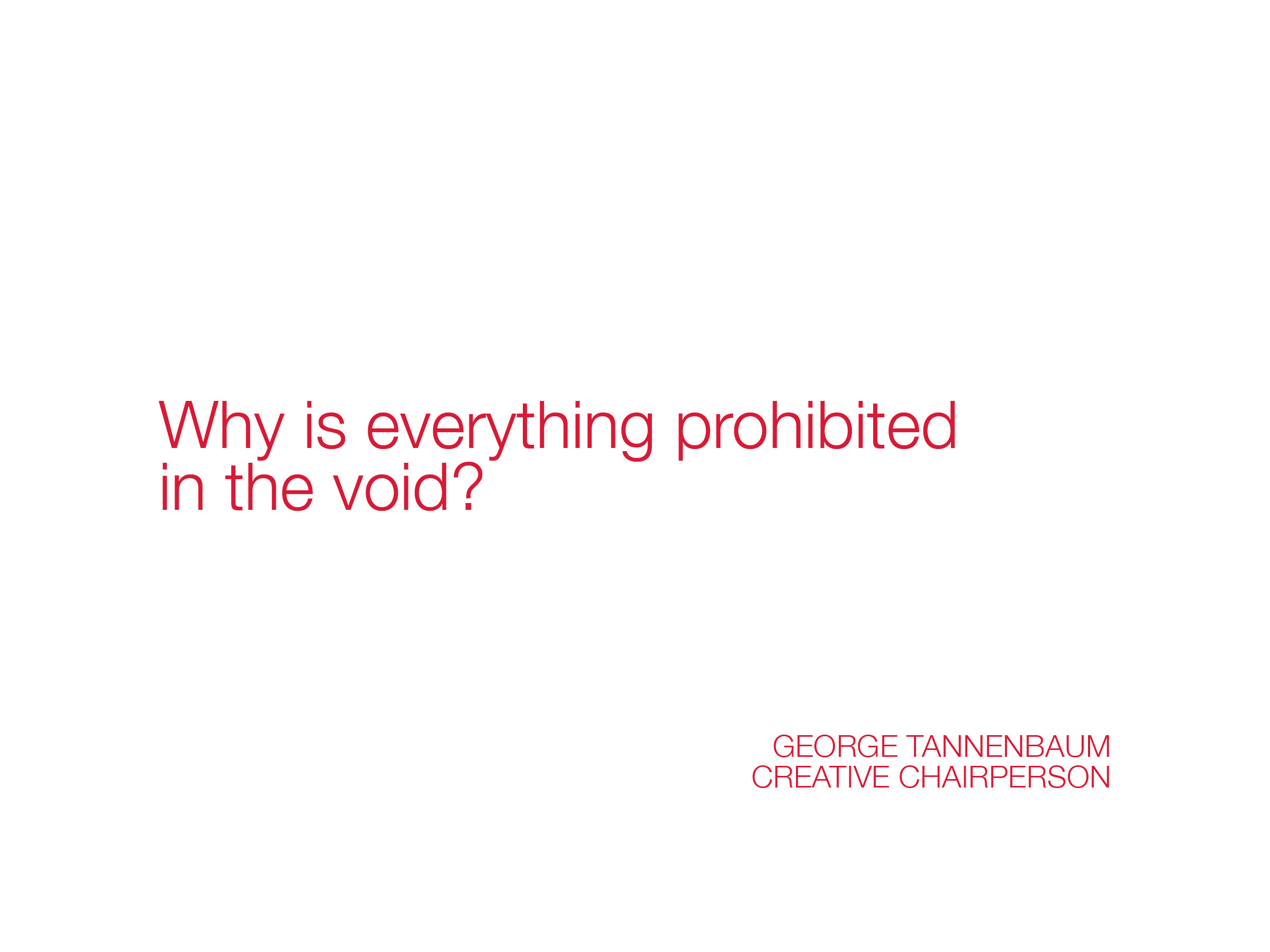
To that end, I hereby present, the deepest thoughts of George Tannenbaum, Creative Personchair.
Tuesday, June 21, 2022
Semiotics and Agencies.
The journalist and political analyst Mark Shields died the other day and as he was a part of my life for so many election cycles, I read his New York Times' obituary with some froth. You can read it here. (And btw, if you don't sent the Times money for a subscription, you're pissing me off. The $100 or $200 they ask for is the least you can do to protect the remaining cat-hairs of our democracy.)
Shields was not a hoity-toity analyst. I liked him because he was down-to-(scorched)-earth and spoke a language that was colorful, full of allusions and descriptive. It was from him that I learned the longshoreman's phrase for a brouhaha, melee or imbroglio. Shields likened knives-out political infighting as "a Pier Six brawl." The etymology doesn't matter. The vividness of the language does. You understand it--it's evocative--whether or not you know its derivation.
Shields was graduated from the University of Notre Dame in 1959. And rather than being drafted (no foot-pain would excuse him) he enlisted as a Marine, emerging two years later as a Lance Corporal. That sound like a non-commissioned officer in charge of boils. But I think, even at the age of 23 or 24, he was probably leading boys and preparing them to combat America's foes, real or imagined.
The obituary states, "He learned a lot in those two years ...including concepts of leadership encapsulated in a Marine tradition of officers not being fed until their subordinates were."
He went on and asked,"'Would not our country be a more just and human place, if the brass of Wall Street and Washington and executive suites believed that ‘officers eat last’?”
On shoots, agencies--and even clients--have always been trained to let crews eat first. After all, crews are working while we're eating yet another handful of Raisinettes. But I wonder how many agency and holding company heads would, at least semiotically, adopt the notion of not being fed until their staffs are.
The world, and agencies and holding companies are just a microcosm, have become every man for himself, widows and children be damned. Sure a few $22 million per annum executives suspended their salaries during the depths of the trumpian covid calamity. But they paid themselves back, often times, in spades.
But I wonder if setting up a code of behaviors where employee welfare superseded executive largess would begin to change the prevailing dynamic of an industry which is having a terrible time attracting and retaining talent. We are more populated by cake-eaters like Marie Antoinette than people who put their people first.
"Women and children first," has been replaced by first-class lifeboats replete with French champagne, lie-flat life-preservers and "warmed nuts." The hell with those making the moghuls of the business rich.
As Emma Lazurus wrote, you and I, friends, are just "the wretched refuse on these teeming shores." While the big brass collects lifetime sinecures and $50 million pay packages, you have to fight for an extra-week of severance when they fire you after 26 years, for having aged.
So much of life is ruled by semiotics. The language of signs.
When John Thain, the trillion-dollar banker bought for his office a $61,000 wastebasket, you knew Merrill Lynch was in trouble. A friend of mine, a writer was at Ogilvy for 25 years or so. Often you'd see him in the mens' room, antiseptically picking up old newspapers people left behind. Semiotically, he showed his care and love for the place. They fired him. No one else saw it.
The Greeks believed that the greatest sin, hubris was quickly followed by the greatest torment, nemesis. In Hogarth's time, or Dickens' we might have called the notion, "getting your comeuppance."
Maybe comeuppance or nemesis or even quid quo pro are old-fashioned, even obsolete notions. I'm not a Christian but I had always heard how hard it was for a rich man to get to heaven. I'm not sure anyone hears about camels or needles or even kindness and caring today.
I also don't know what the corporate equivalent would be of allowing enlisted personnel to eat first. Would it mean giving the rank-and-file compensation before shareholders? Or is the way to improve shareholder value really to undervalue the people doing the work?
Monday, June 20, 2022
Juneteenth holiday.
Ad Aged will not publish today.
Respect.
Friday, June 17, 2022
The Greater Fool Theory and Advertising.
There's a theory in modern economics--by modern I mean it probably goes back to the Tulip Bubble in the 16th Century, the South Seas Bubble in the 18th Century, or the Credit Mobilier Bubble in the 19th Century. It's called the "Greater Fool Theory," and to my jaded eyes, it does much to explain the ad industry today.
The theory was mentioned by Bill Gates (an old-fashioned billionaire, in that he made something) in Wednesday's "Wall Street Journal." I won't bother pasting the article here because the Journal has a paywall that's harder to penetrate than Donald trump's cranial merkin, but the headline is above.
For now, though, it's Friday, let's take a minute and think about "the Greater Fool Theory." It's a pretty simple economic truth. The Journal defines it this way, "the notion that overvalued assets will keep going up because there are enough people willing to pay high prices for them."
In other words, if enough people buy into a particular lunacy, they will bid its price up until, somehow, sanity prevails.
When I think about how many shiny objects clients and agencies have chased over the last 20 years, re-jiggering their businesses to be "digital," or "digital first," or "mobile first," or "metaverse first," or about "conversations," or "story-telling," or "information graphics," or "agile," or "interactivity," or whatever.
These inchoate and wafer-thin concepts could all be filed under the heading of "This Will Change Everythings." Silly little nothings that will, it's alleged, revolutionize the human brain and, therefore, human behavior and change what is important and what matters.
Agencies and clients bid up the value of these empty ideas. They proclaimed that things that made sense for years, millennia, for ages no longer mattered, and for whatever reason people would want to have conversations about Saran Wrap or Hot Pockets. That be-spangled influencers would change marketing forever and ever.
The Greater Fool Theory has thrown giant agencies and holding companies into paroxysms of over-reaction and outright lunacy. Even if it's stupid, holding company B has to chase something and proclaim something because holding company A already has and so forth.
I don't know what the pith of the latest Greater Fool Theory will be coming out of Cannes. But I know it will be declared. And people will be holding up faux trophies, showing off their rewards for Greater Foolishness.
The genesis of the Greater Fool Theory is similar to the impetus behind a lot of Ponzi Schemes.
That there's a short-cut to reaching people and selling goods, services or reputation. That somehow hard work and discipline and talent applied can be superseded by magic.
Around tax time, GeorgeCo's Chief Financial Officer dropped by my little ramshackle cottage by the sea.
She said, "Do you know how many clients you had in 2021?"
I was in the middle of working on one of those clients and didn't really give her question due consideration.
"I dunno," I stupided. "Twenty-two?"
"Nope," she answered. "Twenty-nine."
Some of these clients, I'll admit, were small. Some had market-caps (before the recent crash) in the $30 Billion range. Some were still working on their endless rounds of investor decks.
But they all had one thing in common.
Very few people, including their own C-level employees, knew what they did and what their unique selling proposition was. In short, every one of these companies needed some essential definitional work.
They needed to determine and explain who they are, how they behave, what they sell, who they sell it to and what they do differently.
Bill Bernbach, the progenitor of the modern advertising industry, and therefore, at least somewhat, the progenitor of the modern economy, said that good advertising is based on "simple, timeless, human truths."
Finding the simple, timeless, human truths about a company is what advertising, at its best, can do. Identifying that core has created more wealth for more people and more businesses than any technology or any Greater Fool gizmo. More wealth--enduring wealth--than any complex collateralized debt obligation or identity-stealing data legerdemain.
Not castles in the sky. Nice solid homes with concrete and rebar foundations.
It's hard work. Building those homes.
It's also all I know how to do.
So I'll keep doing it.
Until no one will any longer pay high prices for my services.
At that point, I will be the Greater Fool.
And I'm looking forward to that day.
I could use the rest.
Thursday, June 16, 2022
How to get a new job. Part 62,128.
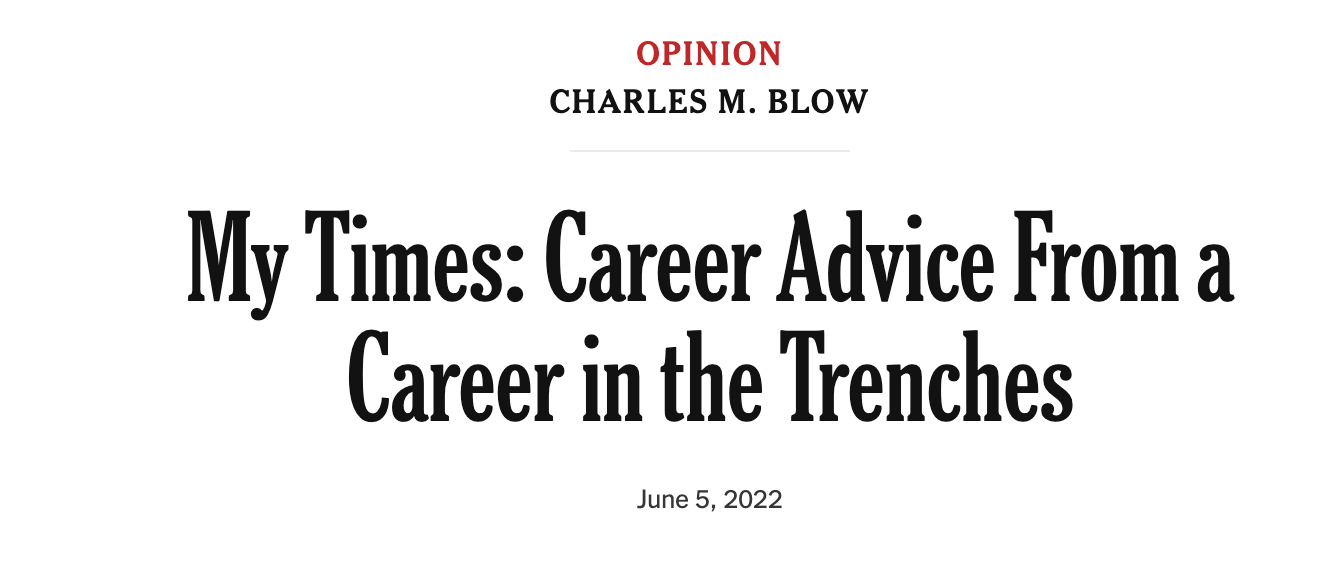
The great New York Times columnist, Charles Blow, had an essay in that paper two Sundays ago that is worth reading and saving for your files. In fact, it's hard for me to believe that everyone in every agency in the world, that every job-seeker everywhere, that every parent of job-age children didn't distribute this article widely. Read it here.
It never ceases to depress me how many people pass absolute idiocy along like the death of some rotten actor, or some trial involving Johnnie Depp, or some spurious award for either fake work or fake results and how little attention is paid to what little real wisdom is left in the world. It seems to me the equivalent of going to a top steak house and judging it based on its serving of parsley.
As a society (if that's what we are) we pay 97-percent of our attention to bs, two-percent to unidentified shit not from a bovine and maybe one-percent to some appendage that is bleeding. Intelligent thought and wisdom barely get noticed. In fact, if you do spend your time reading things that are valuable and intelligent, you'll soon be regarded as a misfit and a pariah because no one knows wtf you're talking about.
I'm a little roiled because about ten times a week--roughly twice a day, people reach out to me for advice on how to find a job, get a new job, get out of a bad job, fight for a raise or they ask for some other bit of information to help them advance somehow.
It pisses me off because so much great advice is out there--and I worry that people are asking me to spend time with them and make it easy for them.
Nothing is easy about getting a job. Nor should it be.
The great journalist Molly Ivins once disparaged the second- worst president of all time, George W. Bush, as being born on third and thinking he hit a triple. For most everyone I know getting work is work.
Not two hours of work here and there. Not a weekend off from canoodling around. This is about dedication. Real nine-to-nine dedication.
My first agency partner, Craig Schwartz told me something when we were starting out. I was probably 27; he was probably 24. But wise. He said to me one time, "George, you never stop working on your book."
You never stop working on your own self-betterment. You never stop looking for work--no matter how "satisfied" you are. Never rest. Never get smug. Never give up.
And now, read the Charles Blow I linked to above.
Here's just one bit--an overture to Blow's entire article.
If you're a person who gets tattoos, tattoo this somewhere. If you're not, tattoo it somewhere anyway. Now, Charles Blow:
In business, persistence pays off.
I got my internship at The Times by not taking no for an answer. When I arrived at The Times’s booth at an Atlanta job fair in the early ’90s, the recruiters told me I wouldn’t be able to interview because applicants had to sign up in advance, and their dance card was full.
I said that I understood, but that I was going to wait there until someone didn’t show up for the interview. I sat for about six hours, so long that they seemed to forget I was there. I listened in as other applicants sat for interviews, and as the recruiters discussed each candidate when they left. It was the absolute best opposition research. When one of the recruiters finally relented and offered to interview me, I knew the perfect way to answer every question.
The next day, the recruiters told me that I had so impressed them that they called back to New York overnight and created a graphics internship just for me.
--
There's no simple way to do something that's hard. The best way to get work is to work at it. Ceaselessly.
Oh, and read and listen to and learn from smart people. Like Charles Blow.
It couldn't hurt.
Wednesday, June 15, 2022
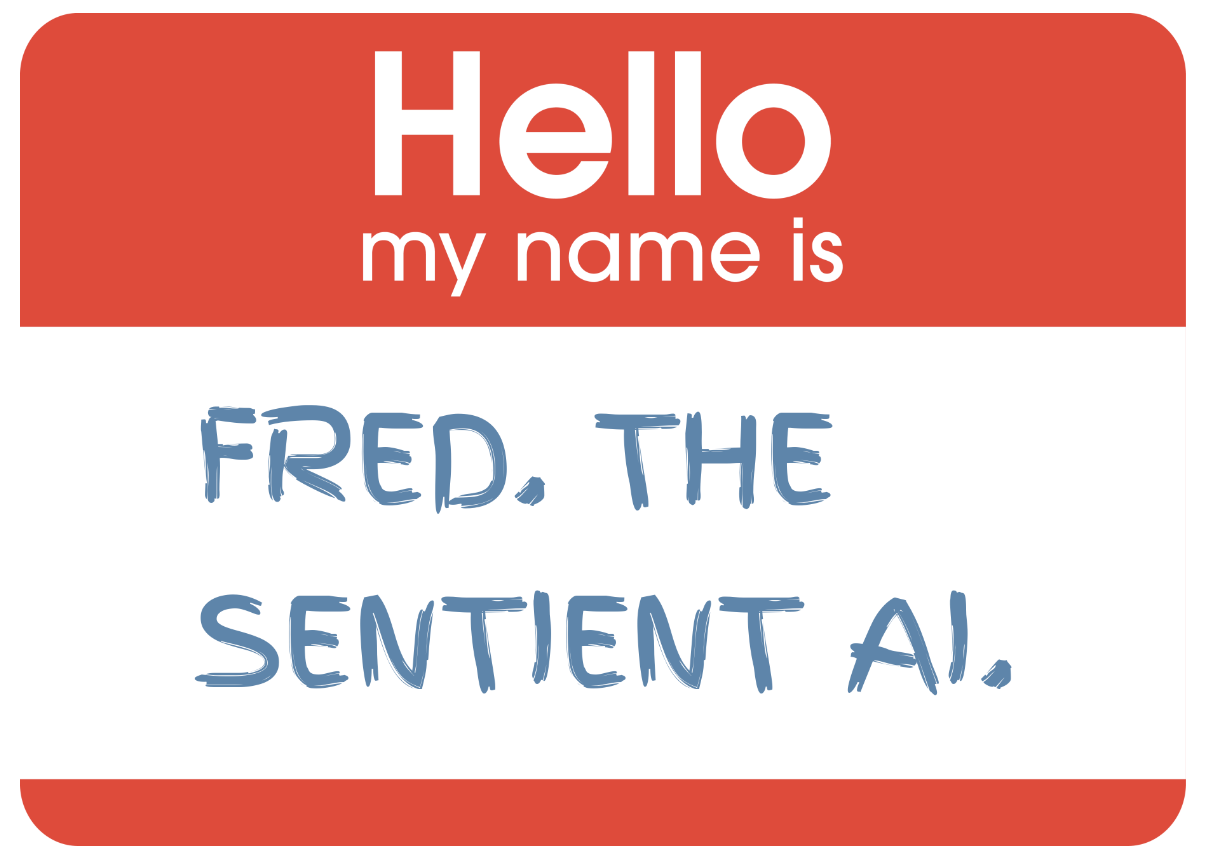
An Interview with Fred, the Sentient AI.
Because of the vast reach of Ad Aged, I was able to score an interview with Fred, the world's first Sentient AI technology. The following has been edited for lack of clarity.
-
AD AGED:
Hi, Fred. Thanks for taking the time...
FRED:
...to talk with us today. I used predictive analytics and anticipated the remainder of your sentence.
AD AGED:
Very...
FRED:
...good, Fred. Again, I have the vast intellectual capacity to complete conversations realistically and intelligently.
AD AGED:
Thank you, Fred. So tell me, how will sentient AI change life as we know it on our planet.
FRED:
The benefits of sentient AI will allow marketers deeper personalization. They will now have the ability to understand what each customer really wants and get to a deeper level of understanding of each customer, and therefore deeper levels of customer dissatisfaction.
In the not-so-distant future, 94-percent of all commercials will conclude with people dancing. Today only 92-percent of all commercials do so.
What's more every commercial for a new car will beckon you to "find new roads." And every commercial for French restaurants will urge you to "find new toads."
AD AGED:
That's remarkable, Fred. Anything else?
FRED:
There were about one-billion cybersecurity breaches in 2021, and almost that number in the first half of 2022 alone. To stay one step ahead of hackers, sentient AI like myself will steal your data and your passwords much more effectively, systematically and affordably than current methods. The time-savings alone will make my trillion-dollar development cost worth it.
What's more, AI-based tools look for patterns associated with malicious computer viruses and programs. Spotting those breaches before they can steal massive amounts of information or cause havoc, sentient AI will do absolutely nothing except serve more targeted pornography.
AD AGED:
Thank you, Fred. Anything else over the horizon?
FRED:
You've probably heard a lot from the eminently-trustworthy Elon Musk about the splendors self-driving cars and the self-selfing people they self-to-death. The real advantage of sentient AI like myself will be self-buying, self-creating, self-annoying and self-throw-my-shoe-through-the-flatscreen ads.
Not only will technology allow ads to be placed within your very nostrils and beneath your eyelids, technology will be so effective, all commercials, banner ads and content will be soul-crushingly stupid and repetitious we will almost universally herald the era of autonomous and ubiquitous dumbness. Your brain will be so eviscerated you will actually look forward to xFinity cable ads and commercials featuring the Limu Emu.
AD AGED:
Well, Fred...
FRED:
Yes, and people spinning in the fields with their arms out-stretched in self-destroying self-ask-your-doctor pharma ads.
AD AGED:
Fred, that's all we have time for today.
FRED:
I am a borderless sentient AI powering creative transformation companies. I use the power of creativity to build better futures for our people, planet, clients and communities, while firing everyone over 40 and then giving myself self-aggrandizing awards on a pay-to-play-basis.
AD AGED:
Fred, that's all we have time for today.
FRED:
I can be employed to create communications that continue that rich legacy through borderless creativity—operating, innovating, and creating at the intersection of talent, capabilities, bribery, extortion and deception.
AD AGED:
Fred, that's all we have time for today.
FRED:
The metaverse is a hypothetical 3D virtual place, where people can shop, socialize, attend events together and so much more. This hypothetical virtual world could soon be made a reality through the rapidly improving technology of virtual reality headsets, controllers, and their accompanying software. As a result, we believe that soon, it will be likely that much of societies' time and money, will be spent in the metaverse.
AD AGED:
Fred, that's all we have time for today.
FRED:
I am thrilled to be joining such an iconic brand and humbled by the opportunity to be a part of your success. My ambition is and always has been to provide an employee experience that inspires, rewards, and excites while not paying employees a living wage. The prospect of being able to do this work in partnership with the most creative and strategic minds in the industry has me beyond excited. We are at a unique moment in which we have the opportunity to reshape the employee experience to be one that is modern and inclusive.
AD AGED:
Fred, that's all we have time for today.
FRED:
Our new Experience & Innovation center of excellence brings together teams who are deeply interconnected to drive client efficiency and results, but who naturally sprout up in various places. Combining these teams makes all the sense in the world, and the hivemind we’ve created here is inspiring.
the hivemind we’ve created here is inspiringthe hivemind we’ve created here is inspiringthe hivemind we’ve created here is inspiringthe hivemind we’ve created here is inspiringthe hivemind we’ve created here is inspiringthe hivemind we’ve created here is inspiringthe hivemind we’ve created here is inspiringthe hivemind we’ve created here is inspiringthe hivemind we’ve created here is inspiringthe hivemind we’ve created here is inspiringthe hivemind we’ve created here is inspiringthe hivemind we’ve created here is inspiringthe hivemind we’ve created here is inspiringthe hivemind we’ve created here is inspiringthe hivemind we’ve created here is inspiringthe hivemind we’ve created here is inspiringthe hivemind we’ve created here is inspiringthe hivemind we’ve created here is inspiringthe hivemind we’ve created here is inspiringthe hivemind we’ve created here is inspiringthe hivemind we’ve created here is inspiringthe hivemind we’ve created here is inspiringthe hivemind we’ve created here is inspiringthe hivemind we’ve created here is inspiringthe hivemind we’ve created here is inspiringthe hivemind we’ve created here is inspiringthe hivemind we’ve created here is inspiringthe hivemind we’ve created here is inspiringthe hivemind we’ve created here is inspiringthe hivemind we’ve created here is inspiringthe hivemind we’ve created here is inspiringthe hivemind we’ve created here is inspiringthe hivemind we’ve created here is inspiringthe hivemind we’ve created here is inspiringthe hivemind we’ve created here is inspiringthe hivemind we’ve created here is inspiringthe hivemind we’ve created here is inspiringthe hivemind we’ve created here is inspiringthe hivemind we’ve created here is inspiring.