Last night was one of those nights in New York. Sultry, muggy and deliciously wonderful.
My wife and I got tickets to see the New York Shakespeare Festival's production of "Much Ado About Nothing," in the Delacorte Theater in Central Park. For my dime you should see Shakespeare whenever you're able. He's kind of like the Ray Charles of playwriting--a genius, an institution, the guy who wrote the book on writing the book.
The play was delightful, with a brilliant cast highlighted by the surpassing Lily Rabe playing the variably bewitching and shrewish Beatrice.
But for me, a life-long New Yorker, the most magical moment of the night came just after intermission when the final act began in complete darkness amid a simulated thunderstorm.
The theater was completely dark, except for the spill from the Belvedere Castle and if you gazed skyward you could see stars over Manhattan.
Stars over Manhattan.
Beautiful. Wistful. Magical.
Their lightyears'-away-twinkle fighting, I presume, for a parking space below.
Friday, June 27, 2014


Thursday, June 26, 2014
Resolute in the Tempus Fugit.
The weather last night sat on New York like a sweaty sock after three-hours of schoolyard basketball. It clung to everything with a moist stink that gave no quarter. Though I had the AC blasting in my apartment and the conditions inside were cool and dry, Whiskey nudged me awake at halfway between two and three and we headed uptown to the Tempus Fugit.
I hadn't been at the Tempus Fugit for some time, for a couple of months, actually. I wasn't turning abstemious. Nor was my lifelong battle with insomnia finally resolved, it's just that I've been excessively busy of late, and getting up to the place seemed an impossibility.
"Welcome," said the bartender as I descended the two steps into the place. "You have been conspicuous in your absence." He hustled around the bar and brought Whiskey a bowl of cold water. Back behind the bar he pulled me a Pike's Ale ("the ALE that won for YALE") and we began our evening.
I sipped slowly at the sweet amber, draining my glass and getting a refill before I responded.
"I have been busy," I answered. "And scared. Scared that the freelancing thing wouldn't work out."
"Ah, your confidence issues. Untrammeled by drink, drugs or years of therapy."
I laughed and finished my second Pike's.
"Well, it's tough hanging out a shingle after 30 years of working for others," I said. "Who knows if my phone will ring? Especially since I refuse to budge and lower my rates or my standards."
"The other day," he began "some kids found there way here, three of them, two girls and a guy, to the Tempus Fugit. I don't get many patrons who aren't regulars." He slid over a giant glass jar filled three-quarters of the way up with pickled hard-boiled eggs.
"Egg?" he said.
"You don't get many patrons period," I volleyed.
He continued, "They were, judging by the shortness of their shorts and their accents, German tourists. They asked for Pike's. They each sipped gingerly at their brew, putting their glasses down on the bar top after the slightest of sips.
"'Gluten frei?,' they asked.
"'Nein,' I replied.
"With that, they put an assortment of bills on the bar, shot me an 'auf wiedersehen' and that was the end of that."
"Your point eludes me," I said as he filled me again.
He slid over a small bowl of salted Spanish peanuts which, as usual, I pushed back at him. He then went around the bar, topped off Whiskey's water bowl and returned to his station.
"Ah, my point," he said, wiping the mahogany with a clean damp terry. "My point is simple. Be like Pike."
"Be like Pike. That should be my motto."
"Wear it as a frontlet," he continued. "Don't change with the times. Don't bend in the wind and certainly not in a breeze. Don't go gluten free because it's the thing to do."
"Well, it's easy for Pike's to stay the same. They don't make it anymore."
"They don't make anymore of you, either."
"They didn't just throw away my mold," I answered, "they nuked it."
I pushed two twenties across the bar in his direction. He shoved them back to me. This also never varies.
"On me, " he said.
And Whiskey and I walked home.
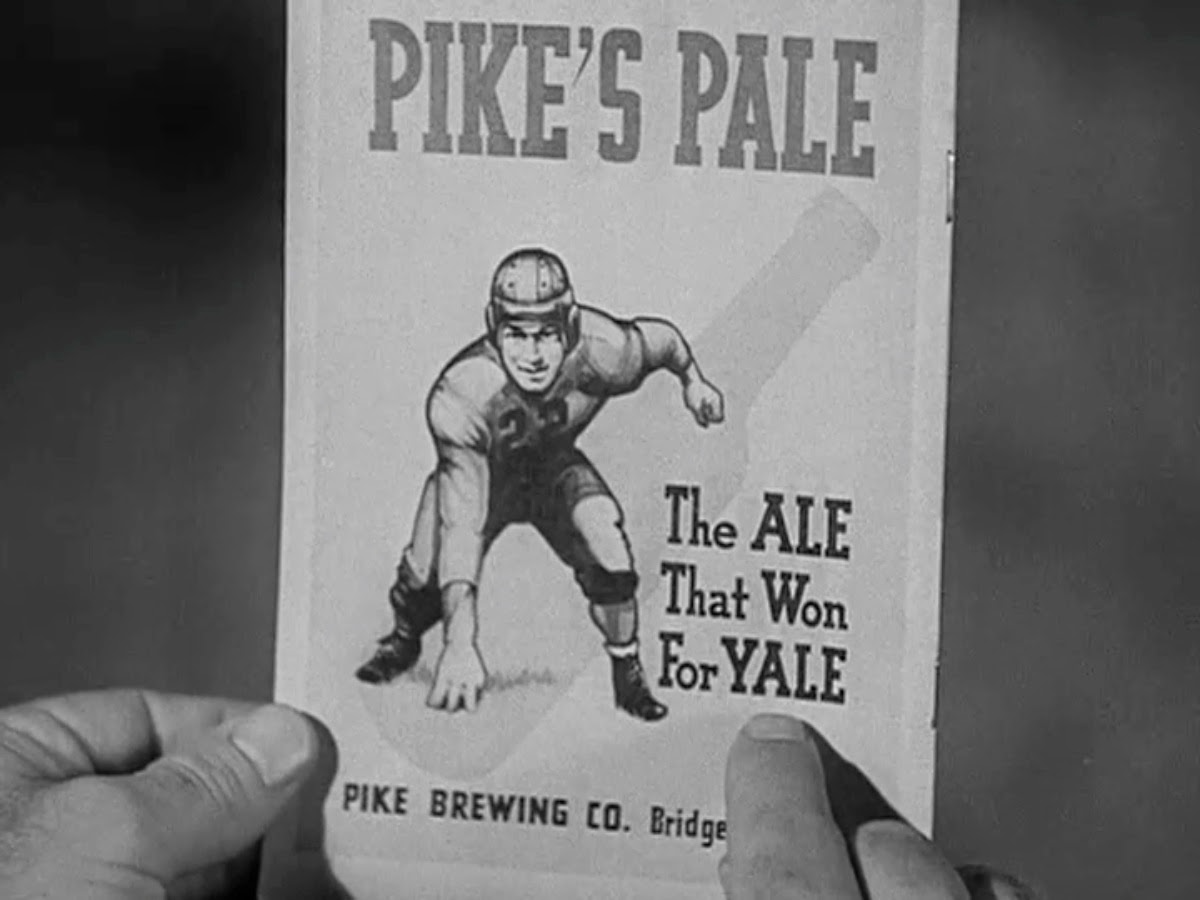 |
| Pike's, thank god, never varies and never withers. |
"Welcome," said the bartender as I descended the two steps into the place. "You have been conspicuous in your absence." He hustled around the bar and brought Whiskey a bowl of cold water. Back behind the bar he pulled me a Pike's Ale ("the ALE that won for YALE") and we began our evening.
 |
| There are still some kegs of Pike's scattered about. |
"I have been busy," I answered. "And scared. Scared that the freelancing thing wouldn't work out."
"Ah, your confidence issues. Untrammeled by drink, drugs or years of therapy."
I laughed and finished my second Pike's.
"Well, it's tough hanging out a shingle after 30 years of working for others," I said. "Who knows if my phone will ring? Especially since I refuse to budge and lower my rates or my standards."
"The other day," he began "some kids found there way here, three of them, two girls and a guy, to the Tempus Fugit. I don't get many patrons who aren't regulars." He slid over a giant glass jar filled three-quarters of the way up with pickled hard-boiled eggs.
"Egg?" he said.
"You don't get many patrons period," I volleyed.
He continued, "They were, judging by the shortness of their shorts and their accents, German tourists. They asked for Pike's. They each sipped gingerly at their brew, putting their glasses down on the bar top after the slightest of sips.
"'Gluten frei?,' they asked.
"'Nein,' I replied.
"With that, they put an assortment of bills on the bar, shot me an 'auf wiedersehen' and that was the end of that."
"Your point eludes me," I said as he filled me again.
He slid over a small bowl of salted Spanish peanuts which, as usual, I pushed back at him. He then went around the bar, topped off Whiskey's water bowl and returned to his station.
"Ah, my point," he said, wiping the mahogany with a clean damp terry. "My point is simple. Be like Pike."
"Be like Pike. That should be my motto."
"Wear it as a frontlet," he continued. "Don't change with the times. Don't bend in the wind and certainly not in a breeze. Don't go gluten free because it's the thing to do."
"Well, it's easy for Pike's to stay the same. They don't make it anymore."
"They don't make anymore of you, either."
"They didn't just throw away my mold," I answered, "they nuked it."
I pushed two twenties across the bar in his direction. He shoved them back to me. This also never varies.
"On me, " he said.
And Whiskey and I walked home.
Wednesday, June 25, 2014
Old Iron Ass.
I show up in the office before everyone else. When I have pressing
things to do—
like I do most days—an ad to write or a commercial to come
up with, I plant myself on my Aeron and face my keyboard and start pecking.
Earlier this week I had a bunch of headlines to write. I
settled myself in my seat and spun out 75.
Once the headlines were done, it was time for taglines. I
filled three pages, single-spaced, with lines.
When I get work like this, I become Old Iron Ass.
I sit as enduringly as Bartleby at his scrivener’s table and
I write.
I stay zeroed in on my screen. I get in a groove and type. I
type for hours without respite. I stay in my seat until I am done. No Facebook. No phone calls. Not even bathroom breaks.
Old Iron Ass will get it done.
Tuesday, June 24, 2014
Advertising advice from Frank Sinatra.
There was an
obituary in today's "Times" that made me think of advertising. At
least the last part did, advice from Frank Sinatra.
The obit was of
Joseph Charles Michael Tafarelli, aka Steve Rossi, who formed the debonair half
of a Martin and Lewis-type act in the 1960s. You can read the obit here.
Here's the part that really got me.
A story about Rossi seeking advice from Ol' Blue Eyes.
The Times reports: “In the early ’60s, Marty and I opened for
Sinatra. I went to his dressing room. I said, ‘Frank. We’re very nervous. Can
you give us some advice?’ He said, ‘Yeah, kid. First: Do the best you can.
Second: Give ’em all you got. Third and most important: Remember, they didn’t come
to see you in the first place.’”
I think that kind of works for advertising:
Do the best you can.
Leave nothing on the table.
And make your work good enough to compensate for the fact that no one really wants to see it.
Equality.
Yesterday I was listening to a National Public Radio interview with Israeli Prime Minister Netanyahu who was discussing the three Israeli teenagers kidnapped by the terrorist organization, Hamas. The report lasted 7 minutes and 36 seconds. At which point Netanyahu was rudely cut off and NPR went to their local feed, which consists primarily of traffic reports.
This morning on the same radio program, there was a report almost as long on people who can't clap on the beat. It included this quotation, ""Some of y'all don't understand that this kind of clapping is killing black folk. Do you understand what I'm saying? Killing us."
What's happened in our world is that we have lost our hierarchy.
We have lost our ability to say "that's important and that's trivial."
We have lost it in our daily lives.
We have lost it in our business.
It seems that often we put more time and resources behind doing a mobile ad than we do on a campaign of three TV spots.
I know we're all supposed to live in a politically-correct Valhalla where all people, things and ideas are equal.
I know that for whatever reason being told you're judgmental is today one of the great criticisms you can sling at someone.
But all things are not equal.
They're not created equal.
They don't influence equal.
They are not of equal importance, revenue, meaning.
Sorry.
As my kids would say, sorry I got all judgy on you.
This morning on the same radio program, there was a report almost as long on people who can't clap on the beat. It included this quotation, ""Some of y'all don't understand that this kind of clapping is killing black folk. Do you understand what I'm saying? Killing us."
What's happened in our world is that we have lost our hierarchy.
We have lost our ability to say "that's important and that's trivial."
We have lost it in our daily lives.
We have lost it in our business.
It seems that often we put more time and resources behind doing a mobile ad than we do on a campaign of three TV spots.
I know we're all supposed to live in a politically-correct Valhalla where all people, things and ideas are equal.
I know that for whatever reason being told you're judgmental is today one of the great criticisms you can sling at someone.
But all things are not equal.
They're not created equal.
They don't influence equal.
They are not of equal importance, revenue, meaning.
Sorry.
As my kids would say, sorry I got all judgy on you.
Monday, June 23, 2014
Fathers and sons. (Not Turgenev.)
 |
| It turns out my father was nothing but dots. |
"The New York Times" has a new online feature that lets you see the paper as it was printed for any day in the last 129 years. You can not only browse via topics you're interested in, you can see the surrounding articles and, of course, the ads of the time.
The "interface" is a little unwieldy, I'll admit, but nevertheless, over the weekend, I lost an hour going through the Times' archives.
The first person I looked up was my father, Stanley I. Tannenbaum. He worked at a large New York agency, Kenyon and Eckhardt, rising from copywriter in 1954 to Chairman of the Board 15 years later. Six years after that ascent, he was out on his not inconsiderable keister.
As much as I knew about the bare-bones of his rise and fall, reading about him in the Times' ad column was a bit of a revelation. It's seeing a person as he's seen by the world, not as you might see him as his son.
At the end of one article, by the great Times ad columnist Philip Dougherty, my old man was asked about the efficacy of Kenyon & Eckhardt hiring so many senior creatives at such high salaries. My father explained it this way: "We're putting our money where we make our money."
In a strange way those nine words summed up everything that's gone wrong in the advertising business in the holding company era.
We put money everywhere but where we make money.
Like most things in our modern world, there's a really simple solution to everything complicated.
You want to balance America's budget? You stop spending $1 trillion on bombs.
You want to stop terrorism in its tracks? Find alternatives to importing petroleum.
You want to heal advertising? Make better advertising.
That starts with putting money where we make money.
A trip across town.
Since I started freelancing in east New Jersey six weeks ago, I haven't found a good way to travel to my office from my apartment.
I live a stone's throw from the East River and for now I'm working a stone's throw from the Hudson. This is too absolute by half, but you can't get there from here.
I remember reading somewhere that the Inca could ascend to Machu Pichuu via the Inca trail quicker in the 15th Century than travelers can today. Much the same thing, I think, could be said about getting across town in Manhattan. I think Lenni Lenape trails probably hied people faster than the M31.
That said, I can't really say anything bad about the formidable building in which I am working. The sun pours in, for an open plan, there are places to go where you can squeeze out ten minutes of quiet, there's a decent cafeteria so you don't have to eat lunch at one of the local businesses (which are mostly car-dealerships or lumberyards) and there's an ambient rooftop that I suppose people who aren't freelancers can take advantage of.
The one thing I really miss in all this, of course, is a neighborhood bookstore. Yes, my office now is strewn with all sorts of books, but there's no place to browse and discover new things. And despite what some may say about the splendors of the internet (and they are many) real live paper books have palpable (and pulpable) advantages that are not to be sneezed at.
No more howling at the moon this morning.
I'm still on the crosstown bus,
And I have only half an hour to go.
I live a stone's throw from the East River and for now I'm working a stone's throw from the Hudson. This is too absolute by half, but you can't get there from here.
I remember reading somewhere that the Inca could ascend to Machu Pichuu via the Inca trail quicker in the 15th Century than travelers can today. Much the same thing, I think, could be said about getting across town in Manhattan. I think Lenni Lenape trails probably hied people faster than the M31.
That said, I can't really say anything bad about the formidable building in which I am working. The sun pours in, for an open plan, there are places to go where you can squeeze out ten minutes of quiet, there's a decent cafeteria so you don't have to eat lunch at one of the local businesses (which are mostly car-dealerships or lumberyards) and there's an ambient rooftop that I suppose people who aren't freelancers can take advantage of.
The one thing I really miss in all this, of course, is a neighborhood bookstore. Yes, my office now is strewn with all sorts of books, but there's no place to browse and discover new things. And despite what some may say about the splendors of the internet (and they are many) real live paper books have palpable (and pulpable) advantages that are not to be sneezed at.
No more howling at the moon this morning.
I'm still on the crosstown bus,
And I have only half an hour to go.
Friday, June 20, 2014
Advertisers have lost the attention of a generation. An update.
Yesterday I was directed to an article in "The Financial Times," called "Advertisers have Lost the Attention of a Generation." Read it here.
It seemed that the assertion in the title was based on a startling statistic. Teens watch only 21 minutes of broadcast television a week.
Some time after the article was published, a correction was issued by "The Financial Times."
The 21 minute statistic they mentioned was wrong. They meant 21 hours.
That's like saying "The US suffered only minor casualties in Iraq; only 21 died." Then finding out 1260 died and not revising the gist of the article.
It's like saying "New Lincoln gets only 10 miles to the gallon." Then discovering it gets 600 mpg.
When something material changes you should change your material.
In fact if teenagers are watching 21 hours of broadcast television a week, I would say television advertisers haven't lost a generation. I would say a new generation has embraced television. Especially since it seems so many young people watch primarily cable TV. And the 21 hour/21 minute stat was based on broadcast viewership.
I realize people--exponents of the death school of television--will say, "yeah, but they're zapping commercials." Or "they're tweeting while they're watching." Or "they're in the other room making grilled cheese."
But that's not the point. Or the points.
1. When the stat you've based your article's thesis on changes by a factor of 60, you have to either revise the article, or, better, pull it all together.
2. Unless you're writing editorials, you should try to remove your personal biases from your reporting.
3. There's this misguided idea that people of my generation and older were chained to the TV set and they practically seduced and mesmerized by commercials. That commercials had some sort of hypnotic effect on them. All because the consumer wasn't in control like they are today.
That notion is below even hogwash.
People ignored commercials in days of yore. We watched TV while reading a magazine. Or we went into the kitchen to make grilled cheese. We've done all that since the advent of TV 65 years ago.
If anything has lessened viewership of TV spots, it's not dvrs.
It's that networks and cable stations in their greed have made commercial pods too long. They easily last five minutes now. That's plenty of time to decide to do something else.
Personally, I believe viewership of spots would increase if:
a) Spots were longer. More 60s, please.
b) They were shown in shorter pods.
c) Brands sponsored entire shows like they did in the early days of TV.
d) We made more shows "events." We brought "live" back.
It seemed that the assertion in the title was based on a startling statistic. Teens watch only 21 minutes of broadcast television a week.
Some time after the article was published, a correction was issued by "The Financial Times."
The 21 minute statistic they mentioned was wrong. They meant 21 hours.
That's like saying "The US suffered only minor casualties in Iraq; only 21 died." Then finding out 1260 died and not revising the gist of the article.
It's like saying "New Lincoln gets only 10 miles to the gallon." Then discovering it gets 600 mpg.
When something material changes you should change your material.
In fact if teenagers are watching 21 hours of broadcast television a week, I would say television advertisers haven't lost a generation. I would say a new generation has embraced television. Especially since it seems so many young people watch primarily cable TV. And the 21 hour/21 minute stat was based on broadcast viewership.
I realize people--exponents of the death school of television--will say, "yeah, but they're zapping commercials." Or "they're tweeting while they're watching." Or "they're in the other room making grilled cheese."
But that's not the point. Or the points.
1. When the stat you've based your article's thesis on changes by a factor of 60, you have to either revise the article, or, better, pull it all together.
2. Unless you're writing editorials, you should try to remove your personal biases from your reporting.
3. There's this misguided idea that people of my generation and older were chained to the TV set and they practically seduced and mesmerized by commercials. That commercials had some sort of hypnotic effect on them. All because the consumer wasn't in control like they are today.
That notion is below even hogwash.
People ignored commercials in days of yore. We watched TV while reading a magazine. Or we went into the kitchen to make grilled cheese. We've done all that since the advent of TV 65 years ago.
If anything has lessened viewership of TV spots, it's not dvrs.
It's that networks and cable stations in their greed have made commercial pods too long. They easily last five minutes now. That's plenty of time to decide to do something else.
Personally, I believe viewership of spots would increase if:
a) Spots were longer. More 60s, please.
b) They were shown in shorter pods.
c) Brands sponsored entire shows like they did in the early days of TV.
d) We made more shows "events." We brought "live" back.
Julian Koenig, 1921-2014.


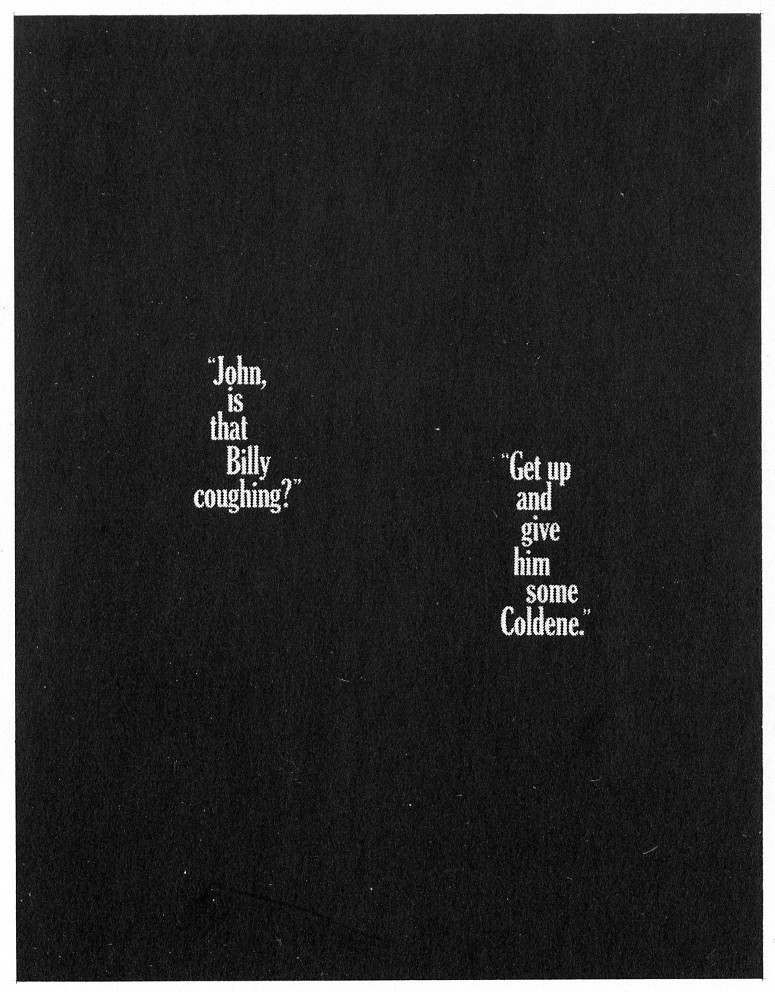
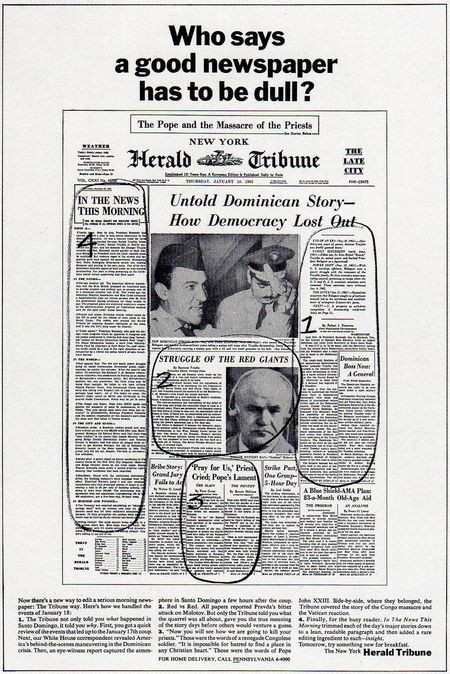
Julian Koenig died June 12th and his death escaped everyone's notice, including mine. I learned about it yesterday through America's top news-source, Facebook. Since then, I've mentioned Mr. Koenig's death to a few people--a few of my peers--and their reaction has been, who?
Julian Koenig?
Who?
How dare we.
Julian Koenig wrote "Think Small."
Julian Koenig wrote "Lemon."
He wrote the Harvey Probber chair ad above. One of my favorites.
"If your Harvey Probber chair wobbles, straighten your floor."
He wrote for Timex, "It takes a lickin' and keeps on ticking."
As an industry, we eat our old and ignore our legends.
We act like a Yankee fan who doesn't know the Babe, or Mickey, or even lesser lights like Enos Slaughter.
We shouldn't live in the past, but we should learn from it.
For instance, in 1966 while being inducted into the Copywriter's Hall of Fame, he excoriated the organization for giving the award based on "creativity" and "artfulness." Sales should be the only important measure he said.
I'm working today.
But what I'll spend some portions of the day doing is finding every Julian Koenig ad I can, and reading the copy.
Thursday, June 19, 2014
A statistical goof.
This morning I got another one of those "TV is dead" articles, bemoaning, this time the loss of an entire generation of people who simply don't watch TV.
 The email promoting the article had the above as its text.
21 minutes a week.
Startling.
Scary.
That's not even one sitcom.
Then I read the article which had advertising executives in Cannes scared to death about this information.
"I'm nervous about being out of a job a year from now..." one of them said.
The changes seemed that seminal.
I read the article, of course, with my usual healthy cynicism. People will watch commercials, I believe, if we make them good.
The killer app, I believe, isn't a device, or a pixel, or a channel. It's creativity. It's breaking through. It's uniting a fractured universe through something universally enjoyed or provocative.
In any event, I finished the article.
And there was a correction at the end of it.
It probably should have been at the beginning of the article.
Nevertheless, it read:

My high school math says that's a margin of error of 6000%.
Like saying a car gets 1200 mpg rather than 20 mpg.
I don't have the feeling I'll be out of work in a year.
21 minutes a week.
Startling.
Scary.
That's not even one sitcom.
Then I read the article which had advertising executives in Cannes scared to death about this information.
"I'm nervous about being out of a job a year from now..." one of them said.
The changes seemed that seminal.
I read the article, of course, with my usual healthy cynicism. People will watch commercials, I believe, if we make them good.
The killer app, I believe, isn't a device, or a pixel, or a channel. It's creativity. It's breaking through. It's uniting a fractured universe through something universally enjoyed or provocative.
In any event, I finished the article.
And there was a correction at the end of it.
It probably should have been at the beginning of the article.
Nevertheless, it read:
My high school math says that's a margin of error of 6000%.
Like saying a car gets 1200 mpg rather than 20 mpg.
I don't have the feeling I'll be out of work in a year.
So I went back to work.
Subscribe to:
Posts (Atom)