This morning "The New York Times" had an article on its sports pages on the New York Knicks. It didn't concern the coach or any particular player. It was about the General Manager who knows how to manipulate contracts and their terms to optimize his team's roster. No longer is it the players who are most responsible for a team's winning or losing. It's the money guys who count, the guy who staffs the team.
It's not basketball you're watching, it's accounting.
Of course the same paradigm is true for all sports.
And, now that big money--bankers--own everything, it's true in just about every business.
What we're living through is a miasmatic transition.
The people who do things and make things hardly matter.
Only the money guys do.
Advertising seems less about the quality of the product we make (ads) and more about our billability and the 20 or 40 hours allocated for this project or that.
Creativity is secondary to administrativity.
Thursday, June 30, 2011


What advertising can do.
We all know the statistics. How many ads and messages we are bombarded with each day. How many images and words are sent our way. How busy and cluttered and crowded our brains have become. We trot out this information as if it were a new phenomenon. (Which it's not.)
Posit that for a second and let me run this by you.
At its highest form, the purpose of advertising is to bring order to the universe. Amid the noise, advertising can bring clarity.
In my 26+ years in the business, I've seldom worked with a client who actually knows what they sell. So despite the color coordination that branding people have imposed, most brands remain cacophonous and dissonant.
The brands we love, and it seems we all pretty much love the same brands, are clearly defined and they don't waver from their definition regardless of what they're selling.
The issue that most brands are facing is a mass of their own messages in various media without the clarity of definition. They use the latest technologies and channels and chatter but they haven't done the most important job they can do.
Saying who they are. What they stand for. And how they behave.
Posit that for a second and let me run this by you.
At its highest form, the purpose of advertising is to bring order to the universe. Amid the noise, advertising can bring clarity.
In my 26+ years in the business, I've seldom worked with a client who actually knows what they sell. So despite the color coordination that branding people have imposed, most brands remain cacophonous and dissonant.
The brands we love, and it seems we all pretty much love the same brands, are clearly defined and they don't waver from their definition regardless of what they're selling.
The issue that most brands are facing is a mass of their own messages in various media without the clarity of definition. They use the latest technologies and channels and chatter but they haven't done the most important job they can do.
Saying who they are. What they stand for. And how they behave.
Wednesday, June 29, 2011




Tuesday, June 28, 2011

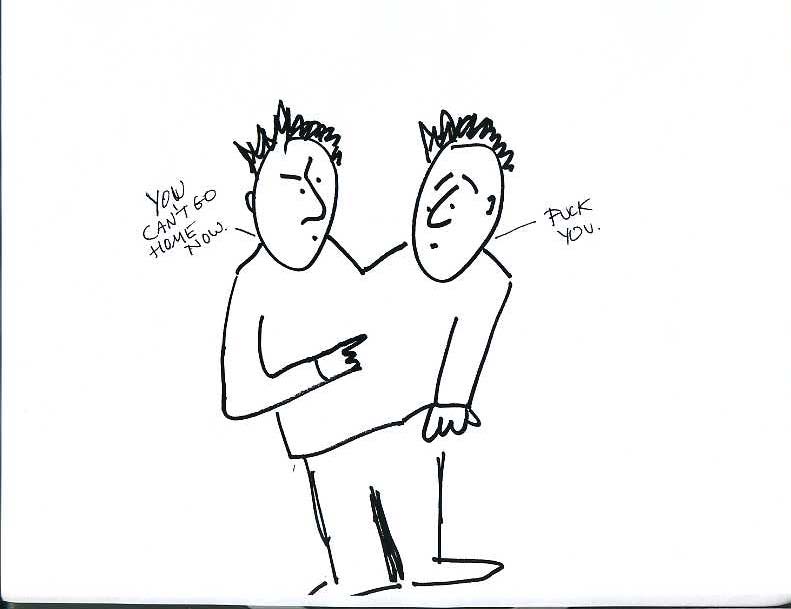
Some thoughts on Jargon.
When I left Ogilvy for places west, my brilliant mentor wrote on a napkin over dinner, 15 things I should do in order to be successful in future jobs. I've carried that list with me since it was given to me and I think about it often.
One of the things on this list, buried somewhere in the middle, is something I have been unable to follow. It could be why I've had 12 agency jobs in my 26 years, four in the last seven. And that's this: "Learn the jargon of the agency."
It seems to me that there are two ways to exist in any social organization--whether that organization is a company, a group of friends or even a family. You can be on the "inside" or you can be an "outsider."
Some people are happier, and more valuable as outsiders. Their crankiness, their nettling, their dissatisfaction with status-quo-ism is what, at least in part, impels these organizations forward.
Adam Morgan in his excellent book "The Pirate Inside," called such outsiders "denters." And these people are organizationally, a pain in the corporate ass. First off, they align not with the company they work for but the brands they work on. They are not overly concerned if they'll be at the company in ten years' time. They prefer tension to acceptance. And finally, they are on a quest--a personal mission--to drive their brand vision ahead.
Maybe it has something to do with my birth order or some vagary of my upbringing, but I have never felt a part of anyplace I've spent a lot of time; I've felt apart not a part. Maybe I should grow up and not bite the hand that feeds me and my family.
Maybe I should accept the so-called "wisdom" of the dominant complacency. That the world, and human wiring, is changing fundamentally and for all time. Maybe I should learn the jargon and start speaking of planar modalities and conversations about air freshener.
Nah.
I'd rather not.
One of the things on this list, buried somewhere in the middle, is something I have been unable to follow. It could be why I've had 12 agency jobs in my 26 years, four in the last seven. And that's this: "Learn the jargon of the agency."
It seems to me that there are two ways to exist in any social organization--whether that organization is a company, a group of friends or even a family. You can be on the "inside" or you can be an "outsider."
Some people are happier, and more valuable as outsiders. Their crankiness, their nettling, their dissatisfaction with status-quo-ism is what, at least in part, impels these organizations forward.
Adam Morgan in his excellent book "The Pirate Inside," called such outsiders "denters." And these people are organizationally, a pain in the corporate ass. First off, they align not with the company they work for but the brands they work on. They are not overly concerned if they'll be at the company in ten years' time. They prefer tension to acceptance. And finally, they are on a quest--a personal mission--to drive their brand vision ahead.
Maybe it has something to do with my birth order or some vagary of my upbringing, but I have never felt a part of anyplace I've spent a lot of time; I've felt apart not a part. Maybe I should grow up and not bite the hand that feeds me and my family.
Maybe I should accept the so-called "wisdom" of the dominant complacency. That the world, and human wiring, is changing fundamentally and for all time. Maybe I should learn the jargon and start speaking of planar modalities and conversations about air freshener.
Nah.
I'd rather not.
Monday, June 27, 2011
I "like" my Gastroenterologist.

I don't know if you've ever had a colonoscopy. It's something you're subjected to around the time you turn 50 or if you have a family history of colon cancer. All told, it's not the most pleasant procedure in the world. At some juncture you may feel like you're all alone in the world, save for a long, pliable tube with a micro-camera at one end.
I need to make an appointment for a colonoscopy, so I searched online for my Gastroenterologist's phone number. The first thing I saw, after getting his phone number is that a site called Citysearch was offering me the chance to "like" Dr. Schmerin on Facebook.
I like Dr. Schemerin, the little I've seen of him. And I'm proud to tell the world all about it.
My friend Neisha.
Is a young copywriter who will one day (soon) be a young, famous copywriter. She's started a blog for young creatives. Advice and wisdom. It's well worth checking out and passing along. http://creativewannabes.blogspot.com/
Irrelevance.
I'm 53 years old.
My wife is a jot older.
Together, we make more than 99.7% of the world's population.
We have two kids.
One's a Doctoral student in Psychology.
The other is entering her Sophomore year at an elite private college.
We live in 10028, one of the wealthiest zip codes in the country.
We have in our household seven computers.
We have high-speed connectivity.
We are all on Facebook.
We Skype each other.
We IM.
We even toss in an occasional tweet.
We spend more time online than we do sleeping.
We travel internationally.
We read incessantly.
We watch a modicum of television.
In short, it might be expected that we are the people advertisers need to reach.
With, I suppose few exceptions, none of us have seen anything that was featured and feted in Cannes over the last ten days.
The irrelevant are creating and rewarding the irrelevant.
My wife is a jot older.
Together, we make more than 99.7% of the world's population.
We have two kids.
One's a Doctoral student in Psychology.
The other is entering her Sophomore year at an elite private college.
We live in 10028, one of the wealthiest zip codes in the country.
We have in our household seven computers.
We have high-speed connectivity.
We are all on Facebook.
We Skype each other.
We IM.
We even toss in an occasional tweet.
We spend more time online than we do sleeping.
We travel internationally.
We read incessantly.
We watch a modicum of television.
In short, it might be expected that we are the people advertisers need to reach.
With, I suppose few exceptions, none of us have seen anything that was featured and feted in Cannes over the last ten days.
The irrelevant are creating and rewarding the irrelevant.
Sunday, June 26, 2011
An evening on the Upper West Side.
Last night my wife and I got free tickets to the Public Theater's "Shakespeare in the Park" which is now presenting "All's Well that Ends Well," (which we saw) and "Measure for Measure," which we likely will see in the next few weeks or so.
However, before the show we walked to Zabar's, perhaps the world's greatest food store, to pick up some food for dinner. We transported our comestibles to a little Zabar's-run cafe, a grungy pace next door to Zabar's with communal tables and a counter that offers sandwiches, soups, pastries and frozen yogurt.
I'm sure it wasn't Zabar's intent when they opened the place--I'm sure they wanted to attract thoroughly yuppified Upper West-Siders, but what they have in their little cafe is dozens of the octogenarians who used to sit on the benches along Broadway, now transported inside spending hours over a cup of coffee and a cinnamon swirl, unraveling the cake a slow inch at a time.
They come for the coffee and they come for their friends. They all seem to know each other. This is a community.
Most of their conversation last night was about the difficulties getting around the city to their various medical appointments.
"The one time he sees me for a full hour and I had to miss my 2:30 because my 11:30 ran so late."
"I left an hour and forty minutes to get to my dentist on the Lower East Side and I called him from the street when I was already late because the trains weren't running because of a police action, what that was, they didn't have the decency to tell us."
"There was a street fair on 6th Avenue and the crosstown had to go on 34th rather than 23rd."
It was like that for the 45 minutes my wife and I were there eating our Caesar salads.
During that whole time not once did any of the elderly we were sitting amidst check their Facebook, send a tweet or check their email. They live in a different world than the world we live in. They don't think about their Klout score, or Kim Kardashian's buttocks or the anything the younger generations wear as a frontlet.
They seemed at peace. Talking. Kvetching. Kibbitzing. Complaining how hard it was to carry a whole cantaloupe back to their apartments.
Their dramas more vivid, even, than the Shakespeare.
However, before the show we walked to Zabar's, perhaps the world's greatest food store, to pick up some food for dinner. We transported our comestibles to a little Zabar's-run cafe, a grungy pace next door to Zabar's with communal tables and a counter that offers sandwiches, soups, pastries and frozen yogurt.
I'm sure it wasn't Zabar's intent when they opened the place--I'm sure they wanted to attract thoroughly yuppified Upper West-Siders, but what they have in their little cafe is dozens of the octogenarians who used to sit on the benches along Broadway, now transported inside spending hours over a cup of coffee and a cinnamon swirl, unraveling the cake a slow inch at a time.
They come for the coffee and they come for their friends. They all seem to know each other. This is a community.
Most of their conversation last night was about the difficulties getting around the city to their various medical appointments.
"The one time he sees me for a full hour and I had to miss my 2:30 because my 11:30 ran so late."
"I left an hour and forty minutes to get to my dentist on the Lower East Side and I called him from the street when I was already late because the trains weren't running because of a police action, what that was, they didn't have the decency to tell us."
"There was a street fair on 6th Avenue and the crosstown had to go on 34th rather than 23rd."
It was like that for the 45 minutes my wife and I were there eating our Caesar salads.
During that whole time not once did any of the elderly we were sitting amidst check their Facebook, send a tweet or check their email. They live in a different world than the world we live in. They don't think about their Klout score, or Kim Kardashian's buttocks or the anything the younger generations wear as a frontlet.
They seemed at peace. Talking. Kvetching. Kibbitzing. Complaining how hard it was to carry a whole cantaloupe back to their apartments.
Their dramas more vivid, even, than the Shakespeare.
Friday, June 24, 2011

Subscribe to:
Posts (Atom)