Monday, October 27, 2025

Think Small.

There was a book review in Friday's "Wall Street Journal," and 72-hours after reading it, I still can't shake what I read. That very notion--of writing that stays with the reader--seems lost today.

Today, at least in advertising, we prefer peppering a reader with lots of Lilliputian bug bites rather than with a round-house punch that leaves a mark. On the rare occasion I see an ad I like, it's usually gone from my memory by the time its last electron flashes before my eyes. Most everything, except forever chemicals and bad policy, have the longevity of an etch-a-sketch.


I've read probably one-thousand books on World War II. The very subhead pasted above promised a re-evaluation of 999 of them. What could the writer possibly mean "ideological conflict was not the cause of World War II." And what does any of this have to do with modren life and the ad industry?

Here are the sentences I can't shake from Simms' review. And I'll admit--my thinking on this isn't done, so what I'm about to type is a little inchoate, and maybe stupid.

[Hitler's] main concern was the dominance of the Anglo-Saxon and plutocratic behemoths of the British Empire and the U.S., whose power threatened to strangle Germany....The struggle against the U.S. was Hitler’s primary concern even before he plunged the Reich into a disastrous war with America.

This matters because Mr. Hellbeck is therefore blind to the link between Hitler’s opposition to international capitalism...

American factory production and dead Russians--30,000,000 (not counting the ones killed by Stalin)--won the war, producing, depending on the type of weaponry, more than the rest of the world combined.


Hitler derided American production, of course. Not realizing the United States could transition from building ice-boxes to building bombers and machine guns and bombs and howitzers. 

What's interesting for me in all this though, is the aftermath, or World War II--ie today--and how it pertains to advertising today.

If you look at DDB's early Volkswagen advertising the Beetle was anti-American. The Beetle was built in "opposition to international capitalism." 

1. It wasn't trendy.
2. It was well-built.
3. It lasted.
4. It didn't go out of style.
5. You didn't need a new one every four years.
6. It was practical, not flamboyant.
7. It was technologically advanced.
8. It was 'slow and steady,' not 'fast and capricious.'

Today's advertising--its economics, what we produce, and its deportment--look like the apotheosis of American capitalism. Most of what the industry produces lasts about as long as two-shakes of a lamb's tail. Very little does what DDB's VW did half-a-century ago. That is build enduring brand value. 

In other words,

1. It's trendy.
2. It shoddy.
3. It ephemeral.
4. It looks old after two-days.
5. You need a new one every four weeks.
6. It's impractical and flamboyant.
7. It was technologically unsophisticated.
8. It's 'fast and capricious' not 'slow and steady.' 


What's more, from a mass-production point-of-view, the modern advertising industry has built vast production lines, not unlike Ford's mile-long Willow Run assembly line. (Rich Siegel calls the interior design of most agencies "The long table of mediocrity.™" We produce masses of undifferentiated rectangles that dot roadsides everywhere with heaps of junk that, using cars as a metaphor, breakdown quickly and don't hold their value.

At GeorgeCo., LLC, a Delaware Company, though I'm Jewish, and oddly for today, I have no Nazi tattoos, we try to follow VW's production sensibilities and philosophies.

We focus on what works.

And we work to make what works work better.

If you want 3200 ads a day to pester people and follow them forever like the Herpes virus, GeorgeCo. is decidedly not for you.

If you want something with enduring value that trades in truth not hype, please give me a ring-a-ling.

It's a philosophical choice.


Friday, October 24, 2025

Traven, Huston and Huston.


There's an inconsequential scene in the great John Huston movie "The Treasure of the Sierra Madre," that most people overlook because the movie is so chock-full of great scenes. This particular scene is easy to breeze by. 

It doesn't have Bogart fritzing out, or a bandit saying, "we don't need no stinkin' badges," or a bare-knuckle brawl. But it might, in essence, explain all that's gone wrong with the advertising industry in micro and capitalism in macro.

I've seen "Treasure" often, but only recalled this scene this morning as I got off the phone with a client and went out for a- three-mile-heal-my-brain walk along the seashore. It occurred to me that in a world where so many clients and agencies extol "kindness" and "authenticity," so few think about "decency" and  
"duty."


HUSTON: Put the mountain back in shape...

BOGART: Do what to the mountain...

HUSTON: Make her appear like what she was before we came.

BOGART: I don't get it.

HUSTON: We've wounded this mountain. It's our duty to close her wounds. It's the least we could do to show our gratitude for all the wealth she's given us.


I've written so many times before on this blog about the "extractive" nature of advertising and so many other industries. How capital (ie the holding company honchos) take all the wealth out of a "thing," and when the wealth has run out, as in the scene above, leave nothing behind but ruin, filth, pollution, slag.

Who shows gratitude for all the wealth people have given them?
As a certain -ump might tourette, "that's a sucker's game."


If you're paying attention to what's happening in a-mired-cardiac today, you'll hear a lot of talk about the splendors of nuclear power. The "stock" of the industry has risen like mad, while fact-deniers downplay the growth and efficacy of wind and solar power.

Nuclear is booming because nuclear is now unaccountable. How could anyone endorse any giant industry that creates deadly waste that is essentially un-clean-up-able for hundreds of centuries. It's easy to be profitable when your business model--as so many are--is smash and grab.


Life is great when you ignore all consequences but the money you make. Very few actions "make no wake." And very few wakes don't swamp the less-fortunate. This is too long to engrave on a coin or a dollar bill, but it's a heckuva lot more precise than e pluribus unum.

This is loo goo bree us for a Friday post, I know. 

But the ad industry seems in an irreversible death spiral. Ten years ago, WPP employed 200,000 people. Today, about 98,000. Similarly, we used to build industries, categories, companies, markets, economies, sales, jobs. We were the spark of the world's greatest economy.

Today, we win awards. Make fake ads people in the industry (and no one else) sees. And make a billion small ads a day that stick to people like stink from a cesspool.

We forgot this:


Instead we flog this:


The mountain's been raped.

The rapists got a golden parachute and a nine-figure pay-out.

We got the slag. 


Thursday, October 23, 2025

The Official Blog of.

I guess about 50 years ago, when the earth was a couple of degrees cooler, the oceans measurably less-acidic, and the white house was still standing, some marketing person typed, "_________ is the official pork rind of summer."

Wow!

Their client ate that up like they were nicotine-filled M&Ms at a focus group.

It's like they got a sponsorship for free. They never had to pay the people who own the rights to the season, because no one does--yet. They just glommed onto the appellation and went onto their next blight on our airwaves.

Soon, and quickly, others jumped on the "official ______" bandwagon.

In short order, we had the official beer of summer, the official hot dog of summer, the official charcoal briquet of summer, the official lemonade of summer, the official club soda of summer, the official cola of summer, the official grape soda of summer, the official lemon-lime soda of summer, the official orange soda of summer.

If the Dr. Brown's people are reading this, how about "the official cel-ray of summer." That sings! 

This "official pork rind of summer," uncorked at least two more asinine marketing avalanches. 

First, every sport, occasion, moment, day of the week became a marketable entity that could be claimed by a marketer. You see companies suing others over using the word "the" or the color orange or putting jam on bread. Everything has been stolen and venal companies hold onto their stolen assets like a third-grader gripping a kickball when things don't go his way.

We have "the official ________ of pickelball." And because that's absolutely meaningless, some copycat built on it and typed, "the official _________ of neighborhood pickelball." Someone else went to "the official ________ of left-handed neighborhood pickelball."

As Billy Pilgrim said, "And so it goes." As george said, "And so it pukes."

A second phenomenon followed. Quickly.

Now every calendar integument  has been cordoned off and appropriated for some or another or another organization, real, purported or marketing. 

January is National Mentoring Month, Slavery and Human Trafficking Prevention Month (presumably they're ok other months), and Veganuary. February is Bird Feeding Month. March is Brain Tumor Awareness Month (you can forget about your brain tumor in April.) April is Poetry Month and Cancer Control Month and Confederate History Month (some cancers aren't controlled, apparently.) May is Smile Month, Zombie Awareness Month and International Masturbation Month

Skipping around, we have Ice Cream Month in July. Honey Month and Pain Awareness Month in September. Pizza Month in October. Academic Writing Month in November. (I can't wait.)

More short term, there's Malbec Day, Hummus Day, World Milk Day, International Sushi Day, Beer Day, Egg Day, Porridge Day, Tripe Day.

In fact, if you spend any time on Linked In, you'll see one of these months or days being flogged for its nominal commercial value almost every day.

I think this is one of those technique that make it through creative meetings easily and go on to sell to clients even easier.

ACD: Don't you see--we rename Tuesday 'Achoos-Day.' Everytime someone sneezes they'll think of Kleenex.

ACCOUNT: Do you realize the earned media value of this? We'll get billions in sneeze-pressions!

CLIENT: Sneeze-pressions! Did you T M that? I love it!

Go into any supermarket at virtually anytime of the year, virtually any day of the week, or turn on the TV or radio turning any sporting event and you'll see about 92,000 of these official nonsenses.

Everyone's an official blank of blank.
Everyone's award-winning.
Everyone's the same.
Everything's the undifferentiated. 
And it sucks.

This is my official dumbest post of today.
But so it's not a total waste, I'll include something smart.

-----
(3) NOT GOOD, NOT DIFFERENT

In the past week, virtually every company in amerrykaka has announced an F1 partnership. I know what's in it for them (free tickets) what does it mean to me?


Wednesday, October 22, 2025

Call of the Ad in the Wild.

There are many woes that come with running your own small agency. There's the loneliness--most days I work completely alone. There's the constant hunt for new business--retainer accounts these days are as scarce as politicians with ethics. There are the clients who seem to think Net90 is an acceptable way of doing business. Ouch.

Also painful is how infrequently you see your work making it from your computer to production to paid media. From my earliest days in the business, my favorite moments have always been when I get to see my work in situ. You know, in the wild.

(Not wild postings btw, which allow people to make fake work look like it ran.)

Just about 90 minutes ago I got a note from a client. GeorgeCo., LLC, a Delaware Company has an offering I call "the Nifty Fifty." It's 50 headlines for one (not-inconsiderable) price. My tagline for the Nifty Fifty, which is my third most-popular offering, is "A year's worth of ads for a week's worth of pay." IMHO, it's just want clients need in the Insta era--in an era where you have to be always on, always topical and always fresh.

The Nifty Fifty cost more than el car wash (a collection of 80 car washes in southern Florida) wanted to pay. We settled on something I named "the Dirty Thirty." That is 30 ads, in this case billboards, for three days wages.

I love doing work like this. 

For one, when you have to write 30 of 'em, or '50, or even
"the Century," (100 ads) you don't have time to be precious. Also, at that level of ubiquity, every ad doesn't have to do every thing. Basically, as a copywriter, you're just telling a joke, or making a copy point, and showing a logo. You're reminding people your client is there. And giving them a reason to visit.

For most of my life, Tiffany's ran on page A3 of the "Times" what we used to call a 300-line ad. (That's an ad about the size of an index card. In standard newspaper "lineage," it was 1/9th of a page.) Tiffany's weren't really selling what the ad featured. They we're just saying to readers, "hey, we're here. Don't forget about us."

And maybe, "oh, and we're likable, too."

That was my thinking about the Nifty Fifty. A lot of what brands need to do is simply remind people they exist in a way that doesn't annoy the shit out of people. Most brands forget about that last part. So, they annoy the shit out of people.

I saw this a few moments ago. 
The diametric to "The Nifty Fifty."

Also, I realized--in conceiving of this offering--that clients have websites and emails that need lines. And powerpoints and holiday cards, too. Having a panoply of lines is like having ammo in your arsenal. It's better than shooting blanks. And getting blank stares.

These usually aren't ads you have to spend a great deal of time thinking about if you're a viewer. They're not asking for a lot from you. We're just trying to "stop the scroll," and give you a smile, and maybe implant something in your already too busy head.

My client just sent me the iPhone photo below from somewhere in West Palm Beach. It's just one of many billboards we did together.

I've written thousands of ads in my time. I used to write 500 a year when I was working in-house at Bloomingdale's. Seemingly I wrote almost as many when I was head of copy at Ogilvy on IBM. I probably write 250 a year for my own business. They work for me. They get me clients. Which gets me money. Which I like.

Here's one my client just sent me.

As I like to say, "advertising ain't rocket surgery."

Sometimes it's as simple as handing someone a laugh. And getting a check for it.

Halavai.


Tuesday, October 21, 2025

All The Reasons You Read My Blog in One Post.

If you spend any amount of time on LinkedIn, or with the remnants of what to be the advertising trade press, you'll read a lot of esoteric bushwa about this or that. 

You'll see job descriptions that may boggle your mind. Like a career in "customer pipeline management." You'll read articles about "optimizing the middle distances in the customer journey." You'll read about agencies that do bang the drum selling things I can't even understand, like this:

I've read that four times (I'm willing to do a lot of work to try to make a point) and it seems like a certain saliency is missing. Or even human-ness.

Likewise with these random inscrutables:


I don't, really I'm not playing dumb, know what any of this means. 

I see things like the examples above, they irk me, and I usually turn the page and go back to work.

I've got clients who need me and pay me and I don't like shit hanging over my head. So I work rather than perseverate or theorize.

But last night, maybe just before bed, I read something that was so obscure, abstruse and reality-loose, that it nettled me and kept me awake.

It also sparked my 97.87937749048947392745-percent photographic memory into action.

I remembered a bit from "Ogilvy on Advertising," almost verbatim. OK, 97.87937749048947392745-percent verbatim.

We are fine-tuning and optimizing and excruciating and maximizing the life out of communications. We know every trick in the book to get more "rise" out of less "run."

We've forgotten what's most important.

We know the periphery--we specialize in it.

We've forgotten the core.

We frolic in letting the data-science, or gobbledygook tail wag the love-of-neighbor dog.

We forget that we have to: 

Stop people.
Make a promise.
Deliver a smile
Impart information.
Persuade.


Or, to make it easier for you, dear reader:


In other words, and to be all Georgian-and-Rhyming about this,


Or 
to be all Georgian-and-Borscht-Belt about this,


Or, a little kindness with get you more customers than 17-MBA's-worth of marketing science. And the thousand thumb-nail-sized ads you're staying late to grind out in batches and buckets and blasts. Of those thousands of ads you're assaulted by, 97.87937749048947392745-percent don't even have a headline outside of 'Buy One Get One,' or some equivalent invisibility. They usually just depict stock photos of stock people with stock smiles pointing to a computer screen.


81-percent have people in impossible poses. Have you ever laid on your belly on the floor and tried to type on your laptop? It's nearly impossible. And its virulence suggests that it's the only position most people work in. Stupid as that is, the headlines are usually stupiderer.

We forget, what Ben Franklin, the inventor of lightning and kites once apocryphally said,  “A spoonful of honey will catch more flies than a gallon of vinegar.”

Or, for pithy's sake,


We continue to do a million uglies and hope one of those annoying pathogenic messaging sand-flies will nip someone to cah-ching effect. We don't want to think. And create one with niceness. We just want your money. No matter how much it costs to get it.

It's sad, that when we forget the truths and embrace the trends, this is what we do.


Monday, October 20, 2025

Book 'Em.

Of course, if I were somehow visited by a magical genie who could grant me three wishes or (inflation adjusted) one point six wishes, I'd have Heidi Klum sitting by my side, and untold wealth. I'm only human--and I apologize for that.


Eventually, on my "wish Hit Parade" I'd get to world peace, eradication of hate, reversal of environmental despoilation, elimination of racism, and a good old-fashioned salt stick, warm out of the oven and made without calcium propinate to preserve freshness.

At the very top of any list however would be a strange one. But just what a-merry-kaka needs at the moment. 

I wish we had political leadership that could read--and that engaged in reading as a way to surround themselves with genius--as I do.

I wish we had political leadership who could see past the everyday and learn from the past so that we can arrive at a better present. In short, I wish we had leaders who could read and learn from reading. Not just read and calculate what such-and-such will do to their polling numbers or how they can capitalize on the latest event or non-event.

Last night, reading-wise, was one of those syzygy moments for me. 

Useful. Not just for Scrabble.


I finished one book early enough in the evening so that (thank you, Dame Insomnia) I could start another.

I finished this:


And started this:


Here's the headline and subhead of "Blood" from a recent "Wall Street Journal" review. I finished reading this on the evening of the day I went to the "No Kings" rally in my little Gingham Coast town, where I spend more time than I like, preferring the island Manhattan, 'smoke in your pipe and put that in,' as Leonard Bernstein wrote and Chita sang.


I'll admit, 17th Century British history is not my strong suit. I get lost in the sea of Henrys, Georges, Charless and various bishops and the strife between the state religion and the pope's religion. But during the mis-era of trump, it's hard to NOT read a book summed up by the subhead here:


Through most of the book's 432 pages, I had to stop every paragraph or so and shake my head. Was the author writing about today--or almost 400 years ago? Here's a bit from the "Times'" review that will explain.

If you don't have the curiosity, stamina and there are too many football games on tv for you to read "Blood," do me (and yourself) a favor. Read these two pages. They're like the recap of a great boxing match written blow-by-blow by an A.J. Liebling or Red Smith.


Moving forward in time (just a bit) to the 18th Century, once done with "Blood," I began, eagerly, to read "The Zorg." (Zorg, though it sounds like a TV alien from a 1970s sitcom, means "care" in Dutch.)

Zorg got one of the best reviews I've ever read in "The Times." What's more, the review itself was illustrated with a painting by JMW Turner. I can no more resist JMW Turner than Ike could resist Tina.


There's an emerging trend in a-merry-kaka now, to deny the horrors of slavery. Even to deny that it was bad, unchristian, and wrong. Many in power are trying to re-write history and that it ever happened. Many are saying its victims should be thankful for slavery--we civilized them!

I'd wager in the next couple of years, we'll see the stirrings of a movement to allow dark-people entrance into our country if they submit to a certain unpaid-servitude. How else can we keep people of color down while getting our grass cut?

Here's a small summary of what happened on the Zorg only 250 years ago, a mere fart in the diarrhea of time:


And here's the Times' review concluding paragraphs.


The ...clash between humanity and property. (I removed the word 'ancient'.


That's why my wish would be for leadership who could read and lead. And learn, not just burn.

I can dream, can't I?


Friday, October 17, 2025

Of Rats and Humans.

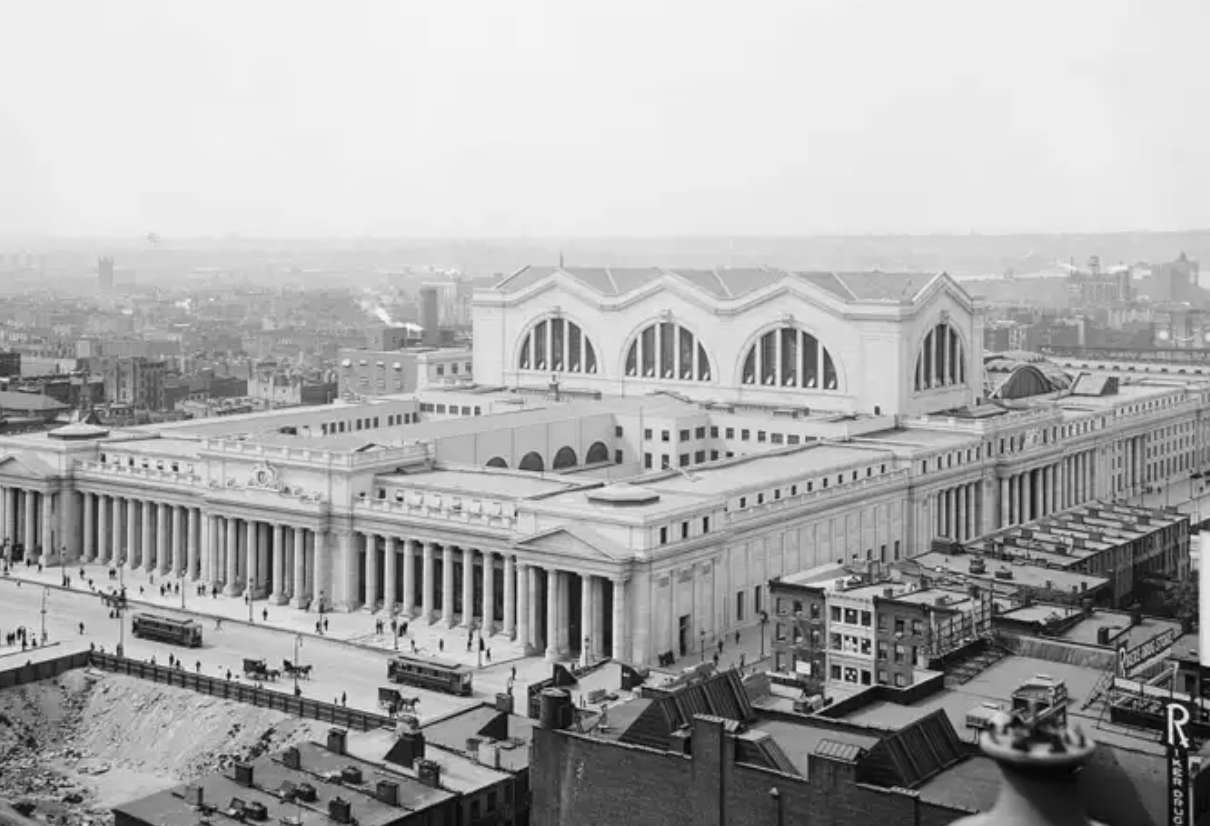
I've written more than once about the demolition of the Beaux Arts masterpiece, Penn Station and it's replacement, a low-ceilinged sump of urine-scented linoleum bathed in a frizzy fluorescent crackle and homeless puke.

The tearing down of great buildings and replacing them with ugliness is about architecture, of course. But more, since great building are usually commissioned by giant corporations or governments, their buildings semiotically tell us how they see the people they're supposed to serve. 

The Yale architecture professor and critic Vincent Scully said this about Penn Station, new and old.


I care about this because I think the same denigration is happening with the work our industry produces. 

It's usually sloppy, badly-designed and it doesn't treat people with respect. It doesn't respect their time, their intelligence, their desire for uplift. 

The one metric for creative work today is cheap. 

If you can shoot it on an iPhone, ok.
If an algorithm can make it, even better.
If it's free, farty and fatuous, even better still.

What does that say about how we see our customers? Our employees? Our selves?

Our industry, which once built brands of grandeur and granite now screams "buy one get one" and talks down to everyone and everything. Our industry's work is pandering. Base. And is judged solely on its cheapness. If AI can do it, who care if it's vile. It's purportedly cheap.

I can't prove this. 

And in a better world, wouldn't even have the urge to. The logic behind what follows is so obvious it should need no ballast behind it.

Treating people well is good for business. It's probably also good for farm animals--they are probably more productive, more nutritious and fetch a higher price when they are cared for with dignity.


Even, surprisingly, Walmart seems to have learned this "golden-rule-based" lesson. (amerika looks at itself as a christian nation until decency costs money or means being fair to people with dark skin.)

Treating people badly eventually destroys businesses, brands, corporations, countries. Treating animals with disdain has poisoned our food supply. One in eight amerikans is diabetic. That's almost 40 million people.

Again. In advertising we have to make a decision. Treat people, including those who work for us as we want to be treated, or treat them so that you can optimize your profit while minimizing your expenses. Thus, destroying everything while enriching a few.

The holding companies have made their decisions. Maybe they'll get away with it because like so much else in the world today they've consolidated wealth and have monopoly power. 
Maybe they'll win. Besides, they're rich and I'm just one person.

Etiam si omnes, ego non.

Ict Nicht.

Not I.


How it started:


How it's going: