Saturday, April 30, 2011

Houses without foundation.


One of the things I noticed in the photographs from the tornado brooked devastation of the American south, is how many of the houses picked up and destroyed like children's toys were built without foundations.

In the wake of Modernista!'s closing this week it caused me to wonder how many agencies and how many ad campaigns were similarly built, without foundation.

There are advantages to building foundation-less homes. It's fast, cheap and who needs a basement anyway? But though these houses looked fine before the tornadoes struck, they were weak, vulnerable and not made to last.

I've worked in this business for 26 years. I've worked for 12 different agencies. Some had an ethos, a belief system, a way of doing things. However most work and most agencies seem to be built on following what's "hot" or "cool" at the moment. They don't get in and explore the fundamentals of their own brand or the brands they work on. They produce well-designed derivations of the things that won awards the year before.

Award-winning work more and more often seems to be based on quick, cheap jokes. Thoughtful, deep work, work built on the essence of a brand (not just on making a brand cool) is considered too ponderous. It's fallen out of favor.

Houses without foundations are fine when the weather is fair. Likewise agencies when the economy is strong.

What happens when the wind blows?

Thursday, April 28, 2011

I definitely don't like it.

I am staying right now in Las Vegas in a 3,000 room hotel that doesn't contain a single clock or a single lamp with wattage enough to read by. I'll admit, I haven't really given the city or the hotel a chance, I've been working too hard. But it's not likely I would ever enjoy myself here. The city seems to be to urban architecture what Kraft singles are to cheese.

The hotel is decorated--festooned actually--with the work of I suppose hundreds of local artists. I guess this makes them feel like they are intrinsic to the community.

Look, I'll admit I am Scrooge-like and ahedonistic. But I gotta tell you. Most local artists aren't fit to paint a pee stained fire hydrant.

A viral ad.


I finished last night "A History of the World in 100 Objects" by Neil MacGregor, director of The British Museum. One of the final chapters featured the coin shown here. It made me think of modern advertising.

Just over a century ago, women in the United Kingdom didn't have the right to vote. Women tried many tactics to get attention and to raise the issue, including chaining themselves to the wrought iron outside of 10 Downing Street and deadly letter bombs. But perhaps the most effective effort was their defacement of the penny.

Their message was clear. They broke the law to make it. And it was ubiquitous. There were too many pennies of this ilk for banks to recall them all. So the pennies circulated, spreading their simple, declarative message. Influencing, slowly, the people seeing that message and passing it along.

Of course, this example is not the first viral movement ever. But it made me think of two things. 1) That nothing is new under the sun. The current viral-nistas act as if they've invented something new. They haven't. This form of advertising is likely as old as dirt. And 2) For a communication to go viral, it should probably follow the precepts of our English penny. Be notorious. Be simple. Be lasting. Be easy to pass along. And finally, be meaningful at some elemental level.

Wednesday, April 27, 2011

To my daughter.

My older daughter, who is a doctoral student in psychology, has an internship interview today and she's nervous. I spent a nice amount of time with her on the phone last night talking about success and "getting the job."

I don't have a lot of time this morning. I am off to Las Vegas for three days of conferences with my client. So this will be a little blunt.

Sarah, I told her, if your work is good, and it is, if you've accomplished things, and you have, collect your thoughts and speak with moderation and modesty about what you've done and where you're going.

There's an expensive co-op apartment house in Manhattan on 5th Avenue and 66th Street. It used to be an office building housing an interfaith religious group and directly across 66th Street from the magnificent Temple Emanu-El. About five years ago, the building was "converted" from ecclesiastical use to riches for the rich. But they left the Biblical inscription. Micha 6:8, I think. I think it's good advice for most everything.

"Act justly, love mercy and walk humbly with your God."

Tuesday, April 26, 2011

Why is the internet so dumb?


We hear almost daily how the Internet is changing everything. People who "get" the internet are full-blown mockers of people who "just don't get it." The internet, we're told, is changing the "media landscape." (Why can't they just say 'changing media.' I've stopped at dozens of scenic overlooks and never once seen a media landscape.) The internet is changing commerce. The internet is changing customer service, education, how we fight wars, etc.

If all that is true, then why is the internet so fucking dumb? I have an absolutely complete LinkedIn profile, but got the job matches shown above. Me? Chief People Officer? That's like putting Genghis Khan in charge of a girl scout troop.

And if you can ratiocinate your way out of conceding that the internet is dumb, when will it stop generating dumbness and call it elegance and intelligence?

How to spot a blowhard.

Blowhards (fulminatus fulminata) are rife within agencies and at the helm of small consultancies with names like Lavender Ingot. They leap off the pages of trade magazines and they can also be found in the sanctum sanctorum of advertising holding companies.

These tell-tale signs will help you spot them.

1. Blowhards cannot modulate their volume. Their voices are loud, consistent and utterly baseless. To that end, blowhards
2. Issue proclamations without evidence. The most common of these proclamations goes like this, "______________ is fundamentally broken." They won't say how ________ is broken or what being broken means. Just that ________ is broken.
3. They don't have enough time to fix what is broken. What's broken is so fundamentally broken that it will take three years and seven million dollars to fix it, and fixing things part-way is useless because what is broken is so badly broken.
4. Blowhards have a lot to say when a project kicks off but they are absent once the work begins. In short, blowhards can identify problems but are too busy and too valuable elsewhere to actually fix problems.
5. "That's not how I would do it." Blowhards don't like anything that's been done but don't actually do anything themselves.
6. Blowhards assert that a small agency in Brooklyn with less than a million dollars in revenue (and who has done great data viz on this) has more to teach us than an multi-national agency with $1 billion in revenue.
7. Blowhards are better than you at powerpoint.
8. Blowhards are always 12 minutes late for 30-minute meetings.
9. Blowhards believe that most marketing problems can be solved through data visualization. (See #6.)
10. Blowhards don't believe in data that doesn't support their world view that "_________ is broken."

Monday, April 25, 2011

It ain't easy.

This post is a combo platter of three ideas. One comes from an article I just read in "The New York Times" called "A Generation’s Vanity, Heard Through Lyrics." In it, John Tierney reports on a three-decades-long study by a Dr. DeWall, a psychologist at the University of Kentucky. "In a meta-analysis published last year in Social Psychological and Personality Science," Drs. DeWall, Twenge and Joshua D. Foster looked at data from nearly 50,000 students — including the new data from critics — and concluded that narcissism has increased significantly in the past three decades."

Second comes from a chat I had with my boss. We spent half an hour together lauding the ability of old-timers, like ourselves, to take a licking and keep on ticking. In other words, we, unlike so many youngish people, have the stamina to fight through the vicissitudes and hang in there until we sell something.


Finally, I found, on moreintelligentlife.com, the video I've pasted here. I like it because in a mere 94-seconds it shows the myriad decisions a creator has to make, the unending alterations, to make a work of art.

It's not easy doing what we do. And in our overly democratic work-worlds where everyone gets their say, and everyone can take potshots, it's hard to get work produced. It's not all about you. You have to suck it in and take it some times.

But you are not alone if you can.

Truth (and soul) in advertising.


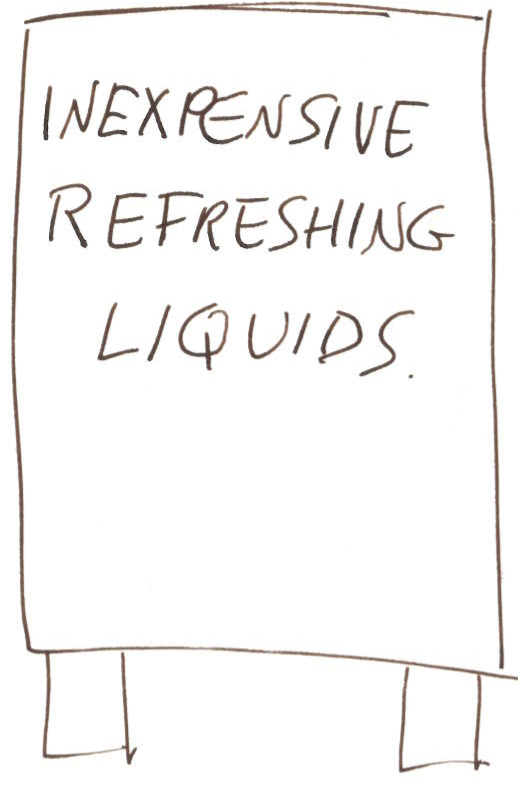
Seeing a sign like this, which I just saw on 9th Avenue between 39th and 40th, brings to my mind so much that is wrong with the advertising industry.

I find this sign amusing. Direct. Honest. Different and attention-getting. It's exactly the kind of thing you would not get from or get out of an agency. And if it did get out of an agency and to a client, it would never get approved.

The conversation would go like this.

"Can't we say 'inexpensive' instead of 'cheap.' Cheap is off brand and too downscale."

"I don't understand 'freaking.' It's too close to 'fucking.' Can't we say something more positive and appetizing? Like 'refreshing' or 'delicious?'

"Beer is fine, but it's too limited. We have lagers, and pilsners and ales, as well."

"Not to mention sodas and mixed drinks."

"And coffee, tea and bottled water. Can't you include those as well?"

So, we are left with:


Ball-less, non-descript and forgettable.

The Celtics of Boston.

It doesn't happen very often but once in a while it does. Either because I'm tired or lazy, I succumb to a sporting event on television. It happened this weekend, twice. The Knicks, the basketball team of my youth were in the NBA playoffs against the great, but aged Celtics of Boston.

"I fear the Indians of Cleveland," the Old Man said in Hemingway's "Old Man and the Sea."
"Have faith in the Yankees my son. Think of the great DiMaggio."
"I fear both the Tigers of Detroit and the Indians of Cleveland."
"Be careful or you will fear even the Reds of Cincinnati and the White Sox of Chicago."

This was to be epic, in other words. Hemingway-esque. My resurgent Knicks of New York against the hated Celtics of Boston.

So I watched.

Watched the Knicks get treated like an old dishrag. Thrown around willy-nilly. Meaningless. Beaten. Trampled. Eviscerated. Schmised.

One thing you see on TV nowadays, however, made me think about advertising. There is an absence of anything but noise. The commercials, the announcers, the arenas. They are noisy. Noise fills every vacuum. The noise overwhelms everything.

Noise is the antithesis of thought. And it's what we prize above all else.

Saturday, April 23, 2011

Olde New York, 1999.


One of the things I miss in our the modern world is that there are fewer and fewer bookstores and less and less time to browse in them. My New York, the New York I grew up in and aged in, is the story of these places disappearing. Sometimes I take a long walk home from work and it's like working past old girlfriend's houses. That's where Books & Company was, that's where Colosseum was, that was the home of Doubleday, Scribners, Bretanos.

One of the best of those now-malled (mauled) bookstores was Gotham Book Mart, just about the only non-diamond-seller on 47th Street between 5th and 6th--the center of New York's Diamond exchange. Gotham had the great advantage of being family owned, and they owned the five story building they had cluttered with books and memories. You could spend the day there.

Outside of Gotham there was a sign, shown above, designed by the great artist/cartoonist John Held, Jr. "Wise Men Fish Here," it reassured. And they did. The store was populated by many great writers who made it their home away from home in New York. (Starbuck's made a big thing about people needing a "Third Place," a location that wasn't home or work. For many people the Third Place used to be stores like Gotham.)

Gotham was the closest bookstore to Ogilvy when Ogilvy was on 8th and 49th. It was still a schlep, but whenever I had the time, or was feeling shitty or needed inspiration, I would head over there. There was a bookseller at Gotham called Flip, Phillip was his proper name, but it was always Flip you looked for.

Over the years Flip and I became friends. I was writing a book on pirates in the late 90s and Flip was one of the world's experts on pirate literature. As the saying goes, he had forgotten more about pirates than I'll ever know.

I thank Flip frequently for turning me onto the fiction of the great Raphael Sabatini, who wrote "Captain Blood," "The Sea Hawk," and of course, "Scaramouche."

"Scaramouche," Flip told me had the greatest opening sentence in English literature including "Moby Dick." "He was born with a gift of laughter and a sense that the world was mad."

Gotham closed around 2005 and moved to nicer, smaller quarters on 46th Street between Madison and 5th. They never fit in that location. Instead of the mayhem and serendipity of their original location, they were neat, oaky and organized. They went out of business in a great auction of their stock that I had to miss.