George Tannenbaum on the future of advertising,
the decline of the English Language and other frivolities. 100% jargon free.
A Business Insider "Most Influential" blog.
A little more than 60 years ago when Europe was war-torn and worse for wear, the great photojournalist Robert Capa and Ingrid Bergman fell in love. This photo was taken by Capa. The absurdity of a bathtub and Bergman in bombed-out Berlin.
Bergman wanted to marry Capa. But Capa knew that he would have to give up being a journalist were he to do so. He turned Ingrid down and continued traveling the world shooting wars. He died in Indo-China having stepped on a landmine at Thai Binh.
Money people will never understand creative people--people who would choose their creativity over, even, the allure of Bergman. No big point here. Just something to think about when you curse the gods.
Years ago, I had the best run of my career when I was an ACD on the Gorton's Fish Sticks account. You can read one of my previous posts about working on that business right here: http://adaged.blogspot.com/search?q=bergman
But given the recent demise of the sultry sex-pot pin-up girl Bettie Page, I thought I'd write today about the Gorton's spot I shot with her.
My partner and I had spent about two weeks trying to beat the Bergman spot--and each time we showed a storyboard to my boss he'd exclaim, "Great Caesar's ghost! Go back to the well, dig deeper. This spot is good. But I'm looking for magic." The magic that had previously earned me and my partner a coveted Bronze Addy (Eastern Region)for the Bergman spot.
Finally, after yet another all-nighter, I think I blurted something like, "Uncovering a better Fish Stick." My partner heard that line and grabbed it like an all-pro line-backer going after a loose pigskin.
"Uncover! This is gold! We uncover, unveil, strip-down a Gorton's fish stick! We show Harriet Housewife that only the finest, meatiest fillets go into every Gorton's stick."
And who better to make that point than the finest, meatiest pin-up girl, Bettie Page?
We whipped out a board, contacted Page herself and the rest was fish stick history. What a girl! What a catch! And another Addy to boot.
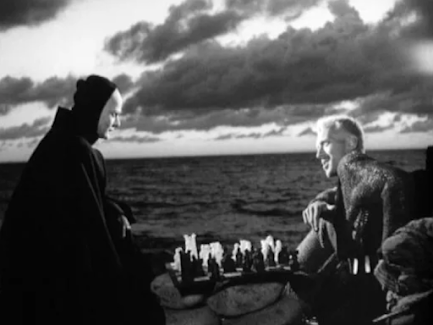
Early on in my career I worked on Gorton's Fish products. Gorton wanted to trumpet the healthy side of eating fish. My partner and I came up with a concept based on the scene in Bergman's classic The Seventh Seal in which the protagonist plays chess with death. We had the bright idea to recreate the scene with a fish-stick playing death instead, and defeating it.
Somehow we sold the spot and we decided to contact Bergman to see if he'd be interested in directing it. We figured that was no more outlandish than Gorton's actually buying the spot. To our surprise, "Ing" (as he preferred to be called) said OK. He actually thought it was pretty funny.
Bergman had never shot a commercial before and he insisted on the first rough cut. When that came in at 128-minutes we realized we had a problem on our hands. "Ing" proved to be a nice guy, however, and once he understood what we meant by a "tir tee" he readily complied. The spot ran for over two years and picked up a host of awards in the European shows. We were shutout in the US, though. A bit too ethereal for the judges.
Adjö så länge, Ingmar. Goodbye, my friend. I shall miss you.
The phone rang just as I was leaving the house for a week shooting in California. Three types of people call me on our landline. There are telemarketers, even though we are on every DO NOT CALL list known to the NSA. There are politicians, to whom the do not call laws, and most others, don't apply. And there's Uncle Slappy.
The thing is he learned my home number when my wife and I moved to our current apartment 15 years ago. That's from before the time cell phones were prevalent and Uncle Slappy never saw the need or had the desire to learn a different number for me.
If you're the only relation of an older relative like Uncle Slappy and Aunt Sylvie, you pick up the phone when it rings. Though, knock wood, the both of them still have sap running through their branches, they're not, as they'd be the first to admit, getting any younger. Besides, you should never take the health of 86 year olds for granted. So even though my producer was downstairs waiting to travel with me to JFK, I took the call.
"You'll never guess who I just met," the old man began.
"Hi, Uncle Slappy, everything ok?"
"Guess who I just met. The most stunning woman by the pool."
"I'm sure Aunt Sylvie is enjoying that," I said.
Uncle Slappy is, like I said 86, but he still enjoys a well turned ankle. Even if it is housed in granny shoes.
"I met Ingrid Berman."
"Ingrid Bergman's been dead since the early 80s," I said.
"That's neither here nor there. I met Ingrid Berman. From Massapequa Park."
"And she's beautiful, Uncle Slappy?"
"Well," he said with timing that would put Jack Benny to shame, "Of course she is." He paused a long pause. "Of course, she's no Ingrid Bergman."
As the economic gloom spreads, as staffing becomes leaner, we will all be berated, scolded and otherwise brow-beaten. You must become more efficient. We will all have to work harder and faster.
I don't disagree that so much bullshit gets in the way of productivity. One morning many years ago a boss of mine held up a copy on The Wall Street Journal in one hand and The New York Times in the other.
He said, "Each day these start blank, and each day they publish and the quality is pretty good." He was right. By and large, there's too much carping and too little doing or, better, too many discussions about what needs to be done or about what has been done. And not enough doing.
However, just now I came across a quotation by Ingrid Bergman that reminds me that magic might just be sacrificed when productivity is king.
"A kiss is a lovely trick designed by nature to stop speech when words become superfluous."
Certain bits of creativity are products of serendipity, magic and luck. We can not force-produce them.
I'm not sure if anyone today knows who Robert Capa is, or anything about him.
Capa emigrated/escaped from pre-World War II Hungary and became, quickly, the most-important war photographer ever--taking probably the most-famous photos in both the Spanish Civil War and World War II. He also, though I'm too tired to Google right now (I had about 27 client meetings today and I'm writing this as I drift off to sleep) was a founder of the famous organization of news photographers, Magnum.
Capa, to my prurient eyes, also did something equally outstanding. He rejected the most-beautiful woman in the world, Ingrid Bergman, because she insisted he give up his calling, war photography, and settle down.
There's a back story, and not necessary a life-affirming one behind every one of the photos above. But that's not the point of today's tired-uninspired post.
Capa famously said something that I think about a lot. Even though I'm just an advertising copywriter.
Capa said, "If your pictures aren't good enough, you're not close enough."
This, sadly, is from a man who died 20 years after he spurned Bergman, stepping on a landmine crossing a rice paddy in war-ravaged Vietnam.
Those eight words, for me, are the phrase that pays in the ad business--no matter what your job in the ad business, where you work, or what your level.
If your work isn't good enough, you're not close enough.
Get closer to inspiration. Get closer to your planner. Get closer to your boss. Get closer to the account guys. Get closer to the brief. Get closer to digging deep. Get closer to researching like a sonofabitch. Get closer to writing one-hundred ads. Get closer to looking at the world upside-down. Get closer to someone with a little distance. Get closer to people you can lean on or try an idea out with. Get closer to, like Capa, danger. Get closer to doing something dumb. Counter-intuitive. Something that's 27% dumb. Or 47%. Or 87%.
Obviously, I don't mean physical proximity.
I mean ardor. Passion. Sweat. Caring.
It's all too easy to live life with diffidence.
Like Thoreau said, with quiet desperation.
I'm five weeks away from turning 66. I was talking today with a friend I'm handling an account with--a senior guy. We had an incredible meeting with a giant client that went amazingly well. In just three-days I had created about four-times the work a giant agency would have created in about four-times the time.
My friend said to me, "You obviously really got into this."
"No," I answered. "I'm an old man now. But I'm lucky. I love what I do. I love unraveling problems. I love figuring things out. I love doing this."
"I can tell," he said.
And that's what I mean, "get closer to loving what you do."
I started reading Ingrid Rossellini's new book last night, "Know Thyself: Western Identity from Classical Greece to the Renaissance." You can buy it here.
(And yes, Ingrid Rossellini is the daughter of the great director Roberto Rossellini and the great actress Ingrid Bergman.)
What got me last night was a quotation Bergman attributed to Joseph Campbell, but that the web attributes to a 4th Century Roman writer, Sallustius.
Regardless of who said it, it's worth spending a few moments thinking about.
"A myth is something that has never happened, and is happening all the time."
Chew on that for a few minutes.
Think about the stories we create for brands. Think about the stories we create for ourselves, as writers. Think about the universality of human nature, and the myriad things that are "happening all the time."
You don't need to spend much time reading advertising trade magazines or even your Linked In-feed, before you trip over someone blathering on about experience design, or user interface or some other mumbo-jumbo.
There are dozens of slide-shows clanking around cyberspace with some dweeb talking about new media landscapes, empowered consumers, and people seeking out cheaply produced content, that will somehow, magically get passed along and induce sales.
I think we spend too much time thinking about how much in the world has changed. And not enough time thinking about how much the world hasn't changed.
We sprint after the ephemeral and transitory to the exclusion of universal truths.
Let's fuck everything we do in advertising, save for one criterion.
Let's asks ourselves if we've scratched a universal itch. If we've created something that someone will notice--and care about.
" Since I was a little kid I've always loved old movies. Today, there are a couple of great film archivists who month after month re-release old movies worth watch. The most prolific of these is Criterion and as a consequence I buy just about everything they produce.
My recently I received in the mail "The Phantom Carriage, a 1921 Swedish movie by director Victor Sjöström. "The Phantom Carriage" is a dark fable about love and death that foreshadows Bergman's "The Seventh Seal."
It ain't exactly something you'd find on the Hallmark Family Channel or Comedy Central. In other words, it's no barrel of laughs.
But if you're in the mood to see Death in living two-color, give it a whirl. --
BTW, a couple times a year, Criterion runs 1/2-price sales through Barnes & Noble. You can pick up a bit of brilliance and history like "The Phantom Carriage" for about twenty bucks.
It was unusual for the Seraperos de Saltillo to have a practice at Estadio de Beisbol de Francisco I. Maduro during my one long season playing under the all-seeing and all-punishing Mexican sun in Saltillo, Coahuila, Mexico. But our losing ways had been losinger than usual and our manager, Hector Quetzacoatl Padilla, aka, Hector Quesadilla, thought it wise to try to correct some bad habits before they came worse habits.
Like me, el estadio was born old.
What's more, running a ball team, or dealing with a bunch of kids, or any group of people in an office, or a family vacation, is sometimes more about showing who's boss than having any real reason for doing something. You have to, at times, lay down the law if for no other reason that to slow humankind's inevitable and inexorable slide into entropy.
I can see my house from here.
In other words, Hector called practice this evening because too many of the Seraperos were doing things their way and not his way. Playing with their shirts untucked, with their sanitary hose down about their ankles, showing up late to the ballpark, or the worst sins of all in the deep eyes and unforgiving strictures of Hector, missing the cutoff man on a peg from the outfield, missing a sign, or bunting one into the air for an easy hip-pocket catch by the opposition's backstop.
We played continuously that summer. Often we averaged more than a game a day for a stretch of two weeks or three. "You don't make money if you don't fill the ballpark," I heard one official from the team mutter once, as we set off on our rickety team bus to play nine games in seven nights. And so, we played until we dropped and the we picked ourselves up and played some more.
As a consequence the chances we had to practice were limited usually to loose pepper before the game, some desultory batting practice, arm-strengthening long throwing, and routine shit, like shifting when a lefthander came up, or learning little niblicks of tricks like as you were running the bases, drawing a throw from the outfield so the lead runner could advance.
But this was a full-fledged practice after a twilight loss to the Olmecs or the Stevedores or the Pelicanos. This was a wind-sprint, puke on the warning-track kind of practice. Because Hector was mad.
He was mad at the nothingness of the team. The lack of bite and the lack of fight. He was mad that too many of the boys were just getting through the season, not fighting through the season.
Hector, when he was a player, slid spikes out into second even if his team was down 13-2. There was no phoning it in in Hector's world. Baseball was a way away from the crushing horror of his childhood and giving up on baseball, even during a single, fleeting moment of lassitude, signaled a return to the pain of a father who hit you--and not with an open hand--and sleeping five to a mattress in a two-room wooden shack full of brothers and empty stomachs.
A life without heart or health or hope. A life of hell and helplessness. Baseball was the out from that, and Hector played every game like he was playing death in a Bergman movie and he was always one move behind.
We clambered into groups according to our positions. I was in with the "bend-over" infielders, the guys who had to crouch at the knees and bend at the waist to do their defensive job. The first basemen were off on their own, working with Gulliermo Sisto on their footwork and their scooping bad throws out of the dirt. Gordo Batista worked with our two catchers--getting them to stick their fat Indio asses almost onto the dust to block against passed balls, and then pop up like a child's toy to make the wicked peg to second.
The outfielders, five of them, practiced dumb stuff, like staying in the game not looking for pretty girls in the stands and hitting the cut off and backing up the one-over outfielder lest one bound past him.
Hector was with us bend-overs, hitting us sharp grounders to our left or to our right, trying to get us to leap like Brooks Robinson to stab the ball before it could escape our clutches for extra bases.
Hector was particularly angry at me that night. Earlier that day, a rocket shot by me and I reacted too slowly and tried to compensate by grabbing at it barehanded with my right hand because I was too molasses to dive and get it. From where the liner hit my hand, my hand was swollen like an overstuffed Cuban sandwich and it pulsated like a ringing telephone.
Then, at once, the lights in the decaying stadium went off. The stadium was supposed to be a showcase--a modern wonder of the baseballers' art. But by the time bribes and graft got done with it, half the wooden seats had no backs, half the stairways had no railings and the infield was covered in rocky littoral, not major league loam.
The lights went out because it was nine-o'clock and the grounds' crew turned the lights out and disappeared for the night. We breathed a breath of thank god and began to leave. But Hector stopped us.
The moon was bright and Hector gathered us in. "We will practice with our ears and not our eyes," he said. "We will hear what the wood says when it hits a ball. We will listen where the wind blows a fly ball and will sense the ca-bump of the enemy's spikes and calculate when we can throw him out or not. We will listen to the sound of the game."
Hector fungoed grounders to the infielders--hard, short, fast-bouncing hits to our right or to our left. He wanted us to learn, to be like Willie Mays and anticipate with 99.999% accuracy the vector of the ball before the ball itself even knew. The great ones, Hector said, could do so. Clemente, the Pirate of Pittsburgh. Mays, the Giant of San Francisco. Brooks, the be-wingéd Oriole from Baltimore.
Like my own be-spikéd feet, the Serapero infielders had ears of clay. Once, only once, I dove to my left and heard a low grounder into my Rawlings 'Finest in the Field' glove. But that leather embossed slogan, like such much else that emanated from el Norte was a lie and an over-promise. I was not, and never would be the finest in the field, more apt, I was the fuck-up in the field.
I said to Hector across the infield in my bad high school Spanish, words I knew he might understand. "I am no Vayu," I barked as if talking to a bad dog, "I am no Vayu, the ancient god worshiped by the even more ancient Persians."
"No se," Hector growled back.
"I am no Vayu," I said, echoing myself. "The vital breath of the world, is not the same as the vital breath in my human body. I am disconnect. Incongruity. Think left, go right."
Hector laughed at that. To me, Hector was an easy-laugh. Our senses were connected that way which is why he quickly became my first father and I his only son. Even when he was mad at me which was unusual, he loved me like my own father never did.
Orestes was born not with feet but with rockets.
"Cosmos and person are one in one person in ten million crowds of people. Perhaps Francisco I. Maduro himself had that vital breath, or Minoso of the Chicago pale hose who was never thrown out no matter how like a wild javelino he ran. But Porfirio Diaz gunned down the breath of the people and kept his kingdom of Mexico, as unvital as he was to anything but his own greed. And Minoso, black, was kept out too long because of white."
He shot another grounder my way and I fielded it in the dark cleanly across my body. I took two half Nijinski hops and zinged the ball across the infield to where the first basemen were but they did not see, hear or anticipate the sphere's arrival. It flew to Sisto's face through the dark and missed his prodigious beak only at the last minute, interrupted by the instincts of his hummingbird reflexes.
"Es totalmente," Hector shouted and we left the dark of the field for the gloom of the dripping locker-room. I stayed for a moment on the field and then lay on the dessicated grass between home and third. Hector lay down next to me and up at the lonely stars we stared.
"We are two people," the old man said in his mountain Spanish. "We are two people in one cosmos on one planet in one city in one stadium on one team. We are two people in one cosmos. We are not the vital breath of anything."
"Maybe because most nights we are too tired to even breathe" I answered.
We blinked against the blinking of the stars--more stars than the number of people at the most crowded of celestial ballparks.
"We are not the vital breath of anything," Hector repeated and his growl of a voice reverberated from Alpha-Centauri back to me.
"Except each one of us is the vital breath to the other. Your breath is vital to my breath is vital to your breath" Hector ended.
"Each one of us vital to the other," the stars and I repeated.
We breathed and talked to the blinking stars without blinking.
The stars were bright. The lights in el estadio stayed dark. There was no sight to be seen and no seens to be sighted. Yet, ever-groping at the molecular darkness, we somehow found our way. We found a beacon, unblinking, in the dark.
This might sound a little weird but nevertheless it's true. I became a first-time home-owner at the age of 40. Since that time--more than a quarter-of-a-century--I've observed two types of refrigerators behaviors.
I started out when my kids were young with refrigerator-as-bulletin-board. The front surface of our machine was metallic and when my wife and I traveled, we would try to bring home souvenir magnets of the places we'd been. It was a dopey way of teaching our kids some rudimentary geography. It was also an expedient way of giving them a little gift something on our return.
On the fridge, we'd also have magnetic alphabet letters. We'd hang our third-grader's collage, or a snapshot of a kid at the beach, or a letter from our super telling us about some repair that was happening in our building.
The refrigerator surface was, in a word, noisy.
Then, as happens to people when they work 24/7 and are good at what they do, we decided we had to renovate our apartment.
We started, of course, with the kitchen. We reconfigured it to use the space more efficiently. We knocked down a wall and built a peninsula as a divider from our dining area. We put in new custom-made cabinetry and new flooring. New appliances. The renovation to be clear cost as much as the original price of our apartment. But that's par for the course if you're behind the avarice eight-ball, as most people are.
Our refrigerators in our renovated New York kitchen and our rarefied Connecticut kitchen are way too snooty to be treated like our original ice-box.
First, they are clad in fine millwork. We therefore must abide by the old New York dicta "Post No Bills." Instead, on our expensive marble countertops, we have to give over a couple-thousand dollars' worth of square-feet to a large school-kids' calendar. The sorts of notices we used to put on our fridge, now take up valuable counter-space. How else will we know when our dental appointments are or when Julia and Mario are coming for the weekend?
It occurred to me in the dark of night how vital our refrigerator used to be as a communication device. And how our counter-space now plays that role.
It also occurred to me how weed-like communication can be. How much easier it is to add than to take away. How we gravitate to clutter not importance.
As my therapist said to me almost forty years ago in the days before I had ever even been online, "The problem with the internet is the problem of hierarchy. Everything everywhere is shouting at you every minute. There are no chapter headings. No "front of the book," or appendix."
Last night I was scrolling on LinkedIn--as I do. I get a lot of my business from people I "meet" on the site, and business is important to me. (See price of renovated apartment above.)
For the last six months, whenever I see a connection on LinkedIn who posts things that are blindingly obvious, platitudinous, insipid or just plain dumb, I remove them from my network. I do this with the ferocity of Bergman's Grim Reaper in the "Seventh Seal." But despite my eugenic pruning, the dopey just keeps on coming.
And all this with none of the Sweeney crap.
The issue, I think, facing many people and companies today, is not that different from my refrigerator issue.
Without serious, scrupulous editing your brand becomes a Fresh Kills landfill of fetid junk. That's the obvious default for most brands and people. Meaningless always-on annoyance that some content "strategist" has recommended and called it a cadence--when it is more like a dump truck. A ferocious dump truck.
BTW, every content strategy is the same: Post more content.
Others, don't play at all. They sink into oblivion because they simply are not present. They don't show up with anything fun, interesting, important, persuasive.
Someone now will utter the word "curation." But that's a bullshit word to make someone feel like there is discretion in a world where there is none. It's like trying to avoid trumpism. You can't get away.
The only ways are to succumb or to shut off completely.
Each way sucks in its own way.
And unlike a refrigerator, the light never goes on.
The great John Updike died yesterday. These are my remembrances from working with "Rabbit," as I dubbed him.
Back during the halcyon days of my career, when I was a bronze-Addy winning ACD on the ever-so-glam Gorton's Fish Sticks account, my partner (Craig--are you out there?) had had quite a run. First, we shot a spot with that rollicking Swede Ingmar Bergman (read about it here: http://adaged.blogspot.com/2007/07/ingmar-and-me.html. We followed that up with another Gorton's spot with the stickiest of all fish stick spokespeople, Bettie Page http://adaged.blogspot.com/2008/12/bettie-page-1923-2008.html.)
Now we were "tasked" (as account people like to say) with introducing a new line of Gourmet Gorton's fish sticks called "Gorton's Signature." I think it was Craig who said it: "Let's get perhaps the most notable literary signature of all. Let's get Updike." And so we did.
Off camera Updike was shy and laconic. But under the lights he was a pro. "Gorton's signature fish sticks," he intoned, "made from select filets of fresh--never frozen--young scrod." Then he signed his name ( in tartar sauce, a bit over-the-the-top for my taste, but that's show-biz) and said, "They're the only fish sticks good enough for Gorton's signature. And mine."
The language is a bit tortured but the point is clear.
"As "Wild Strawberries" didn't compete for "OSCAR" I think it is wrong to nominate the picture and therefor {SIC} I want to return the "CERTIFICATE OF NOMINATION."
"I have found, that the "OSCAR"-nomination is one for the motion picture art humiliating institution and ask you to be released from the attention of the jury for the future.
I don’t think you can imagine the pressure if you weren’t there, if you didn’t live through it. If you weren’t—pardon the excess—present at the creation. It was crushing. Soul-sapping. Non-stop.
Here’s the “back-story.”
When we were a junior team, my partner Craig and I had somehow sold a spot to the Gorton’s Frozen Fish people that featured a fish stick playing chess with Death like in Ingmar Bergman’s “The Seventh Seal.” You can read about it here: http://adaged.blogspot.com/2007/07/ingmar-and-me.html We outdid ourselves, Craig and I did, and even got the famously reclusive Swede to direct our spot.
You can imagine the fanfare, the success, the raises, promotions and awards we accumulated. We were drunk on our own power. How do you follow something like that up?
They said we couldn’t. But we did. First for our “Uncovering a Better Fish Stick” campaign which we shot with the beautiful and sultry stripper Bettie Page.http://adaged.blogspot.com/2008/12/bettie-page-1923-2008.html We followed that award-winning spot with a campaign Gorton’s “Signature” Fish Sticks, where we did a spot featuring the great John Updike. http://adaged.blogspot.com/2009/01/john-updike-1932-2009.html What now? Three award winning campaigns. And now our boss was breathing down our necks wanting more.
Five straight weeks of late nights and weekends had yielded us nada. Oh, we came up with great spots, of course we did. But nothing worthy of Gorton’s and their new “Giant” fish sticks. “These say big,” I said to Craig, tossing another sheaf of tissues into the trash bin. “They say big, they don’t say giant!”
Craig hit it. Or rather lightning hit Craig. “Giant! Starring Liz Taylor. We recreate the scene at the end where she waves goodbye to James Dean, only we have her wave goodbye to a Gorton’s fish stick!”
“Criminy!” I ejaculated. “That’s it.”
Craig and I quickly got on the blower with Liz’s people and in just a few hours the spot was sold through to Liz and Mr. Gorton himself.
Liz was a doll to work with. Took direction like well-trained golden retreiver. And at the end of the shoot, she gave us each a small diamond—a chip off the 66-carat one Burton (the cad) gave her. A small token of remembrance.
I’ll miss the violet-eyed beauty. Heck, I already do.
It's been a while since I visited the Tempus Fugit. Not that I haven't wanted to walk up there and have the sweet nectar that is Pike's Ale (the ALE that won for YALE.) It's just that my summer maladies have revisited once again and between a general feeling of weakness and a real bout of an ailment called pericarditis (an inflammation of the pericardial sac) I have been unable to visit.
Last night, however, Dame Insomnia kissed me gently and pulled me lovingly from my sleepy nest. She helped me on with my jeans. She tied my wing-tips. She even helped me place the leash on Whiskey's collar, and before long she guided my feet uptown to the Tempus Fugit.
There are inanimate objects or natural phenomena that change with greater rapidity than the Tempus Fugit. It's entirely possible, to my eyes at least, that the Tempus Fugit has changed less in the 89 years since it opened at the height (or depth) of Prohibition than have the giant Sequoia in Yosemite or, say, the great cataract we call Niagara Falls.
I'd wager that some of the low wattage lightbulbs that illuminate the bar are the same ones bought decades ago by a salesman who might have known Edison in Menlo Park as he tinkered away in his factory and thought about making plastic discs speak and spouting hate against Jews.
Whiskey and I assumed our positions. Me on my favorite stool one in from the end; Whiskey curled like a stock photo at my feet. Once again the bartender with the grace of a Martha Graham, an Isadora Duncan or a young Phil "the Scooter" Rizzuto, swept around and back with a bowl of cold water, salted Spanish peanuts and a short eight-ounce pull of Pike's. In mere moments he was back behind the bar, perched in his catbird seat, leaning and ready to inform, enlighten, amuse and elucidate.
I had drained Pike's number one and second glass was placed before me.
"A man came in the other night," the bartender began his story as he began wiping the bar with a damp terry, both in a circular motion. "He wore high lace-top boots with camouflage khaki tucked in. They looked rather like World War I-style puttees."
"A style I haven't missed," I said.
Ignoring me. "His shirt was also camouflage and over it, he wore a multi-pocketed safari vest. He had two cameras strapped around his neck. One a small automatic, another compact but larger like a Leica."
"'I am a war photographer' he began. 'I take pictures of battle.' I bid him go on. I thought about Capa's work in Spain, or on D-Day's bloody shingle. I thought about Capa with his head blown off by a Vietnamese mine that lay beneath the grass. He turned down a life, he did, with Ingrid Bergman--she wanted to marry him--to pursue war photography. And it killed him in the end."
I drank my drink and drank him in.
"What wars have you photographed?" I asked. "Congo? Colombia? Gaza? Egypt? South Sudan? The Karen rebellion? Afghanistan? Pakistan? Iraq? Myanmar? Tibet? Or maybe something closer to home? The Bloods? The Crips? The Latin Kings? The Antis? The Pros? The Westboro Baptist Church, perhaps. Have you travelled to the Bronx and seen the war of poverty? What have you shot?
"The war photographer stared into his glass. 'I have shot no wars,' he said to me. 'But that is what I aspire to do. To capture the blood, the sweat, the shit, the human stains.'"
The bartender stopped wiping the bar and he stopped his reverie. Then he began again.
"It was Capa who said, 'if your photographs aren't good enough, you're not close enough.'Today there are people who call themselves war photographers, but do it from arm chairs or arm's length. There are people who do not create art who call themselves artists. Writers who do not write. Parents who absent parenting. Even, I'm sure, bartenders who cannot pull a brew." He pulled me another Pike's.
"It is an Empire of Illusion we live in. A Cathedral of Ephemera. We are all residents of the United Sham of America."
"That's a little dark for a Monday night," I laughed.
He continued:
"Liber scriptus proferetur,
In quo totum continetur,
Unde mundus judicetur."
"My Latin's a little rusty," I admitted. "Outside of the Tempus Fugit, I seldom use it."
He translated:
"Lo, the Book of Ages spread
From which the deeds, all deeds are read
Of the living and of the dead.
"That's from Thomas of Celano. A 13th Century Franciscan. It couldn't be more relevant today."
"Deeds. Not words," I said.
Whiskey stirred at my feet. She probably looked at her internal clock and noticed it was time to leave. Or maybe she had had enough Latin for one morning.
I pushed two twenties across the bar and held them there.
I've been busy of late, running hither and yon and was delayed getting to this year's Cannes. I flew out around 4 yesterday afternoon on a specially recommissioned Concorde and arrived in my suite early this morning where I found some time to write this missive.
Though I do not usually succumb to the siren of nostalgia, I must say that I thought back to my first trip to Cannes some 22 years ago.
My partner and I were the creative team on Gorton's Fish Sticks. In Gorton's we knew we had inherited a legacy, a tradition of great work, and we had to do more than just another emotionally moving spot for reconstituted and breaded fish. We had to raise the bar.
The particular fish sticks we were to advertise were of the "Lite" variety. They had 15% less cholesterol than the our arch competitor Mrs. Paul's. "How 'bout we make Mrs. Paul the Whore of Babylon?" I ventured to my partner, Craig. We weren't just thinking another pretty commercial with a cut-away of a crispy fish filet, we were already thinking epic. "No," rejoined my partner. "Mrs. Paul is a Nazi dominatrix. With a leather cat o-nine tails she forces innocent victims to eat high cholesterol fish sticks."
"Wait," I said. "Wait." "The Seventh Seal," said Craig. Simultaneously, we said "The Gorton Fisherman plays chess with death."
The rest, of course, is advertising history. We got Ingy Bergman to shoot the spot and it blew the judges at Cannes away.
As I've written before in this space, and I am painting with a football-field-wide broad brush, one of the major differences between amerika today and the amerika I grew up in is that we've become over the last forty years a nation of spiritual bullies.
I remember talking to my deceased friend Fred about this. "We used to root for Jimmy Stewart fighting Potter, or political corruption in old movies," I said one night over a Pike's Ale (the Ale that won for Yale!) "We used to root for Gary Cooper to take down the Frank Miller gang. Or Bogart confounding the Nazis, even if it meant giving up Ingrid Bergman."
Today, our Stockholm-Syndrome Nation roots for the pistols.
"Bomber," (Fred's baseball team nickname for me) "you're right. Now people root for entrenched powers and make excuses for big money. They forget that most entrenched power was born on third and thinks they hit a triple."
In the four years since Fred died, the amerikan infatuation with bullyism has grown more fervid and intense.
That's the only way I can understand our current mal-administration, our unjust bombings, our militarized police, our lack of social safety net and healthcare, the evisceration of public education and the mandatory-ness of "accepting" at every turn 4,000 words of small-type "terms and conditions," just to download a substack.
Not to mention the yuck-symbolism behind 45-percent of all vehicles on the road being 7,000-pound pick-up trucks that are seldom used to pick-up anything more than processed cheese food from our local infarction factories.
Many people have remarked through the years at my anger.
Fine. And go fuck yourself.
I am angry.
(George Shaw once said, "the power of accurate observation is often called cynicism by those who haven't got it." You can substitute anger for cynicism and it works just as well. George, I'm sure, would agree with George.)
Angry at companies that cut service but never cut prices. Angry at taxes that hit me more than the mega-rich.
Angry at people who give air to the trumps, the musks, the malefactors. Angry at the semantic bullshit like calling tax-cheat job-creators. Angry at our collective acceptance of lies and the lying liars who, like Mary McCarthy said about Lillian Hellman, "every word she writes is a lie, including 'and' and 'the.'"
Angry at the rigging of the system by people like Mark Read, out-going CEO of WPP. Read literally destroyed half the market-cap of WPP, lost half the clients, can't win new ones, and fired thousands along the way. Read, when he finally leaves, will likely walk away with a life-long stipend along with scores of millions, if not hundreds of millions of dollars worth of parachute and parting gifts.
This man did to WPP what Atilla the Hun did to Pax Romana.
What makes me angry though, isn't just what's been done. What's being done every day, and the well-clad marzipan flatulence that shrouds the fat gleam of privilege, it's that 99-percent of my world, seems oblivious to it all.
99 percent of the world knows the latest bit of asininity from the 29/12 news cycle (it's way worse than 24/7) but they don't know shit about the charade of the modern world. Many even defend it. A case of Cosmic Stockholm Syndrome.
The great Robert Riskin wrote in the Gary Cooper-Barbara Stanwyck movie directed by Frank Capra, a line delivered by Walter Brennan.
"I know the world's been shaved by a drunken barber."