Monday, July 11, 2022

What is Advertising? What is its Purpose?

I'm rounding third and heading home.

If Psalm 90 mentioned "three score and ten," (my Aramaic is a bit rusty) I am approaching three score and five. 

That's ok with me. 

I do not fear mortality. In fact, with the way America has descended into an intolerant, gun-toting, theocratic hell, I might even welcome it. The world has changed more substantively--and for the worse--in the last palin-trump-mcconnell-thomas- infused decade--than I can tolerate. If this collapse of  enlightenment thinking is merely an overture to the opera that's coming, then in the mangled words of Samuel Goldwyn, "include me out."

But, George, yours is a blog about advertising.

Oh, yeah. You're right.

OK. Advertising.

The great writer Ben Kay in his surpassing blog wrote a post last week, an assessment of the Gran Prix winners at Cannes.


According to Ben's observations, there were 30 Grands Prix winners--let's call them Grand Pricks--and only four won got a $12 trophy for their thousands of dollars in entry fees doing work for something produced by a corporation.

I've had nearly a 40-year career in advertising. That career has helped me put two children through college and advanced degrees with no debt. It's helped me afford two homes--the mortages on which are essentially paid off. I have a decent car (though it was built in 1966) my health, money in the bank and all the appurtenances of a life well-lived.

In those 40 years, I've written ads for:

//steak sauce// mustard// credit cards// paper// word processors// typewriter// a bank// a bank for the wealthy// donuts// muffins// apple sauce// whiskey// beer// pudding// german cars// American cars// technology// technology services// retirement funds// airlines// and about one-hundred other products I can't think of early on a Saturday morning.

The average supermarket in America--one-minute of research tells me--has between 15,000 and 60,000 SKUs on its shelves. 

I would imagine the average fascist-enabling Home Depot or Walmart have many more.

But in the current sump of our industry, the idea of selling what people buy, or what people produce, is as unlikely as Fred Flintstone wearing a hard-hat when he's down at the quarry. We no longer want to be associated with the dirty, menial things that used to make our world go-round.

It's the advertising equivalent of what we used to call a "garbage man" rebranding himself a "sanitation engineer."

Here's what I do:

I take stuff clients want to sell, whether it's the idea of what they do or what they actually make, or the good it does for people, and I make it simple, understandable and lust-worthy.

Clients want to sell.

Advertising's job is to help them sell.

That's how I see it.

That does not mean I don't have a conscience. Or that I want to sell bad things. It means that I am honest with myself. 

There's never been a Nobel Peace Prize for a three-minute case-study fill on recyclable diapers and deforestation in sub-Saharan Lithuania. 

But a lot of people--of all colors, genders, orientations, national origins, religions, dominant-handedness--have lived better lives because they made something the world wanted to buy and earned a decent-living thereby.


Like Rick Blaine, I'm no good at being noble. But there's something to be said for the hard-work of real work. And our real work is the real work of selling real things for real clients to real people for real money and, hopefully, to do real good.


A dying ember: truth.


Friday, July 8, 2022

Judgey.

Not long ago, I read a book review in The Wall Street Journal of an anthology called "Openings & Outings" by David Pryce-Jones. Buy it here. 

[I abhor Murdoch and his evil designs on the world. I hate myself more than usual for reading the fascist Wall Street Journal, but I love reading book reviews. And I think in terms of variety of books reviewed and the quality of their reviews, they do a better job than anyone. Fascism notwithstanding.]

Pryce-Jones is one of those odd British characters who's related to everyone, who comes from more money than you can shake an heiress at, and, like Rick Blaine is truly a citizen of the world. What does all that mean? He's cousins with both Helena Bonham-Carter and Baron Elie de Rothschild. That ought to give you an inkling.

Though I'd mark myself down as a Liberal, Pryce-Jones hails from the other side of the political spectrum--the right. And he's written and edited for "The National Review," "The Financial Times," "Commentary" and more. I bridged the political divide and ordered, on the strength of the Journal's review, this volume.


While reading Pryce-Jones, I came upon an essay he wrote on someone called Piers Brendon. Brendon is a British historian and educator. Pryce-Jones hates him and here's how he describes Brendon: 

"Piers Brendon is instead an anti-historian, that is to say one who describes the past not in order to capture how it really was but only for the sake of passing moral judgments about it. For him, the past is to be judged solely in the light of the present, as though the outlook in today’s moral and intellectual arena is not just the product of the times but rather some sort of final word."

I've read a lot of good writing in my time. 

And I've puzzled for more than a decade now over the absolutist moral judgments of today.

But Pryce-Jones captures it, perfectly.

It's hard not to, in 2022, get political. Or, as my adult daughters would say, get "judgey."

We banish people for songs they sang or jokes they told a lifetime ago. We assign them to the ash-heap of history. We take their names off of buildings. We have more people in the world today who are personas non grata, than we have people who aren't covered au gratin. We fire them for something they did in 1981. 

And it's wrong.

You cannot judge someone from 1880, or even 1980 by 2022's standards. Morals, beliefs, standards are mutable. They blow with the wind and change with the times. Sure, there are bad people in the world, but most people follow the temper of the day. They're swimming with the tide. They're not doing anything evil, they're just doing what's done.

It doesn't make them bad.
It makes them human.
Flawed.
Mistaken.
Fuckedup-phrenogenic.

Not everyone can be a lone voice crying in the wilderness. There ain't but one Moses, or John Lewis, or Gandhi every century or so.

I once had a conversation with a friend of mine. She happened to be religious. Her father was a minister. She went to church every Sunday.

I said something like, "Who are we to condemn the Aztec or the Mayan for rituals that involved human sacrifice and ceremonial cannibalism? That's their law, their truth. I'm not sure we can bring our code into it."

We had a falling out over that.

Most people today regard those practices as wrong. I agree. But that doesn't mean we have the right to condemn great cultures (civilizations that will probably last longer than ours) as universally corrupt, horrible or irredeemable.

What if in 30 years it's decided that keeping a dog as a pet is wrong? Will future generations regard me as a horrible creature because I've raised four spoiled golden retrievers?

The main point in all this is simple.

It does no good to appoint yourself the arbiter of morals for all time and for all humanity.

If you believe, as I do, in the words of Dr. King, "The moral arc of the universe is long, but it bends toward justice," it means that the very essence of our species involves slow progress toward greater humanity.

It's easy to look back and say "those folks were stupid, ill-informed and inhumane. They were racists and sexist and worse."

It's easy to pass judgment on all that's come before. By your standards today.

It's easy to make the world an if-then proposition. It's easy to classify people who look a certain way or come from a certain place or who speak in a certain manner as retrograde and therefore unpalatable or worthy of scorn.

One of our main jobs as humans is to find understanding. Empathy. It's to understand that everyone carries a burden. None of that excuses or even tempers bad behavior. But maybe the entire world would be better off if we hated a little slower, listened a little more carefully and gave the benefit of the doubt a little more readily.

It's all-too-easy to pass judgment on all that's come before. By your standards today.

And that's exactly why we shouldn't do so.


Thursday, July 7, 2022

A Man Out of Time.

Back almost thirty years ago a writer I had scarcely heard of, Joseph Mitchell, died. He had been with The New Yorker since the late 1930s. Accordingly, in tribute to him, the magazine ran a spread or two of notable writers saying how much they admired Mitchell.

I went out and bought every one of Mitchell's books I could find. And I read them. A couple of times through. (There were still bookstores in New York back then. Including Books & Company, which sold signed copies of Mitchell's books.)

A story emerged about Mitchell. He had spent from 1964 to 1995 at the New Yorker without publishing a word. He came into the office every day, and he typed. But no one saw any writing and nothing was submitted to the magazine. Other writers took to going through his garbage pail at night to see what Mitchell was up to. 

They came up empty.

In certain rarefied writerly precincts, Mitchell's flame has never died out. The New Yorker Festival regularly pays homage to him. They organize a trip to a graveyard he wrote about on Staten Island. Or they gather to talk about his great writing on the long-gone greasy-spoon "Sloppy Louie's."

About once every two years or so, someone finds a stray piece of never-before-published Mitchell. And the New Yorker duly publishes it. I would imagine their readership that week leaps. As if Playboy uncovered some forgotten cheesecake featuring Marilyn Monroe or Dorothy Stratton.

In The New Yorker's February 16, 2015 issue, they published an essay by Mitchell, a "personal history." It was called "A Place of Pasts." I've read it probably once each month since it was published seven-and-a-half years ago. 

It's the opening sentence that gets me. It hits me like Alexander being shish-kebobbed by a Persian javelin.

"In the fall of 1968, without at first realizing what was happening to me, I began living in the past. These days, when I reflect on this and add up the years that have gone by, I can hardly believe it: I have been living in the past for over twenty years—living mostly in the past, I should say, or living in the past as much as possible."

By my math, Mitchell was around eighty when he wrote those words. I'm 15 and a half years from that mark. But I think I'm beginning to understand what Mitchell was getting to in his essay.

(By the way, I'll paste the article--because I'm nice--at the end of this post. However, if you can afford it, subscribe to The New Yorker. Or something else you like. Supporting thinking is our civic responsibility.)

Lately, I've been saying a sentence to myself that in a backhanded way sounds like it might have been written by Mitchell himself. I've been calling myself, "A man out of time."

I mean that sentence, unfortunately, in two ways. 

One, though I am very healthy and fit, I have a bit of a premonition that things are coming to an end for me. Maybe because my father died at 73 and his father at 56, I don't foresee an Ichabod Crane future for myself.

I don't have the tell-tale creases in my earlobes that portend a coronary, or the perhaps apocryphal line on the back of my neck that medievally is supposed to signify doom, but I just feel "done." I've done enough. My kids are fine. I've got money in the bank. And I have no material wants. And no one really needs me. It's being un-needed that's the worst.

If the great scorekeeper decided to pen my name, I wouldn't put up a fight. I'm not much looking forward to the emergence of American Nazism and it seems to be coming, and inexorably. Nazism of any stripe is rarely good for Jews. Given my mercurial nature, I would not last long under president Marjorie Taylor Greene. I don't think we'd hit it off.

The second meaning to my ears of "A man out of time," is the more conventional one. 

That I have a set of standards and behaviors that no longer belong in today's world. Worse, the way things are done today offend me. That's too mild. They make me mad.

Here's where, not above, I won't go gentle into that good night.

I won't shrug my shoulders and show up late.

I won't half-ass work and say to myself, "it's good enough."

If I promise five, I'll deliver eight. If I promise Wednesday, I deliver Tuesday.

Also, I'll research things on my own. I won't trust a brief. I don't trust anyone else to do what I consider my province.

All those behaviors mark me as an anomaly. They're the behavioral equivalent of wearing knickers and a pince-nez or jodhpurs and a riding crop. I'm anachronistic in a world that seems content to phone it in. On a network that seems to drop three calls in five.

I read somewhere not long ago something I liked.

  • A meeting should be no longer than twenty minutes.
  • A powerpoint no longer than fifteen pages
  • And an email no longer than fifty words.

In other words, show respect for your viewer.

Sorry about this post.

I'm getting old.


--


Personal History FEBRUARY 16, 2015 ISSUE

A Place of Pasts

Finding worlds in the city.

BY JOSEPH MITCHELL


Joseph Mitchell was born in 1908 into a prosperous family of North Carolina cotton and tobacco growers. At the age of twenty-one, he came to New York City to pursue a career as a writer, and he started contributing to this magazine four years later. In the late sixties and the early seventies, he began writing a memoir. What follows was intended to be the third chapter but was never finished.


In the fall of 1968, without at first realizing what was happening to me, I began living in the past. These days, when I reflect on this and add up the years that have gone by, I can hardly believe it: I have been living in the past for over twenty years—living mostly in the past, I should say, or living in the past as much as possible.

And now, right away, before I go any further, I must interrupt myself and say that I am not entirely satisfied with the phrase “living in the past” as a description of my way of life—it makes me sound like some kind of sad old recluse—but living in the past is the closest I can come to it; I hope that my meaning will become clearer as I go along.

And I should also say that when I say the past I mean a number of pasts, a hodgepodge of pasts, a spider’s web of pasts, a jungle of pasts: my own past; my father’s past; my mother’s past; the pasts of my brothers and sisters; the past of a small farming town geographically misnamed Fairmont down in the cypress swamps and black gum bottoms and wild magnolia bays of southeastern North Carolina, a town in which I grew up and from which I fled as soon as I could but which I go back to as often as I can and have for years and for which even at this late date I am now and then all of a sudden and for no conscious reason at all heart-wrenchingly homesick; the pasts of several furnished-room houses and side-street hotels in New York City in which I lived during the early years of the Depression, when I was first discovering the city, and that disappeared one by one without a trace a long time ago but that evidently made a deep impression on me, for every once in a while the parlor or the lobby of one of them or my old room in one of them turns up eerily recognizable in a dream; the pasts of a number of speakeasies, diners, greasy spoons, and drugstore lunch counters scattered all over the city that I knew very well in the same period and that also have disappeared and that also turn up in dreams; the pasts of a score or so of strange men and women—bohemians, visionaries, obsessives, impostors, fanatics, lost souls, gypsy kings and gypsy queens, and out-and-out freak-show freaks—whom I got to know and kept in touch with for years while working as a newspaper reporter and whom I thought of back then as being uniquely strange, only-one-of-a-kind-in-the-whole-world strange, but whom, since almost everybody has come to seem strange to me, including myself, I now think of, without taking a thing away from them, as being strange all right, no doubt about that, but also as being stereotypes—as being stereotypically strange, so to speak, or perhaps prototypically strange would be more exact or archetypically strange or even ur-strange or maybe old-fashioned pre-Freudian-insight strange would be about right, three good examples of whom are (1) a bearded lady who was billed as Lady Olga and who spent summers out on the road in circus sideshows and winters in a basement sideshow on Forty-second Street called Hubert’s Museum, and who used to be introduced to audiences by sideshow professors as having been born in a castle in Potsdam, Germany, and being the half sister of a French duke but who I learned to my astonishment when I first talked with her actually came from a farm in a county in North Carolina six counties west of the county I come from and who loved this farm and started longing to go back to it almost from the moment she left it at the age of twenty-one to work in a circus but who made her relatives uncomfortable when she went back for a visit (“ ‘How long are you going to stay’ was always the first question they asked me,” she once said) and who finally quit going back and from then on thought of herself as an exile and spoke of herself as an exile (“Some people are exiled by the government,” she would say, “and some are exiled by the po-lice or the F.B.I. or the head of some old labor union or the Mafia or the Black Hand or the K.K.K., but I was exiled by my own flesh and blood”), and who became a legend in the sideshow world because of her imaginatively sarcastic and sometimes imaginatively obscene and sometimes imaginatively brutal remarks about people in sideshow audiences delivered deadpan and sotto voce to her fellow-freaks grouped around her on the platform, and (2) a street preacher named James Jefferson Davis Hall, who also came up here from the South and who lived in what he called sackcloth-and-ashes poverty in a tenement off Ninth Avenue in the Forties and who believed that God had given him the ability to read between the lines in the Bible and who also believed that while doing so he had discovered that the end of the world was soon to take place and who also believed that he had been guided by God to make this discovery and who furthermore believed that God had chosen him to go forth and let the people of the world know what he had discovered or else supposing he kept this dreadful knowledge to himself God would turn his back on him and in time to come he would be judged as having committed the unforgivable sin and would burn in Hell forever and who consequently trudged up and down the principal streets and avenues of the city for a generation desperately crying out his message until he wore himself out and who is dead and gone now and long dead and gone but whose message remembered in the middle of the night (“It’s coming! Oh, it’s coming!” he would cry out. “The end of the world is coming! Oh, yes! Any day now! Any night now! Any hour now! Any minute now! Any second now!”) doesn’t seem as improbable as it used to, and (3) an old Serbian gypsy woman named Mary Miller—she called herself Madame Miller—whom I got to know with the help of an old-enemy-become-old-friend of hers, a retired detective in the Pickpocket and Confidence Squad, and whom I visited a number of times over a period of ten years in a succession of her 
ofisas, or fortune-telling parlors, and who was fascinating to me because she was always smiling and gentle and serene, an unusually sweet-natured old woman, a good mother, a good grandmother, a good great-grandmother, but who nevertheless had a reputation among detectives in con-game squads in police departments in big cities all over the country for the uncanny perceptiveness with which she could pick out women of a narrowly specific kind—middle-aged, depressed, unstable, and suggestible, and with access to a bank account, almost always a good-sized savings bank account—from the general run of those who came to her to have their fortunes told and for the mercilessness with which she could gradually get hold of their money by performing a cruel old gypsy swindle on them, thehokkano baro, or the big trick; and, finally, not to mention a good many other pasts, the past of New York City insofar as it is connected directly or indirectly with my own past, and particularly the past of the part of New York City that is known as lower Manhattan, the part that runs from the Battery to the Brooklyn Bridge and that encompasses the Fulton Fish Market and its environs, and which is part of the city that I look upon, if you will forgive me for sounding so high-flown, as my spiritual home.

In my time, I have known quite a few of the worlds and the worlds within worlds of which New York City is made up, such as the world of the newspapers, the world of the criminal courts, the world of the museums, the world of the racetracks, the world of the tugboat fleets, the world of the old bookstores, the world of the old left-behind churches down in the financial district, the world of the old Irish saloons, the world of the old Staten Island oyster ports, the world of the party-boat piers at Sheepshead Bay, and the worlds of the city’s two great botanical gardens, the Botanical one in the Bronx and the Botanic one in Brooklyn. As a reporter and as a curiosity seeker and as an architecture buff and as a Sunday walker and later on as a member of committees in a variety of Save-this and Save-that and Friends-of-this and Friends-of-that organizations and eventually as one of the commissioners on the Landmarks Preservation Commission, I have known some of these worlds from the inside. Even so, I have never really felt altogether at home in any of them. And I have always felt at home in the Fulton Fish Market.

I know the exact day that I began living in the past. I didn’t know it then, of course, but I know it now. The day was October 4, 1968, a Friday. I had recently been in what I guess could be called a period of depression, during which, on the advice of a doctor, I had begun keeping a detailed diary, really a journal, and I have continued to keep it, so that I have a record of everything of any consequence that happened to me on that day and on almost every day of my life since then. On that day, according to my diary, a dream woke me up around 4 A.M. In this dream, I was standing on the muddy bank of a stream that I recognized, because of a peculiar old slammed-together split-rail bridge crossing it, as being the central stream running through Old Field Swamp, a cypress swamp near my home in North Carolina. I had often fished in this stream as a boy. In the dream, I was fishing for redfin pike with a snare hook hung from a line on the end of a reed pole. I was watching a sandbar in some shallow water out in the middle of the stream that the sun was shining on, and I was waiting for a pike to show up over the sandbar where it would be clearly visible and where I could maneuver my line until I had the hook under it and could snatch it out of the water. I was intent on what I was doing and oblivious to everything else. And then I happened to look up, and I saw that the bridge was on fire. And then I saw that the mud on the opposite bank was beginning to quiver and bubble and spit like lava and that smoke and flames were beginning to rise from it. And then, a few moments later, while I was standing there, staring, fish and alligators and snakes and muskrats and mud turtles and bullfrogs began floating down the stream, all belly up, and I realized that the central stream of Old Field Swamp had turned into one of the rivers of Hell. I dropped my pole and spun around and started running as hard as I could up a muddy path that led out of the swamp, but the mud on it was also beginning to quiver and bubble and spit, so I plunged into a briar patch beside the path and tried to fight my way through it, whereupon I woke up. I woke up with my heart in my mouth. 


Wednesday, July 6, 2022

A Funny Thing's Happened on the Way to the End.

When I was young in New York, it was a very different city than it is today. In virtually whatever neighborhood you lived in, there were restaurants and stores that catered to that neighborhood. Generally speaking, anything you could possibly want was just a few blocks away from your apartment.

If you wanted a good corned-beef sandwich, you could go to the little German place down the street that hand-sliced the corned beef. Or you could walk a few blocks further and find a Jewish deli where the infarction seemed a little fresher and fatter.

Same for donuts. 

You could always run to the supermarket and buy a box of Hostess', but chances are, at least in the city, there was a Happy Donut storefront or a Sip 'n Dip that made fresher donuts and in more varieties. 

The same was true if you needed a new pair of Levi's. There was likely a musty-smelling Army-Navy within spitting distance that could accoutre you with very little sturm und drang.

Along the way, as we stumbled toward the great consolidation of capital, all the little neighborhood places went belly-up. The neighborhood still had the need for a corned-beef sandwich or a donut or a pair of jeans, but seemingly all at once, instead of a mom and pop selling your wares, you found yourself buying from a franchise.

Your sandwich was no longer made for you by someone you might know by name. It was pre-made and pre-packaged. It was really pretty lousy. Not fresh. No meat. Personality-less. But the only show town.

Same for donuts. The city used to teem with neon signs depicting concentric circles. Now there's Dunkin'. And they suck.

Same with jeans. Army-Navy's are gone (the Army and Navy aren't. We spend about $1 Trillion/year on our armed-forces). You can go to the few remaining GAPs. But the service is woeful. Their quality is questionable. And no matter what size you are, they don't have yours.

Maybe it's just nostalgia on my part.

But I scarcely eat a meal or get a glass of lemonade where I don't say to myself, these things used to be better.

That leads me to question a founding mania of modern-day capitalism, at least as we're bludgeoned by it in today's America. 

Everything is about "scaling."

"How does it scale?"

But everything that's scaled sucks.

Hotels. Airlines. Movie theatres. Cable. Phone service. Sports.

I really can't think of any business that's consolidated that I actually feel well-served by.

That brings me to the modern advertising industry.

When I was beating the bushes looking for a job during a Reagan recession in the early 80s, I remember dropping my portfolio off at 41 agencies. 

I got called in for interviews at little shops that had 15 people. Local shops that had 100 or so. The near-national shops with between 300-400 people. And the giant shops with 1000 people or more.

There were a lot of agencies. And many of those agencies produced unique, specialized work.

Agencies that did work for 'garmentos.' Agencies that specialized in luxury goods. Agencies that helped underdogs fight the bigs guys and so forth.

You could spot a Scali ad. An Ammirati ad. An Ogilvy ad. There was differentiation.

Today the giants do borderless work as Team WPP or Team Raven Ocelot. It doesn't matter who does the work, because all the work that's produced, virtually everywhere, by virtually every agency is virtually the same.

As I said above in my much-repeated lament about my inability to find a really good sandwich, everything today is pre-made and pre-packaged. Really pretty lousy. Not fresh. No meat. Personality-less. But the only show town.


If you're inclined at all to think about any of this, you might want to pick up a decade-old book--a National Book Award-winner-- by George Packer, called "The Unwinding." You can buy it here.

I have a near eidetic memory, and I've never forgotten the passage below from Packer. It's given me some clarity about the state of advertising today.


About five years ago as he was zapping me with his neo-Freudian cattle prods, my therapist asked me, "When you start your agency, what will you call it?"

I hadn't thought about it at the time. I was working at an advertising "Walmart," but was at the managerial-level. I answered off the cuff. "I'll call it GeorgeCo., because I'm selling me. My clients will get me. Not an ersatz me. Not anyone else."

Touch wood my business is going well. And I see friends whose businesses are going well too. Over $16 cocktails or $4 seltzers, they sometimes ask me, "When are you going to scale?"

I usually make a fat joke, like I used to do when someone would use the phrase "elephant in the room," when I was back at Ogilvy.

But I ain't scaling.

I'm not trying to grow so I can sell and lose control over what I'm building.

I'm not considering future considerations.

I'm doing what I love. 

Working with people I like. For people I like. Doing work I like. And making money I like.

I suppose doing things you like in business hearkens back to the 80s, or before. And it's certainly not au courant.

Of course, I understand the "economies of scale." At least when you're mass-producing locomotives or automobiles or even laptop computers. But I don't get how the notion applies to something that's meant to be made for individual people. 

I don't know how economies of scale applies to donuts or corned beef or even getting a pair of jeans that fits. I don't get it in advertising, either.

When so much of getting work right comes from one person sitting next to another person and listening, listening, listening, then thinking, thinking, thinking. Then working, working, working.

I'm more than a little bit sure all that doesn't scale.


Tuesday, July 5, 2022

If Major League Baseball Were Run by the Cannes Festival of Advertising.


Special to Ad Aged
July 7, 2022
Cooperstown, NY

Major League Baseball's annual award season is upon us with all the fanfare and recognition our nation's past-time deserves. A record 42 players won the Most Valuable Player award in the American League, with 14 of those winners batting above their body weight. 

"The range of winners was extraordinary," said Jim Ebersole, IV, "everyone from Luis Alvarez who batted a sparkling .257 and led his Guardians squad to a sixth-place finish in the American League's Eastern Division, to a host of players who never even appeared in a regular-season game. 

One such player, Roger Labunski of the Chicago White Sox, hit seven consecutive home runs in batting practice and fielded flawlessly while playing pre-game pepper. Manager Tony Tonosco said of Labunski, "I can't imagine a guy who has as many tools as Labunski. Sure, he never cracked our lineup, but if he's not worthy of an MVP award, who is?"

Over in the senior circuit, 37 NLers took home the coveted Most Valuable Player trophy, four of whom were still on major league rosters at season's end. 

Reds' manager Arky Spanderson commented, "They've never played in real-world conditions. But when it comes to intersquad games with sand-lot rules, these guys can't miss. They can't hit. They can't throw. They can't field. They're the real deal."


Not too many years ago, important awards like MVP, went to just one player--usually the person who did the most to propel his team forward. That led to disappointment and much grumbling.

"It was bad for morale," said one baseball exec who wished to remain nameless. "Let everyone win an MVP award. The fans love it and it makes players--even ones who are no good--feel like they're living their best lives."

Cheb Chubby, president of the National League said, "once we started charging entry fees for awards, our revenue skyrocketed. So what no one cares about our sport or the games we play? Who cares that they have no consequence? We're making money hand-over-leather-gloved hand."

Meanwhile in Philadelphia, the last-place Phillies and their 14 minor-league affiliates, all of whom also finished in the cellar won "Major League Network of the Year" Award.

"We lost $414 million year-over-year and attracted in toto fewer fans to our ballparks than any other organization. We're more likely to go belly-up than a flounder at Coney Island in the summer. But we paid for the "Major League Network of the Year" Award, and dammit, we're going to milk it like an incontinent cow."

Finally, a bunch of paunchy white men drinking $600 wine from crystal wine glasses accepted the "Bends Toward Justice" Diversity Award. CEO Rark Mead said through a ghost-written tweet, “We spent $1 on diversity for every $1000 we spent on Cannes. We earned this award we paid for.”


Friday, July 1, 2022

Tikkun Olam.


Sequoia Roots, Mariposa Grove by Ansel Adams


I'm not trying to go all Jewish on you. 

I am not a religious person.

But just as a TV show must have something going for it if it lasts ten seasons, Judaism must have something going for it since it's lasted 6,000 years. Through the Crusades, the Holocaust and, today, Marjorie Taylor Greene and the likes who believe that the United States is a "Christian" country. (You can always spot a Christian country. It's the one that acts un-Christian.)

Tikkun Olam means "repair of the world."

It's a foundational thought in Judaism. 

One person alone can't do much. But one person alone helping one person is the moral equivalent of saving the world. If we all said, "we'll do one thing, brook one kindness, raise one person up," well, that's how we repair.

About a year ago, I had an idea.

I saw a friend, a CMO at a multi-billion dollar company, was looking for creatives for his in-house creative department.

I called him. "I know a lot of people. I just taught a couple of classes. Can I help?"

Then, the idea.

What if we started a school, paid for by a brand, taught under my aegis, to help people get starter jobs and to help companies build marketing departments? A dirt under-the-fingernails way of learning the business. Where the students would get real briefs, get paid by the client and be taught by me and friends.

The students would present to the client, get feedback from the client, and make real work that runs in the real world.

I got a client to gamble on the idea.

I reached out to Tom Christmann and Paul Fix at AdHouse. They came up with a name: AdHouse/InHouse.

I wrote some ads looking for students and posted them on LinkedIn. We got 3300 responses from five continents.

I partnered with Steph Cajucom, a friend and Creative Director who's now at Translation. She and I went through those responses. Picked eight students. Then we taught alongside each other.

I enlisted the help of Kerry Feuerman who taught a session on presentation skills.

Rob Schwartz came in and talked about having a thousand ideas.

The class had the ideas.

They presented the ideas to a dozen people from the Client. Including their North American CMO.

Smiles. (Was that applause I heard, or just my heart fluttering?)

Last week, Steph was in Cannes. As was the NA CMO, the Global Chief Brand Officer, the COO and one of the Founders. They asked Steph to present the students' work.

The. Client. Bought. Work.

Now we're working on how to produce work. Real work. In the field, measurable work. Work expected to influence minds and hearts. 

Now we're working on next time. Our next Tikkun Olam.

As Rob said to Steph and me, "I think the Tikkun Olam strategy is really working here. There is so much to repair on Madison Avenue. But it happens one ad at a time. One class at a time. One client at a time."

Thanks, Client.

Thanks, Students.

Thanks Tom and Paul.

Thanks, Kerry.

Thanks, Rob.

Thanks, Client (They deserve a lot of thanks.)

Thanks, Tikkun Olam.

Thanks, World.


Thursday, June 30, 2022

The fight.


Since I left the Holding Company Hegemony of Advertising, the DMV-ing of creativity, where waiting in line to face petty bureaucrats who don't care, is more important than you, or irreverence, or a joke, I have, in the patois of the fight game, moved up a weight class. Or two weight classes. Or started my own weight class.

That is not to say I've put on "the Covid 19," or gained any avoirdupois at all. What I mean is I've found new ways to challenge myself.

Yes, it's tautological. 

But challenging yourself is challenging.

And I was already in a big arena when I was at Ogilvy on IBM.

But now, that looks puny. Withered. Flaccid. Like a piece of scrap paper blowing in the wind.

See the insistent scrap paper, here.

One of the best things I learned at Ogilvy about life and advertising and exertion was a mantra I believe created by Ogilvy's long-time CEO, Shelly Lazarus.

She used to say our mission was "To be most valued by those who most value brands." 

I am part philologist. I don't just read words. I think about their meaning. How those words of Shelly's were a call to action--an exemplar for me. 

They pushed me.

How can I be "most-valued"?

Two decades ago, while at Ogilvy I was moved into a smaller office after smaller even though I was doing a great job. However, I was threatening to someone who couldn't do what I did and my lack of deference angered him. Ergo, broom closet.

Chris Wall wrote me when that happened.

A coda to Shelly's mantra.

"George, there will always be annoyances and distractions in large organizations - keep your eyes on the prize, make the work great, and the world will be your oyster. If we don't right the problems here one day, we'll all go elsewhere and be successful for somebody else. That's the ultimate power of knowing how to make things happen."

Right now I'm working with more high-powered C's on a more fundamental level than virtually anyone I know. I'm dealing with more C's than volume three of the Encyclopedia Brittanica. Whatever that is.

Working with a mere President seems like kickball as opposed to the World Series.

And those C's and I aren't talking not about procurement or the metaverse or borderless creativity--terms that have virtually no meaning. We're talking about and doing the work to make their brands most valued.

A lot of this sucks, I have to tell you.

I live in a beach community most of the time. I'd gladly trade in my blue mood for a blue drink. 

Of our human parts, our muscles, our heart, even our brains, grow stronger the more we use them.

So, the fight goes on.


Wednesday, June 29, 2022

Mike Tesch.

Mike Tesch was my boss at Ally & Gargano in the early 90s. He was once one of the biggest names in all of advertising. At the time. At any time. 

A creative in advertising not knowing Tesch is like an Art Historian not knowing Caravaggio. A playwright not knowing Shakespeare. A cineaste not knowing Citizen Kane.

That's the way the world is now.  We have an entire political party that knows neither the Constitution and the Bill of Rights nor the golden rule. Right and wrong is flexible. Fair is foul and foul is fair. The battle's lost and won. 

But, lest I get accused of being polemical--back to Tesch.

When Mike hired me I sat in the darkest corner office I had ever sat in. It was like being in the presence of a god. He said to me, "I want this to be the agency where you can be as good as you think you are." 

That's the second-best thing any boss ever said to me about a job. (The best came from Marshall Karp, ECD at Marschalk. "I want you to go home at night and tell your spouse what you did at work."

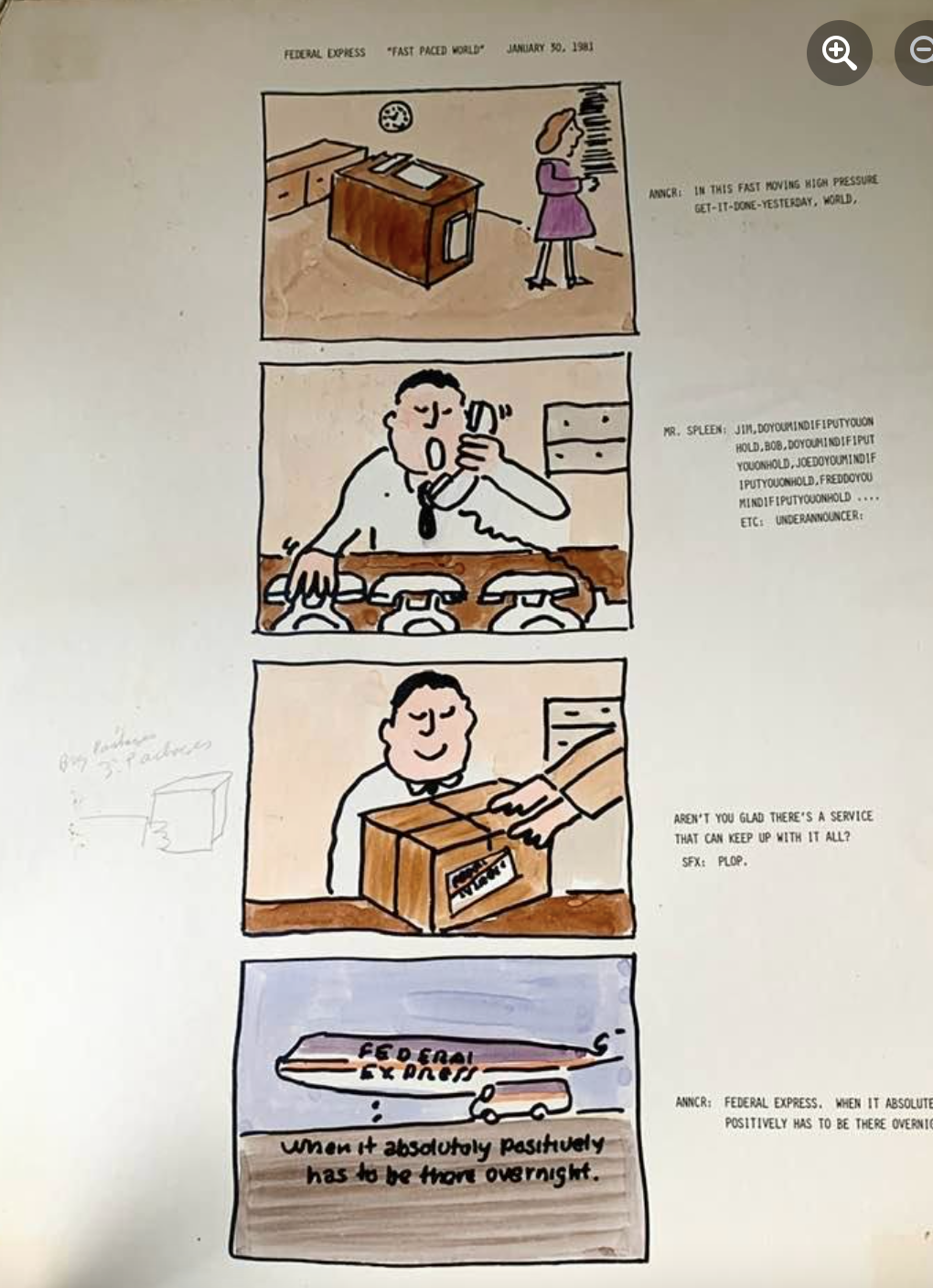
Mike was just about the most-famous person in advertising then. All those FEDEX and Dunkin spots and Hertz ads. And Pan Am. Advertisements with soul, truth, meaning.

Here's one of my favorites:


And another:

No one knows his name anymore.

Mike's widow Billie befriended me on Thursday. I went through her feed and pulled the pictures below.  I didn't put them in any sort of order because a creative mind like Mike's or a creative career like Mike's is most-often not linear. It's a chrysanthemum of exploding ideas like a misbehaving Fourth of July firework.


It makes me sad. Especially on the heels of the Cannes self-congratula-ton. And the presenter at Cannes who stole one of my ads and used it as the cover slide to a presentation of his. On creativity. Of all things.

Mike was mean at times. Hard. Threatening, though only 5'3".  Temperamental. Unpredictable even.

He burst into my office once. 

I was 30. 

I started sweating.

He showed me a marker comp he just did. A marker comp. McCabe had worked at Carl Ally and everyone had a love/hate with him because of his success at Scali/McCabe. 

Mike showed me his comp and said, neurotically, looking for affirmation from me. "I'm as good as McCabe." 

Borscht Belt beat. 

"And taller."