After two weeks in Italy, only working now and again, I am heading back to the various offices I am working in.
While away I was busy. Busy for three agencies. In fact, during our whole second week of time off, I had something impending hanging over me and my keyboard like the veritable sword of Damocles.
Had I full-time employment, I would have protested this crush. But when you're freelance--and a new freelancer at that--"no" should be eliminated from your vocabulary. You have to come through lest your phone stop ringing.
So, I got up early and worked and went to sleep late and worked. And I got things done, billing hours along the way.
I am four months into freelancing now and I can safely say I don't enjoy it. It's not that the money isn't coming in, it's the precariousness of every single day that gets to me.
I would suppose, perhaps with undo optimism, that if I continue without a full-time job, I'll get used to it, I'll learn to handle the capriciousness of the day-to-day. But for now I am in full nail-biting mode.
That's all for now.
I have to work.
Monday, July 14, 2014


Friday, July 11, 2014
Uncle Slappy on Art.

Besides, and truth be told, Uncle Slappy has, for virtually all of my 56 years, found a way to hand me a laugh or give me something to think about. Last night was no different.
I began our conversation by telling him we were headed to Milan today. Tomorrow morning, we're slated to see DaVinci's "Last Supper." In the evening we're going to La Scala to see Rossini's "Le Comte Ory." La Scala is the epicenter of world opera. It is to opera what the Colosseum is to lions, Yankee Stadium is to baseball and Penn Station is to the smell of urine.
"Hi, Uncle Slappy," I began innocently enough.
"Oy," he responded with more than a spark of alarm. "You're calling from Italy. Something's the matter."
"No, I'm just checking in as usual."
"From Italy, just to check in. You're a regular JP Moneybags."
"We're seeing The Last Supper" tomorrow, Uncle Slappy."
"The Lasr Supper," feh," he said. "If you want to see a masterpiece come down to Boca. I'll show you a masterpiece."
"Boca does have a fine art museum," I admitted. "But The Last Supper is considered the pinnacle of Western art."
"Pinochle or not," he continued, "You should see the painting Maury Abromovitz just hung in the club house, near the ping-pong tables. I'm proud to say, there's a likeness of me in it."
"Well then, it must be a masterpiece."
"Maury calls it 'The Last Nosh.' It's a bunch of us boys getting one last bagel and lox in before Passover."
"The Last Nosh," I repeated.
"Of course, no one rises from the dead."
"Of course not," I said.
"It's all I can do to rise and get the remote."
With everything now fully in perspective, he hung up the blower.
I thought, for more than a few passing seconds of bypassing DaVinci.
Thursday, July 10, 2014
Lake Como.
Yesterday we had the longest drive of our trip, from Rimini on the Adriatic, to the most beautiful spot I've ever seen, Montrasio in Lake Como.
In all we covered nearly 250 miles, which is a lot on the Autostradda, where you can't chill for a minute. It's worse, even, than the confluence of the Bruckner and the Cross Bronx--it's high-speed bumper cars. But we averaged 140 kph and made it here in good time.
My Alfa Romeo Guilietta is a fine little car with a good diesel engine and a six speed gearbox. We rattle a bit when we reach 160 kpg (roughly 100 mph) but we're ok at 140, and though the change oil light has been flashing the whole time, thus far the car has performed admirably.
Italian drivers seem to have a knack for driving at high-speeds precisely in your blind spot, and switching lanes and merging, etc. seems to be a blood sport, but all is well, in general and I am beginning to see the wisdom in driving like an Italian. Everyone stays alert and you move very fast.
Now a word about America's failed politics.
Unlike America, Italian roads are velvet smooth. There are no rough patches, no potholes, no litter, no fuss, no muss. Italians, unlike Americans, accept the power of the State to levy and collect taxes. They benefit in the form of trains that run and roads that don't look like the Vietnamese DMZ.
After over 1000 miles of driving, we have decided to chill today.
I am sitting under a high-cumulus cloud cover between the hotel's pool and the deep blue waters of Lake Como.
No ads need to be written today, so far anyway. No conference calls beckon. No day-rates to be billed.
Just me, sleeping, in the foothills of the Italian Alps.
In all we covered nearly 250 miles, which is a lot on the Autostradda, where you can't chill for a minute. It's worse, even, than the confluence of the Bruckner and the Cross Bronx--it's high-speed bumper cars. But we averaged 140 kph and made it here in good time.
My Alfa Romeo Guilietta is a fine little car with a good diesel engine and a six speed gearbox. We rattle a bit when we reach 160 kpg (roughly 100 mph) but we're ok at 140, and though the change oil light has been flashing the whole time, thus far the car has performed admirably.
Italian drivers seem to have a knack for driving at high-speeds precisely in your blind spot, and switching lanes and merging, etc. seems to be a blood sport, but all is well, in general and I am beginning to see the wisdom in driving like an Italian. Everyone stays alert and you move very fast.
Now a word about America's failed politics.
Unlike America, Italian roads are velvet smooth. There are no rough patches, no potholes, no litter, no fuss, no muss. Italians, unlike Americans, accept the power of the State to levy and collect taxes. They benefit in the form of trains that run and roads that don't look like the Vietnamese DMZ.
After over 1000 miles of driving, we have decided to chill today.
I am sitting under a high-cumulus cloud cover between the hotel's pool and the deep blue waters of Lake Como.
No ads need to be written today, so far anyway. No conference calls beckon. No day-rates to be billed.
Just me, sleeping, in the foothills of the Italian Alps.
Wednesday, July 9, 2014
Rimini.
We've spent the last two nights in Rimini, Italy, a booming resort city of 140,000 on the Adriatic coast.
When I was a kid, I had imaginative wanderlust, even though I never got to go anyplace. To satisfy my curiosity I would scour the oversized atlas that had been given to me as a gift. I would read the exotic names (anything's exotic when you come from gritty Yonkers) and dream of what those various places were like.
When my wife threw out the idea of celebrating our 30th anniversary in northern Italy, I again got out my atlas. Internet maps are great but they pale in comparison to the view you get from an atlas. There you can see the scope and minutia of where you're planning to travel. As I viewed my atlas, dozens and dozens of towns intrigued me. If we could only take a year, I thought, there are just so many places to traipse.
Rimini, for ridiculous reasons was high on my list. Primarily because Federico Fellini was born there and shot "Amarcord" there, one of my favorite movies. Our hotel, a decent place with clean towels right on the beach was on the corner, believe it or not of Vialle Amerigo Vespucci and I Vittelloni Avenue.
Imagine a street in America named after a great movie. Or even DW Griffith, or Theda Bara, or even, god forbid, Fatty Arbuckle.
We swam in the warm Adriatic. Visited the Republic of San Marino. And ate with gusto.
I for one thought of mad Uncle Teo.
Is he still up in that tree?
When I was a kid, I had imaginative wanderlust, even though I never got to go anyplace. To satisfy my curiosity I would scour the oversized atlas that had been given to me as a gift. I would read the exotic names (anything's exotic when you come from gritty Yonkers) and dream of what those various places were like.
When my wife threw out the idea of celebrating our 30th anniversary in northern Italy, I again got out my atlas. Internet maps are great but they pale in comparison to the view you get from an atlas. There you can see the scope and minutia of where you're planning to travel. As I viewed my atlas, dozens and dozens of towns intrigued me. If we could only take a year, I thought, there are just so many places to traipse.
Rimini, for ridiculous reasons was high on my list. Primarily because Federico Fellini was born there and shot "Amarcord" there, one of my favorite movies. Our hotel, a decent place with clean towels right on the beach was on the corner, believe it or not of Vialle Amerigo Vespucci and I Vittelloni Avenue.
Imagine a street in America named after a great movie. Or even DW Griffith, or Theda Bara, or even, god forbid, Fatty Arbuckle.
We swam in the warm Adriatic. Visited the Republic of San Marino. And ate with gusto.
I for one thought of mad Uncle Teo.
Is he still up in that tree?
Monday, July 7, 2014
Two nights at the Opera.
For the last two nights we have been have been in Verona, Italy, not New Jersey, a medium-sized city about an hour from Venice that is rich, storied and wonderful.
We centered our trip, really, around Verona, for here, for 100 years, they have a summer festival of Opera, held in a first Century Roman arena, the third largest surviving Roman arena after the Collosseum and El Djem, in Tunisia.

Saturday night, we saw "Turandot," by Puccini which, to my mind, is highlighted by perhaps the greatest aria ever sung, Nessun Dorma. It was also directed by Zefferelli, which didn't hurt. Last night we saw an over-blown production of "Aida," a modern version with storm-troopers, prisoners of war, mechanical camels, elephants and horses, and weird soldiers on segways.
Sitting on a balmy evening under the stars and hearing Opera in a Roman arena, well, it beats seeing Meat Loaf in the Meadowlands.
It's also interesting to hear and see the panoply of people and languages that fill the arena--each night the place had about 10,000 in attendance.
There are no planes that fly overhead to mar the sanctity of the performance. And Italians are reverent toward their Opera. Even the roar of motorcyclists disappeared once the music started.
When the music was up and the whole magillah was on, the stars came out, tiny and unassertive against a velvet sky. That was, nearly, perfection. The apogee of art, of engineering and of nature.
Not bad for a kid from Yonkers.
We centered our trip, really, around Verona, for here, for 100 years, they have a summer festival of Opera, held in a first Century Roman arena, the third largest surviving Roman arena after the Collosseum and El Djem, in Tunisia.

Saturday night, we saw "Turandot," by Puccini which, to my mind, is highlighted by perhaps the greatest aria ever sung, Nessun Dorma. It was also directed by Zefferelli, which didn't hurt. Last night we saw an over-blown production of "Aida," a modern version with storm-troopers, prisoners of war, mechanical camels, elephants and horses, and weird soldiers on segways.
Sitting on a balmy evening under the stars and hearing Opera in a Roman arena, well, it beats seeing Meat Loaf in the Meadowlands.
It's also interesting to hear and see the panoply of people and languages that fill the arena--each night the place had about 10,000 in attendance.
There are no planes that fly overhead to mar the sanctity of the performance. And Italians are reverent toward their Opera. Even the roar of motorcyclists disappeared once the music started.
When the music was up and the whole magillah was on, the stars came out, tiny and unassertive against a velvet sky. That was, nearly, perfection. The apogee of art, of engineering and of nature.
Not bad for a kid from Yonkers.
Wednesday, July 2, 2014
Thoughts on mushrooms and mortality.
I have been surrounded by the best food in the world and have indulged heartily in all varieties of things funghible. That is, I've been positively swilling in mushrooms of late. If I could find a funghi-flavored toothpaste, I'd probably have bought it.
All this fun with funghi reminds me, of course, of my grandfather, my father's father and Uncle Slappy's.
Morris Tannenbaum was shtetl born and raised and the youngest of six children and the only boy in his family. The Tannenbaums lived in the poorest village of the Pale of Settlement and were the poorest family therein. As such, it fell upon my grandfather, the poorest of the poor to be, for the whole shtetl, the mushroom taster.
Morris, being the lowest of the lowest of the low was the chosen one. The one whose tasting would confirm if a basket of mushrooms was or was not poisoned.
Each evening as people returned from the woods having picked their funghi, Morris would be called.
"Est," the shtetlites would say to my grandfather, "eat."
And he ate, sampling the mushrooms, tasting them to make sure they were not poison. And if they were, what was the loss? One Morris Tannenbaum--and untermenschen if ever there was one.
For this ignominious task, Morris would earn a quarter of a kopeck, or an egg, or a quarter of an egg if no one had a kopeck. And by these means, Morris, the poorest or the poorest of the poor, collected his small coins, until he walked one day across Europe, finding his way to Hamburg and a steerage fare on the Ptomania, which berthed in Philadelphia of all places, one cold day in November in 1913.
Fare paid for by poisoned mushrooms or not.
And grandfather Morris, whom I never met, I am sorry I am eating the mushrooms you swore you would never again touch. I am not half the man you were. I eat mushrooms without knowing what true courage is.
All this fun with funghi reminds me, of course, of my grandfather, my father's father and Uncle Slappy's.
Morris Tannenbaum was shtetl born and raised and the youngest of six children and the only boy in his family. The Tannenbaums lived in the poorest village of the Pale of Settlement and were the poorest family therein. As such, it fell upon my grandfather, the poorest of the poor to be, for the whole shtetl, the mushroom taster.
Morris, being the lowest of the lowest of the low was the chosen one. The one whose tasting would confirm if a basket of mushrooms was or was not poisoned.
Each evening as people returned from the woods having picked their funghi, Morris would be called.
"Est," the shtetlites would say to my grandfather, "eat."
And he ate, sampling the mushrooms, tasting them to make sure they were not poison. And if they were, what was the loss? One Morris Tannenbaum--and untermenschen if ever there was one.
For this ignominious task, Morris would earn a quarter of a kopeck, or an egg, or a quarter of an egg if no one had a kopeck. And by these means, Morris, the poorest or the poorest of the poor, collected his small coins, until he walked one day across Europe, finding his way to Hamburg and a steerage fare on the Ptomania, which berthed in Philadelphia of all places, one cold day in November in 1913.
Fare paid for by poisoned mushrooms or not.
And grandfather Morris, whom I never met, I am sorry I am eating the mushrooms you swore you would never again touch. I am not half the man you were. I eat mushrooms without knowing what true courage is.
Tuesday, July 1, 2014
Mantova. Once again for Andrew.
We woke early this morning before any of Italy was awake, unless there were farmers somewhere sowing their spaghetti crop. I fired up the Alfa, oil light still flashing, and we headed five kilometers to the richest town per square inch this side of Park and 73rd, Portofino.
There, we saw yachts that would leave a Rockefeller gaping, and each had a pignoli cookie approximately the size of my thumb nail for $1.50 each. After about 30 minutes, we felt sufficiently impoverished, paid $10 for parking in the town's only lot, and hit the winding road for Mantova, pronounced Mantua.
The road took us through the mountainous spine of Italy and a truck-filled industrial stretch that looked more like New Jersey than a $4 postcard. Finally after winding in and out of all those trucks at 140 kph, we made it to our hotel, an old farmhouse just outside of the 15th Century town.
The hotel, who knows why, wasn't open until 2, and we arrived earlier than our GPS had calculated, at 1. So I chucked the Alfa into reverse and somehow found the old town which loomed over the countryside like the witch's castle in the Wizard of Oz.
Sufficiently ignorant of Italian road signs, we roared into the old city and parked. We found out only later that there's a $70 euro fine for this indiscretion. We're hoping to enroll in witness protection sometime after we return our rental car.
We traipsed a bit through the town, cursorily taking in the Duomo, the Piazza and a few other sights, including of course the obligatory blind man with an English sign weakly playing an old accordion and asking once again of course for euros.
At one time, back in the 1600's, 8% of Matova's population of 90,000 was Jewish and housed in the ghetto, which was torn down once Napoleon's troops came through in the early 1800s. There are 150 Jewish families left in town.
I've thus far found the International New York Times.
But who knows if I'll sniff out a bagel.
There, we saw yachts that would leave a Rockefeller gaping, and each had a pignoli cookie approximately the size of my thumb nail for $1.50 each. After about 30 minutes, we felt sufficiently impoverished, paid $10 for parking in the town's only lot, and hit the winding road for Mantova, pronounced Mantua.
The road took us through the mountainous spine of Italy and a truck-filled industrial stretch that looked more like New Jersey than a $4 postcard. Finally after winding in and out of all those trucks at 140 kph, we made it to our hotel, an old farmhouse just outside of the 15th Century town.
The hotel, who knows why, wasn't open until 2, and we arrived earlier than our GPS had calculated, at 1. So I chucked the Alfa into reverse and somehow found the old town which loomed over the countryside like the witch's castle in the Wizard of Oz.
 |
| Empty countryside, then this appears. |
 |
| When it came to Churches, they didn't stint. |
We traipsed a bit through the town, cursorily taking in the Duomo, the Piazza and a few other sights, including of course the obligatory blind man with an English sign weakly playing an old accordion and asking once again of course for euros.
At one time, back in the 1600's, 8% of Matova's population of 90,000 was Jewish and housed in the ghetto, which was torn down once Napoleon's troops came through in the early 1800s. There are 150 Jewish families left in town.
I've thus far found the International New York Times.
But who knows if I'll sniff out a bagel.
Notes from Italia. For Andrew.
We arrived in Italy, in Milan, on Sunday morning at eight o'clock or so. Of course we were disoriented, having slept only fitfully on our eight-hour flight.
We rushed, as you do, through passport control and saluted to the well-uniformed and inattentive guards at customs and then hied to the rental car counter. There, we got a "free-upgrade" from a tiny Euro-car like a Fiat 500 to an Alfa Romeo Guilietta, a roaring sonofabitch of a coupe-like sedan with a six speed manual and a powerful diesel engine. Oh yeah, and an oil-warning light lit.
We roared down the Autostrada through the rain, down to Genoa, then through a series of small picturesque hill-towns because our GPS detoured us due to what it claimed was severe traffic. I have dreamed of driving an Alfa since I was a teenager and first saw Dustin Hoffman zoom with Katharine Ross in his red Spyder. My grey Guiletta did not disappoint. Though my wife of thirty years, lovely as she is, is no 1967 Katharine Ross. Who is?


And of course, I am no Dustin Hoffman. Though I steered our Alfa and we made it three hours later to a little town and a little hotel in Santa Margherita. We ate, as you do, and slept, and looked at the roaring sea which was still showing the effects of a storm.
Most Americans, with our scant knowledge of geography, have no idea of the various seas that subset the Mediterranean. Our town was on the Ligurian, a subset of the Tyrrhenian, of course which is an adjunct of the Mediterranean.
Yesterday, we travelled by small boat through Cinqueterre, stopping to swim in the bracing Ligurian off the coast of Monterossa.
We eat like kings, Ligurian kings, and sleep like Ligurian princes.
More as we head to Mantua.
We rushed, as you do, through passport control and saluted to the well-uniformed and inattentive guards at customs and then hied to the rental car counter. There, we got a "free-upgrade" from a tiny Euro-car like a Fiat 500 to an Alfa Romeo Guilietta, a roaring sonofabitch of a coupe-like sedan with a six speed manual and a powerful diesel engine. Oh yeah, and an oil-warning light lit.
We roared down the Autostrada through the rain, down to Genoa, then through a series of small picturesque hill-towns because our GPS detoured us due to what it claimed was severe traffic. I have dreamed of driving an Alfa since I was a teenager and first saw Dustin Hoffman zoom with Katharine Ross in his red Spyder. My grey Guiletta did not disappoint. Though my wife of thirty years, lovely as she is, is no 1967 Katharine Ross. Who is?
And of course, I am no Dustin Hoffman. Though I steered our Alfa and we made it three hours later to a little town and a little hotel in Santa Margherita. We ate, as you do, and slept, and looked at the roaring sea which was still showing the effects of a storm.
Most Americans, with our scant knowledge of geography, have no idea of the various seas that subset the Mediterranean. Our town was on the Ligurian, a subset of the Tyrrhenian, of course which is an adjunct of the Mediterranean.
Yesterday, we travelled by small boat through Cinqueterre, stopping to swim in the bracing Ligurian off the coast of Monterossa.
We eat like kings, Ligurian kings, and sleep like Ligurian princes.
More as we head to Mantua.
Friday, June 27, 2014
Last night in darkness.
Last night was one of those nights in New York. Sultry, muggy and deliciously wonderful.
My wife and I got tickets to see the New York Shakespeare Festival's production of "Much Ado About Nothing," in the Delacorte Theater in Central Park. For my dime you should see Shakespeare whenever you're able. He's kind of like the Ray Charles of playwriting--a genius, an institution, the guy who wrote the book on writing the book.
The play was delightful, with a brilliant cast highlighted by the surpassing Lily Rabe playing the variably bewitching and shrewish Beatrice.
But for me, a life-long New Yorker, the most magical moment of the night came just after intermission when the final act began in complete darkness amid a simulated thunderstorm.
The theater was completely dark, except for the spill from the Belvedere Castle and if you gazed skyward you could see stars over Manhattan.
Stars over Manhattan.
Beautiful. Wistful. Magical.
Their lightyears'-away-twinkle fighting, I presume, for a parking space below.
My wife and I got tickets to see the New York Shakespeare Festival's production of "Much Ado About Nothing," in the Delacorte Theater in Central Park. For my dime you should see Shakespeare whenever you're able. He's kind of like the Ray Charles of playwriting--a genius, an institution, the guy who wrote the book on writing the book.
The play was delightful, with a brilliant cast highlighted by the surpassing Lily Rabe playing the variably bewitching and shrewish Beatrice.
But for me, a life-long New Yorker, the most magical moment of the night came just after intermission when the final act began in complete darkness amid a simulated thunderstorm.
The theater was completely dark, except for the spill from the Belvedere Castle and if you gazed skyward you could see stars over Manhattan.
Stars over Manhattan.
Beautiful. Wistful. Magical.
Their lightyears'-away-twinkle fighting, I presume, for a parking space below.
Thursday, June 26, 2014
Resolute in the Tempus Fugit.
The weather last night sat on New York like a sweaty sock after three-hours of schoolyard basketball. It clung to everything with a moist stink that gave no quarter. Though I had the AC blasting in my apartment and the conditions inside were cool and dry, Whiskey nudged me awake at halfway between two and three and we headed uptown to the Tempus Fugit.
I hadn't been at the Tempus Fugit for some time, for a couple of months, actually. I wasn't turning abstemious. Nor was my lifelong battle with insomnia finally resolved, it's just that I've been excessively busy of late, and getting up to the place seemed an impossibility.
"Welcome," said the bartender as I descended the two steps into the place. "You have been conspicuous in your absence." He hustled around the bar and brought Whiskey a bowl of cold water. Back behind the bar he pulled me a Pike's Ale ("the ALE that won for YALE") and we began our evening.
I sipped slowly at the sweet amber, draining my glass and getting a refill before I responded.
"I have been busy," I answered. "And scared. Scared that the freelancing thing wouldn't work out."
"Ah, your confidence issues. Untrammeled by drink, drugs or years of therapy."
I laughed and finished my second Pike's.
"Well, it's tough hanging out a shingle after 30 years of working for others," I said. "Who knows if my phone will ring? Especially since I refuse to budge and lower my rates or my standards."
"The other day," he began "some kids found there way here, three of them, two girls and a guy, to the Tempus Fugit. I don't get many patrons who aren't regulars." He slid over a giant glass jar filled three-quarters of the way up with pickled hard-boiled eggs.
"Egg?" he said.
"You don't get many patrons period," I volleyed.
He continued, "They were, judging by the shortness of their shorts and their accents, German tourists. They asked for Pike's. They each sipped gingerly at their brew, putting their glasses down on the bar top after the slightest of sips.
"'Gluten frei?,' they asked.
"'Nein,' I replied.
"With that, they put an assortment of bills on the bar, shot me an 'auf wiedersehen' and that was the end of that."
"Your point eludes me," I said as he filled me again.
He slid over a small bowl of salted Spanish peanuts which, as usual, I pushed back at him. He then went around the bar, topped off Whiskey's water bowl and returned to his station.
"Ah, my point," he said, wiping the mahogany with a clean damp terry. "My point is simple. Be like Pike."
"Be like Pike. That should be my motto."
"Wear it as a frontlet," he continued. "Don't change with the times. Don't bend in the wind and certainly not in a breeze. Don't go gluten free because it's the thing to do."
"Well, it's easy for Pike's to stay the same. They don't make it anymore."
"They don't make anymore of you, either."
"They didn't just throw away my mold," I answered, "they nuked it."
I pushed two twenties across the bar in his direction. He shoved them back to me. This also never varies.
"On me, " he said.
And Whiskey and I walked home.
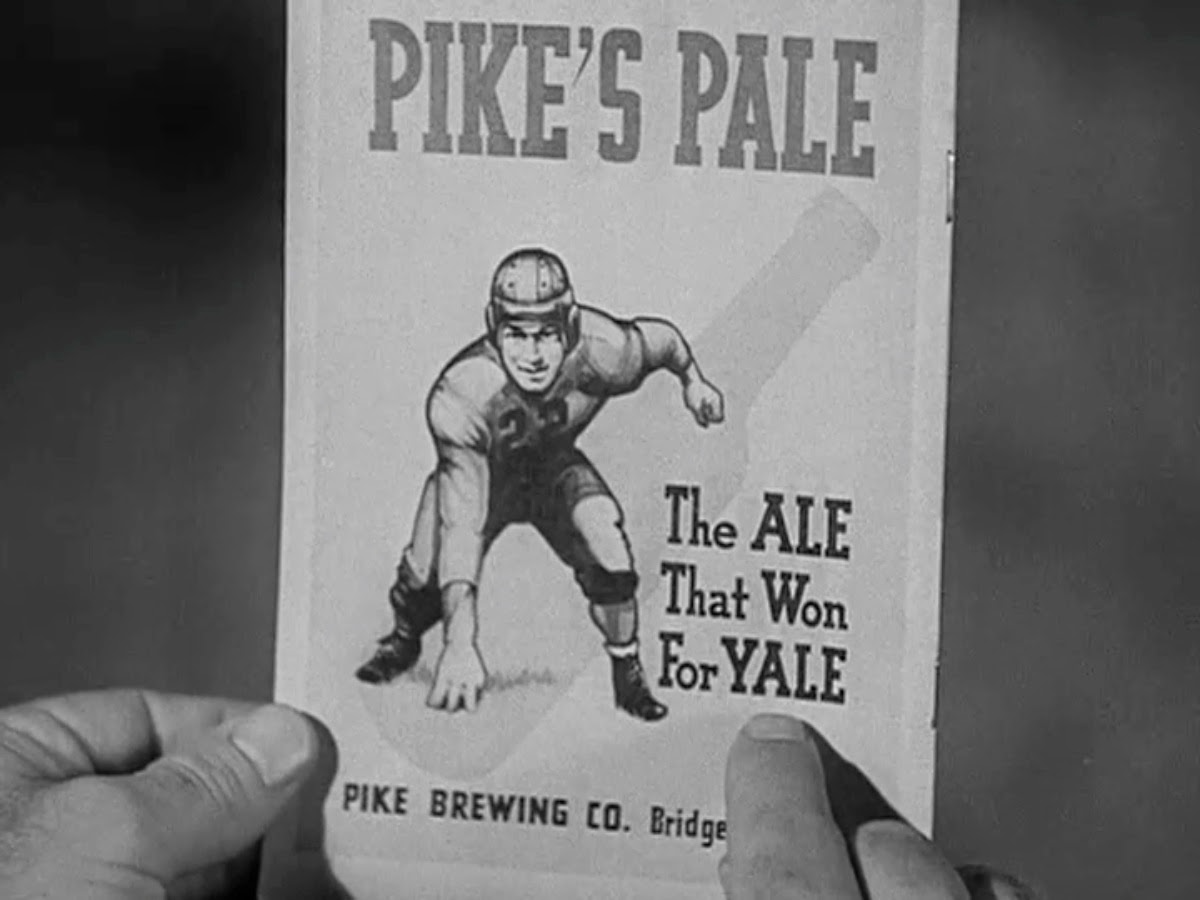 |
| Pike's, thank god, never varies and never withers. |
"Welcome," said the bartender as I descended the two steps into the place. "You have been conspicuous in your absence." He hustled around the bar and brought Whiskey a bowl of cold water. Back behind the bar he pulled me a Pike's Ale ("the ALE that won for YALE") and we began our evening.
 |
| There are still some kegs of Pike's scattered about. |
"I have been busy," I answered. "And scared. Scared that the freelancing thing wouldn't work out."
"Ah, your confidence issues. Untrammeled by drink, drugs or years of therapy."
I laughed and finished my second Pike's.
"Well, it's tough hanging out a shingle after 30 years of working for others," I said. "Who knows if my phone will ring? Especially since I refuse to budge and lower my rates or my standards."
"The other day," he began "some kids found there way here, three of them, two girls and a guy, to the Tempus Fugit. I don't get many patrons who aren't regulars." He slid over a giant glass jar filled three-quarters of the way up with pickled hard-boiled eggs.
"Egg?" he said.
"You don't get many patrons period," I volleyed.
He continued, "They were, judging by the shortness of their shorts and their accents, German tourists. They asked for Pike's. They each sipped gingerly at their brew, putting their glasses down on the bar top after the slightest of sips.
"'Gluten frei?,' they asked.
"'Nein,' I replied.
"With that, they put an assortment of bills on the bar, shot me an 'auf wiedersehen' and that was the end of that."
"Your point eludes me," I said as he filled me again.
He slid over a small bowl of salted Spanish peanuts which, as usual, I pushed back at him. He then went around the bar, topped off Whiskey's water bowl and returned to his station.
"Ah, my point," he said, wiping the mahogany with a clean damp terry. "My point is simple. Be like Pike."
"Be like Pike. That should be my motto."
"Wear it as a frontlet," he continued. "Don't change with the times. Don't bend in the wind and certainly not in a breeze. Don't go gluten free because it's the thing to do."
"Well, it's easy for Pike's to stay the same. They don't make it anymore."
"They don't make anymore of you, either."
"They didn't just throw away my mold," I answered, "they nuked it."
I pushed two twenties across the bar in his direction. He shoved them back to me. This also never varies.
"On me, " he said.
And Whiskey and I walked home.
Subscribe to:
Posts (Atom)