Monday, March 14, 2022

Bravely being brave.


About 39 times a day I hear someone, a client banging his own timpani, an agency chieftain trying to banal his way to unique, or a lowly creative person exhorting someone somewhere in advertising to "be brave."

I think that that's little more than spiritual cotton candy. Be brave. 

It’s bad for your teeth and soul. Fluff.

If an advertiser is brave, what's a test-pilot, or a fire-fighter, or even a single mother trying to juggle career, a kid's homework, attending recorder recitals while paying dental bills, the mortgage and trying to put something other than processed mac and cheese on the table. 

If what we do is brave, what people who cure disease or heal the sick or respond to 911 calls is positively Herculean. No, we have jobs to do. And very little of our jobs entail any of the behaviors listed above.

Let's downshift for a second to get closer to what I mean. Starting with George Orwell. Always a good place to start.

Orwell said, "In a time of universal deceit, telling the truth is a revolutionary act."

Let's start there.

Let's make ads that tell the truth--and by the very act of truth-telling zig when everyone else has spent their millions and billions on zagging.

Let's tell the truth.

At a time when our entire industry is talking about saving the world, teaching dolphins braille, and saving democracy by closing their non-revenue producing offices in Russia, let's tell the truth.

Truth-telling is not bravery.

It's human-ness. It should be the rule. Not the exception.

So, if I worked for Verizon: 

"How to decipher a 16-page bill made to confuse you."

"We say our network's reliable. Yet we seem to drop three calls in ten: some answers."

"We cut corners, planes crashed, hundreds died. What we're doing about it."

"Our cars sucked for 40 years. Here's how we're going to win you back." 

"We over-prescribed deadly opiates. We're spending $15 billion to start the healing.”

"We don't answer our phones and leave you without internet for days. Here are 15 things we're doing to fix that."

I'm tired of our industry doing things they should have been doing all along--treating people with respect, being honest--and calling it bravery.

I'm tired of the way our industry usurps perfectly good words and overuses them to the point where their very meaning is corrupt and sullied. Robust. Agile. Brave.

How about rather than saying, we start showing.

Show we're good by our actions and behaviors and our reporting of them. Let's tell the whole truth, not the Pangloss truth.

Maybe if we spoke more honestly, we could speak more quietly and with less bombast.

That would be brave.


Friday, March 11, 2022

The Mis-Answer Man is Back!


The Mis-Answer Man is here to mangle your pressing questions. Today's topic, "Are Lemon Squares a Passe Dessert?"

1. You fired me at the start of the pandemic. Can I assume you've forgotten by now and just start showing up?

Yes. We never paid you anyway. And your presence will save us from renting temps so prospective clients think our offices are occupied.

2. My boss calls meetings for no apparent reason other than he likes having people around so he can act important. Do I have to show up just to massage his fragile ego?

Yes. That is the very definition of your job.

3. The agency refrigerator hasn't been cleaned since before the pandemic. Should I still store my lunch in it?

No. Current holding company strictures no longer allow for employees to take lunch breaks. 

4. My agency has a "hot desk" arrangement and people are reserving places by leaving their masks as placeholders. What can I do?

Be happy your agency has hot desks. Most agencies are economizing by providing only room-temperature desks.

5. What about the psychological effects working at home has had on people? Loneliness. Burnout. Isolation.

We'll be having a smoothie bar in the office every fifth and seventh Tuesday of the month.

6. My agency wants us back three-days-week but that means I have to find full-time childcare what can I do?

You should get a part-time child.

7. Now that we're returning to the office, can I re-establish work/home balance by refusing to take late-night phone calls or respond to after-hours emails?

No.

8. I'm a perma-lancer and have been working exclusively remote, so no one knows how old I am. I'm afraid they'll cut me loose when they see I'm in my 60s. What can I do?

File for unemployment.

9. Now that we are together again, I'm worried about highly-charged face-to-face confrontations. How can I lower the tension level?

If someone confronts you just repeat, "that's not a best practice."

10. Since the beginning of the pandemic, I've heard a lot about the great resignation. What can management do to ease its effects?

Hire a raft of new C-level workers who have figurehead jobs and don't show up anyway.


Thursday, March 10, 2022

A story about stories.


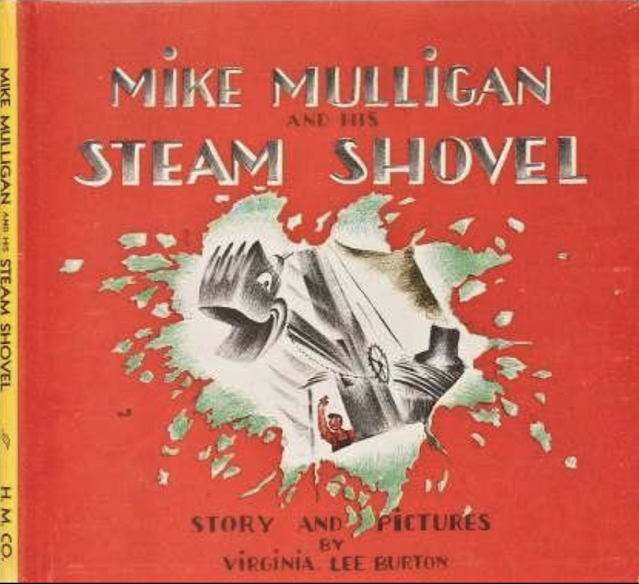
For 98.7 percent of my professional life, I never heard the phrase storyteller. In fact, I never heard it at all, except from maybe when I was in nursery school or my kids were and we'd have storytellers come in to tell us about Mike Mulligan and His Steam Shovel.
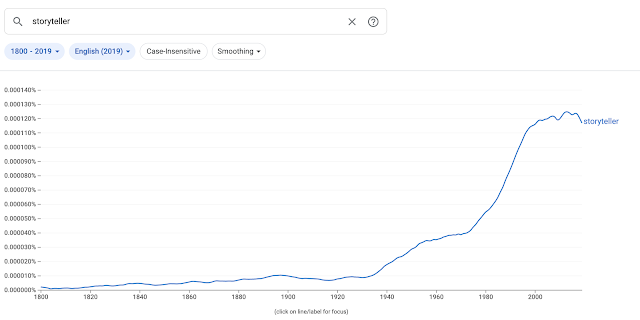

The explosion of the word Storyteller. (From Google nGram.)

But for about the last four or six years or so, everyone and everything has become all about storytelling. I think if you took every putative advertising person on LinkedIn and chose just the ones who described themselves as storytellers, you could quickly outstrip the population of China or India or both put together. Everyone is a storyteller and everything is about storytelling and great brands tell great stories and so on and so forth.

To my jaded ears, it all sounds like the next generation of teenagers who, almost invariably, think they're the first ones to discover sex. Well, the fact is, like sex storytelling has been around for as long as humans--approximately 200,000 years. And like sex, not everyone can do it and even fewer people are good at it.

I've heard UX people say they're storytellers. I've heard package designers say it. Even people designing signage in theme parks. It's a bit like advertising pompuspeople who call their commercials "films." No, my friends, Citizen Kane is a film. Shane is a film. Bad Day at Black Rock is a film. You make commercials.

OK. Enough of that.


About three months ago, as I do, I read a book review in The Wall Street Journal on a new translation and annotation of the centuries-old book of stories "The Annotated Arabian Nights: Tales from 1001 Nights," edited by Paulo Lemos Horta and translated by Yasmine Seale.

Here are the first two paragraphs of the review--the reasons why I immediately dropped lucrative client business and ordered the eleven-pound book. I've underscored bits from the review because I have some points to make.

"In an empire long ago there lived a king who discovered his wife sleeping with a palace slave. Crazed by jealousy he vowed that henceforth he would marry only for the length of a night and each morning his new bride would be killed. 

After he had carried out his wicked agenda for some time, Scheherazade, the brave daughter of the king’s vizier, demanded that she be the next in line to the royal bedchamber. 

During the first night she beguiled the time with a fantastic story, breaking off at a moment of high suspense as morning arrived. The king agreed to delay her execution so long as she took up the tale the following night—and the reprieve was extended again, and again, until, after one thousand and one nights, the king saw the error of his ways.

That is the premise of what may be the greatest treasury of stories in all of world literature, which have now been newly translated by Yasmine Seale in a gorgeous illustrated volume, edited by Paulo Lemos Horta, entitled “The Annotated Arabian Nights.” 

On display again is the spectacular panoply of storytelling, from tales of magic and wonder to murder mysteries to instructional fables to sexual burlesques. 

I began reading "1001" Monday night, starting with its almost 100-page forward by Omar El Akkad. According to both the Journal and El Akkad, 1001 is a story that is really about the importance of telling stories. After all, as in the review above, for Scheherazade, storytelling is quite literally a matter of life and death. 

If she is interesting, she lives. And thousands after her live.

If she is boring, she dies. And thousands after her die.

Booker Prize-winner A.S. Byatt says in the forward about 1001, “This story has everything a tale should have. Sex, death, treachery, vengeance, magic, humor, warmth, wit, surprise and a happy ending. ”

Like most writers--even those of us who toil in advertising--I believe in the power of stories. I've searched a lifetime and read and re-read foundation stories and the oldest and most seminal tales of Western literature, from the Iliad and Odyssey, to Gilgamesh, to Greek and Hebrew and Christian creation myths. 

I've scoured the Canterbury Tales, the Compleat Works of Shakespeare, Cervantes, Dante, Petrarch, Plutarch and more. I've looked at and thought about what makes a story over-arching and important.

And, after all that, I'm annoyed by so many people in the business who co-opt and thereby sully the notion of story when what they're really doing is slinging a spiel. Usually for a BOGO sale. Or a Pontiac Door Buster Sale.

I'm all for storytelling in advertising. Brands like Nike, Apple, even IBM, have established creation myths and every additional message they produce--when they're on brand--adds to that myth. Nike has created "You. The Athlete." Apple, "You. The creator." IBM, "You. The Thinker."

But not everything is a story. And not everyone is a storyteller.

With GeorgeCo., LLC, a Delaware Company, I'm running something more than just an agency. I'm helping brands find their story and even more important, helping them stay true to that story.

As above, in advertising we can learn from the great books. At the very least we can learn as Scheherazade learned.

Storytelling, whether you're a Vizier's daughter laying next to a psychotic king or someone guiding the fortunes of a brand in a dangerous and competitive world, storytelling is a matter of life and death.

Tell good, true, honest stories and you and your brands win.

As A.S. Byatt said, tell stories with "sex, death, treachery, vengeance, magic, humor, warmth, wit, surprise and a happy ending," and you won't have to shout at people, re-target them and cookie their every move.

Tell stories that are interesting and we live.

Don't and we die.


Wednesday, March 9, 2022

A numbers game.

Once again, she visits quite often, Dame Insomnia dropped by my queen-sized bed last night. Rather than toss about like a beluga whale in a tempest, to shunt her away, I opened up my Kindle app and plowed through to the finish of yet another book I was reading.

Reading for me is many things. When I'm on my high, hoity-toity horse, I call it my "restorative niche." I shut off the world--whatever is annoying me or oppressing me or chasing me like a Crusader after a heretic--and I escape to second century Rome, or a pirate ship laden with chopped chicken liver, or into the protozoa that eventually grew into life, as we know it, on this dying planet. 

Reading is also a competitive edge. I'm averaging, during these benighted Dark Ages 2.0 days, more than a book a week. And despite the pointed allegations of my wife that I read the non-fiction equivalent of an Archie Double Digest, or the barbs from other friends that I read the same book about the Holocaust over and again, I read eclectically and somehow--whether I'm reading about Josiah Wedgewood, "the Radical Potter," or life when the world was lit only by fire, I find lessons and guidance for life today. 

Reading is like carrying around various geniuses as friends. I have discussions, glean perspectives and I am given prismatic lenses that allow me a view of the world that lets me look at everything through little refracted bugs' eyes. I don't accept anything. I try to look at things in as many ways as my brain can. And if that's not the definition of training yourself to be a creative thinker, I don't know what is.

Five decades ago when I was a sullen teenager, as opposed to a sullen old man, my father phlegmed to me, "the world's smartest people read The New York Times' book reviews." That got me into a habit that abides to this day--when there are no bookstores. Adding to it, along the way, The Wall Street Journal's excellent book section, and the dozen or so reviews a week friends from around the world send me. 

In fact, I challenge you to do the same. Try it for a week. If you're not, after a week, a more thoughtful, less compliant, more subversive and interesting person, I'll refund all the money you spent for this advice.


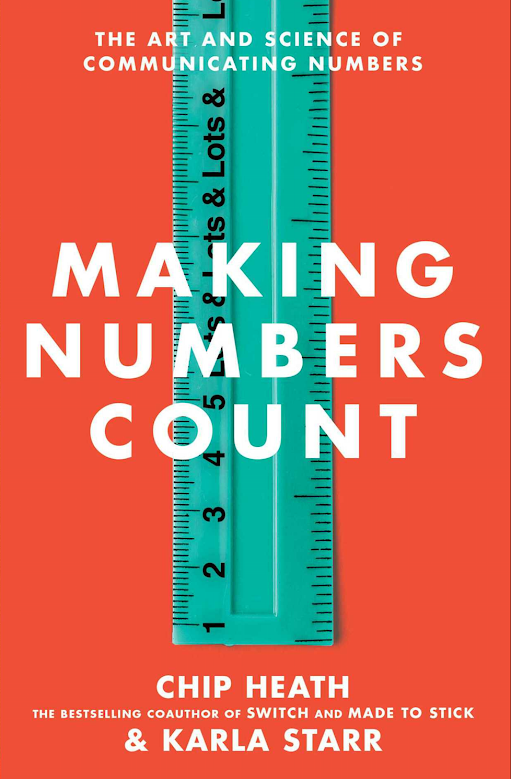
The book I read last night was "Making Numbers Count: The Art and Science of Communicating Numbers," by Chip Heath and Karla Starr. You can read, if you can elude the pay-wall police, a review from The Wall Street Journal here.

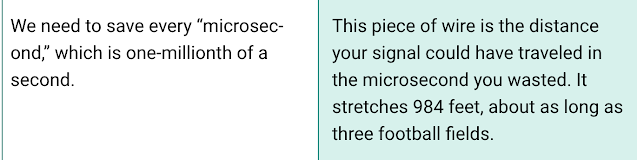
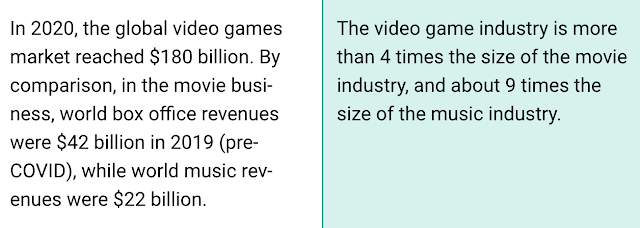
Here are just five simple examples from a book filled with dozens. Each one is about making information interesting, exciting, memorable and usable.


I'm glad I read Heath and Starr's book. But I'm sorry it was 200 pages, not just a 12-page article in the Atlantic, the New Yorker or Highlights for Kids.

I'm sorry that we have to have entire books that essentially say something we should have running through our veins. Especially the veins of those of us in the advertising and marketing and sales or any customer-facing pursuit. Like I said, I read the book in one sitting, but I can rewrite it in two words. Two words I think the entire communications world has fundamentally forgotten.

1. Be.
2. Interesting.

I remember back when Volkswagen's advertising was the best in the world going to the New York Auto Show at New York's piss-stench hulking Colosseum--where a pre-fab, day-light blocking trumpmerkinmallhighrise intrudes today. It must have been 1973 or 4 because it was the year the "Super Beetle" was introduced to America and the first time I saw amber turn signals.

A spokesman was showing a small crowd the turn signal. "It shines amber to stand out," he said. "And it has a special relay so the signal turns on the moment you flick it on."

OK. Big deal.

"You might not think that's important, but a conventional turn signal can delay turning on for a second. At 60 miles per hour a car moves 88 feet in a second. So our turn signal can turn on 88 feet earlier."

I don't know why that's stayed with me almost 50 years. And I don't know why we no longer, in our industry or anywhere else, work hard and respect readers and their intelligence enough to do that sort of elementary mathematics.

When you think of how many times you hear from verizon how reliable their network is and how little it registers--it's because no one at that giant company or its affiliated agencies is thinking about making a claim that's memorable. So, they cut and paste one for the billionth time.

When I worked on IBM servers, they often claimed to be reliable to an industry measure called five-9s. That means their servers were up and running 99.999-percent of the time.

OK. But what does that mean?

It means out of the 31,536,000 seconds in a year, your server will perform flawlessly for 31,535,684 seconds. It will need attention just 316 seconds a year, about 8/10ths of a second a day--roughly six blinks of your eyes.

You don't have to be a double-dome to do this math. It wasn't that long ago Hal Riney for Alamo said, instead of free miles, "there are over eight million miles of roads in Alamo country, and all those miles are free."

Or Dave Dye created this one. Nothing about awards, borderless creativity, working at the intersection of bull and shit and the seamless interplay of 9200 offices in 348 solar systems.

Just a focus on a compelling fact presented in a compelling manner.

i.e. be interesting.


Tuesday, March 8, 2022

Some writer shit.

Not too many years ago the great writer, Robert Caro, took a break from writing volume five of his giant biography on Lyndon Baines Johnson to publish a book called "Working." Like virtually everything Caro does these days, the publication of something by Caro gets almost as much attention--at least in some rarefied circles--as Kim Kardashian getting a new ass-injection.

As you'd guess, "Working" was about how the famously precise and thorough Caro (winner of two Pulitzer Prizes and two National Book Awards) works. Not only did I read the book the moment I could get my hands on it, I twice went to hear Caro speak about his book, his career and his discipline.

I'm an advertising writer who has an antiquated view of what advertising can do. That view is based on having been raised on the work of Doyle Dane Bernbach, Ally & Gargano, Ammirati & Puris and Scali, McCabe, Sloves. The best work of those great agencies was based on facts. Their work wasn't adjectival or about flourishes, filigree, decoration and style for style's sake. There was no room for any sparring or dancing. The best of it was a punch between the eyes that you felt in your heart.

As he did so often, Carl Ally said it best, this time whenhe coined the mission for his agency: "To impart useful consumer information in an executionally brilliant way." Bill Bernbach had his spin on essentially the same notion. He believed that the best advertising was "based on simple, timeless, human truths."

[My list above, by the way, is very American--because though I'm a great fan of the greats of English advertising, Hegarty, Abbott, CDP, Trott, I don't have very good recall of their wisdom. Bernbach was the progenitor of all this, so of course I've memorized his words. I worked at Ally & Gargano, and hold words emanating from that agency as a shibboleth.]

Back to Caro.

An ad written by David Fowler.


I read this from his book working. While at Ogilvy, I published it in this space, and my great co-worker David Fowler ran over to my desk to give me a spiritual hug. 

It's a good feeling when you discover you're not alone. 

Caro's line is this, it comes from his first journalistic experience, when he was working on his school paper at the Horace Mann School in the Bronx: 
“I always had this desire, and I don’t know where it comes from, to find out how things work and explain them to people.”

To find out how things work and explain them to people.

On first blush, this belief may work better for technologies or cars or banking products. Complicated things that are more rational and thoughtful than, say, M&Ms or frozen pizza or hair gel.

That caveat is fine, if that's the way you want to be. But I think that interpretation is parochial. The best candy advertising, for instance, Starburst or Snickers, really talks about what those silly multi-billion brands do for people.

The line is relevant to almost all communication. Not just Quantum computers, the hybrid cloud or a braking system.

My guess is if you respect people, you'll find out how things work--everything from diapers to the soul of a company--you'll take the time and do the work and explain why.

Every day--yes, every day--I hear about 90 million voices seemingly in unison swearing to make everything from Swiffer to room-freshener part of culture. 

It might cost me business to say this aloud, but I don't even know what becoming part of culture means. My culture isn't your culture and I've yet to buy a car, tv, computer or a pair of jeans that's a part of culture. Or spent $500 for a pair of tickets to view the culture of Tropicana orange juice in a special performance at Lincoln Center.

I run an agency now.

I'll leave integration with culture to someone else.

If you have a garden tool, a shelving system, a security technology, I'll explain them to people. Not so they become engineers. But so they want your product.

That's what this is about.

Convincing the mind so you love with your heart.


Monday, March 7, 2022

Thinking about doing


The freelance world--the agency world--is competitive. And when something is competitive, I aim to win.

The good people in advertising, or any other walk of life, are like that: they want to win. The best people go a step further. They want to win without being assholes.

Since I entered the freelancer/independent agency market I had a simple theory. To succeed against all the hundreds of other freelancers out there, I had to do something to stand out. I realized with my large LinkedIn network, I could create little ads for myself. I wouldn't exactly be selling off the page, but if I were lucky, I'd make myself known and be one of the people people thought of when they needed help.

I've been running these little ads with some regularity. It's been 778 days since I was fired at five in the afternoon, eight hours after everyone else in my "firing class" was canned. In those 778 days, I've probably run 200 ads.

That means I wrote 200 ads.

That means I wrote 200 ads that I considered good enough to show me off. Which means, I wrote 1,000 or more that sucked.

That's 200 ads in addition to my not inconsiderable client work these very ads have helped me get. And the rewriting, the billing, the chasing, the hondling, the hocking and the haranguing that comes from running a business. That's 200 ads in addition to having written approximately 550 posts during that time in this space.

Recently, I decided to take about 81 of my 200 ads and make a  book out of them. It's free if you have the temerity to ask for it.


It's either a coffee table book or a book you spill coffee on. Whichever comes second.

I sent a copy to my old Ogilvy boss by email with a subject line that read: 81 ads.

He quickly wrote back.

"I"m slacking. I've written only ten headlines today. How do you do it?"

I've been thinking about agencies and their lack of productivity, or surfeit of cobwebs since I've been a senior creative. So for about the last 25 years.

When I was the head of a giant beige monolith in Boston, I had a radical idea. I noticed that my highest paid creative people--presumably my best creative people--had no time to actually create. They were in meetings from early in the morning until fairly late into the evening.

I tried to designate Friday as a meeting-free day and I was almost booted out of the building. Can you imagine? I wanted my best creatives to spend 20-percent of their time creating. That got me regarded as a radical, the John L. Lewis of ad game.

When I worked with the boss I mentioned above, I'll call him Steve, we had a relationship based on mutual respect. I'd say further that we shared an understanding of our essential strengths. When I gave copy to Steve, I would always print it out so he could carry it around and read it like a PhD. student might read a manuscript.

In a short while, Steve would come down to my table with my copy marked up. There'd be a question or two. A comment. A reordering of words. But all the mark-ups were only suggestions. Thoughts, not edicts, that I could accept, think about, improve upon or reject as I saw fit.

I'm getting, eventually, to Steve's question, "How do you do it?"

Since I've been out on my own--two years and two months, I've done more work than I've done in any previous twenty-two years.

I don't have meetings about work.

I don't have meetings about meetings.

Then meetings about the effectiveness of meetings about meetings.

As odd as it sounds to even to my cauliflowered ears, GeorgeCo., LLC, a Delaware Company has been based basically on two things.

1. Deep self-appreciation. Be kind to yourself, to the people you work with and the work you're asked to do. If you bring deep self-appreciation to the table, you abide by your standards--even raise them.

And, 

2. Trust. Trust that you've done right by the job, the client, your craft, and yourself.

Trust cuts down on nit-picking, perseveration and second-guessing.

That gives you the time you need.

To do a lot of work.

That's how I do it.


Friday, March 4, 2022

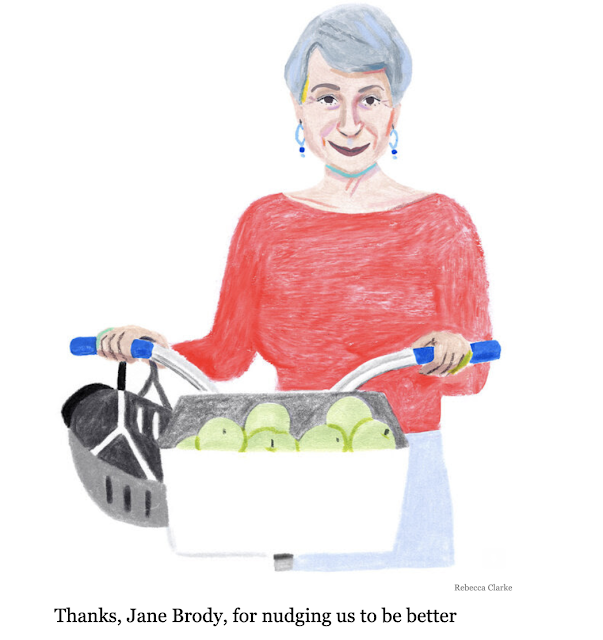
Jane Brody and us.


My wife of almost 38 years and I have been voracious readers of The New York Times for well over half a century. That's not an exaggeration. In many New York households like the ones we grew up in, The New York Times was ever-present. In some, like the one I grew up in, the "paper" paper, which arrived at our front-door every morning, was literally fought over. 

God forbid someone wanted the Sports while someone else was doing the crossword. Or someone was reading a theatre review while someone else was reading the business section. The Times and its legendary writers became part of our lives.

One of those legendary writers was Jane Brody. Brody started writing the Health column in the Times way back when Gerald Ford was president, in 1976. My math says that means she wrote the column for 46 years and for the Times for 57 years.

Late last month, Brody retired. You can and should her last column here. If you're interested in really good writing, you owe it to yourself to read it and maybe save it.

Late last month, another Times writer, Tara Parker-Pope wrote a farewell tribute to Brody. There was a bit in it that made me think of the advertising industry--and what our real purpose is as advertising practitioners. 

Parker-Pope writes, "Jane was among the first journalists to recognize that better health doesn't happen in the doctor's office--it's rooted in the small decisions we make every day....

"In fact, when Jane first interviewed at The Times in 1965, she told managing editor, Clifton Daniel, that she thought the paper's science coverage fell short of serving its readers.

"It doesn't go far enough," she told him. "It doesn't help people live better lives."

Over the last 12 years or so, I've compiled a list of newspaper articles where complicated things are dissected and then explained, simply and entertainingly, to readers. 

Newspapers do this. But agencies don't, can't or won't. We don't have the expertise, the time or the talent. And I think the line I underscored above makes all the difference.

Our business has demeaned itself and destroyed any trust/esteem it once had by selling--only selling--to people, and usually shouting while doing it.

It's led me to conclude that newspaper journalists are ahead of advertising creatives in serving their readers. 

Simply because they hold to the belief that they are helping people live better lives.

By that I don't mean the bushwa purpose so many advertisers engage in to assuage their egos and whitewash or greenwash their iniquities. 

I mean, it's time for us--the ad industry--to recognize that what we sell is important to people, and therefore, even something as dopey as a hamburger or a credit card should be presented as something that actually serves you in some way.

If it's a burger, it's made out of better meat.

If it's a car, it's safer, or lasts longer.

If it's a telco, it's more reliable and attentive.

If it's a cloud, it provides better tools, access and security.

If you offer nothing better, and you're not helping people live better lives, what's the point?

Find something better. Then advertise.


Thursday, March 3, 2022

Milestones.


As I enter my third year running GeorgeCo., LLC,  Delaware Company, even though I started GeorgeCo. after more than forty years in the advertising business, I've learned a few things. In fact, I think it's honest to report that I've learned more about advertising in the two years I've been a soul and sole proprietor than I did in the forty years I was working for others.

You have to learn. The same way I'd have to learn if I were to survive Armageddon. I'd have to learn things I'd never learned because they had always been done for me. As I like to say, working on your own is like walking a tightrope without a Net 30.

Along the way, I've hit some milestones. Some I've bounded over. More where I stubbed my toe and wound up with some gnarly nails. The trick is trying to learn no matter what.

The first milestone I passed is how important it is to slog. I had no years where everything I touched turned to gold pencils or gold heads or gold lions. I had many more years where I worked and worked and worked. Where I did the hard work of making work, of listening to clients and helping them build their business. Work can be joy. But it is also work. And anyone who thinks success can come without sweat was either born a billionaire or delusional or both.

For me, my dedication to the slog reaffirmed my belief that agencies are agents. That we stay behind the spotlight and work for the greater good of our clients not for our own glorification and aggrandizement. I don't care what's au courant. I work for my clients today--I guide them and I push them and I challenge them. But I never forget I do it for them. 

I promote myself, you have to. But I spend 98.7-percent of my brain muscle working for my clients.

Early on, I disappointed a client. That was milestone number two. They were pleased with my first round of work but felt the second round made the work worse, not better. I learned that sometimes you fuck up and fucking up is ok. I redid the work for the client, without extra charge, and I made them happy. I still work with that client today.

Once I heard Steve Hayden say to a client, "If we hadn't had that failure, we might not have this hit." 

I passed my third milestone when I had a prospective client bark at me. He wanted me to evaluate his website and give him feedback on how I would re-write it. 

After all my years in the business, I gave that task the time it deserved--ten minutes. (I wasn't being paid.) The prospective client accused me of 'phoning it in.' I barked back. "Just as a realtor can look at your house and immediately evaluate why it's not selling, I can do the same with your site. It doesn't take a professional a long time to size up a problem." 

Thank goodness we decided not to work together. Milestone three--is easy. It's having enough respect for yourself to allow yourself to work only with people who love you and trust you.

Milestone four came for me when I encountered a dickweed of a client who decided to try to stiff me out of $54,000. It's not unusual for clients to act as if they're Goliath and you're lowly David. They're big and you're small and therefore they have the right to push you around.

This is where you learn the importance of impeccable record-keeping and airtight contracts. Oh, and also having a brother who's one of the world's top attorneys. 

Of course, they had no cause for not paying me, except somebody probably spent my money on an illicit girlfriend or at the racetrack. Or just because they wanted to throw their weight around. Or because they could. And of course, there was no apology. But there was a lesson underscored. And a lesson learned. If you get the gut feeling that a client is an ass, go with your gut.

Oh, and maybe I learned this from my Bronx roots. When shoved, shove back harder.

Milestone number five came when I learned to go not only with my gut but with my sinew, as well. A lot of times you get assignments that seem obtuse and ill-defined. 

When you're working in an agency, nominally, there's an infrastructure of people around who can make things clear. Or clearer. Planners to clarify. Account people to calm you. Cohorts to defibrillate your synapse. When you work for yourself it's just you, your brains and your typing fingers. Work and work and work and work until you work the problem out. 

Labor omnia vincit, the Romans said. Work conquers all.


Milestone six came when I began to learn how to charge. If you've spent your life in the ad industry, you've seen the agency's sense of its own worth crumble. We compete on price, like a used car dealer, and to my old eyes it sometimes seems that the holding companies are in a race to the bottom.

You've lived through layoffs, salary freezes and a greater and greater share of agency revenues dedicated to supporting higher-ups who have somehow convinced themselves, shareholders, the Internal Revenue Service and most of the agencies they control that their shit don't stink. Their pay has gone up. If you're old like me, yours, at least in real dollars, has probably gone down. 

Learn your worth. Not with a sense of entitlement or aggrandizement or hued by an over-inflated ego, but according to the value you--and only you--can provide. In Manglehattan, where I've lived for most of my life, plumbers charge $450/hour, an Ivy-League lawyer $1,000/hour, and a top McKinsey consultant about the same, and one of trump's hookers, considerably more.

This is the biggest, most important milestone of all. Not just learning your self-worth, having the composure to demand it. When someone balks, take a breath, turn on your heels and say, "I'm sure you can find someone at the price you're willing to pay."

Now:

To the couple of dozen of clients and handful of colleagues who have helped me learn these things over the past two years, and to a friend, far-away, who is thinking of going freelance and who, thereby inspired this reflection, thank you. 

Thank you for teaching me.

Even more, thank you for trusting me. 

And for letting me come through for you.


Wednesday, March 2, 2022

The practice of theory.


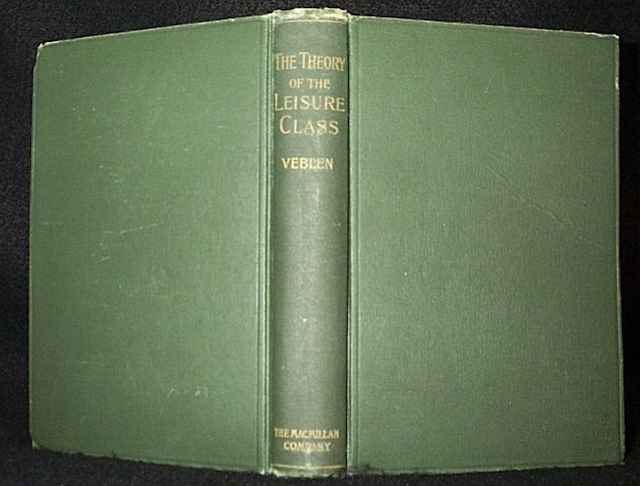
I have to believe most people, even people as old as the oceans like me, don't know who Thorsten Veblen was. Nor do they know of his important book, "The Theory of the Leisure Class."

Way back in 1899, the Norwegian-born University of Chicago professor Thorstein Veblen wrote that ground-breaking study and critique of "consumerism" and capitalism. I don't know how academia regards Veblen today or his book. But I'd imagine it's just one more of those many volumes that people cite and never quite get around to reading. Like the Magna Carta or the agency handbook or the constitution if you're a republican.

Just a few moments ago I read, as I frequently do, an obituary in The New York Times. To my field of synapses, it never fails to amaze me how frequently you just happen to find something major when you're not looking. It's the openness of your mind that matters, not your hunting ability. Things actually find you. That's why, I think, so many special people have messy desks. The art of searching leads to the epiphany of finding.

The obituary I'm talking about, which you can read here, tells of the life of David Boggs, 71, whom the Times calls "The Co-Inventor of the Ethernet."

I'm not a tech guy, but the ethernet, to my humble brain, makes much of what we call "digital" possible. The way I understand it, Boggs' ethernet makes it so we could transfer data across networks. It helps parse data into packets and transmits those packets either through wires or wirelessly. The ethernet assumed that some packets would be lost along the way, but somehow--don't ask me based on my cursory reading to explain this--because of redundancy, the show and the internet would go on.

If you're reading this now (how's that for stupid) chances are Mr. Boggs' technology ideas have something to do with that. The ethernet essentially made the word legible.

Here's the thing in the obituary that really got me. The life lesson I got from reading about someone elses' life. 

In the early 1980s, Mr. Boggs took the stage at a California computing conference, to discuss the future of networking. A

technologist from a rival company to Boggs' questioned the mathematical theory behind ethernet. He claimed it would never work with a large number of machines.


You get a lot of that kind of aggressive doubt in advertising and marketing today. You'll be told something you wrote isn't emotional. Or it's too emotional.


Someone will rap your knuckles and say that there isn't a logo in the first four seconds. Or the URL isn't up long enough. Or the Kars 4 Kids pink guitars are the wrong shade of fuchsia. Or it won't get 'engagement.'


There are plenty of theorists who theorize about how to create work and where to propagate marketing messages. They'll produce decks as numerous as leaves on the trees and swear up and down those trees that if marketers only would only follow their baroque theories success would be theirs. They, almost tautologically, reject the marketing things that work and have worked for marketers since time began. That is impactful, artful,

intelligent, persuasive and ubiquitous work is really the only thing that works. In sum, make something good and run it.


But creativity--in practice--is almost always trumped by theory.


I call that, apologies to Mr. Veblen, the Leisure of the Theory Class. It's borne by people who criticize, but they don't make anything. They are the gurus of our industry who seem to preside over people like me, a g(u)runt.  

And somehow, someone at volume will question whatever you're proposing. And they'll have the theory to assert it won't work. Theory is always right because it has nothing to prove and is always right--look, I've proved it on paper. If a theory is wrong, you merely amend it and propose a 2.0. Or in the case of the Web itself, a 3.0. Which will be built with no more privacy, security or acuity than any previous version. 


When Boggs was told his ethernet wouldn't work, he had the perfect, unequivocal response. A response we should all store for further use.

"Seems the ethernet does not work in theory,” Boggs said, “only in practice.”

-


About 100 years ago, I wrote two ads a week for a large retail bank in New York. An industry friend often talks about how he did the same for a group of restaurants.


There were no theorists around in those days. 

There was something smarter: people with experience, judgment and taste.


They would say, "run that ad. And that one."


Then when the ads ran, you either saw a lot of people in a lot of bank branches or restaurants or you didn't.


We wrote ads. We didn't theorize.

We weren't smart enough for that. 


Tuesday, March 1, 2022

Embracing science.


I finished a book on Friday evening that, like most books I devour, got a good review in either "The New York Times" or the neo-fascist "Wall Street Journal." For all the darkness that has descended upon our planet--from the death of liberal democracy, to the destruction of our planet, to the dilution of the very meaning of the word truth, we are in the midst of a flowering of really great books.

Each month, the aforementioned newspapers publish index-card length reviews of a dozen or two dozen new books that I can't wait to get my mitts on. While many of these books have absolutely no bearing on my life--they won't help me save 32-cents a week heating my home, or find peace and tranquility in a world that seems arrayed against me, or find a way to have a comfortable retirement on the coast of Portugal fo $13,750/a year, I read them because they massage my brain. 

That is, they make me think.

I was taught algebra in the 1970s by Mr. Adolph Nelson, who was already two or three hundred years old when sullen, teenage George slouched his hypotenuse off in his hormone rife classroom.

This being the early 70s, Mr. Nelson said things to his students--repeatedly--that would have him canceled and gutted and kicked out of the teaching profession, and probably the state, today. I remember him dressing down a kid called Joey Flashner for being a painful combination of lazy and dim.

"Joey," Mr. Nelson would croak, "Scientists say your brain gets creases when you think a lot." (98-percent of New Yorkers have good comic timing. It's in the water and Mr. Nelson was no exception. Therefore, he paused.) "If that's the case, your brain must look like a cue ball."

The class calmed down about twenty minutes after that and we went ahead, as most humans do, solving for X.


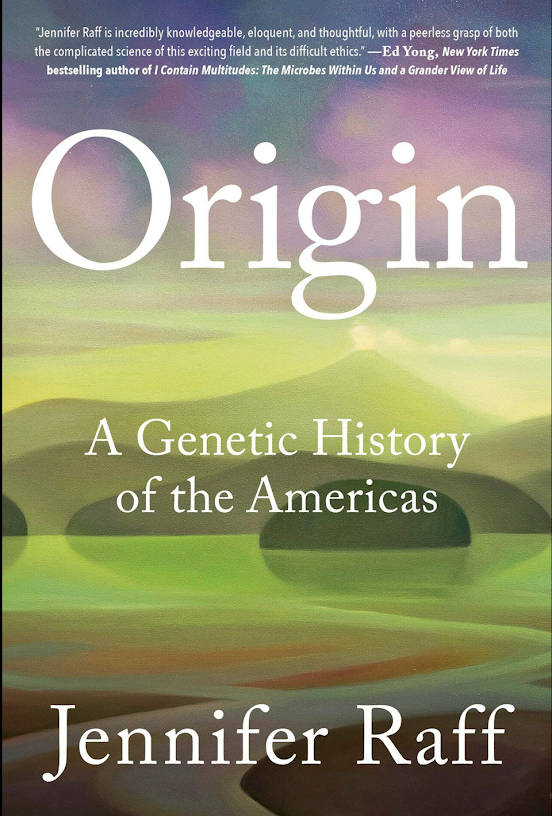
I read "Origin: A Genetic History of the Americas" based on just a handful of words from the New York Times review: "The Kelp Highway hypothesis." Kelp Highway. I had never heard of that. And since the lord kelps those who kelp themselves, I was intrigued. The hypothesis is the idea that the first peoples of the Americas dated not from about 15,000 years ago--as has been believed for at least a century--but from 30,000+ years ago, and spread from Alaska to Chile to Greenland by small boats along the life-sustaining kelp highway.

I know the kelp highway has nothing to do with advertising, but it does get my brain crevicing.

But here's the advertising point today, since according to my membership in Local 1232, Bloggers, Cranks and Crackpots, I'm required to have an advertising point.

Here it is: If science isn't careful it works like this: "We used to think, but now we know." Advertising, when it's not careful, works similarly. How many meetings start with, "that's the way it was, now it's like this?" Whether they're talking about digital trends, changing consumers, media, creativity or process.

We used to think, but now we know.

What science, advertising and life are really about is this statement: "We used to think, but now we think."

In other words, life is about constant learning. It's about challenging your perceptions. Finding different ways. Trying. Experimenting.

Just as there is no one true god, there is no one true way. There are very few--if any--if-then propositions in life, and very little genuine causality.

That's why I read books that make no sense.

They help me find new ways of looking at things.

They help remind me of the importance of questioning everything. Especially know-it-alls and the bombastic.

At least that's what I think. 

Right now.