Wednesday, October 19, 2022

Feathers and Ruffles.

Back in my earliest days in the business, making an ad wasn't that different from how it was done during the Napoleonic Era. 

On my formica desk, I had a rubber cement gluepot with a 1/2-inch brush. I had an old IBM typewriter--not a sleek Selectric II. I had oaktag sheets of layout paper where we would plan the design of a catalog page. And I had copy paper in triplicate with character-count measured on the horizontal axis and lines measured on the vertical.

I made up a rule right then and there--way back in the waning days of the Jimmy Carter administration. I didn't trust copywriters who didn't have ink on their hands. 

Today, even though we work in digital pixels not in natural forms, I still abide by that, perhaps Old Testament, imprecation. Even though there is--it seems--no ink anymore, I don't trust copywriters without ink on their hands. Even if that ink is merely metaphorical.

By that I mean, very simply and very austerely, I don't trust copywriters who don't write. Further, I don't trust copywriters who don't burn with words and the need to write them down and express their ideas.

During my last year at Ogilvy, I became enamored with one such writer: Debra Fried. 

In fact of all the 6,000+ posts I have written in this space, Debra is the only one besides me to have written more than one. This space is her tabula rasa. She can cavort here anytime.

Alas, Debra has no need for this space.

Because she has just inaugurated her own blog. You can leave this decrepitude and find hers here.

I learned from Time "The Weekly News Magazine," that every company or product or movie should have a single-line epigram that defines inviolably who they are and what they do. I recommended Debra do the same. Here's hers: 

A blog about clothing and life, but not in that order.

I'll say one more thing about Debra and tie it to an old baseball legend. 

Lou Gehrig, a better player, sent Wally Pipp to ride the pine.

When Debra wrote her first piece in this space she was Lou Gehrig to my Wally Pipp. 

Pipp was the Yankee's first baseman for a decade. He had a headache one day and Gehrig substituted for him. And surpassed him. And became a hall-of-famer. And played 2,130 consecutive games--fourteen straight seasons--without taking a break.

The outpouring of acclaim for Debra's first post overwhelmed this humble space like a tsunami washing over a Charlie Brown Christmas tree.

All that to say, get thee to Ruffle. 

But visit me once in a while as well.

I'll miss you when you don't.


Tuesday, October 18, 2022

Deep Self-Appreciation.


The world of working for yourself is a more challenging world than working for a company. No matter if that company is large or small.

At least it has been for me.

Because working for yourself--more so than other kind of work--is a constant struggle for self-belief, and in believing in the value of what you do. Despite all your natural and unnatural fears and self-doubts.

When you work for another entity, you have a value and a station and a salary band assigned to you. You can add to it, increase your worth, but there is always an outside arbiter who is the ultimate judge of how much you get paid, what your title is, which meetings you get invited to, and so on and so on.

When you work for yourself, all that shit is up to you.

And if you're at all neurotic (and what creative person isn't?) you have to fight with your demons. The demons that tell you you suck. Or that your day rate is too high. Or that your work wasn't good enough. Or that you'll never work again. And everything you've ever done and every connection you've ever made somehow counts for nothing.

Learning your worth is, to be as reductive as possible about it,  what life is all about.

If you grew up as I did, an abused child, you start life with at least one foot in a bucket. Most people never remove their foot from said bucket. 

As Henry David Thoreau said, most of us, "lead lives of quiet desperation and die with their song still inside them."

That song, by the way, goes like this: 

No one is like me,
No one can do what I can do.
You'd be lucky to have me,
If you don't know that, screw you.

When you don't value yourself, when you don't work on your DSA (Deep Self-Appreciation) that's the song that stays unsung inside you.

I lost two jobs last week.

Both in a soul-crushing manner.

One of them, I was told I was too expensive. Though the person who recommended me for the job is arguably the most-powerful woman in advertising and on the board of the company I was to work for. 

Even though I was to position their company and write speeches for their CEO, I was asked to lower my fee. Which I did. But apparently not enough. So they went elsewhere.

Rejection stings. Maybe worse under these circumstances,

The other one involved an ex-client. I did all the work, then they decided they didn't need it and asked me to cut my fee. 

If I didn't believe in myself, I'd have had my tail between my legs and been looking to apologize. Instead, I said to them, :I did the work. I expect to be paid. Period. You can't order a pizza, change your mind and expect not to be charged."

I'm getting paid. I spoke to procurement today. A little less than we had originally contracted for--but I still came out ahead. As you should when you work hard.

What have I learned from all this?

Get paid.

Get paid.

Get paid.

Don't work for less than your worth.

Charge for every hour.

And, most important, remember they're not doing you a favor giving you work. You're doing them a favor helping them out.

It's taken me 64 years and ten months to learn this.

I wish I had learned it sooner.

But maybe I wasn't ready.

I'm ready now.


Monday, October 17, 2022

Of Rats and Gods.

There's a famous quote by a Yale professor, a man who was once called America's most notable architecture critic, Vincent Scully. No, not the baseball announcer.

How it started:


How it's going:


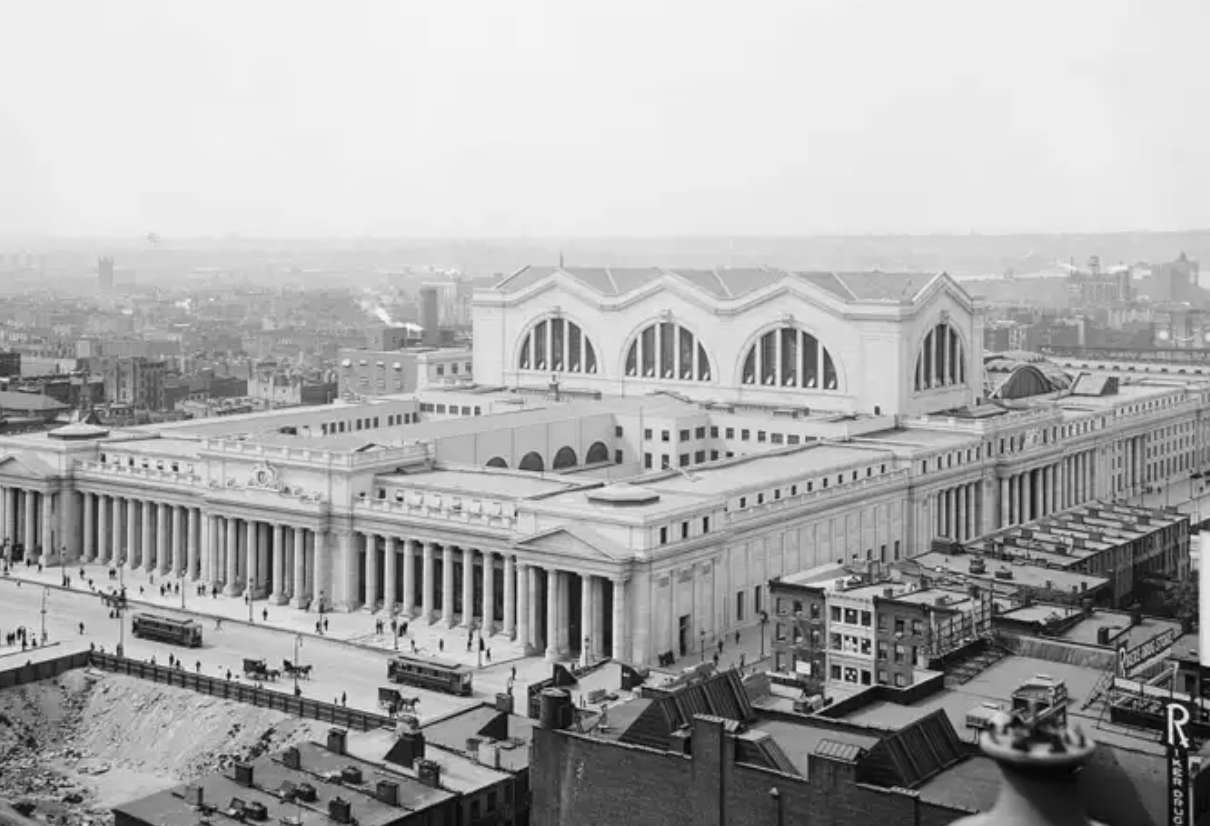
When Penn Station, the Beaux Arts masterpiece was torn down in the early 1960s and replaced with a low-ceilinged tangle of urine-stained, toxic linoleum, Scully said "One entered the city like a god; one scuttles in now like a rat."

I was talking to a copywriter friend who isn't far from my age. These conversations are a bit like parachute jumps. After a few seconds, you pull the rip cord and start talking about how bad the industry has become.

It's horribly au courant today, for the "media" to decry the work ethic of nearly everyone and blame a generational, or societal lassitude for offices not being able to get people to come back. No one takes a second, or even a millisecond to consider the semiotics of the offices we're meant to come back to.

And I want to run up the page a few inches.

And think about the difference between entering an office and feeling like a god or scuttling into the office like a rat.

The rodentification of work--the tasks assigned, the nonsense of technocratic-timesheet-sphincter-twisting, the ugliness and the clangor of where you sit, the ass-end-of-Manhattan location of your office, the general decrepitude of the physical plant and the non-working wireless and on-again-off-again photocopiers, and so on and so on makes workers--that's you and me--feel like rats.

In the words of Nobel Prize-winner Bob Dylan, we have the subterranean homesick blues.

Semiotics matter. When you treat someone well, they perform well. If you treat them like rats that feel like shit.

Back to my conversation with my friend of a certain age. 

When we started in the business, offices were a competitive edge. They attracted people. Agencies competed with each other based in part on looks. You felt good about where you worked. You brought your friends and family to see.

Similarly, even as a junior, you had your own office. With a door. With your own space. With walls where you could hang an ad you were proud of or a picture of your significant other. It was your sanctum. It's where you were at home and where you had belonging. 

It's hard to believe that all that's been stripped away in the modern holding company oligopoly--and with a whimper not a bang. 

It's hard to believe that when you're so under-considered that you're stacked in an open-space with no privacy and no "place of your own" that you're supposed to respect the place that so disrespects you.

Back when I was at Ally & Gargano, our offices were designed by the architecture firm of Gwathmey Siegel Kaufman. You literally felt "chosen" to work there. 

Here are two other agencies designed by Gwathmey Siegel in the late 80s. 

Imagine.

McCann.


And D'Arcy (now, roughly speaking Publicis.)


I don't really care about aesthetics.

But I do care about how people are treated.

Treat them like rats, they'll return the favor.

Treat them like gods, you might not have 40% attrition rate.


Friday, October 14, 2022

The Books of George.

Except for Jeopardy, I don't watch TV at all, not even sports. Up here on the Gingham Coast of Connecticut, I rarely meet people for drinks or dinner. And outside of walking Whiskey, my golden retriever, and taking her swimming in the turbid waters of the Long Island Sound, I have no hobbies.

I'm not going to build a model schooner in a bottle, or plant tomatoes in the backyard, or put down new paving stones in our driveway. 

I get two hours a day, what my therapist of thirty years, Owen, calls my restorative niche. In those two hours, I remove myself from my woes and pressures and feed my head. 

I do that by reading.

For all the "anti-enlightenment" darkness in the world today as we careen toward a combination of autocratic or theocratic rule, the number of great books available at about the price of a latte or two is burgeoning. I spend a lot of time reading book reviews, and now that I have made the move to digital books, I have no space issues--nothing to stop me from buying five or more books a week.

I'm sure there's a German word for people who amass books they'll never read. But there's still ooomph to be gained from having them, even if you haven't the time to read them. In fact, I've renamed my reading-mania "hanging out with geniuses a couple hours a day." I feel it serves me well, even if a lot of what they bring to me is over my head.

I thought today, I'd give brief descriptions of some things I've read lately, that I think you, dear reader, and the world would gain by reading.


1. You must read "Solito" by Javier Zamora. It's a harrowing memoir of a boy, just nine, and his 2,000-mile trek to escape an American-propagated war in El Salvador to reunite with his parents who have already made it to America. 

It's way too acceptable to call humans "illegals." Too many call them "rapists and murderers," and other racist trumpian xenophobic smears. It's way too easy to ignore the American-fed wars and colonial economic exploitation and attribute the etiology of poverty and make it the fault of the poor and voiceless. 

Please read this book. The world would be better if everyone did.

2. "One Hundred Saturdays: Stella Levi and the Search for a Lost World," is in an odd way a wonderful companion-piece to "Solito." Stella Levi grew up in a 600-year-old Jewish community in Rhodes (a part of Greece) until the Nazis arrive and send her entire world of 1,700 towns-people 2,000 miles to their death camps. The book, illustrated with about a dozen paintings by Maira Kalman, is Levi's journey, her survival, her finding a place in a world where her place was stolen from her.

Both Solito and One Hundred Saturdays are about that most human of quests. The hunt for home. And the trauma of having none.


3. There's a lot in the news today about the "threat" from China and the looming global war over what we in the west call Taiwan. If you're my age (god forbid) you might remember the carnage of Vietnam. Ronald H. Spector's "A Continent Erupts: Decolonization, Civil War and Massacre in Postwar Asia, 1945-1955," is a long and head-grinding book about the upheavals in Asia at the end of World War II. 

My own education and upbringing and orientation raised me to be myopically Eurocentric in my world-view. A Continent Erupts is a necessary corrective. You'll find yourself, for instance, reading about seminal conflicts and shaking your head and wondering, "how did I miss this?"


4. Lloyd Llewellyn-Jones' "Persians: The Age of the Great Kings," is another such corrective, this time looking to emend typical Western ignorance of the great Persian civilizations dating back to Xerxes and earlier. Our bias usually pits the barbarian "Easterners" against the enlightened democratic Greeks at Thermopylae, a jaded view of world history if there ever was one. Truth, of course is neither as black and white or as limited in scope. If you want to see a region of the world you know little about--without current Islamophobia--Persians is worth the effort.


5. Speaking of Persians, I highly recommend Paulo Lemos Horta's "The Annotated Arabian Nights: Tales from 1001 Nights," translated by Yasmine Seale. Of all the hundreds or thousands of book reviews I've read in my life, Sam Sacks' review from the Wall Street Journal, might be to most positive I've ever seen. I can't really sum up Scheherazade in just a few sentences, but I can quote Sacks' review.

"In an empire long ago there lived a king who discovered his wife sleeping with a palace slave. Crazed by jealousy he vowed that henceforth he would marry only for the length of a night and each morning his new bride would be killed. After he had carried out his wicked agenda for some time, Scheherazade, the brave daughter of the king’s vizier, demanded that she be the next in line to the royal bedchamber. During the first night she beguiled the time with a fantastic story, breaking off at a moment of high suspense as morning arrived. The king agreed to delay her execution so long as she took up the tale the following night—and the reprieve was extended again, and again, until, after one thousand and one nights, the king saw the error of his ways.

"That is the premise of what may be the greatest treasury of stories in all of world literature...  On display again is the spectacular panoply of storytelling, from tales of magic and wonder to murder mysteries to instructional fables to sexual burlesques. But also contained in this heaping volume is the history of how the tales coalesced, a story every bit as intricate and engrossing as those that enchanted the mad king."


6. One of the best books I've ever read about the modern economy, "The Radical Potter: The Life and Times of Josiah Wedgwood,"  by Tristram Hunt traces the rise and rise and rise of Wedgwood china, perhaps the world's first globally-traded luxury good. Not only will you learn a lot about "influencer marketing," (Wedgwood first sold directly to nobles--once they bought his wares, everyone else did, too) you'll also learn about craft and design. 

Finally, you'll learn of the fall of Wedgwood, thanks to the pernicious influence of investment bankers who essentially bankrupted the company, moved manufacturing to Thailand, and destroyed its workforce while using Wedgwood's not- inconsiderable revenue stream as their personal ATMs.

That's all for today.

I'll do this again, if'n y'all liked it.

Read.


Thursday, October 13, 2022

The First Time I Was Called 'Grandpa.'

The first time I was called Grandpa I was the creative head of a shitty 200-person agency down on Spring Street in New York. Either the worldwide chief creative officer or the CEO decided I wasn't cool enough, so they brought in from the LA office a thirty-something creative and made him co-head of the New York office with me.

Immediately, he set out to bury me.

Not by doing better work.

Better work is hard. So why bother.

He made sure it wasn't about better work.

His way of getting ahead was via character assassination. "George is old." "George is a traditional ad guy." "George isn't into skate culture, or gaming culture, or hip-hop culture."

One day in a meeting to my face, he called me "grandpa." This is fifteen years before I became a grandfather in real life. 

Frankly, it was about five years before I ever even entertained the notion of me being seen as old. 

As this blog bears out, I have enormous amounts of energy. While my hair has greyed at the sides, I'll pop out of a cab faster than anyone, run up the steps at full gallop, and I'm usually, when I worked in the office, the first one in and the last one out. And the one to handle the gnarliest of assignments and client snags. As Reggie Jackson once said, "It ain't bragging if you can do it."

Nevertheless, grandpa-ism worked its magic.

About six months after this person arrived, I was out on my not inconsiderable keister.

In short order, I got a better job at an agency that was then considered the hottest in New York, if not the entire country. But, because I was 'needy,' I accepted a job that was beneath my station in terms of scope. 

Soon, I started hearing that agency's version of "grandpa." Essentially, it was said that I was just playing out the string. That I didn't want too much to do--just run my business and go home at a decent hour. 

They got away with saying, essentially, "He's 52. To him it's just a job. He has no greater ambitions."

In each of the cases above, I should have clanged a set of cymbals and made a stink. 

The same sort of etiology emerged at my last agency job. I was under the thumb of people less experienced, less hard-working and less knowledgeable than I. But it was assumed I accepted vassal-hood because I considered myself too old to keep pushing the rock up the hill. I was too old to have ambition.

In the Diversity Equity and Inclusion schema, ageism gets very little play. 

When I and four other senior creatives were fired from Ogilvy, WPP CEO Mark Read said we "harkened back to the 80s." That was code for basically saying, "they're old."

If five people of color were let go and Read said, "they harken back to the deep south," he would have been excoriated in the press and would never have worked again in any industry. 

However, calling old people old is perfectly acceptable. In fact when WPP runs a chart that shows that few than nine-percent of their employees are over 50 (25-percent of the population is) there are no consequences for that blatant discrimination. WPP publishes essentially the same progress-free pie-chart every annual report. With impunity.

I don't understand why prejudice of this sort, why prejudice so inculcated in the "culture" of so many organizations is endorsed by the management of those organizations, their shareholders and worst of all their clients, but it is.

You can treat people badly, ignore their human-ness, insult them to their face, pay them less than what they're worth and there are no consequences.

I'm happy to discuss this with any agency leader or holding company leader at any time.

Y.Z.O.M. 

(Your zoom or mine.)

Wednesday, October 12, 2022

Copy That.


I got a call late last week from a Fortune 50 company. 

Not the kind of call a one-person agency usually gets.
No matter how large it is.

That's ok.

Without being too unduly arrogant, I'd put my copy department up against any other agency's copy department. 

No matter how large they are.  

Or where they're located.

After 42 years in the business, after being "chosen" by some of the biggest names in the business, I'm finally coming into being on the edge of the brink of the cusp of the precipice of beginning to get close to believing in myself.

This client asked me to re-write, to "George-ify" about twenty pages of copy. 

They need it by Friday.

Only thing is, I wasn't allowed to start until I got an ok from procurement.

My experience tells me that the richer the client, the more impossible it is to get an approval from procurement.

No procurement, no money.

You learn that along the way, too.

Procurement approved my proposal 72-hours after they said they would. 

That fast.

That meant I had 72 fewer hours than I needed to do the work.

But like I said, Fortune 50 company.

So even though the client's "deliverables" list was as vague as a republican plan for universal healthcare, I got to work.

The first thing I do, always, is organize my copy deck.

I make a cover sheet.

A table of contents.

Any copy that needs to be written I create a page for. 

I number the pages.

I choose a font and typesize and create a style sheet. How I'll handle headlines, subheads, etc.

It's good when you're under pressure to create a grid you can organize your creative into.

Then instead of worrying about what you have to do and how much is hanging over your head, you see the blanks you have to fill in.

I'd rather say, "I have nineteen pieces of copy to write," than "I don't know what I have to do."

Knowing is better than not knowing.

If I have nineteen pieces, that means each time I complete one, I've knocked another five-percent from the total. If I do six before walking the puppy that's thirty-percent. If I write two more before lunch, I'm up to forty-percent. Five more before dinner, I'm two-thirds done.

Around that point, I usually call the client.

Can we talk tomorrow afternoon around four? 

I'm not done at that point, but I have a deadline and I have to be.

That's called sticking a firecracker up your ass.

It stinks but it works.

I didn't really need this work. I was plenty busy without it. But work begets work and work is a force that gives me meaning.

Besides, a Fortune 50 company.

So I jammed.

I used all my faculties to get it done.

To do it well and get it done.

I can't say it was fun. 

Or that the money was particularly good.

Or that I enjoyed the experience.

But ninety-nine times in a hundred work isn't a tiptoe through the tulips. It's a flamenco through a minefield.

That's ok.

As the old joke goes, a man sees someone repeatedly banging his head against the wall and he asks, "Why are you banging your head against the wall?" 

The man replies, "Because it feels so good when it stops."

Sometimes work is like that.

It feels so good when it stops.

Tuesday, October 11, 2022

Misty Water-Colored Memories of the Way We Were.

I tripped over a quotation the other morning by the non-Nobel-Prize-winner Czech writer, Milan Kundera.

The sentence is so important that you have my permission to copy it, use it as a screen-saver and even, if you still nominally have a functioning memory, to memorize it.

You might even want to spend three minutes between your invidious and mindless meetings to think about it.

The quotation--and excuse the gendered-ness of Kundera's pronoun choice, is this: "The struggle of man against power is the struggle of memory against forgetting."

A reductive way of rephrasing that (since I have the temerity to re-write Kundera) is this: Those who control memory, control the world.

That, my friends, is today's struggle to be human condensed to fortune-cookie length. If you own the narrative, you own the world. Silencing those who buck up against the narrative--firing them, stripping them, silencing them, beating them is a good way to become king. Or autocrat.

While it would be simpler to talk in grand political terms here, or in terms of American history, I won't. 
Instead, I'll focus on what I know best--the struggle against power in the advertising industry.

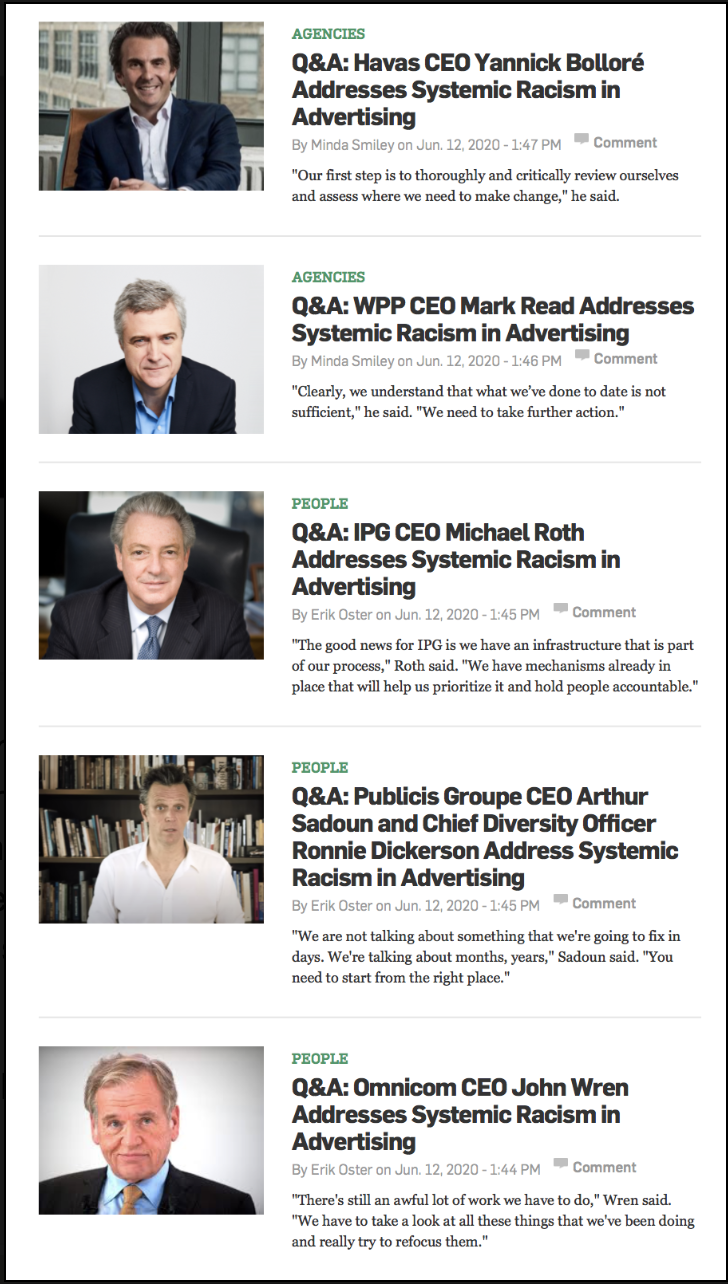
Power in the advertising industry today rests in the hands of four or five older white men. No judgment about their age or complexion. Just facts.

These are the four or five older white men who routinely take home $20 million + annually, probably for life. 

About once-or-twice a year, they and their proxies (the agencies they control) issue proclamations about the importance of Diversity, Equity and Inclusion. They even capitalize the words to show how much they care.


A little over two years ago, all five were interviewed in the trade "press," on what they're doing to address "systemic racism in the advertising industry."
You can read my post about it here. (Since I published that post, Michael Roth has retired and he's been replaced by Philippe Krakowsky.)

My two cents re Kundera are that the Holding Company leaders above are hoping we forgot about all their pledges. They don't like memory.

I wrote at the time a plea for Diversity, Equity and Inclusion accountability. I asked:

1. Will any holding company reduce its investment in awards shows, spending that money instead on diversity efforts until equity is achieved?

2. How much is each holding company spending on DEI?

3. How many Diverse employees do they have per salary band?

4. What is their DEI retention rate?

5. What is the median salary of DEI employees? Are they paid wages that would allow them to live in the cities they work? 

6. Who qualifies as Diverse? Does it include age? Is it based on background or solely on "race"?

Now let's shift to another facet of memory and forgetting. The idea that holding companies help agencies grow.

What happened to these agencies? A list from my memory of once 100-600-people-businesses that were bought and, in the parlance of South American political prisoners, "disappeared"?

Hal Riney.
Scali McCabe Sloves.
Needham Harper and Steers.
NW Ayer.
Levine Huntly Schmidt Beaver.
Della Femina, Travisano.
Geers Gross.
Geer DuBois.
McCaffery McCall.
Lord Geller Federico Einstein.
Ally & Gargano.
SSCB.
Lintas.
Ted Bates.
Benton & Bowles.
D'Arcy McManus Masius.
Rosenfeld, Sirowitz.
Kenyon & Eckhardt.
Leber Katz.
Calet Hirsch.
DKG.
Saatchi & Saatchi.
Dancer, Fitzgerald & Sample.
Cliff Freeman.

The Holding Companies, in the nearly complete absence of  investigative reporting and therefore accountability, have washed all these "mergures" (merger + failure = mergures) away. 

There is no one to report on loss or gain of revenue, employees or any bona-fide calculus of business success.

Memory is destroyed.

Power cannot be combatted.

Hell. Meet handbasket.

Don't forget who controls your career.


Monday, October 10, 2022

An Essay (and Assay) of Technology.


Just about every day there seem to be ten articles or seven about the self-driving-car future. Most of these articles involve some sort of technological mishap. A traffic tie-up or a fender-bender due to misbehaving microchips, or something else. 

Maybe it's happening all the time and because there's no "man bites dog" story involved it doesn't become news, but I've yet to hear a single item about commutes being materially shortened, cities becoming decongested, mobility being greatly improved or deliveries becoming more efficient and less expensive.

Likewise, I've heard one-hundred and three thousand stories about Web 3.0, the Metaverse, crypto-currency and microwave popcorn, and I've yet to land on any real advantage any of these disruptive technologies will deliver to my day-to-day life.

If you said to me, driverless cars will reduce transportation costs, pollution and congestion by 30-percent, I'm in.

If you said, Web 3.0 will eliminate surveillance capitalism, privacy exploitation and lessen the smoggy presence of digital exhaust, I'd say, 'sign me up.'

But these things get trotted out and sold hard without anyone letting you in on their great advantages.


Even at my advanced age, if I was quietly working out in the backyard and had somehow developed the "double-S-reverse-rising-sinker pitch" or a "twisker," like the great hurler "Popeye," I could easily gain a major-league tryout. Because I'd be able to do something better than it can currently be done.

Today, I don't know where all the better is.

I see the same thing in advertising, I'm afraid.

I'd guess that about seventy-percent of ad dollars today are being spent on channels that didn't exist when I entered the business 42 years ago.

They're using technologies small minds like mine can't even conceive of.

And here's the thing, for all that newness, I don't know where the better is.

I'm not better informed about products. I'm not more aware. I'm not more amused. And there's hardly a product, person, service or company that I don't think creeps out of the muck of the ninth ring of mercantile hell like the creature from the black lagoon.

That is most of the messages I do see make me hate the companies that put them out there. Not because I am anti-advertising but because I am anti-advertising that insults my intelligence, my taste, my dignity and my right to my all-but-vanished right to privacy.

We've invented a lot of new.

We haven't invented any better.

This is the giant cosmic plotz of our modern age.

Old guys like me know what works.


With no media expenditure, no as in zero, this dopey ad got my company's name almost 45,000 impressions in less than one business day.

This long-copy ad got almost 70,000 impressions.*****

Do I employ social strategists? Technologists? Programmatic presdigitators? Do I need a battery of consultants to plan this shit and then monitor my every minute to make sure I do it, then have 44 meetings to discuss what I've created?

No.

I don't have to reinvent anything new.

I only have to do what's worked in communication since our species became bi-pedal. 

When we stood on two feet that led to our vocal chords descending down our trachea. That repositioning gave us the ability to utter a range of morphemes and phonemes other species couldn't replicate. Over time we assigned meanings to them. Eventually, words, language and writing systems were formed. 

These were new technologies 100,000 years ago, or 50,000 years ago, or 10,000 years ago.

That's what I do.

I take all those technologies and write something funny and bold. I hope it hands you a smile. 

Then I hope for the best.

If something plops like seagull shit on a picnic bologna sandwich, I try something else.

I'm not against new technologies.

Not if they work better than the old ones.

But use what works best.

Until something comes along that works better.

That's it.


--

***** By the way, one of the reasons Ogilby fired me
is that their holding company CEO, Mark Read said, "I harken back to the 80s," and don't understand new media. I'd guess my new media ads are out-performing anything Ogilby has ever run for any real client. Much less why mark can't read.


Friday, October 7, 2022

Friday Notes from a Lugubrious Fucker.


I finished a book on Wednesday that I can hardly recommend with more enthusiasm. 

I forget where I read it, but once I read that most people regard the words, "I could hardly put it down," as about the highest praise you can give a bit of writing. I happen to hold to an opposite point of view.

A really good bit of writing demands that you put it down. Reading a chapter can be like running a mile uphill. You're winded at the end. You need to gain your composure, mop your brow, collect yourself, buoy your balance and think.

The book is called: "One Hundred Saturdays: Stella Levi and the Search for a Lost World" and you can order it here. You can read a guest essay by the author Michael Frank here and find reviews online. I had read the review in the Wall Street Journal--I won't link to it because they have a Stasi-engineered paywall and you have as much chance getting through as logic has reaching donald trump.

I'm not going to talk about the book here today. But I am going to talk about one passage that hit me like a building collapsing. In a good way. I think it's something we all should think about as we go through our careers and our lives and our living. 

I think it's important because it's about gods and ghosts and invisibility and presence. All of which are aspects of life and therefore worth consideration.

Here's the passage that got me. A description of the other-wordly magic that is in the connected ether of the world. 

"They called it Los Corassones Avlan, after a phrase in Judeo-Spanish that was often used in the Juderia and has no real equivalent in English. Los corassones—or korasones—avlan: literally “hearts speak”—but it wasn’t clear to me quite what that meant, or said, until Stella explained: “You’re in your kitchen preparing dinner, or you’re sitting in an armchair and reading a book. A friend pops into your head: you see her face, you think of a remark she made, a story she told. A moment later, there’s a knock at your door. You open it, and there is that same friend. ‘Ah,’ you say, ‘los korasones avlan.’  

"Hearts speak? Hearts summon? Hearts know?"

In advertising, if you stick to your knitting, if you answer overt and implicit calls for help, calls from friends, calls from clients in need, calls from the few people way up in agencies that somehow managed to keep their humanity, something happens without your even knowing it.

The goodness in the industry, the goodness of the good people around you becomes connected like the fabric of a well-knit sweater. The ghosts of gods are in the room with you. The ghosts of gods help you write, think, kibbitz, find clients, get noticed.

There's no causality in this ghostness. Los Corassones Avlan cannot be summoned with an ersatz bat signal. You can't put $2 down on Los Corassones Avlan in the Seventh at Aqueduct and expect a $2.30 payout. Los Corassones Avlan doesn't work like that.

But if you work, if you're honest, if you're kind, if you're fair, if you over-deliver, if you lift up and don't put down, Los Corassones Avlan appears. Or might.

I ran into Los Corassones Avlan once in Central Park. I was having a hard time finding a job, I turned the corner, and there was a recruiter I knew. 

I ran into Los Corassones Avlan once in an elevator. An old friend, a new boss, serendipity.

I run into Los Corassones Avlan most often through the magic of connections I didn't even know I had. The ghosts of gods work that way.

That's why beyond doing good work every time you do work, you have to go beyond and try to be good. Try to be a mensch. A human. Helpful. With love. 

Hearts speak. Hearts summon. Hearts know.

I know this is a lot from a lugubrious fucker like me.

Shit happens.