George Tannenbaum on the future of advertising, the decline of the English Language and other frivolities. 100% jargon free. A Business Insider "Most Influential" blog.
Monday, March 20, 2023
21 Things I Don't Understand About Marketing Today. And Never Will.
Friday, March 17, 2023
Bionic Monopolies.
We seem to have that today. In a nation where many are born into debt, get further and further deeper into debt, have no healthcare, education, recreation or social mobility and die beholden to someone somewhere.
![]() |
| Source: https://www.weforum.org/agenda/2020/09/social-mobility-upwards-decline-usa-us-america-economics/ |
Frick, Schwab and Carnegie sold 95% of the steel in the US--but they could only sell it once. Rockefeller sold 90% of the oil--but only once. Swift and Armour, 90% of the meat--but only once.
Amazon, Google, Facebook, Microsoft, Netflix, CVS, Walmart and their ilk sell you products, but own your data identity. They sell it and sell it and sell it and sell it. You and your endless stream of data are their product.
Maybe there's a backwater of an eddy for the four Holding Conpanies that control at least 70% of the jobs in the ad industry. Keep your mouth shut and your head down or you'll never work in this town again.
Here's a bit from The Nation, I'll admit, a liberal journal. Nevertheless, here are some facts. Not sure what you and I can do about any of this (even though not long ago ad agencies were proclaiming 'the consumer is in control') but it might make sense to at least know you're being fucked coming and going when you're being fucked coming and going.
Thursday, March 16, 2023
Rise over run. And run over rise.
The advertising industry I grew up with--the industry my Uncle Sid worked in starting 1945 and my father worked in starting 1952, was an industry that reflected America, at least America's rosier view of itself.
Today, of course, many in advertising claim our job is to shape culture.
I'm more of a believer that we reflect culture and present to our viewers an idealized picture of American life. For instance, America is the fattest nation in human history. But everyone in every soda, beer and Doritos commercial has abs that would make Alain Delon jealous.
As I walk through the world today as an old man in a young world, I feel many times, like an alien from a faraway galaxy. Many of the standards and values--both big and small--that I grew up and which are inculcated in my worldview, have become undone. Little things which in my day were the lubricant of social and commercial intercourse are no longer a part of today.
At the cheese counter of Fairway, one of the biggest cheese counters in New York:
GEORGE: Do you have any cheese from Portugal?
CHEESE MONGER: No.
--
At a newsstand, asking for an issue of America's third-largest newspaper:
GEORGE: Do you have the Wall Street Journal?
NEWS-SELLER: What's that?
--
On the phone with a high-end appliance store as my wife re-does our Connecticut kitchen:
GEORGE: How long will it take to get the 42-inch Sub-Zero?
APPLIANCE PERSON: At least nine months.
--
At the bagel shop virtually every morning:
GEORGE: One everything, one plain, one pumpernickel.
BAGEL PERSON: Corn muffin, poppy, sesame?
GEORGE: No. Everything, plain and pumpernickel.
BAGEL PERSON: Salt, poppy?
GEORGE: No. Everything, plain and pumpernickel.
(Walks home with everything, plain, poppy.)
Those four real instances of "customer service" have happened to me in the last few months. To my eyes, the first depicts a lack of caring and an ignorance of substitute goods. The second, a general ignorance of my generation and the institutions we deemed important. The third, an overall lack of service, and a lack of caring about a customer's needs. The fourth, an utter lack of listening and attentiveness.
I get the feeling from everything I see and hear in the world, how agencies are (under)staffed and how so few accounts now are agency-of-record relationships, that the four examples of interactions I've described above are not dissimilar to interactions between agencies and clients today.
My guess is clients feel like I feel when I go to virtually any store for virtually anything.
I can't get what I want.
The store itself is often sloppy and badly stocked.
I can't find anyone to help me and guide me.
I'm often dissatisfied with what's being offered and the price I'm being made to pay.
The prevailing ethos in modern America is that consumers--that's you and me--demand low prices. We pay for those low prices with a shitty shopping experience, no service and often cruddy products. In the same way we allowed giant companies like General Electric kill our waterways, like the Hudson River, with 'forever chemicals' like PCBs--and not be responsible for clean-up, we're allowing so-called service companies to bilk the system in return for what are allegedly low-prices.
Now that it seems so many advertising accounts are run through procurement and wins are based largely on advantageous pricing, I can't imagine that the collateral effects of low pricing--rotten service--hasn't hitched a ride.
What no one seems to realize is that low prices--no matter where you supposedly get them--have a high cost.
Walmart has a sizable percentage of its workers on public assistance (which you pay for with your taxes.) One of New York's energy companies is decommissioning the giant Indian Point Nuclear Power Plant about 30-miles from Manhattan. For decades they provided lower-cost energy to millions of New Yorkers. Now, however, they want to release millions of gallons of "heavy water" into the beleaguered Hudson River. They claim they can afford no other way to dispose of the waste. We pay for that, too. And will until the veritable end of time.
The point in all this is everything has a cost.
And low prices are one of the most expensive things you can buy.
And, as we used to know in New York, you can pay me now, or pay me later.
Wednesday, March 15, 2023
Dig?
For about five years, early in my career, I worked day-in and day-out for the fourth-largest bank in New York City.
This was no easy job.
The bank itself was divided into two parts. The retail part--their 400 or so branches in New York and New Jersey. And their corporate part, which 35 years ago, mostly involved taking a vig on large-scale wire-transfers from money centers in Europe to New York.
The banking business at its most elemental isn't that much different than building a castle in the sand at the beach. You have to balance how much to take out and how much to put in to keep the edifice you're building from collapsing. Take out too much--sand or money, collapse. Put in too much--sand or money, collapse.
The bank used its retail business like a savvy kid might use a plastic shovel. When they needed funds, they offered high rates on CDs and savings accounts. That would attract money.
When they had a surfeit of funds, they'd offer lower rates on mortgages and other sorts of home loans.
I wrote about two ads a week for five years helping the guys in a $3000 suits keep the bank's ledger-based balance. If an ad didn't pull in money or push out money, you'd be on the hook to come up with one that did the job.
During my five years in that job, I rose from copywriter to Sr. Vice President Group Creative Director, because I worked hard to understand the why-fors and where-fors of what I was doing. I didn't just have an assignment to do another ad. I felt the pressure of helping the bank stay in balance. During those same five years, I learned more about the bank and its products than the bankers themselves.
When I left for what I had hoped would be greener pastures, Frank S., the marketing SVP of the bank wrote me a note.
"I don't know what we're going to do without you. You're the only one here who knows the difference between a home loan and a home-equity-line-of-credit."
In the grand advertising scheme of things, that ain't much. It certainly wasn't the kind of thing that would get me into Wieden or Chiat.
But I wonder.
I wonder if that's why advertising has become so unimportant to so many people--and worse to so many business leaders. Because no one in advertising has the wherewithal or the incentive to live and breathe a brand, and therefore find out what makes it different.
How can you show something off to its advantage if you don't understand what that something is?
Very few ads today--in any category from automobiles, to telcos, to airlines, to hotel chains, to QSRs, to FMCGs, to beer/seltzers, to agencies themselves, could pass the thumb test. If you covered their logo with your thumb, could the ad be for anyone?
Are all products really all that similar that every car commercial has virtually the same casting spec, on the same road, in the same weather, with the same voiceover saying the same words.
I just took ten minutes and went through some 60-year-old Volkswagen ads.
I highlighted facts.
![]() |
I do believe that agencies and clients, in an effort to squeeze every productive hour out of every productive worker, have created a system that practically assures that the advertising we commission, create, pay for and run will be wholly unproductive.
Instead of "optimizing" how much clients and ad people know about their customers and the products we sell, we've decided to optimize their hours and eliminate their downtime. Time I always used to learn stuff the people I was trying to get ahead of were not willing or able to learn.
The clients GeorgeCo., LLC, a Delaware Company has today--everything from complicated technologies, to safer, more profitable chickens, to a healthier frozen pizza, to more thoughtful financial management--know that through the years I have earned a PhD. in their products. And every day I am taking self-taught continuing ed classes.
Advertising exists to differentiate.
To make Four Brothers Deli's turkey sandwich sound better than Five Brothers Deli's turkey sandwich. To do that job you actually have to sample the sandwiches. You might have to learn about them.
You can't differentiate only through cinematic technique, music and 26-letters rearranged.
It takes much less than that.
An idea.
Tuesday, March 14, 2023
Emptiness.
Friday night, late, in the wake of the collapse of Silicon Valley Bank, I got about 900 text messages from various people looking to me, of all people, for reassurance that the world isn't coming to an end.
Some of them worked for companies that had their payroll deposited in SVB. Some worried about other accounts at SVB. Most worried about collateral damage. Other banks going down. Wall Streeter plummeting from high-floors. And of course, poor brown and Black people getting the worst of it all while the megarich get barred from doing business for 18 months, are fined two-week's salary and then spend a few months on a verdant Caribbean island. All on the condition that they're not forced to admit any wrong-doing.
Most systems, businesses, relationships and other social organizations are sustained, in part, by confidence. Once confidence dissipates or evaporates, it's easy to see even giant billion-dollar entities as little more than the shakiest house of cards. I've seen this at agencies. In about a year they can go from an upholder of the Fortune 50 to paying workers 50-cents on the dollar.
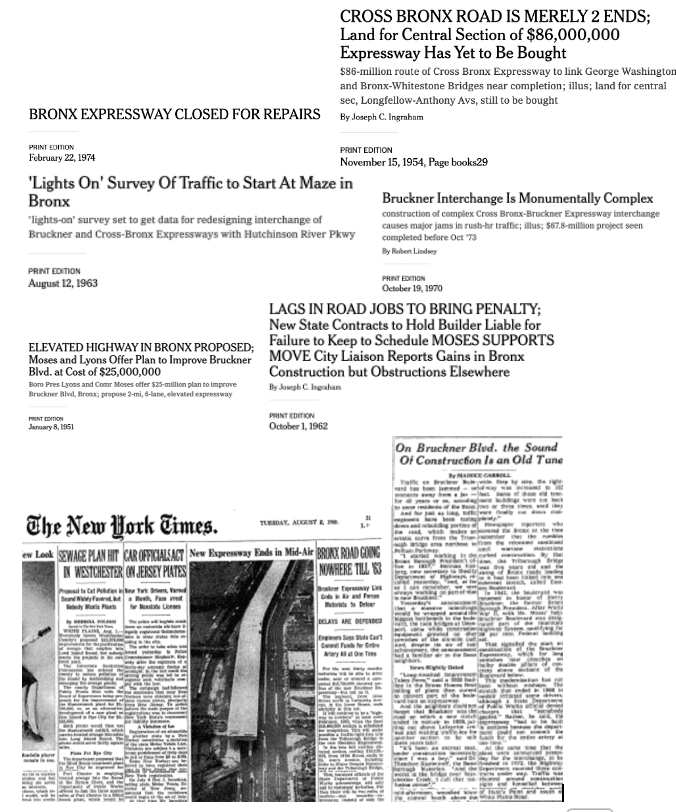
When I was about ten and reaching a certain understanding of the news that was played on the radio, there were dour reports that the mob had supplied the Bruckner project with sub-standard concrete. Both to better squeeze greater profits from the project itself, and as an annuity of sorts. The Bruckner, because it was so shoddily constructed, would always need to be under repair. That's good for union jobs and for those who skim off the top of union dues.
Cheap construction never stops charging. As do most things cheap. (Buy some street-meat next time you're in the city and see how it keeps, gaseously, making you pay.)
Of course, being ten or so, I misunderstood a lot of this. I pictured overpasses collapsing as we were driving over them in my father's 1951 Studebaker. Plummeting to my death, to date, hasn't happened. What has happened is this: the Bruckner is still under construction today. And will be well after I am buried and dead. Yes, in that order.
This digression has a point.
It's hard to build things that last.
The hard way is expensive, slow and demanding. It's often not-acceptable to shareholders who want their money now like a slobbering loanshark.
The easy way promises a lot and delivers plasticine dreams and potholed realities.
The advertising business over the last twenty-years has looked to the easy-way as the right way. Half of the new media discussions I've sat in since the rise of computers, data and digital, promised ineluctable results with very little investment. We'd have amazing results, fully-measurable, from essentially free media. Why spend money on media, when you can use "owned" and "earned."
What's more, once an advertiser's hooks, or canines, were embedded in a consumer's wallet, they couldn't be wrested away. That person was attackable and vulnerable forever.
As Napoleon might have said when his Grande Armee was forced from the edges of Moscow in 1812, leaving tens of thousands of his snarling Frenchmen shivering to death in the permafrost, "well, that didn't work out."
About every three days, someone somewhere heralded the advent of yet another, 'this will change everything' (ir)reality. So many people believed advertising and marketing could produce what I'll call a "Tuesday-Thursday-Causality." That's my nomenclature for those who believe that success can be quick and predictable and planned.
Real success in any endeavor is not easy and never will be. Like the ancient story of the Three Little Vegetable-Based Porcine Protoplasm Entities, it is harder and more expensive to build a dwelling out of bricks than out of straw. And if you're bonus is calculated quarter-to-quarter, straw looks like the wise fiduciary choice.
The story applies to advertising not just children's sleep habits.
The trend in everything now is a pernicious short-termism. There are virtually no more Agency of Record relationships. Most everything is project-based.
We look to huff creativity like delinquents huff glue. We look for a quick high rather than a solid foundation. Another metaphor might do. We propagate the advertising equivalent of "wham, bam, thank you ma'am."
During World War II in Hawaii, thousands of soldiers looking for a schlong-specific release could pay a couple bucks for literally three-minutes of well-clocked sex. That had its place, I suppose, if you're 18 and about to die on Iwo Jima, you might try to get your two-dollar's worth of pre-death euphoria.
But it's no way to build something you hope will last.
At GeorgeCo., LLC, a Delaware Company, I've had a number of quick hits. A client has their back up against a wall and wants to rent my brain and both my typing fingers to construct a beacon for their business. Fortunately, about 80-percent of my revenue, touch-polyethylene, comes from ongoing repeat business.
Not only does that allow me and my client-partners to build something longer-lasting, it helps us think more than the next insertion order or trade show. It allows me a deeper understanding of both the company paying me, their offerings and the clients they seek to serve.
Just as cotton candy is the apotheosis of empty calories, and the brothels I described above are, perhaps, the apotheosis of empty sex, a lot of what's happening in the world today is empty brand building, empty marketing, empty advertising.
You can only run on empty for so long.
Before you're stranded in the middle of nowhere.
I worry that our entire world is built on a foundation of empty calories and cotton candy.
Ergo.
That empty feeling.
Monday, March 13, 2023
The Me in Meander.
An' sick of tryin'
Ah'm tired of livin'
An' scared of dyin'
But ol' man river
He jes' keeps rolling' along.
Friday, March 10, 2023
Sixty Six-Word Stories. More or less.
Apocryphally, Ernest Hemingway wrote a six-word story that could take your breath away:
Baby shoes. For sale. Never worn.
The great illustrator and writer, Tom Gauld, not long ago came out with this extension:
Using the above as signposts, I wondered if I could write some six-word stories about the modern advertising industry.
Here goes:
Revenue up. Margins down. Cut staff.
Revenue down. Margins up. Cut staff.
Revenue up. Margins up. Cut staff.
Shareholders want higher returns. Cut staff.
No matter what's exogenous, cut staff.
No matter what's endogenous, cut staff.
Is that a grey hair? Buh bye.
Is that a wrinkle? Buh bye.
Different point of view? Buh bye.
Trophies more important than real work.
Lies, damn lies, case study videos.
Bryan Buckley's too expensive, use iPhone.
You frighten your boss, buh bye.
200 banner ads due before lunch.
Four years' experience. Suddenly too old.
Hop on trend. Quickly hop off.
Celebrities solve all your marketing problems.
The answer? Data or more data?
A.I. One word or two?
No raises. C-suite needs doubling.
Open collaborative workspace needs noise cancellation.
Open workspace. One cough. Sixty sick.
It's original if you copy Wieden.
More for you, less for me.
Plead poverty. First class to Cannes.
Do it faster. No thinking allowed.
More people briefing ads than creating.
Three
days creative, three weeks revision.
We support diversity. But aren't diverse.
I ate
already. You? Working lunch.
Mandatory lunch-time meeting. No lunch.
EOD. Is not 'end of December.'
PowerPoint leads to pointless creative.
24 people in meeting. 22 unnecessary.
Six-second spot. Twenty-minute caveat.
Pre-pro. I gained six pounds.
508 unread emails. That's since Tuesday.
47-second script. 30-second spot.
Been due tomorrow for a week.
Ad agency run only by CPAs.
Let's create better work, by committee.
17 rounds of feedback? That few?
Nothing sucks quite like a compromise.
Sure it sucks but client's happy.
Consumers morons. They're not your wife.
Not counting our losses, we're growing.
Throw under the bus. Rinse, repeat.
People ignoring ads? Just scream louder.
Diversity? Yes. Diversity of opinion? No!
Where are all the old people?
In Williamsburg no one watches TV.
Your timesheets, late. You're locked out.
We used to have that account.
You like it? I love it.
Destroying the environment but nice logo.
Doesn't work seem like it's NSFW?
They took my Aeron; readjusted lumbar.
Awards mostly for work that's fake.
Business results? You really harken back.
Pharma disclaimer mentions diarrhea eight times.
Verizon, big logo? Not an idea.
Paul Giamatti is no Albert Einstein.
Ask you're doctor if you're allergic.
No ending to spot? Everyone dance!
Thursday, March 9, 2023
Stats. And Obfuscation.
When I was a boy, many things were simpler.
Let me start with something that was always meant to be simple: Baseball.
For as long as people were playing baseball, we evaluated players in roughly the same way. Below are some stats of the great Roberto Clemente.
Maybe we were painting with a broad stroke, but by looking at batting average, home runs, runs batted in and a few other bits of data, a fan could swipe right or swipe left on a player.
We have holding companies that have shed tens of thousands of employees over the last half decade as well as one-third of their revenue being named 'network of the year,' 'international network of the year,' 'global network of the year' and 'globular network of the year.'
Are current clients giving me more business?
And so on.