Yeah, right.
George Tannenbaum on the future of advertising, the decline of the English Language and other frivolities. 100% jargon free. A Business Insider "Most Influential" blog.
Thursday, December 19, 2024
Everyman, I Will Go With Thee.
Yeah, right.
Wednesday, December 18, 2024
Leaps, Eeps.
If the world were a better place, instead of reading this we could go to a ballgame together, or a bar like the Tempus Fugit, or even a coffee shop. Once there, we could grab a brew and have a conversation.
| A cocktail napkin from the Tempus Fugit (artist's rendering.) |
So, I blog.
Blogito, ergo, sum.
I blog, therefore, I am.
My conversation starter today is simple.
All progress comes from taking a leap of faith. From doing something of which you're not sure of the outcome.
All progress in love, in creativity, in almost any pursuit comes from leaping. Leaping, usually, before you look.
The central issue in the stagnation of the modern world (here's what I mean by stagnation, it takes longer to fly coast-to-coast today than it did 65 years ago. It takes longer to drive places today than it did 65 years ago. Economic growth is not nearly what it was in post-war America. From 1800-1900 life-expectancy virtually doubled. From 2000-2025, it's decreased by about 10%. You can read more about stagnation here. And here.)
If you think for a moment about the ad industry's latest infatuation with AI, you'll get a clearer view of what I'm writing about.
AI, most reductively, is a pattern-matching protocol. The intelligence looks at examples of what went before. It "decides," this is similar or this is different. And goes on from there.
So, if you feed AI a million MRIs used in screening for breast cancer, it can put the ones with anomalies in one pile and the ones without anomalies in another. It doesn't understand disease or tumors or anomalies. It just knows what they look like and classifies accordingly.
Predictive text on your phone acts the same way. It doesn't understand what you're typing. It merely makes a prediction on what you mean based on the fatness of your thumbs and the probability that past performance leads to future results.
Today, many people--creative people among them--want to bring the same predictive acuity to creative acts.
If...then.
The problem is creativity is, and has always been, and always will be based on surprise.
If...wtf.
Creativity is unpredictability.
In our infinite obeisance to the scourge of machines we have decided to contrive to use predictions and precedents and previousness to create.
If you disagree with the above, take it up with Edward O. Wilson. He likely has more patience than I do for the discussion.
If Wilson can't explain it, the following clip should. That's from Ninotchka. Ernst Lubitsch. Billy Wilder. Melvyn Douglas. And Garbo.
In my 67 years, I’ve seen no better discussion of what makes us laugh and why. It has absolutely nothing to do with predictive computing capabilities.
Take a leap of faith and learn why unpredictability is so important, so lovely, so life-affirming. So funny.
Tuesday, December 17, 2024
Putting the Fun in Pundit.
It wasn't all that long ago--a decade and a half, really, that I was toiling at the self-proclaimed "digital agency of the decade."
It was a place much better known for winning awards than for helping brands. But it was stuffed to its crumbling rafters with all order of pundits, prognosticators, pomposticators and proclaimers who, like Wilde's definition of a Cynic could "tell you the price of everything and the value of nothing."
While at this agency, I heard from a dozen people a day that the new calculus of marketing success was gathering Facebook likes. That a million likes would translate into marketshare, somehow.
This is before people were hep to the notion that Facebook should more accurately be called "Democracy-Destruction-Book," or "Child-Sex-Trafficking-Book," or "Perpetrating Anti-Semitism-Book."
These dozen people a day were so cool, they spent good portions of their day telling the world where they were via Four Square or Heptagonal Rhombus or whatever, often boasting how they were mayor of one over-priced coffee bar or another, as if that mattered as much as a bucket of warm spit.
While at that agency--trying to bring it a degree of marketing gravitas to it (or gravlox, whichever is better on toast) I connived a sin as bold and egregious as that of any heretic from Jan Hus to Martin Luther.
When someone was going on about the viability of this or that new technology that would undo in an MBA's quarter 200,000 years of human behavior, I had the "brass," to say, "show me one example."
Show me one example where Facebook likes turned into share points. I did the same at Ogilvy, too. A media person tried to brow-beat me into opening a spot with a logo. It would, she assured me "perform better." I said, "I would think it would perform worse. Who cares about a logo except a client or a media person tracking these things." She said, "No it will perform better." I said, "I'm not asking for a lot. Just one piece of data that proves it to me." For whatever reason, she left the fluorescent conference room in tears.
These days being reality-based is heretical. Any abeyance of the orthodoxy of the theory class will get you sent to binary Siberia. You'll be one of those who "harkens back," or who "doesn't get it."
The passage below was just published in The Economist and sent to me by a friend. Yes. I have friends who read The Economist. They're not 42-year-old management trainees.
OOTUPs (one of the usual pundits) made one of the usual predictions, that AI will eat creative. By application, there's no need for creative.
I'm not 100-percent sure what Mr. Tobaccowala's predictive track-record is. Or what, if anything, he's actually done to have achieved pundititude. I'm also not sure if anyone from the Economist, or any client who pays his consulting fees, ever says to him, "Rishad, dude, you were as wrong as a climate denier on your last set of predictions. Maybe, if you're interested in how humans respond, you ought to read a little Shakespeare some time. Like "What a piece of work is man," or something. Or at least some Charles Schulz."
I was thinking about pontificatory impunity and then it hit me.
The reasons pundits get away with pontification it is simple. From their daises at Davos or Austin or CES, or wherever, their words give followers the permission they need to do what they wanted to do all along which is cut costs and act less human because it saves money.
Pundits are today's equivalent to the lackeys that complimented the emperor's missing haberdashery. They're marketing court jesters. Their existence depends making anodyne statements that soothe and support (and never challenge) the dominant complacency.
Yes. I’d quote someone wildly if they spoke at every forum worth its lanyard that there's a direct correlation between hot-fudge-sundaes and washboard abs. I'd even pay them. Especially if I could get my cardiologist to agree.
There's a lot of purpose-washing in advertising or green-washing. Like Chevron saying they'll spend $100 million on clean air, when they earn $20 billion in profits from dirty air. Or agencies going full-force on DEI in 2019 only to abandon it by 2024. Or a chain like Starbucks banging on about how they'll get rid of plastic straws by 2070 or some such. As if going strawless should take longer than building the great wall of China.
A lot of what we read from quotations like the above is Pundit-Washing. The same sort of "pseudo-science" that under-pinned eugenics, forced sterilizations and the idea that humans don't have a single origin, and therefore race is a bonafide construct.
Pundits say things. They make us feel good and in the know, so we self-fulfilling-prophecy-ize them. We repeat what makes us feel good. Especially if we have investors to please.
Above is a chart of Intel's market cap. You can see (if you can read a chart) that the company has lost two-thirds of its value over the last five years. With the rise of Nvidia--a company currently valued at $3.3 trillion (45x Intel) Intel probably ain't going to come roaring back.
Of course advertising won't solve Intel's technology and innovation lacunae. But good advertising, where they show what they're doing, how they're inventing, how they're planning to return to viability, if not prominence, is important. You know, why should anyone care? What's in it for them?
Instead, Mr. Tobaccowala, Intel runs AI-generated ads beckoning us to elevate our success with AI at the edge. When it comes to tech, I'm a pretty brainy guy. I have no idea what those words mean or why I should care to find out. Especially find out from a company that's seen it's market-cap tumble by over $200 billion over five years.
If I lived near Intel headquarters, I'd love to visit one of their mens' rooms and stand close by the urinals. I'd hear the sound of money (and their future) being pissed away in a stream of urinary AI.
For about 30 years, I've heard about technology that will deliver to me the right message at the right time. I've yet to experience one instance of the same. Usually, I get ads for endless seafood buffets while I'm on my way to a colon screening.
Someone, please, show me one example of AI helping a business' marketing succeed. (Outside of a business that sells AI.)
Monday, December 16, 2024
Always Write.
I read something long ago and faraway, back when words mattered, our attention spans were longer than that of a goldfish, the world was somewhat cooler and polio wasn't again a thing.
I forget where I read it or what I was reading or who it was about. And these were the paleolithic days when you couldn't immediately save something to a pdf and keep it in a folder to find when you needed it. In short, I read it, remembered the part that mattered to me, and left the back story for all time.
The piece I read was about an author, a fancy-schmancy one at that, who lived alone in the mountains above Denver, Colorado. When he was writing, he would sit at his type-writer, blindfold himself and just type.
No it wasn't a kink.
It was a think.
He didn't want self-editing, over-think and all sorts of other writerly-afflictions to intrude on his words and the fingers and brain that were rendering them.
He wanted to full-speed-ahead. Not exasperation through perseveration.
Likewise I read that Kerouac with "On the Road," or Ginsburg with "Howl," taped together innumerable sheets of typewriter paper and scrolled the near-endless sheet into his old Smith-Corona or Remington. Whoever it was, like Dirty Harry or Charles Bronson in some cinematic gore-fest, didn't want the delay of having to pause to put more paper in the dingus or ammo in the killing machine.
Truman Capote, of course, said of the Beats, "that's not writing, that's typing." And to a degree, he may have a point. Speed is good. Spontaneity is good. Getting it down is good. Not necessarily art, but good.
In fact, I read somewhere about a Hollywood screenwriter, I forget who, who would stay late at his desk and write the entire first draft of whatever he was working on in one sitting. His thesis was a simple one. And one I happen to agree with: write fast, because re-writing is always easier than writing.
What prompted today's digression, roughly my 7,000th since I started this blog (you can probably add 1,000 manifestos to that total and you have some idea that my fingers bleed) was my usual weekend self-torture. Particularly on weekends when my calendar is stuffed to the gills wth places I have to be and things I have to do.
When that's the case I have a monkey on my back. When will I write this blog? Chances are I won't get to the computer until late when my brain is mushy and my eyesight is blurry.
But then I realized something.
I have been a writer on deadline since I worked in the in-house advertising department at Bloomingdale's and for three years in the early 80s was charged with writing about ten ads a week.
That onus has remained on top of me for the forty years since then. I'm almost always behind the "I-have-to-do-this-eight-ball."
When that's you're life, you're a little like a good gunnery sergeant in a battle zone. You're always looking for something to size up, aim at, and get into your sights.
This post was written entirely in my head and largely committed to memory because when you're charged with writing on demand, you demand such acuity from yourself. You find not just topics, but references, jokes and whole paragraphs. You cobble them out in grey matter, and when you can finally get someplace to pixel it up, it's all there.
For most of the last twenty years of my agency career, account people, planners, other creative people and especially bosses would make me out to be some sort of a freak because I can write so fast.
I often felt like an animal in a zoo. They'd throw me the meat of something that needed doing, then back away so as to expend no empathy.
That's what practice and pressure can do for you.
Virtually no one understands how I got so fast. I have a standard phrase for that--a well-written one at that.
"I don't start typing," I tell people, "until all the words are already in my fingers."
IYKYK.
Or better, IYWYK. (If you write, you know.)
Friday, December 13, 2024
I'm Just a Bill.
There are as many ways to define a brand as there is corruption in politics. If you ask ten advertising people (hurry, there are only about a dozen left after all of this week's 'synergies') you'll probably get fifty definitions. It's likely all of them will have some elements of truth in them. Defining what brand means is a bit like defining "pretty," or "love," or "freedom." Brand means different things to different people at different times.
But for me, the dyed-the-wool-New Yorker, much of my cosmology orbits around a certain solipsistic question: "what's in it for me?" That leads me to define brand this way: "a brand is a promise to a customer."
That is what will you do for me? How will you behave? What can I expect from you for the money and/or time I give to you?
I'm sure a simple statement like "a brand is a promise to a customer" will upset a lot of people. For one, it's easy to understand. Second, it's not high-falutin' and complicated sounding. Third, I'm not a brand-strategist. What right do I have to offer a point of view on something so intellectualized and professional? Last, it's not ™. How can it be valid if it's not convoluted?
But I'll stick to my definition.
If I were in the supermarket and looking at the 77 different kinds of lemon-fresh soap, which one makes a promise that I can respect, remember and believe? Same for hamburger joints. Cars. Even what agency I'd choose to work for if I were ever again, heaven forfend, going to work for an agency.
I've held onto this brand-as-promise belief for a couple of decades now. Not to give away too many GeorgeCo., LLC, a Delaware Company's secrets, very often I talk to clients about my brand-as-promise belief.
I usually say something like, "You might spend $5000 a year on your cell service, your ISP and your cable. Outside of promising a triple-play bundle, you have no idea what you're going to get for all that money. When the installer comes to set up your cable and your internet, you'll get about a dozen goldenrod pages with eight-point type on them. You have no idea what your service entails. You know what you have to do..pay every month. You have no idea what they're doing for your money. What happens when service stops, there's an outage, you don't understand your bill? What does the 'brand' do for you then?"
Most clients nod politely, glance at their watches and hope someone will make it stop.
Then I trot something out.
"That's why I wrote your brand a Bill of Rights. It's what you believe. It's how you work. It's your commitment to your customer. Your salesforce can deliver it. It can be on your site. On the back of business cards. It's your brand and your promise."
There's a Yiddish word, kvell, that best captures client reactions. They're thrilled that I've done the work and helped elevate them. They thank me. They pay me. Then, usually, it goes nowhere.
Why put anything your brand can't do in writing?
In any event, your brand should write a Bill of Rights. And you should stick to your beliefs and practices.
Here are GeorgeCo.'s. As found on my site.
I'd be happy to write yours.
For a hefty fee. (That's on-brand.)
Thursday, December 12, 2024
One of This Year's Ten Best Posts.
I was just in my early 20s and I had landed a job in the in-house advertising agency of Bloomingdale's. Except for a few frustrating years writing catalogue copy for the Montgomery Ward catalogue, I was finally getting paid to sit behind a typewriter and write. 
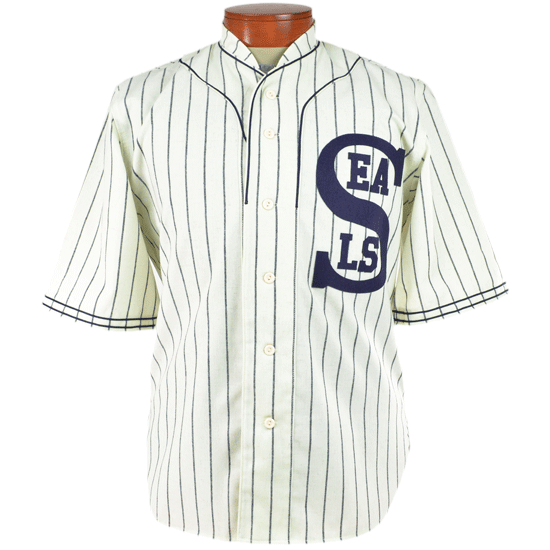
What's more, the agency itself was like a great professional ball-team that hadn't quite broken into the major leagues. The 1933 San Francisco Seals come to mind. A Double A team that sent nearly half its players to the bigs, including an 18-year-old Joe DiMaggio, whom they later wrote a song about.
Way back in the early 80s, I learned something about people and life that is extremely important.
Our team at Bloomingdale's was led by John C. Jay. He went on to help run Wieden & Kennedy.
One of the things I learned at Bloomingdale's is how insecure--paralyzed by insecurity so many people are. Bloomingdale's was a horrible place to shop. It was disorganized. You couldn't get help. And almost invariably they didn't have your size, even if you were a normal size--like a 15 1/2-34, or a 44L. (Sorry I used the word normal, that's considered impolitic today.)
I talked to my creative director, Chris Rockmore, about it. Chris was a friend and a wise man.
"George, Bloomingdale's sucks. But they have taste. If you're insecure about how to dress, what to wear, how to enter a room or what to wear for an interview, you got to Bloomingdale's. If you buy it there, you can be sure it's ok."
"No purple three-piece suits?" I joked.
"American Express is built on the same insight. People are nervous when they travel. "Don't Leave Home Without It," is reassurance that you're protected, you have a safety net with you. You're a "member," even in a strange land."
It's the time of year we're in now that brings this all to mind. It seems to me that 7/8ths or 11/12ths of all magazines and newspaper articles and youtube garbage recounts the "top ten _______ of the year."
Every creative you meet, every agency you look into, every airline, hotel, coffee shop, book, travel destination, museum and dry cleaner is on some "best of," or "top ten" list somewhere. When movies are judged nowadays the first criterion is their box-office success. Artistry, story flow, acting, plot are way down the list.
I just now got an email from The New York Times, of course, "The 10 Best Books of 2024."
I read a lot of books.
Maybe 40 a year.
And I respect The New York Times. Since there are no more bookstores staffed by people who can read, I rely on book reviews from quasi reputable outlets to guide me to my next book.
What's more, I really have nothing against lists like these.
But it's helpful to remember how much they play to your own insecurities. That you couldn't identify leading books, coffee shops or efficacious agencies without some outside verification.
What's missing in all this is an essential part of being human.
I used to talk about it a lot with my daughters when they were starting their adult lives. If they were applying to a university or for a job, they'd invariably say, "I don't have exactly what they're looking for. I'm short on such-and-such." As if that were a fatal flaw.
I'd answer simply.
Everything good that happens in life comes from a leap-of-faith.
Our current global stagnation--stagnation in every sphere whether its technology, advertising, politics or whatever--is because we're not willing to try something new. We only want to try something proven.
In that safety lives ossification.
It's why I just saw all these articles featured prominently in Ad Age. Yet I haven't seen five good ads this entire year. Yet there are 52 creative campaigns I need to know about.
That's ossification.
Maybe one of the top 10 words of the year.
Wednesday, December 11, 2024
Murder. Mergers. Me.
"The pro-tech argument I often hear... is that it’s better than nothing for people who would otherwise not have access to services. Which is to say: Emotional support [or customer 'service'] through a chatbot is better than no support at all....
"We’re increasingly becoming a society in which very wealthy people get obsequious, leisurely human care.... Everybody else might receive...[very little.] Or, as Pugh puts it, 'being able to have a human attend to your needs has become a luxury good.'
"As I was reading her book, I had a minor revelation about the growing lack of trust in various American institutions...the picture is one of declining faith over the past 40 years. That’s roughly the same period in which technology has accelerated and replaced or bowdlerized a lot of low-stakes human interaction, otherwise known as weak ties, like the ones you have with a grocery store clerk you see regularly or even the primary care physician you see once a year."
This is clearly what's happened to our business. Both how we serve clients and how we're treated by the companies that employ us.
All humanity, all decency, all kindness and most insight and empathy (which are based on humanity, not binary code) have been removed from the system. They're no longer. Treating someone or even a client well is not just anomalous, it will get you fired.
I read all this.
I thought about this commercial done probably 35 years ago by, I think Leo Burnett, now a Publicis agency.
If I was in one of those corner aeries with old men whose salaries include seven figures and whose net-worth includes eight, I'd watch this commercial now and again.
No.
I'd watch it every day.
I'd watch this fairly often, too. Especially if I were feeling suicidal.
Tuesday, December 10, 2024
Stagvertising.
editor's note: This post was written almost three weeks ago. Before the Omnicom/IPG subsumation, which gives us an entity that has over 1,000 separate presidents. Perhaps more presidents than creatives. Though written back in November, it is today, more relevant than ever.
I don't remember the exact conference room, but I remember I was in a conference room at R\GA (Agency for the Digital Age) when I first heard the term: Minimal Viable Product.
I also remember throwing up a little bit in my mouth. I can still taste the bile.
The term MVP was tossed around as if it were acceptable. No one--a linguist, someone interested in semantics or even a human transliterated it into "The Least We Can Do and Get Away With It." Except for cancer, bullying, belly-fat and taxes who wants the minimum of anything.
But here we are.
Minimal Viable Product.
I finished Monday night a book called called "Boom: Bubbles and the End of Stagnation," by Bryne Hobart and Tobias Huber.
You can buy it here, buy a machete here to cut your way through it, and read The Wall Street Journal review here.
I read a lot of challenging books, and Boom is among the most inscrutable I've ever read. That's not only because I don't have an advanced degree in economics, it's also because I'm almost 67 and have never once used the word "thymotic," though Hobart and Huber use it about once every twenty pages.
That said, the thesis of "Boom" is simple.
All the things modern social organizations, enterprises, laboratories, research centers, universities and even ad agencies do to increase their bottom lines run counter to their need to create something great.
Cost-accounting will never produce the first lightbulb, cheese in a can, or great ad.
Yet, in every sphere of our lives, cost-accounting is our sine non qua. That's Latin for "our scrotum in a vise."
Huber and Hobart talk about how in academic research roughly 47 out of 100 hours is spent on writing grants. And probably another 20 to 30 hours is spent looking for citations and precedents. Leaving about one-hour-in-five to actual thinking.
That's not counting meetings, meetings about meetings and the meetings we have to complain about having too many meetings.
The advertising parallel is there for all to see. We probably spend 47-percent of our time on award entries. 30-percent of our time studying previous award-winners for tips, and 20-percent of our time watching HR's "handy" videos. I call them handy because they're usually about not touching anyone and not greasing any palms.
In both scenarios, the dynamic leads to something very dire. Work that is only incrementally different from work that went before, that is work that is "stagnant," not "inventive." Our work doesn't go from the Wright Brothers to Lockheed's Skunk Works. It goes from a 20-watt bulb to a 20.5-watt bulb. That we get awards for.
The point is the system has in effect mandated that we derive a "Minimal Viable Product." In an agency, you can only spend a finite number of hours. Experienced people are unaffordable. And no longer do we really get to know the client or the product.
Instead, we are told we have to--by end of day--fill in 27 different sizes of digital rectangles and everyone of them must say "triple-play bundle," and fourteen other mandatories, all as people around us are being "right-sized," or "outsourced," or "castrated," and the we wonder why people hate our work and we hate our jobs.
The system, the dominant complacency, demands that we create a Minimal Viable Product for Minimally Viable Effect and that we, in essence, become Minimally Viable Humans.
Think about this in terms of your last flight on a commercial airline. Even if the flight attendant had the innate kindness of a Mother Teresa, she has no time for eye-contact, no time to be decent, no time for anything but Minimal Viable Linoleum.
Meanwhile the plane itself, has minimally viable seats, minimally viable bath-rooms, minimally viable pretzels, and probably minimally viable safety equipment. The same ethos applies to the actual flight. Departure, arrival, getting baggage all governed by minimally viable standards.
If you want to think about it, most everything today operates under these strictures. It's why almost everything sucks. From your expensive meal to your cheap one, from your government to your subway ride to work.
What's The Least We Can Do and Get Away With It?
Huber and Hobart believe in the lack-of-common-sense-ness of bubbles. Massive expenditure of things that could change everything--that might never happen.
Those bubbles--whether they burst to build--create standards, enthusiasm, opportunity, competition and spillover effects.
For instance, if an agency has one real account where good work is done, the entire agency improves. Everyone competes to do the good work. And people who can't get into that account get angry and work to make their business great.
That's how Boom businesses, Boom agencies and Boom careers are made.
Or stagnation.
Monday, December 9, 2024
The Black Bird. And Holding Company Mergers.
Of course I have an axe to grind. Anyone who says they don't is either lying or they've bought a chain-saw. (See above for a dramatization.)
For about thirty years now, I've played a little game in my head. When I see a giant company, one of the ones who used to spend a lot on advertising, make a substantial move, I try to imagine what the cover of the Harvard Business Review will say about that move five years from now.
Back in the mid-1990s, I worked on the Mercedes-Benz account.
Mercedes-Benz had been blindsided by the advent of Japan's entry into the super-luxury car-market. Acura. Lexus. Infititi, they all ate away at M-B's share of that rarefied (and profitable) niche. What's more, Japan back then was like China today. Their economy was soaring--their yen was strong against the dollar and the Deutsch Mark and they could afford to sell their cars more cheaply and in essence buy marketshare.
When I worked on the Mercedes pitch around 1992, I remember reading that Mercedes had gone from selling 100,000 cars in the US to selling about 60,000. Unless you're an ad agency or an internet start-up, losing 40% of your sales is generally a bad thing.
One of the ways Mercedes responded was to expand its product line. In just a few short years, they added to their four-car-line-up, bringing out an SUV, a two-door-roadster, a luxury coupe and a few other models. I remember writing those Harvard Business Review cover-story headlines in my head, "Mercedes: Expanding Products, Contracting Sales." Or "Mercedes: Going Mass and Keeping Class."
Though it appears the second track has won out, thirty years ago, no one was sure.
The Harvard Business Review-cover game is a good one. In amerika today you can play it with politics, climate policy, trumpism, the democratic party, or any number of topics. You can play the same game with the ad industry. Though if you know anything of extractive industries that deplete once and for all all available resources, you know how that one will turn out.
As I look at business today--as seen partially through the lens of my 30,000-strong LinkedIn network, I write my HBR covers.
I see hundreds of start-ups in my feed. And over the almost six years GeorgeCo., LLC, a Delaware Company has been percolating, I've worked with hundreds more. I've worked on everything from frozen pizza to a tech company that gleans insights from literal chicken shit. There's one thing they all have in common. There's one thing maybe all advertisers have in common: They all underspend.
I say this for the most mercenary of reasons, of course: I want their money. I want them to spend with me.
But more, I say this because I've developed a marketing belief system based on my opinion. I believe in something I call the Four Ds. I sell this world view, with no little success, to my clients. They seem to believe it, too.
I see the word "scale" more times in a single-day than a project manager sees overages coming from the c-suite. But perverting what Mark Twain is said to have said about the weather, "everybody talks about scaling, nobody does anything about it."
In short, no one wants to spend (with me or anyone else) on any of the Ds above, especially the first, most-important two, or the last, most ROI-y one.
Growth is multi-variant.
That's a MBA-y way of saying it depends on a lot of things, in proportions that change every day. But one of the most important is the one most companies think about least: D1.
99-percent of the companies I see seem not to know what they sell, not to know what makes them different, or important, and not to know why people should consider them.
Worst of all, if you believe the Trout and Reis dogma that a company has to own one word in the customer's mind, like Nike owns Athlete or Apple owns Creative or IBM (until they ceded it) used to own Think, 99.999999-percent of companies fail to own a word--and 99.999999999999999999999999999999-percent of CMOs fail to realize that they must (to achieve D1-ness) own that word.
So.
Under.
Spend.
So.
No.
Growth.
You can write your own Harvard Business Review cover. I have a raft of art-directors and for a small fee, I can have it designed for you. You can frame it an hang it in your workspace or have a digital copy on your phone.
More important, you can hire me.
And work to make your Harvard Business Review cover come true.
--
[As an industry, and as observers of the industry, there are two sets of HBR headlines we might think about this morning. One set might be: Advertising Holding Companies: The Economies of Scale or Advertising Holding Companies: The Economies of Fail.
The second might be: America Without Anti-Trust Regulation: The Death of Competition and Innovation. or America Without Anti-Trust Regulation: Size Matters (Too Much.)]
Friday, December 6, 2024
Laura (Oh!) Tannenbaum.
Laura Tannenbaum, my wife of almost 41 years, is our final participant in Guest Post week.
During that time, she hasn't had a single involuntary day off. She's the Lou Gehrig, the Cal Ripkin, the Joe DiMaggio of freelancers.
A decade or so when she was squeezed out of a long time job and I was squeezed out of my five year job, we both found ourselves "mature" and unemployed. I asked Laura, "what do you do better than anyone else in the world?" Like a lot of women (too many in my opinion) she said "nothing."
But she was obviously wrong.
Because she hasn't had a single involuntary day off in over ten years. She was wrong. Though she'd never admit that.
Here's Laura's post.
It will tell you more about her talent, drive, and energy than my dopey powers ever could.
One more thing: Laura has a lot of energy. Of course, she tires me out.
She can also out-energy a 14-month old golden retriever.
Laura's post.
I received this text from a close friend who’s incredibly talented:
I’m stressed over a big project, but glad for the work.
It’s keeping me up at night.
Hope I can get a handle on it soon so I can calm down.
Who cannot relate?
As soon as I read this, I knew that pain—as I was also feeling overwhelmed by a Sisyphean task. I had 2 large, complicated assignments from different teams. For weeks I was counting on these to have staggered timing. But of course they were both assigned and due on the same day.
The analysis is paralysis
At first I froze over how perplexing each assignment was. So instead of digging into the work and perseverating over it, I did my daily puzzles and even did some new ones, then I read that editorial I meant to read over the weekend. You get the picture…I wanted to do everything but these assignments. And another day went by avoiding the inevitable. This made me even more nervous. Finally I stayed up one night worrying about how I could possibly get everything done. I took a look from a high level, then down to earth to a reflection pool of sorts. And I realized there was a way to get this going.
One lap at a time
When our older daughter was overwhelmed by a swim test she needed to do to swim in “A” water at her camp, my husband told her to concentrate on one lap at a time. She shouldn’t be thinking about all of the laps as that was too much. Just think about that one lap you are in. Then think about the next lap. We all agreed that this was an important life lesson. And it certainly applied to my situation. I could do the work by taking it apart, piece by piece.
There was a method afterall
After looking at that lap pool and thinking it through, I was able to do one part of one assignment and actually turn that in early…I even over-delivered on the assignment. The team was pleasantly surprised by my timing and effort, then gladly moved that along. In the meantime I forced myself to look at the 3 parts of one assignment and figure out the most difficult part. I reasoned with myself that if I could do the toughest task first then the rest wouldn’t be as hard. That turned out well as I worked through the complexities and finally got that piece ready. The team was impressed when they saw it. I was glad to get that done and move on.
Mapping out what was left
Or the blockhead blocked it out
For the rest of the assignments, I blocked everything out taking the input from the brief, even though I knew it wasn’t really what was needed. This gave me structure for what goes where and how it would eventually come together. Then I put it all together.
5 courses of “of courses”:
Of course the brief was way off.
Of course the clients had different expectations.
Of course they wanted it right away but couldn’t meet for a few more days.
Of course I was promised people to help me but I was all alone.
Of course everyone had helpful materials and comments to share—after the fact.
How do you spell relief?
It was all done and on time, and better than anyone expected.
And finally I could rest assured and think beyond these projects.
There was still plenty more to be done, but the first draft was out there.
What was the lesson learned?
Take each lap as it comes, take the high road and muster everything it takes to get the tough stuff done first. Have confidence that you will get there. And like anything worthwhile, there will be some pain involved. Work is called work because it is. But it can be rewarding well beyond the paycheck. And that’s pretty important.
So next time that boulder starts
to roll your way, know you will overcome it.
And you’ll be better for it.