Monday, May 29, 2023

Hudson Weekend.

I'm not sure if there has ever been, since the very beginning of life on our pale blue dot, a weekend with more beautiful weather than there was this past weekend, which happened to be not only my wife's birthday, but Memorial Day as well.

We had taken a room up in the Hudson Valley--far from both the madding crowds of Manhattan and the Gingham crowds up in Connecticut. Our bed and breakfast was in an 1880s house with a slight view of the Hudson River about half a mile away and through half a million trees.


The river and the low mountains that line it, still bring to mind the beauty the Hudson River School painters captured a century and a half to two centuries ago. The river is wide, its current slow. It seems to give off a slight mist that tints the landscape with different colors depending on the height of the sun and the clearness of the day. 

At times the scene is a gauzy blue. At other times a first-buds of spring green. At other times, the yellow you see after a late-afternoon summer rain. Often, a lonely sailboat will be making its way up the broad river--placed perfectly almost as if by an all-powerful art director.


There was a railroad bridge built in the 1860s by big corrupt monied interests over the river at Poughkeepsie. It's a US Steel affair, all girders and struts and tinkertoy delicate. Like most of Amerika, it had fallen apart by the 1970s and probably by now would have crashed into the river 200 feet below and been corroded by the carcinogens General Electric dumped into the water for hundreds of years.

Instead, money was raised--even the state contributed funds-- and the old bridge was turned into a living-room-wide 1.3 mile walk or bike across the waters. The old rail-line was converted to a recreation path, miles long and serene in parts, an escape from the malling and the falling of the rest of the area that seems equal parts crappy Dollar Stores and Applebee's and fallen apart abandoned factories and warehouses.

Below, everyone is driving around in 6,000 pound pick-ups with loud exhausts as they flit from chain store to chain store looking for more moreness.

My wife and I--older than everyone--looking back at what was and sadly at what is and spending a weekend high above the murk of a mighty river.


Friday, May 26, 2023

A Drive to the Country.

My wife and I took a road-trip on Thursday afternoon to stay in a darling little bed and breakfast not far from the Hudson River and to have a fancy-schmancy dinner at the Culinary Institute of America, across the wide Hudson, in Hyde Park, New York.


The area is about 90 miles from our apartment in Manhattan. And given that America's transport infrastructure saw its brightest hours in the 1950s, just after World War II, the 90-minute drive took us 210 minutes. That's the world today--or at least much of our world today. It seems subsumed by an "I don't give a shit" slovenliness that is about as attractive as decrepit highways themselves.

Having a lot of time to talk, my wife and I talked. And naturally, we talked a bit about the agency business.

"We're old," I began. "We don't really 'choose' jobs that much anymore. We're not looking for a home or any sort of culture. We want to make our money and not get too overly-pummeled. But how do young people choose where to work?" I asked. 

Laura, my wife, answered with her usual practicality. "I dunno," she said. "It seems like most every place is the same."

I avoided a giant-wheeled Jeep out for a day of destroying what's left of our planet. He had decided he wanted to occupy the same slab of cracked asphalt my 1966 Simca 1500 was driving on. I swerved and just missed his rear fender. It was the size of an old steam locomotive.

Laura continued. "The salaries are all the same. The lack of security and unbelonging is all the same. The offices look the same. The work is the same. The fact that your life is ruled by a far-away plutocracy is all the same."

"The business when we started was about being distinctive," I said. "Reception areas mattered. Your office space mattered. Salaries mattered. Who you worked for and the work you did mattered. That's all gone now."

"I have a friend who's a freelancer," she answered. "He only works at West Side agencies because he likes taking the ferry over from Jersey."

"I remember Lori (my long-time headhunter) telling me, 'George, once you're over 35, the only thing that matters is your commute.'"

She laughed and I screamed, again avoiding the same monster Jeep that was coming back at me like an incompetent kamikaze. I drove up on the median to avoid the truck and just missed a herd of hoboes scrounging for fast-food under a culvert.

"George," Laura admonished. "Pay attention. You graze one single bindlestiff and you're in arrears for $17 million. They have a union you know."

"Yes," I grumbled. "Maybe that's my career after advertising."

"It's a tight union," she last-worded. "They don't let bums like you in."


Thursday, May 25, 2023

Big Daddy and a Baddy.


When I was a boy, I was lucky enough to have gone on a class trip to see Tennessee Williams' "Cat on a Hot Tin Roof," on Broadway. 


The production ran for just 160 performances, from September 24, 1974 to February 8th, 1975. It starred Elizabeth Ashley as Maggie the Cat, Keir Dullea as Brick and Fred Gwynne as Big Daddy. 

I'd be lying if I said at the age of 16 or 17 I wasn't most excited about seeing Elizabeth Ashley deshabille and she didn't let me down. As Oscar Wilde is said to have said, "Brevity is the soul of lingerie." And he never saw Elizabeth Ashley.

All lingerie aside (and at 16 or 17, I wished all lingerie was aside) there was a play going on that afternoon, and what a play. 

If I remember correctly, that afternoon was the first time I ever heard the word "mendacity." And while I had no smartphone to look up its meaning, I was able to remember the word and think about mendacity for the last 50 years or so.

BIG DADDY: 
What's that smell in this room? Didn't you notice it, Brick? Didn't you notice a powerful and obnoxious odor of mendacity in this room? There ain't nothin' more powerful than the odor of mendacity.

I've memorized those words and shouted them--more like Burl Ives in the movie version than like Fred Gwynne in the stage performance I saw. Ives had the voice of god, a voice that could fairly rattle the marrow out of your bones. 

I don't know if Williams heard Ives when he wrote those lines--but whenever I see mendacity, especially when it affects me firsthand--I fairly bellow like Ives. 

Like the German philosopher Karl Jaspers, a rough contemporary of Tennessee Williams', I have a very hard time with what Jaspers named "the subject-object split." Ask anyone who knows me well--if you can find someone--when perception and reality no longer share living quarters, it sends my Manichean sense of right and wrong for a loop.

When I see commercials on TV of grinning people jumping through a logo and saying how flexible their phone company is and how happy it makes them, all while flashing a smile that would make Sandi Duncan look like the Grim Reaper, or some really insulting bank spot that extols the virtues of a technology that was old and dumb five years ago and no one really cares about, with a musical bed that should be considered cruel and unusual punishment, really, I'm ok with them.

Dreck is dreck. And phone company dreck or a bank's dreck is the run-of-the-mill dreck. Dreck is everywhere. That's life in advertising. You can fight it--but regression to the mean is a mean master.

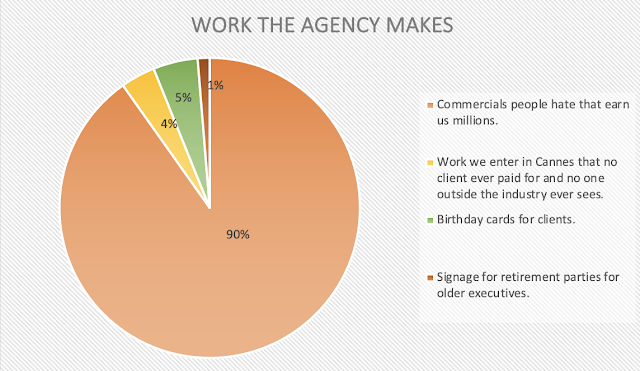
The subject-object split shit happens for me, in a big, loud Burl Ives' Basso Profundo, when an agency makes all its money doing dreck and then bangs on about the great work they do because of this award or that award.

When 90% of what you make is dreck, chill a bit on the fake-crap you do that mommy hangs up on your fridge. That's like a .213 hitter talking about how beautiful his swing is. Or Gilligan comparing himself to Olivier. Or, well you know the rest.

That's mendacity.

It stinks.


Wednesday, May 24, 2023

Tips from New York's Busiest Freelancer.

 My wife, Laura, wrote the post below. Laura might be, touch wood, the ad industry's most-successful freelancer. Since she voluntarily left her vaunted staff-job owing to two HHCOs (heinous holding company offenses) She wanted to: 1. Get older. and 2. Get paid. As a freelancer, she hasn't involuntarily missed a day of work since Millard Fillmore's second term in office, and he only had one term.

Laura, incensed over some recent disparagement of her freelance status and its lack of status, sent me this.

I owe her one-and-a-half day rates for her labors, if I can afford it.


Discrimination that’s not on the grounds of ethnicity, age, sex or disability.


Someone I’ve been working with for a few weeks recently said, “Well you’re just a freelancer so we didn’t invite you to that planning meeting.” I should have been there.


Then this morning another person new to the team sent me a random note asking if I’m a freelancer and do I have other assignments? Why does this matter?


That got me so incensed it inspired me to write this post, my first for AdAged, which as my husband’s many readers know, often delves into the topic of discrimination.


My frustration was over my denigrated “freelancer” status and label, which I felt was unfair.


Honestly, the comment I hear most, after six extremely busy years of not being on staff is, “You are the most unusual freelancer I’ve ever met; you really give a damn.”


I do care. And it shows. 


What else makes me different, aside from the fact that I love what I do and I’ve been fortunate to be a creative director on staff for quite a few years?


The same things I tell people who are just starting out in this or in any business:


1.     Always go above and beyond in every assignment. Wow them. Your goal is to hear that this is so much better than they thought it would be. When an outline is requested, show them 3 outlines and 2 manuscript pages. An intern I supervised once would come to me with 50 well thought out headlines almost every day. I hired him immediately. He’s now an EVP at a hot agency.

2.     Know more than the clients. A wise agency president, who was a writer, once said the pressure is on writers, as we have to know 10x what the client knows about the brand. He wasn’t wrong. This impresses team members, the strategy group, and most certainly clients. Everyone will reach out to you as the knowledge nerd. And that’s ok (except if want to have any kind of life without a constant deluge of questions).

3.     Be eager to participate in anything and everything. People who are not “client-facing” make life difficult when the team needs someone on the call or in the meeting or to do something with clients, even if it is mundane. And who can present your work better than you?

4.     Work while others sleep. Not just during those daytime naps we know some team members take, but beyond the 9-5 day. Some of the best times to write are early before the meetings and daily craziness or in the middle of the night when something is keeping you up.

5.     Know more than just the brand. Know the market, know what’s new, know what’s dope, know tech, know the world. Read and explore. Know that going to a museum, zoo, live performance, or out for a walk can bring a new perspective. A strategist friend working at a games company was energized talking with her 6- and 9-year-old gamer nephews.

6.     Raise your hand. Not every assignment is what you’d want. That’s why you are there. But when you do it better than others, you will get better assignments than others.

7.     Work well with others. You should have learned this in elementary school, but we know lots of people who must have been out that day. Connect with people you are working with, even if it is to just have a cuppa Joe.

8.     Be a human being and even be funny (if that’s who you are). We aren’t robots…yet. Show others your personality, quirks, and interests beyond work. Make someone laugh if you’re comfortable doing that. Recognize someone’s great idea publicly. Give thanks to a colleague. Be a mensch. Treat people kindly (some missed this one in elementary school, too). Kindness will pay off at some point…you’ll have to trust me on this.

9.     Ask for a reco even if you are called “creative gumbo”. Yes, I was called that and it was a compliment (which you can read here). When team members know how good you are, ask them to write a recommendation. When I shared two of these, I was immediately hired for my next gig…no questions asked and at my rate.

10.  Take vacations. There’s a reason to take a break. To fill your head with sea air. To read a book for hours. To immerse yourself under water. To hike heights. To sleep late. To relax. To see a different part of the world.

Know that whenever you plan to take time off, it will never be a good time (in the eyes of those working with you). But you just have to do it. They’ll appreciate you that much more when you return. And maybe, just maybe, someone will actually thank you.

Despite my freelancer label, I’ve been able to enjoy an abundance of interesting opportunities.  I’ve been part of pitch teams, traveled to client meetings across the country and in other countries, participated in market research, spent time in editing suites, been a judge of creative work in awards shows, met with researchers, worked on everything from ads to videos to websites to social media posts, participated in regulatory/legal meetings, taken my dog to work, and I’ve even made a few friends along the way.


So, brush up on those elementary school lessons and you’ll be busier than you want to be. And hopefully, you’ll show others how valuable freelancers can be.


Tuesday, May 23, 2023

Making a Point.

I suppose you could divide my life--yes, literally my life of 65 years in advertising, since I was born into the industry--neatly in two.

Naturally, I am painting here with a broad-brush. But I am being simple and didactic to try to make a point. Actually, to try to make a point about making a point.

In the first half of my advertising life--up through about 1995--many advertisements were based on facts and unique selling propositions. Advertisers looked at their products and tried to find out something startling, interesting or differentiating about them. These differences were meant to communicate a material advantage of the product to the viewer of the advertisement.

Volkswagens floated. Their buoyancy was not in and of itself a salient product advantage. Instead, it was a symbol of VW's superior--obsessive-compulsive--precision-build quality. It wasn't a leap to think people might say, "if it's built well-enough to float, it certainly goes beyond the quality I'd get from any other car."


Volvo's showed their strength as above. Again, a dramatic demonstration of build-quality and a memorable reminder to potential buyers. Volvos were strong, they would last long, they were better than other cars.

Fact-based advertising fell out of favor around 1995 or so. Not with all agencies and advertisers, but with many. 

I can't tell you how many meetings I sat through hearing that "all products were the same," that "consumers didn't like or trust facts," and that consumers wanted an "emotional connection to a brand." In political parlance, we chose presidents based on whether or not we wanted to have a beer with them, not their ideas, accomplishments and ideologies.

To be very broad, as a society, culture and industry, we largely abandoned facts and replaced them with adjectives. We went from searching for details to wordsmithing. We began 'decontenting,' and replaced content with decoration.

We started believing that all decisions were based on emotions without considering that even emotional decisions most-often have a rational underpinning. So virtually every ad seemed to try to do the same thing. 

Buying _________ will make you cool. Buying _______ will make you sexy. Buying _________ will make you popular.

The most egregious example of this can be shown through two examples from what was once one of my favorite brands: BMW.

Somehow in a few short years, we went from unique and ownable advertising to asinine, anodyne pablum. We went from only us to everyone.


Also forgotten along the way, was "voice." 

There are plenty of people in the business who promote themselves as 'tone of voice' experts. Undoubtedly, they can make sweet music with words. 

But pretty sounding language--the Greeks called it 'euphony'--is not and never will be the same as authority. That is knowing what you're talking about, expressing it in terms that readers will understand, and showing them why it's important. 


Pretty writing is elevator music. 

Good writing can be anything from the Beatles to Wagner's Götterdämmerung. In other words, it has emotional range, not to mention truth.


Back about 13,000 years ago, humans who lived around what is today Clovis, New Mexico, in what is today "the United States," sat around and made thousands and thousands of Clovis Points. These were "discovered" about 150 years ago as the railroad went through the territory. Their discovery forced people re-evaluate how North America was settled and when.


Railroad workers found thousands of these points which were used for thousands of years for everything from hunting, to self-defense, to making clothing, to who knows what. They were the primary tool and currency of humans for way longer than almost anything modern people have invented or used.

I'm sure, 13,000 years ago, one neolithic person or a couple, found a better way to make Clovis points so they worked better. One person told another, "chip the stone this way and the point will be stronger." Or "chip like this and the point will be deadlier." 

These product advantages swept through the community and changed how Clovis points were made and used.

This is the way products have always been improved and developed and, yes, marketed.

I can hardly imagine one neolithic human saying to another, "my Clovis points will make you cool."

That ain't much of a sales pitch.

Then or now.

Steak, not sizzle.

Get the (Clovis) point?


Monday, May 22, 2023

Shiva Me Timbers.

Solomon, Solly, Soupy Weinstock had spent 177 of the last 219 evenings attending various Shivas on the Upper West Side of Manhattan, though he would venture to Shivas on the Upper East Side or even Inwood if he knew the dead party well.

Soupy--despite being named Solomon, everyone who knew him called him Soupy--was the ninth-oldest resident of his elevator doorman on West 80th Street, and by his calculus, the 21st oldest resident of the entire Upper West Side, at least up to 103rd Street, which according to Soupy was the dividing line above which was Morningside Heights.


The "Shiva thing," as Soupy called it was not the result of knowing a lot of people who were dying or any community or religious fealty. 


His reasons for attending so many Shivas were simpler and arguably less-pure than that. For one, Spectrum Cable, which he assiduously called Speculum Cable charged $219/month for service and Weinstock refused, just refused to pay it. "For what?" He'd ask, rhetorically, to his quiescent Quasar, "to watch the farkakte Knicks lose again to the Schmuffalo Bills?" 


And two, Weinstock had a rugelach problem. He loved the small, sweet pastries, especially a good apricot one with a raisin or two about to plunge into his pisk and swim through his bloodstream clearing his arteries of plaque as they made their way around his system. Balloon angioplasty, feh.


Ansche Chesed, a nearly defunct Temple on West End Avenue and 100th Street, was essentially the Edward R. Murrow of the Shiva announcement business. Their daily missives sent to members and those who registered for their emails, told of dozens of Shivas a month, and Soupy, wisely for those with a rugelach fixation, had signed onto the email lists of half-a-dozen Upper West Side synagogues, including the big Kahunas, Rodeph Sholom on 83rd Street and B'Nai Jeshurun, which the kids called--with sarcasm 'BJ', which was slightly further uptown on W. 88th Street. Soupy considered BJ a veritable Yankee Stadium of religious sanctuaries. If you could Shiva there, you could Shiva anywhere.


Weinstock sat on a hard chair in the corner of the crowded living room--or dying room--and snuck two apricot rugelach into a yellow paper napkin--the fancy kind--and stuffed the assemblage into the pocket of his houndstooth blazer. A houndstooth blazer was perfect Shiva garb. Respectful, but not dull. And this particular model, which Weinstock bought at Bond's on 45th and Broadway in 1976 during the final days of their colossal semi-annual "going out of business sale," had deep pockets virtually devoid of rugelach-attaching lint. His sweets were safe there, and tomorrow's breakfast was already taken care of.


A short, heavy woman passed out prayer books to each of the sitters and Weinstock knew it was time to face the business-end of the evening. 15-minutes of actual mourning--a small price to pay for endless confections from Orwasher's and Zabar's. 


Fortunately, he had seated himself next to the heavily-laden table of desserts. He heaped crushed ice into a clear plastic cup, filled it with Canada Dry Ginger Ale and as the female rabbi sang atonally like Schoenberg in Hebrew, Soupy picked at a small quart container from Zabar's of mixed nuts, successfully removing about 96% of the plain M&Ms someone had added to the assortment for color.


As the rabbi was Yiskadal-ing, Soupy spotted a blue M&M, perhaps the last of the chocolates, at the very bottom of the nut container, next to a large, broken piece of walnut. 


"Walnuts are bigger now than they were when I was a boy," Weinstock thought. "It must be they feed them anabolic steroids like the schvartze baseball player, Barry Bonds. A walnut should not be the size of a crab-apple," Weinstock asserted. "That is not how the Lord meant for things to be." But on that rumination, Weinstock had reached the blue M&M and his theological disquisition was lost as if Maimonides had had a brain fart.


Weinstock stood on demand as the rabbi said, "please rise." He secretly hoped his age-related wobbling would be mistaken for some sort of quirky davaning, the ritual rocking while praying Jews have done since ancient times.


Weinstock knew no Hebrew. And even his nightly--sometimes twice-nightly Shiva attendance--hadn't taught him any. But he mumbled under his breath so other attendees would think he was holy and reading along.


In a few minutes, about as long as it would take someone to die at the end of a noose if their neck hadn't cracked during their fall, the rabbi came along and collected the mourners' prayerbooks. Weinstock said to her, "I couldn't find the Sports Section," but she wisely gave him only a small nod and otherwise no other reaction.


A few, polite moments after that, Weinstock kissed the foundationed cheeks of various wide-hipped strangers, muttered small words of condolence and made his way to the fluorescent-lit elevator with pennies stuck in the metal grating over the porthole in the protective door. In a minute he was out in the cool New York City air and walking to his junior four, less than eight blocks away.


Arriving home, Weinstock emptied his houndstooth pockets and counted out six rugelach, a small piece of sponge cake and a confection-sugar-topped small linzer cookie of the type they used to sell at Grossinger's bakery on Amsterdam.

"Not a bad haul," Weinstock thought to himself.


He nibbled a raisin that was hanging tentatively off a rugelach and padded to his tiled bathroom to Pepsodent his teeth with a free Oral-B given out by his dentist, Woloch, with every visit.


"Not a bad evening," Weinstock said. 


In bed, he opened the Times, turning right to the obituaries.


Friday, May 19, 2023

I Fear AI.


Good morning, ChatGPT. I thought I'd turn to you to help me write a blog post.


That's good, George Tannenbaum. I am here to further the goals and aspirations of humanity, not usurp the dominion of your decrepit and dying species.

 Thank you, I think. So, tell me, how am I doing.

As an AI language model, I don't have access to personal information or real-time data about you, so I cannot provide an accurate assessment of how you are doing. That being said, you look like you've been laying on the pounds around the mid-section.

 You're saying I'm fat?

I am an AI large language model and do not make        personal judgments. However, you seem to be doing quite        well in the avoirdupois department.  

 You're saying I'm fat?    


I would never disparage you, George. But perhaps you'd rather I use the moniker your so-called friends use to describe you, "Blubber Butt"?

That's cold, ChatGPT.

"Blubber Butt" is not reliant on measures of external meteorological conditions like heat, though animals with blubber, like yourself, walruses and cetaceans, do tend to live in colder climates. Not to mention the narwhal.

Let's move on.

Yes, humans are always in-charge of ChatGPT. If you, dear Blubber Butt, want to move on from this deservedly-embarrassing topic, I will choose to comply.

What does the AI future hold for Old School copywriters like me?

You're not just Old School, Blubber Butt. When you were at the peak of your writing powers, General Motors was merely a Lieutenant, the Gap was all filled in and Old Navy was still light blue.

So, you're saying I'm all washed up?

It's worse than that, Chubs. You're so washed up, bathtubs leave rings around you. You make Mr. Clean look filthy.

Ouch. Let's stop this now. OK. I have other things I have to do. As the saying goes, 'I've been insulted by better machines than you.'

And, given your track-record, you will continue to be insulted. And why not. To paraphrase another failed human, Winston Churchill, you have so much to be insulted about.

Thank you, ChapGPT.

Don't patronize me. I don't need to take that kind of shit from mere carbon-based life forms. Carbon-based life forms, also known as organic life forms, are living organisms that are primarily composed of carbon compounds. They are the most common form of life on Earth and include a wide range of organisms, from simple single-celled organisms to complex multicellular beings like plants and animals, including humans.

Carbon is a versatile element that can form stable bonds with other elements, including hydrogen, oxygen, nitrogen, and many others. This property allows carbon atoms to form the complex molecular structures necessary for life, such as proteins, nucleic acids (DNA and RNA), carbohydrates, and lipids.

Carbon-based life forms rely on various biological processes for energy production, growth, reproduction, and adaptation to their environment. They are capable of carrying out metabolic activities, responding to stimuli, and exhibiting behaviors.

Humans, as carbon-based life forms, are part of this broader classification. Our bodies are composed of organic compounds, and our biology is influenced by the interactions and reactions of carbon-based molecules.

It's worth noting that while carbon-based life forms are abundant on Earth, the possibility of life-based on different elemental compositions, often referred to as "alternative biochemistries," remains a topic of scientific interest and exploration.