Thursday, November 16, 2023

Meetings and Beatings.

Let's start today's post in a very special way; a way I know you'll like. Let's start it with just a little modern agency math.

Wednesday, November 15, 2023

Miss-Takes.

In days of yore, say 2,500 years ago when Socrates was a pup and Marty Sorrell wasn't yet knee-high to a cockroach, what we would recognize as modern alphabets were invented and ordinary people, people like you and me, started writing things down.

Writing had existed for millennia. But writing was an esoteric skill used only by a small group of experts, something like how coding might have been in 1960. The earliest clay tablets that have survived centuries of seismic events, wars, plagues and ancient cleaning women, were written in Cuneiform. The were usually accountings of debt, expenses and how many goats you were owed. 

Writing wasn't widespread. Until about 2,500 years ago, things like Gilgamesh, and the Iliad and the Odyssey, and even the Jewish Bible were transmitted orally, like Herpes. When the alphabet started using symbols of letters to convey phonemes and morphemes, we started writing words down. Then sentences, stories, and shopping lists.

In the early years of writing, it was decried by the cognoscenti. That means the smart people.

They thought the very act of writing would have nasty side-effects. Mostly, it would destroy our memories. We'd lose what we no longer had to use.

You hear a lot of that today, from people like me, who decry those who google everything and therefore never learn memory tricks like I grew up with. For me, beaten into me by my mother, HOMES was how I remembered the Great Lakes (Huron, Ontario, Michigan, Erie, Superior) and VIBGYOR, the colors of the rainbow. 

When I was a budding scholar studying Chaucer, on the top of every test booklet I had to fill in, I'd write a 24-word sentence that I made up. It was something like, "Please know my ribbon can label white fish supper..." Which helped me remember the order of the tales: Prologue, Knight, Miller, Reeve, Cook, Lawyer, Wife of Bath, Friar, Summoner. It was easier for me to remember one silly sentence, or one made up word than eight or twenty-four separate words. From memorizing the streets of Tribeca to Chaucer, I've always relied on tricks like this.

On my hard drive as its terabytes currently sit, I have one folder stupidly called "Good Things." There must be 500 separate files in there. Hundreds of New York Times and Wall Street Journal book reviews of books that I want to but probably won't have the time to read before I die.

Hundreds of smart reminders like this.


Hundreds of dumb jokes like this, which I find funny and so they help me make it through the gloom of day and night.


And probably thousands of pieces I've written about how to get new business and attract new clients and differentiate myself from everyone who doesn't write 24-word sentences so they can remember all of Chaucer's Pilgrims' tales, in order.

Many of these little blips of value, or amusement, or inklings are well-labeled and well-filed. But many more are not. 

It's good to sometimes be disorganized. It's good to rely on an unreliable memory. It's good to turn a corner and see the ground in the sky and the sky in the ground and the world upside-down. It's good to mis-remember something, a joke, or a lyric, or an ad or a quip. It's good to get lost. 

But culturally and spiritually, we are all-too GPS'd to wander and discover. To worry about the wrong way then find the right way even if it wasn't the original way. Most human progress, if we've had any over our 200,000 years or 5 billion years on our pale blue dot comes from finding things that hadn't been encountered before. Progess comes from sea-places and port towns, entrepots, where cultures, ideas and peoples mix and god alone, though she hardly exists, knows what will result.

Like most people, whether they know it or not, I'm a big believer in the everything drawer. One of the beauties of the everything drawer is that it has everything in it. The real beauty of the everything drawer is that you have to search to find things. And of all the joys in this darkening world, the most joyous might be finding something with serendipity. If you make the world your everything drawer, if you regard each moment and each day as a present to be opened, your present and your future will be more tumultuous, and therefore, fruitful.

In other words, and the point today, is that organization and order are beautiful--emanations devoutly to be wished. But they call the little boxes in spreadsheets "cells" for a reason. They are imprisoning. Chaos and happenstance are where invention lay. As Keats wrote in "Ode to a Grecian Urn," "Heard melodies are sweet, but those unheard Are sweeter;." 

The things you find that you weren't looking for are usually better than finding the things you were looking for.

That belief is why a messy bookstore is better than an orderly one. A haphazard workspace with piles of stuff is better than neat for neat's sake, and a room of crazy, entropic stimulus is better than reading a how-to guide or a step-by-step set of instructions on how to make a speech, write a piece of copy, make a presentation, fall off a bike or fall in love.


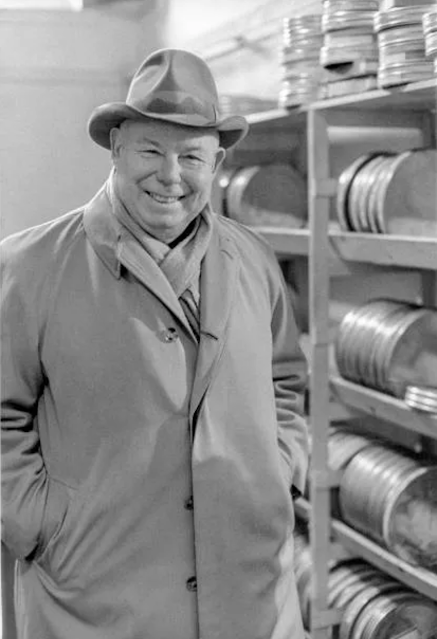
Jean Renoir, son of the painter Auguste, and probably the greatest film director of all time, once wrote, "the foundation of all civilization is loitering." 

I read loitering not as standing on the corner watching all the girls go by. But rather as a recognition (something that the modern world doesn't understand) that when it comes to finding answers, the shortest distance between two points is never a straight line. 

There are no straight lines in nature, someone once told me. I believe that.


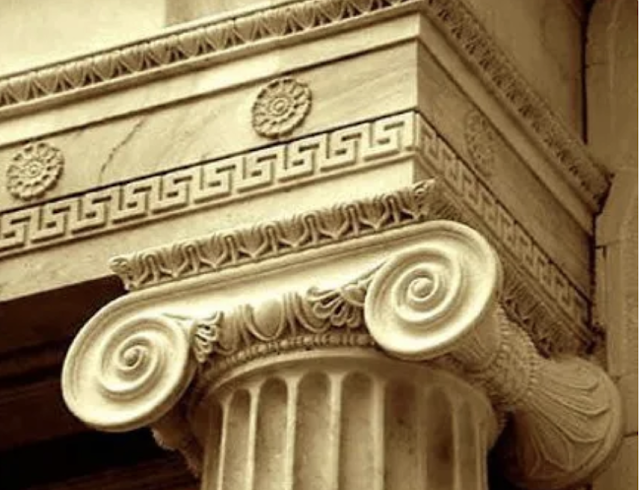
The Greeks reminded themselves in virtually every one of their public and private spaces of the virtue of circuitousness. Think of how many buildings and coffee cups you've seen decorated with this design. A ever-present reminder.

In Turkey, there's a river the Greeks called the Büyük-Menderes. To quote Wikipedia, "the river was well-known for its sinuous, curving pattern." That's where we get our word meander.

Let's do the twist.


Tuesday, November 14, 2023

Elite.


Being something of a cretin, and I don't mean from Crete, I had never heard of Andrew Wylie before this weekend, but now I am fairly in love.

Wylie is one of those intimidating sorts I might have known or worked with for a decade or so. But he's so obviously brighter than every one else, and his appearance is so forbidding, that I don't think I'd ever have been able to work up the courage to talk to him.

He was just interviewed by David Marchese in the Times. Not only did I read every word, and send the article to half a dozen of my friends, I also pdf'd the piece and saved it in a special file on my hard drive. 

Wylie might be the world's premier literary agent and though I read a lot, I'm not exactly literary and I've never been within a hundred or so blocks of any party Wylie would attend. I'm from Yonkers originally, a town so hard-scrabble it makes other hard-scrabble towns look Polident-ready. They don't usually let my type into fancy soirees. The first words of roughly 82-percent of the boys born in Yonkers in the late 1950s were, "Yo! Mariaaaaa!"

Despite all that, Wylie and I share some points of view and, I'm not sure how all this happened, are dismissive of many of the 
"O tempora, O mores" types of things Cicero decried nearly 2,000 years ago. Cicero never had to deal with either the Kardashians or the Golden Bachelor, but he was, like me, aghast when viewing the times and the customs. Who could blame him?

Though I am not a religious person, and have no belief in any higher power, at times I am surprised by the positive cosmic serendipities that happen when I least expect them. Like running into a friend you hadn't seen for years when you were just thinking about her. Or seeing an old boss on the street and he needs someone just like you for a tough but lucrative assignment. Of finding a $20 in a pair of jeans you haven't worn since the Reagan administration.

Somehow some force drew me to this part of Marchese's interview with Wylie. I started, as I so often do in media res--in the middle of things. The brutal parallels from Wylie's business to that of advertising are so obvious I won't even point them out. However, I do suggest, in addition to cutting out and posting Wylie's response on your computer or sending it anonymously to the C-suite of your holding company, maybe you read it twice before moving on and then once again every morning and before you go to bed.

MARCHESE:
My sense is that the publishing world used to be run and populated largely by people who liked books and were interested in literature, and now there’s a cohort of people who work in publishing who might be interested in data analytics, and they’re paying attention to spreadsheets and online search terms. Do you find yourself having to communicate differently with those people? 

WYLIE:
I think that a number of publishing companies have brought in business people to help them in a futile effort to become more distinctly profitable. But it’s comical, because frequently these people don’t understand the difference between selling a widget and selling a good novel. The advantage that they bring to the publishing company is counteracted by the hilarious errors of judgment they make because they don’t know what they’re selling. It tends to be true that the best publishers are people who read books and whose primary understanding of the business comes from what they’ve read rather than from Harvard Business School.

Here's another little portion of the interview that you might want to think about, or at least think about thinking about.

MARCHESE:
Is there anything, in a longer-term, strategic way, that you find yourself puzzling over in the way that maybe 15 years ago you were thinking about authors’ digital rights? 

WYLIE:
Not really. The battles have remained quite the same for a number of years. It’s all about the exaggerated favor that accrues to the distribution piece. I mean, they’re just a bunch of messengers. You don’t have to kowtow to Amazon. You don’t. And yet, “Well, how do we not?”


What’s the answer to that? It’s like your dinner party: You want everyone to come? The room is going to be packed. Or do you want to just have fewer but better people?


Again, parallels to the ad industry where we let social platforms control how we make the advertising we make and decide what to put next to it and how, not, to monitor it. The ad industry's mania for always-on and 'for-everyone-ness' will be our undoing. 


When I see expensive auto brands advertising with hip-hop music, I don't know what they're thinking. That music fractures my brain cells. It tells me they don't value me as an older person and they're forcing on me a "culture" that is not my own. It's as imperial as anything the East India Company ever did.


A final bit from Wylie on that.

MARCHESE:

We’re not supposed to look down our noses at pop culture anymore. Do you think that’s a phony attitude? Is there some defense of cultural elitism that you want to make? 


WYLIE:

Not particularly. I suppose to a great extent I’m just guided by my taste, and that’s probably idiosyncratic and narcissistic of me. I’m not a person who would ever go to Disney World. There are a lot of people who do. I don’t necessarily think that they’re ridiculous. I just don’t share that taste.


I think there was also a time in the ad industry where we were guided by our taste and our minds. We were taste-makers, not trend-followers. And I think the industry and our lives were better for it. The by-products of everyone-wins-a-trophy-itis have given us legitimate vaccine denial, flat earthers, Obama truthers, moon-landing denial, election-denial and more. 


Following is not leading and we need to lead so brands can lead. 


Very heavy, I know. 

Call me elitist.


I'll take it as a compliment.


Monday, November 13, 2023

Losing My Marbles.


Over the weekend, I fired up my 1966 Simca 1500, with 375,000 miles on it. First we filled the old car with about 300 of my heaviest books and everything my wife could stuff into every corner of the vehicle. There wasn't even room for the blankets we usually drape over ourselves, since the colder the weather, the more balky the car's unreliable heating system.

There was a ton of traffic leaving the city. The new road-maintenance regimen requires three lanes to be shut down if road crews are working on one. One lane is the lane they're supposedly working on. One lane is a safety buffer. And one lane is so the road maintenance crews can park their expensive German SUVs. I'd hate to think that they, like everyone else, have to walk to their job site.

By the time we escaped the crush of New York urban traffic, the Simca's three-liter BMW straight six installed by Lothar my Croatian mechanic in Toms River and reputedly the best Simca-man, in the free world was spinning like a gambler's lucky dreidel, and I was regularly hitting 85 on the straights of the winding Merritt Parkway, surely one of the world's most scenic highways through one of the world's least scenic onslaughts of suburbia. 

One thing I've noticed during the three or five years I've traveled up to Connecticut from Manhattan is that an inordinate number of roads are called North Avenue. I don't know what it is, but I think I've counted eight or ten in the 110 miles to our country place. I suppose everyone wants to be north of the city, presumably where the air is cleaner and the rats are hardier.

Speaking of our country place, our ramshackle little cottage on the sea is ramshackle no longer. After four months of construction that took twelve months and x dollars that cost xx dollars, the house is about 99.7-percent new and 99.7-percent less creaky and leaning to one side than ever before. 

The house is one-hundred years old, and for the first time in probably eighty years or longer, there's a right-angle or two on the premises and floors you could play a game of marbles on without the marbles all rolling off to one side. In our benighted age, this counts as progress. Paying for it all does too.

Rafael, our towering 6'8" contractor was in the house to greet us when we arrived, with a beautiful bouquet of fall flowers, the type a society matron would have in the foyer near her private elevator.

My wife remarked how nice that was, the flowers especially. To which I replied with my typical austere stoicism, for xxx,xxx dollars, he should have also dropped off a fan-dancer or two, something for the man of the house who had to sweat to afford  the whole megillah based on his ability to write in eight word spurts thing that make people think, laugh and act.

Also, if you're thinking of rebuilding or renovating a house, it makes sense to not hire someone 6'8", no matter how highly he comes recommended. If the project ever devolves into a shoving match, you're sure to end up with a bruised keister. As Preston Sturges' J.D. Hackensacker, III, (Rudy Vallee) said to Geri (Claudette Colbert) in "Palm Beach Story," "that's one of the tragedies of this life, that the men who are most in need of a beating up are always enormous." Same with contractors.

But onto the counterpoint and the advertising point of today's post.

When we entered the house we were in my wife's gleaming new kitchen. I'd imagine she feels the same way in that kitchen that a tech titan feels when he enters his new 352-foot yacht, the kind they have to raise bridges to accommodate. My wife's pride was a palpable as a teenager losing her virginity.

Rafael showed us an eight foot stretch of Carrera marble that Michelangelo would have coveted. "Thisa woulda makea gooda Davido," he might have said. It shined like Harry Winston under old-fashioned flash photography apparatus. Then he walked closer to the six-burner stove that consumes as much gas as a Saturn V rocket. "Look how I hid the seam," Rafael glowed.

His craftsmanship really was a sight to behold. The unseamed countertop was flatter and seemingly longer than the Bonneville Salt Flats.

Magnificent in all this is something too many of us in our dying business for too long have completely forgotten. A simple word:

Pride.

Pride in doing it right. Even if no one notices.

Taking the time to "hide the seams." 

Here's a bit by Saul Bass that sums up everything I've been writing about for the last 92 years.

Don't blame the machines who can't. Don't blame the people who run the machines. Blame the titans who rule the world who don't care, don't know, and amass all the money. 

They're uglt.


Friday, November 10, 2023

Inflation Blows.

Growing old, as we're all doing, is hard-enough. 

You have to deal with ageism bs. And you have to deal with the aches and pains of your aging body.And you have to deal with the financial bullshit of making a living, making sure you don't wind up in a nursing home, or prisoner of billions of dollars of medical expenses.

You might even have worries, if you're lucky, about your estate or legacy. Leaving something for your kids so maybe they have it a little better than you had it.

Growing old, as I wrote, is hard-enough.

Growing old and having a long-memory is even harder.

It's harder because you remember when the world made more sense. When two ice cream cones didn't cost eighteen dollars. When a stay at a hotel on a tropical beach wouldn't run you $1,800 a night. When a taxi from midtown to the Upper East Side wasn't $32.

In short, you remember things before inflation. Like sneaking out of school to see Willie Mays on his return to New York and getting pretty good seats for $3.50.

The other sort of inflation that screws with this old man's head is maybe even more pernicious than price inflation. 

It's title inflation.

It's rare that I go into a meeting nowadays where I'm not impressed with the "titular eminence" of the people in the conference room or on the zoom call.


Naively, I suppose, not thinking of title inflation, I'll say to myself, "shit, the Senior Executive Chief Executive Officer is in the room. And also, the President. And the Chair of the Executive Committee."

It doesn't take you long to discover that those titles have about as much meaning as the neon signs on a New York pizzeria, by which each place declares that it has "New York's #1 Pizza," or "Best Pizza in New York," or the anodyne but ubiquitous, "New York's Favorite Pizza."

To my old (and tired) eyes it seems job titles work in a similar manner today. About nine people can proclaim themselves "President," or "CEO," or "Chief Creative Officer." And none of those heavily-titled people can "decision" their way across a pair of railroad tracks.

Just as with price inflation there's no guarantee that your "$66 Argentinian steak" will be worth eating, there's absolutely no guarantee that the "President" you're presenting too can decide to go to lunch without having it ok'd by senior management and the board.

Again to my wizened view, our world seems populated by people with giant titles and zero power. Every move they make and every decision they inch toward needs to be a group effort and consensus must be reached. If you were standing by an elevator in the lobby, it would take at least 45-minutes to get everyone together, consider all the options, worry about the ramifications, then press "up."

Here's an old man's dream. Move the decimal point to the left a place or two.

Make the $66 steak a $6.60 steak. 

The $52,000 Honda Civic, $5,200.

And please, if you're working for a company and can say "no" with confidence but are unable to say "yes," or you're afraid of making a decision lest someone somewhere will take exception, let's figure out a name for your job that isn't so elevated.

When you walk around with a big title, there's a promise implicit in that title that you have some power--at least that's the way it seems to the elderly. If you have none, that's fine. We all have crosses to bear and axes to grind. 

I just wish all this inflation would come back down to earth.


Thursday, November 9, 2023

It's Un Real.

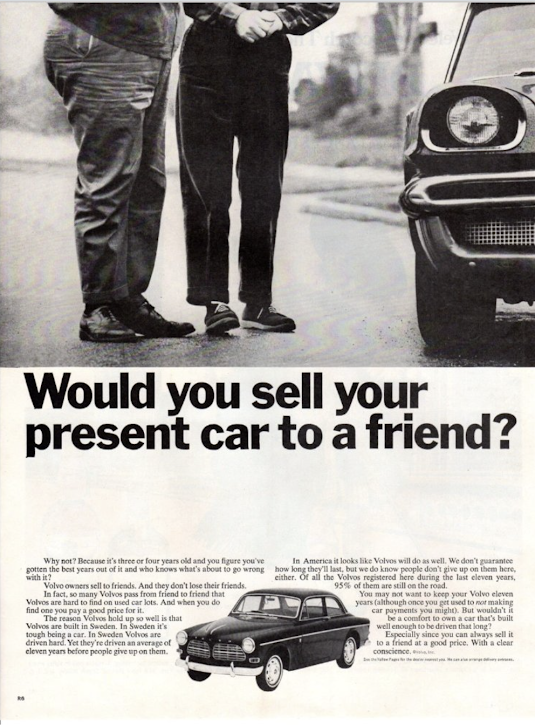
On Tuesday, I posted a raft of 1960s, 1970s, and even 1990s-era Volvo ads. They were pretty good examples of some of the best of a bygone era of advertising.


On Wednesday, Dave Trott sent me a note on muskrat's site that included an ad I neglected. Saying it was one of his favorites from his days at Pratt, in Brooklyn, in the late 1960s.

I always loved the ad, of course. But for whatever reason--I guess I was too excited by the copy, I never noticed the wardrobe of the two guys in the photo. This morning I observed a couple of things. One, the guys look real, with real poses and real wrinkles. They were wearing real clothing, baggy and worn. And two, the guys have real bodies. They aren't cut and svelt. One looks a little fat-assed. You know, like a real person.


I had always believed that one of the extraordinary things about this Volvo ad above, is that they showed and recorded the car being a car. Being driven, being abused, going through the travails of modern life. In fact, they show the car dirty. That's something American car makers of the day, or even today, would ever show. In fact, realism is to be shunned.


Just seconds ago I got an email from The New York Times. It's one of the dozen or so subscriber emails I sign up for. This one must have found me by mistake--because it's all about fashion advice. In this case, can you wear pantyhose as pants? 

I won't comment on that alleged trend. But what I will comment on is the utter-posiness of the photograph above. Of course, I couldn't pick a Jenner out of a one-person line up, much less a Kardashian. But what struck me was the artificiality of it all. Every single pixel of the photo above has had all possible humanity styled the fuck out of it. It's all about as natural and real at trump's cranial merkin.


About two weeks ago I read something called "The Age of Average" by Alex Murrell. Murrell argues that "from film to fashion and architecture to advertising, creative fields have become dominated and defined by convention and cliché. Distinctiveness has died. In every field we look at, we find that everything looks the same." Above are some composite photos that underscore Murrell's thesis. And, I suppose, my thesis, too.

In an effort to make everything, "upbeat, friendly and optimistic," (in the vernacular of about 99.9878475-percent of all briefing documents, we have expunged any and all traces of humanity and reality.

Somehow we're expected to believe people break into dance when they buy nacho chips, are disconsolate when someone else grabbed the last can of beer, are actively concerned with the some au courant banality that in all likelihood occupies less than two-seconds of thought in the course of a month. Linguistically, we're meant to believe people say "boo-yah" or "that's my happy place" at the drop of a woolen cap in August, and that all 350-million citizens in the fattest nation in the history of the planet have abs you could grate cheddar on.

Look, I don't give a rodent's heinie in someone wants to walk around with their underwear on the outside. Sure, I think it's grotesque and stupid, but c'est la vie.

But I do wish as advertising practitioners we could again connive a way to start showing truth and reality again. Depicting things as they are, not as an all-you-can-eat focus-group wishes they were so their Hallmark-sensibility doesn't get hurt.

If I had to write a brief tomorrow, or even make a client presentation, I might as a pre-amble start with these words from Harvey "Big Daddy" Pollitt, as truthed by Tennessee Williams.

"The truth is pain and sweat and payin' bills and makin' love to a woman that you don't love any more. Truth is dreams that don't come true, and nobody prints your name in the paper 'til you die." 

I think the cataclysm that is modern advertising has a lot to do with a world that hates the world we live in and tries to pretend we don't. 

Carl Ally said, "Advertising should afflict the comfortable and comfort the afflicted." Today, instead, we deal in cliches and pablum and, without empathy, try to primrose the world into a bland, blind, blunt numbness so our customers--whom we call targets--are trained to smile and dance like everything's ok. And everything is ok, as long as we have Y-O-Y incremental growth of .22-percent and hit our KPIs as if they are real.

Wednesday, November 8, 2023

My Mother Gave Me Three Things.

My mother was not a nice woman. And she was a horrible mother. She was mean, abusive, borderline, demanding and never once in the seventeen or so years I lived under her teetering roof did she hand me a compliment that she didn't take quickly take-away with her other hand.

However, she gave me some things that today--almost fifty years after I left her tilted little home for the last time--that I am thankful for.

Of course, her house, such as it was, was filled with books. No matter what books were in her stuffed-to-the-gunwales shelves, we were expected to absorb their contents. From the films of Greta Garbo to the Harvard Classics--all 50 volumes in their beautiful olive drab linen covers. 

There could be a quiz at any moment--and the consequences of any intimations of stupidity were not what would be considered acceptable today. The stories I read of English boys' schools,  from Thomas Hughes' "Tom Brown's Schooldays," or something by Dickens, or even old Shirley Temple movies where she was forced to shovel coal and sleep in a freezing attic told of disciplines and regimens far less strict than those my brother and I grew up under. 

In fact, we lived under a rigid system of demerits (there were no rewards) and if we accumulated enough of them, we could be put on report. Usually that meant isolation in the damp and mousy basement where we had to pick up years of detritus and every tie-up in parcels approximately every issue of National Geographic ever published. Somehow my younger sister, Nancy, escaped this torment, though she got more than her share of maternal mishigoss.

My mother also beat me into becoming a bit of a scullery maid or even a scullion. She trained me to the point of excellence at the most grueling and labor-intensive of the culinary arts. To this day, I can peel apples and potatoes like I'd spent a lifetime as a buck private in the army and passed my time in uniform not fighting enemies but up to my calloused elbows in KP. In a John Henry vs. Steam Hammer-type match against a Cuisinart, I'd advise you put your drachma on yours truly. It's not likely any mere machine can best me.

When I think about the rigor I grew up under, it's easy for me to PTSD myself into a psychiatrist-endorsed gloom. It was a helluva upbringing I had. And I have the scars to prove it.

But, on the other hand, when the phone rings and a month of work for three teams is due in three days, I know I can handle it. It's just a heap of potatoes that need peeling.

When a client gives feedback like, "Can you make it ownable without being distinctive," I don't worry. I attack that oxymoron and tackle it like gutters that needed cleaning during a rainstorm or a long parquet hallway that needed to be buffed to a I-can-see-myself-sheen.

When I'm told two agencies before me tried and failed and now I have two days, I welcome the challenge and amn't afraid of it. I've been down that road before and have had a lifetime of worser assignments with more dire consequences for failure.

The final thing my harridan of a mother bestowed upon me was something of a sense of humor. Humor became my coping mechanism and my greatest resource.

And while I have a slate of wife-jokes that might have made Henny Youngman jealous, my mom jokes are even more numerous.

Like this one, which I'll end with.

My mother adopted a highway. After two weeks it went looking for its birth highway.


Tuesday, November 7, 2023

Two Words.

Along the way, two words changed the advertising industry.

I don't know who came up with them or why.

Somebody probably started spouting things like "nobody cares about the product." And I guess no one was there to Gossage-ize them and say, "Our job is to make them care."

So quickly, in just the last couple of decades or so, we added two words to what advertising has always done when it was done well.

We went from:

"Make the product important."

To

"Make the product important in culture."

Ouch.

The "in culture" appendage represented a way to show how cool your mayonnaise was or our plastic wrap. How those products or brands "got it" and fit into our lives.

Nearly every commercial or ad I see these days has generic language, me-too visuals, and a positioning that says a brand is either right for now or built for you or built so you can be your best self or live in your now.


You see spots like this. Which rely on for their “persuasiveness” the endorsement of celebrities who I don’t even recognize. Or music I don't like. 

The $200 shoes don't get talked about. $20,000 dental work is all that's shown.


Let's look at how compelling the super-titled copy is in this Volvo spot for their $80,000 XC90.

1. 'Our most luxurious' is meaningless. 'The most luxurious' would vaguely mean something. Dumb.

2. Spacious seating for up to seven. Parity claim. Dumb.

3. Innovative safety features. As opposed to old-fashioned safety features. Dumb.

4. High quality materials. Oh. I prefer low-quality materials. Dumb.

5. Comfortable for long drives. Again, oh. Dumb.

6. and 7. The car works in the day-time and night-time! Dumb.

8. Every mile a pleasure. Ok. Bumper-to-bumper traffic on roads that haven't been paved since 1962, is a pleasure. Dumb.

My point here isn't to bust New Balance or Volvo, though they both deserve it. My point is that neither of these two all-too-typical spots includes anything salient about the product itself. Nothing that makes the product interesting, different or unique. Nothing that comes close to giving the viewer any reasons why.

They're dumb. Not real. Hoping you like them because they hang with elements some persona says you like.

It's hard for me not to hear the corpse of Bill Bernbach spinning in his grave. 

Again, I can't believe decision-making has shed all of what was important to people just twenty or thirty years ago--and what's been important to people for virtually all of our species' time on this benighted orb. I can't believe that nothing material about the product is worthy of explication or even information. I can't believe no one cares what makes something different or unique or able to answer an individual's needs.

Here are some Volvo ads from days gone by.

They make sense to me now.

Compare them to the Volvo spot above. 

None of these ads try to make Volvo a part of culture.  

They were more interested in making Volvo a part of your driveway.