We are assured through various advertising campaigns featuring women with firm perky breasts and men with granite abs and prodigious biceps, that we are all athletes. We are told that our slog around the reservoir in their gear will make us glorious, victorious and valorous. Puma calls us "after hours athletes." Nike tells us to "find our greatness" (and urges us to track our every motion through their 'fuel band.') And adidas assures us that impossible is nothing.
With billions of dollars beamed at us we suit up and run and bike and swim and lift and spin and step and jump and box and skate. We do it every day, a modern-day religion of self-actualization.
What strikes me as odd is this: I may fantasize about running a three-hour marathon (30 years ago, I came close, clocking in at 3:10:15) but my reality is I am a writer. Writing, not writhing, is what I get paid to do. And while there is nothing wrong maintaining a fitness regimen, I question why so few maintain a creative regimen.
How many art directors, how many copywriters train everyday to improve their skills?
More than 300,000 words ago I began writing this blog. 300,000 words is 1,200 typewritten pages. And those 300,000 words have made me a better writer than I have ever been. Because I have been practicing.
My blogging friends, Rich Siegel at http://roundseventeen.blogspot.com/, Bob Hoffman at http://adcontrarian.blogspot.com/, Tore Claesson at http://toreclaesson.blogspot.com/, Ben Kay at http://www.ben-kay.com/, the people at Sell! Sell! http://sellsellblog.blogspot.com/ and Dave Trott at http://www.cstthegate.com/davetrott/2012/08/the-answer-asks-the-question/ practice their skills every day, or nearly so. They are doing the creative equivalent of 50-mile weeks. They work and work and work to sharpen their skills, their perceptions, their insights.
They practice every day. And, as my mother would be sure to bludgeon me: practice makes perfect.
To bastardize a line from above, they, like me, are "after hours creatives." They find time late or early, to do what they do and by doing get better at it.
It's the only way, I think.
Tuesday, August 28, 2012


Monday, August 27, 2012
Language.
Sitting in an open workspace exposes you to a lot. Not only can I hear just about every conversation within 50 yards of my table, I get to hear the sort of language that fairly makes my skin crawl. If we think about language and the semiotics behind language, the words I hear almost every day are upsetting. If language reflects thought, we are as an industry moribund.
I hear people talking about "decks." Not about a presentation--something living. But about a deck. Something large, ponderous, heavy and inanimate. No one ever said, I'm looking forward to reading that deck. But decks are what we produce. Boring.
I hear account people say, "we'll get the assets from the creatives." Not the ad, or the banner, or the commercial. Again, we as an industry, use a dead, material word. A word that commoditizes that which we get paid to produce.
And we are no longer people, it's no longer "I'll get the work from Tom and George." That sentence is human. It's "I'll get the assets from the creatives."
Even our departments are tainted. Human resources. I am a resource, like a geyser, a fir tree or a vein of coal. Thank you for admitting I am a human.
I remember once when I was in charge of a large Boston agency and we were moving buildings, the General Manager came to me with a "stacking plan." We are not people. We are cord-wood.
We no longer take a day off. That is too casual and not officious sounding. We're on PTO. Some relative, I suppose of PCBs. As if our employer is doing us a favor by paying us for our leisure day. PTO could, after all, be ETO--earned time off. But we willingly give the linguistic power to the holding company.
Language is power and we have given it away.
That's all for now. I have some assets to ideate and have inserted into a deck before a conference call.
I hear people talking about "decks." Not about a presentation--something living. But about a deck. Something large, ponderous, heavy and inanimate. No one ever said, I'm looking forward to reading that deck. But decks are what we produce. Boring.
I hear account people say, "we'll get the assets from the creatives." Not the ad, or the banner, or the commercial. Again, we as an industry, use a dead, material word. A word that commoditizes that which we get paid to produce.
And we are no longer people, it's no longer "I'll get the work from Tom and George." That sentence is human. It's "I'll get the assets from the creatives."
Even our departments are tainted. Human resources. I am a resource, like a geyser, a fir tree or a vein of coal. Thank you for admitting I am a human.
I remember once when I was in charge of a large Boston agency and we were moving buildings, the General Manager came to me with a "stacking plan." We are not people. We are cord-wood.
We no longer take a day off. That is too casual and not officious sounding. We're on PTO. Some relative, I suppose of PCBs. As if our employer is doing us a favor by paying us for our leisure day. PTO could, after all, be ETO--earned time off. But we willingly give the linguistic power to the holding company.
Language is power and we have given it away.
That's all for now. I have some assets to ideate and have inserted into a deck before a conference call.
Eulogy.
By some unfortunate twist of fate I was born, not with the gift of laughter, but on the cusp of slaughter. Not at the hands of the father, like Isaac to Abraham, but at the hands of a cruel and knife-wielding mother who was narcissistic, unstable, borderline and, worst of all, just plain mean.
We have complicated and fancy words now and rarely call people mean, but that is what she was, like a kid pulling the wings off of flies or burning ants alive, I was her insect.
My father, who should have been my protector, because he was aware, was largely absent. Gone for days every week and weeks every month on business trips. And my mother saw in me, magnified and right before her eyes everything she hated in my father writ large. So it was me she scorned, punished and kicked the shit out of.
It was me she slaughtered, more than my older brother and my younger sister, I bore the scars--scars in three places on my head by the time I was four. I was a pin-cushion for her invective and her cruelty.
Yet, she gave me gifts, even if they came from the back of her hand. A love for books, a love for words, a sense of humor (the only way I have survived) and for those I thank her. She gave me a hunger to learn, which I still have. Most of all, she gave me a bad example. She showed me in real life every day, day in and day out, what I would not become. In this way, she became an inspiration.
But for the abuse, the cruelty, the lack of support, the absence of niceness, I can't forgive and after 33 years of therapy, I can't either forget. It's just there, her. Like a permanent limp, or those scars on my face that, being scars, will never be erased.
My brother called this weekend to tell me that she had finally died. We had been watching her for months sink even deeper into her living coma, not leaving her bed, much less her apartment. And now the people who gave her round-the-clock care that we paid for, said she sunk dead.
I can't cry, Willy.
I had done all my crying growing up. I had done all my crying for the past 54 years. I am cried out.
And I can't cry.
We have complicated and fancy words now and rarely call people mean, but that is what she was, like a kid pulling the wings off of flies or burning ants alive, I was her insect.
My father, who should have been my protector, because he was aware, was largely absent. Gone for days every week and weeks every month on business trips. And my mother saw in me, magnified and right before her eyes everything she hated in my father writ large. So it was me she scorned, punished and kicked the shit out of.
It was me she slaughtered, more than my older brother and my younger sister, I bore the scars--scars in three places on my head by the time I was four. I was a pin-cushion for her invective and her cruelty.
Yet, she gave me gifts, even if they came from the back of her hand. A love for books, a love for words, a sense of humor (the only way I have survived) and for those I thank her. She gave me a hunger to learn, which I still have. Most of all, she gave me a bad example. She showed me in real life every day, day in and day out, what I would not become. In this way, she became an inspiration.
But for the abuse, the cruelty, the lack of support, the absence of niceness, I can't forgive and after 33 years of therapy, I can't either forget. It's just there, her. Like a permanent limp, or those scars on my face that, being scars, will never be erased.
My brother called this weekend to tell me that she had finally died. We had been watching her for months sink even deeper into her living coma, not leaving her bed, much less her apartment. And now the people who gave her round-the-clock care that we paid for, said she sunk dead.
I can't cry, Willy.
I had done all my crying growing up. I had done all my crying for the past 54 years. I am cried out.
And I can't cry.
Saturday, August 25, 2012
Neil Armstrong, a remembrance.
Reprinted on the occasion of Neil Armstrong's passing.
Years ago--I think it was the 10th Anniversary of Neil Armstrong's moon walk, I had the honor of interviewing Armstrong for my college newspaper.
Being a "writerly" sort, asked him specifically about his words on setting foot on the moon. How did you come up with "One small step for man; one giant leap for mankind."
Armstrong looked me dead in the eye, "I never said that."
"Mr. Armstrong," I replied, "I've heard the recording a thousand times. I've read about it in history books. Every school child knows you said 'One small step for man; one giant leap for mankind.'"
Armstrong said, "What I said was 'one small step for man; one giant leap for Manny Klein."
I begged the famous flier to explain.
Armstrong told me this story, "When I was a kid growing up in Brooklyn, the walls in our apartment house were very thin. You could hear everything. And every night I would hear our neighbor, Manny Klein, begging his wife for oral sex. Every night, Mrs. Klein would demur.
"Finally," Armstrong continued, "Mrs. Klein relented. She said when a man walks on the moon, I'll give you oral sex. Hence 'One small step for man; one giant leap for Manny Klein.'"
Years ago--I think it was the 10th Anniversary of Neil Armstrong's moon walk, I had the honor of interviewing Armstrong for my college newspaper.
Being a "writerly" sort, asked him specifically about his words on setting foot on the moon. How did you come up with "One small step for man; one giant leap for mankind."
Armstrong looked me dead in the eye, "I never said that."
"Mr. Armstrong," I replied, "I've heard the recording a thousand times. I've read about it in history books. Every school child knows you said 'One small step for man; one giant leap for mankind.'"
Armstrong said, "What I said was 'one small step for man; one giant leap for Manny Klein."
I begged the famous flier to explain.
Armstrong told me this story, "When I was a kid growing up in Brooklyn, the walls in our apartment house were very thin. You could hear everything. And every night I would hear our neighbor, Manny Klein, begging his wife for oral sex. Every night, Mrs. Klein would demur.
"Finally," Armstrong continued, "Mrs. Klein relented. She said when a man walks on the moon, I'll give you oral sex. Hence 'One small step for man; one giant leap for Manny Klein.'"
Friday, August 24, 2012
Save America. Kill an MBA.
My older daughter is swimming a five kilometer race in Lake George this weekend. And my younger daughter returns to Manhattan after 84 days teaching scuba in the Caribbean. So my wife and I have rented cabin for the weekend for the four of us to have a family reunion of sorts.
My wife announced yesterday that she needed to pickup the rental car on Thursday. If she did so, the rate was $59/day. Whereas if she waited until today to pick up the car, the rate would be $179/day. So four times $59. Or three times $179.
Such a "pricing strategy" could only have come from an MBA.
Now take a look at this piece of shit commercial they are running the shit out of in New York. Don't judge it for its lack of idea or its corny cgi device. Try, instead, to unravel and understand what seems to me to be the point of the spot. That is that you get "a single pool of shareable data that powers up to ten devices."
My wife announced yesterday that she needed to pickup the rental car on Thursday. If she did so, the rate was $59/day. Whereas if she waited until today to pick up the car, the rate would be $179/day. So four times $59. Or three times $179.
Such a "pricing strategy" could only have come from an MBA.
Now take a look at this piece of shit commercial they are running the shit out of in New York. Don't judge it for its lack of idea or its corny cgi device. Try, instead, to unravel and understand what seems to me to be the point of the spot. That is that you get "a single pool of shareable data that powers up to ten devices."
Since when were phones, computers, tablets, etc. "powered by data." And since when was my phone called a device. I'm 54 years old. To my generation a device is a thermonuclear bomb.
Only powerpoint-fueled imbecilic MBAs could make sense of any of this.
And shit like this drives companies to ruin. Makes people hate them. And ignore their advertising.
MBAs don't get that.
Never will.
--
BTW, here's my chat with "Chad" from Verizon.
Please hold for a Verizon Wireless sales representative to assist you with your order. Thank you for your patience.
You are now chatting with 'Chad'
Chad: Hello. Thank you for visiting our chat service. May I help you with your order today?
george: what does a single pool of shareable data that powers up to ten devices mean?
george: are devices powered by AC or DC?
Chad: I'd be happy to assist you.
Chad: Would you mind holding for a moment while I check that information?
george: sure
Chad: The currents are for AC. Also the shared data refers to the new plan offerings.
Chad: All of your phones/devices would have access to the "data pool" if you will.
george: i dont understand how that "powers" my devices
george: and what's a data pool? Is there a deep end? Do I need to wear a data swim cap?
Chad: The data package is more for internet usage however the phones run off of being plugged into an outlet.
george: so when they say powers in the commercial, it's misleading
Chad: The thing is smartphones are updated through the internet.
george: Oh. You mean from a software pov. But that doesn't mean they're "powered."
Chad: That is correct.
george: So, I'm not dumb. The commercial is.
Chad: Do you have any questions about our phones or accessories today?
george: Well, I would, if I understood your commercials.
george: It's like they're written in Martian.
Chad: It has been my pleasure to chat with you today! Please feel free to re-open the chat session if you need further assistance . Thank you and have a great day!
Thank you for chatting with us, visit our Online Workshops to learn more about your devices. Click "End Chat" to tell us how we did today via our survey.
Friday reflections.
When I was a kid I was really not that much different than I am today. By that I mean I was as obstreperous, disagreeable and captious as they come. Growing up in the 60s, I wasn't the only one in my "gang," to be this way. But perhaps I was the most voluble.
Consequently, my mother spent a good portion of her time with her hand whacking my head with no little amount of ferocity. I had the kind of child-rearing that could get you arrested today. Back five decades ago, it was merely regarded as strict.
Since I knew no different and assumed that most everyone got fairly-well cuffed fairly often, I never protested this treatment. I figured it was normal to be batted around. Like my mother's cooking, it wasn't until I got to college that I actually found out meals could be served hot.
I left home at 17 and have seldom been back. Partly because my parents moved to Chicago then, and Chicago never was my home and partly because I never liked my parents all too much. Sure, I learned from them. I got a good education and certain skills. But I've still felt the need to have spent the last 33 years of my life in fairly intense, very expensive therapy. And as my therapist says to me, "George, you're a lifer."
My disdain for authority which was generated by my parents' treatment of me has, I think, served me well in my career. First off, I never take what a client says at face value. I question every claim and every brief. I think this makes me a better creative.
I also don't take anything else at face value. The bullshit agencies produce like cattle generate methane. The holy-shit-this-will-change-everything proclamations that seem to be spouted every seven minutes of so by people who want to believe they can turn base metal into gold.
Most of all, what I got from my parents is the feeling that I'll never have a home. I'll never really settle in anywhere and buy into the status quo.
Most agencies, though they claim they want original thinkers and combative personalities want them only so long as those personalities can fit into an Excel spreadsheet cell. What they really want are amen-choristers. People who say amen no matter what the leaders blurt.
Being an outsider means you work hard. You work to do your best. Because you never let your hair down and feel safe anywhere.
Outsiders are, as I stated above, obstreperous, disagreeable and captious. And most agencies can't handle them. They don't fit the mold.
They are, however, where good work comes from.
Consequently, my mother spent a good portion of her time with her hand whacking my head with no little amount of ferocity. I had the kind of child-rearing that could get you arrested today. Back five decades ago, it was merely regarded as strict.
Since I knew no different and assumed that most everyone got fairly-well cuffed fairly often, I never protested this treatment. I figured it was normal to be batted around. Like my mother's cooking, it wasn't until I got to college that I actually found out meals could be served hot.
I left home at 17 and have seldom been back. Partly because my parents moved to Chicago then, and Chicago never was my home and partly because I never liked my parents all too much. Sure, I learned from them. I got a good education and certain skills. But I've still felt the need to have spent the last 33 years of my life in fairly intense, very expensive therapy. And as my therapist says to me, "George, you're a lifer."
My disdain for authority which was generated by my parents' treatment of me has, I think, served me well in my career. First off, I never take what a client says at face value. I question every claim and every brief. I think this makes me a better creative.
I also don't take anything else at face value. The bullshit agencies produce like cattle generate methane. The holy-shit-this-will-change-everything proclamations that seem to be spouted every seven minutes of so by people who want to believe they can turn base metal into gold.
Most of all, what I got from my parents is the feeling that I'll never have a home. I'll never really settle in anywhere and buy into the status quo.
Most agencies, though they claim they want original thinkers and combative personalities want them only so long as those personalities can fit into an Excel spreadsheet cell. What they really want are amen-choristers. People who say amen no matter what the leaders blurt.
Being an outsider means you work hard. You work to do your best. Because you never let your hair down and feel safe anywhere.
Outsiders are, as I stated above, obstreperous, disagreeable and captious. And most agencies can't handle them. They don't fit the mold.
They are, however, where good work comes from.
Thursday, August 23, 2012
For Klimt.
As I said in my previous post, I took the day off to see the Gustave
Klimt show at the Neue Gallery on Fifth Avenue and 86th. The museum is
celebrating the 150th Anniversary of Klimt's birth and the gallery is
showing a half dozen portraits (including Adele Bloch-Bauer I) and
dozens and dozens of smaller paintings and charcoal sketches.
Additionally, the exhibition rooms are decorated the works of the Wiener Werkstatte, including furniture by Josef Hoffmann and Koloman Moser. Their work deserves a show in its own right. If you don't know the work of the Werkstatte, do some Googling. My guess is you'll like what you see.
Additionally, the exhibition rooms are decorated the works of the Wiener Werkstatte, including furniture by Josef Hoffmann and Koloman Moser. Their work deserves a show in its own right. If you don't know the work of the Werkstatte, do some Googling. My guess is you'll like what you see.
The whole schmear, as they say in Yiddish, made quite an impression on me.
I especially liked this line which Klimt wrote in a letter to a friend in 1903. "There is always hope, as long as canvasses are empty."
A day off in New York.
Some years ago, maybe half a decade, Ronald Lauder, the billionaire heir of the Estee Lauder cosmetics fortune, bought a giant mansion on Fifth Avenue and 86th Street and built a museum dedicated to German and Austrian art and culture called the Neue Gallery.
 Lauder also spent about $150 million buying Gustave Klimt's masterpiece, "the Mona Lisa of the 20th Century," Adele Block-Bauer I. The Neue Gallery has the painting on display only through this up-coming Monday, so my wife and I decided to beat the last-minute crowds and we're taking the day off and seeing the painting today.
Klimt was a crazy man. A man of Lucullan appetites, who painted and slept with virtually all those Viennese who lauded his avant-garde works. He was scorned by the Viennese establishment, hated for his upsetting of the societal applecart. His many sketches of female nudes assertive in their sensuality and sexuality would put hair on your chest today. In Klimt's time they were considered degenerate, "Jewish" and were banned.
Apparently, there were Republicans back then, too.
I haven't traveled that much in my life so I can't say I'm fully-knowledgeable in the matter, but I do believe New York is the greatest city in the world. Just as Vienna was in the early 1900s. And London was some years before that.
I've been going pretty hard at work over the last few months. I've partnered with a new art-director, conceived and sold and new campaign and chosen a director for the three spots we'll be shooting in about a month.
Along the way, the usual crush of new business and regular work has continued.
But today, all that is forty blocks away.
I am seeing "The Lady in Gold."
Klimt was a crazy man. A man of Lucullan appetites, who painted and slept with virtually all those Viennese who lauded his avant-garde works. He was scorned by the Viennese establishment, hated for his upsetting of the societal applecart. His many sketches of female nudes assertive in their sensuality and sexuality would put hair on your chest today. In Klimt's time they were considered degenerate, "Jewish" and were banned.
Apparently, there were Republicans back then, too.
I haven't traveled that much in my life so I can't say I'm fully-knowledgeable in the matter, but I do believe New York is the greatest city in the world. Just as Vienna was in the early 1900s. And London was some years before that.
I've been going pretty hard at work over the last few months. I've partnered with a new art-director, conceived and sold and new campaign and chosen a director for the three spots we'll be shooting in about a month.
Along the way, the usual crush of new business and regular work has continued.
But today, all that is forty blocks away.
I am seeing "The Lady in Gold."
Wednesday, August 22, 2012
Floaters.
When you have insomnia as I have, there are two things you can do. One is you can fight it toss for turn and attempt to will yourself to sleep. You can swallow a battery of pills, drink warm milk, chamomile tea. You can try all manner of things to get yourself asleep.
The second thing you can do is live with your insomnia. You can tell yourself your "normal" is to be up from 1:30 to 3:30 every morning, so accept it and find something useful or valuable to do with that extra time. Use the time to watch Buster Keaton silents, to read the histories of Xenophon, or, if you're lucky to have a golden-retriever puppy as I am, you can take her for long, destination-less walks as I do.
The city along the river in the wee hours is an amazing place. It's as quiet as a small town in the midwest, with few people, few cars and only light shipping on the estuary. You can hear the roiling water--which you can't do during the day, and I believe hearing a river "speak" is one of the true joys of living.
Last night, at two, I slipped a leash on my dog Whiskey and headed one block east to listen to the river. We walked quietly uptown for about 20 minutes, passing virtually no one. The dope-smoking teenagers were home, the vandals were looking elsewhere to ply their spray, and whatever ruffians there are left in New York were, presumably, hunting in more populous locales. Whiskey and I walked uptown, unmolested.
We passed the footbridge at 102nd Street that connects Manhattan to Wards' Island. We passed the rotted pilings at 116th and meandered our way around the deteriorating macadam and hex-block. At 122nd Street, we skirted a rusted chain link fence and kept on uptown, across the gravel that lay underneath the Triboro Bridge.
Some politician had the name of the Triboro Bridge (a perfect name for a Bridge that connects three boroughs, The Bronx, Queens and Manhattan) changed to the RFK Bridge, in memoriam of Bobby, but the functionality of Triboro fits too perfectly the functionality of the span to change what I call it.
As we emerged from beneath the interchanges leading to the Bridge, Whiskey and I re-entered a recently-renovated esplanade that starts around 129th Street. We kept heading uptown, the evening soft and gentle like a blonde.
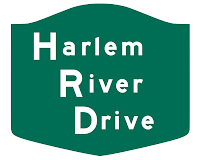
We rounded a slight inlet of the Harlem River (the Harlem and the East Rivers connect around 125th Street as the FDR Drive changes into the Harlem River Drive) and up ahead we saw the visual cacophony of police sirens. Of course there were two police prowl cars there. At night, the cops travel in pairs, like nuns. There was also, in the calm water of the river a police boat with siren flashing and bright light floods lighting the river.
We arrived at the scene. A cop came over to admire my dog.
"What's going on," I asked.
Usually cops stay D and D at a crime scene, but this one spoke. "A floater," he answered. He pointed to a diver in the water next to a shapeless shape.
"Late in the season," I said. Trying to sound street-wise.

The floaters usually come up at the start of the warm weather. This one must have been weighed down with something to come up in late August.
"It's a gruesome way to spend a Tuesday night," I mentioned.
"Well, I ain't in the water with him," he answered back. "You thank God for small favors."
I decided enough was enough. And thank god, though sometimes the river calls my name, that I ain't in the water with him. Whiskey and I turned tail--her literally and me metaphorically and headed downtown, for home.
We had had enough for one night.
The second thing you can do is live with your insomnia. You can tell yourself your "normal" is to be up from 1:30 to 3:30 every morning, so accept it and find something useful or valuable to do with that extra time. Use the time to watch Buster Keaton silents, to read the histories of Xenophon, or, if you're lucky to have a golden-retriever puppy as I am, you can take her for long, destination-less walks as I do.
The city along the river in the wee hours is an amazing place. It's as quiet as a small town in the midwest, with few people, few cars and only light shipping on the estuary. You can hear the roiling water--which you can't do during the day, and I believe hearing a river "speak" is one of the true joys of living.
Last night, at two, I slipped a leash on my dog Whiskey and headed one block east to listen to the river. We walked quietly uptown for about 20 minutes, passing virtually no one. The dope-smoking teenagers were home, the vandals were looking elsewhere to ply their spray, and whatever ruffians there are left in New York were, presumably, hunting in more populous locales. Whiskey and I walked uptown, unmolested.
We passed the footbridge at 102nd Street that connects Manhattan to Wards' Island. We passed the rotted pilings at 116th and meandered our way around the deteriorating macadam and hex-block. At 122nd Street, we skirted a rusted chain link fence and kept on uptown, across the gravel that lay underneath the Triboro Bridge.
Some politician had the name of the Triboro Bridge (a perfect name for a Bridge that connects three boroughs, The Bronx, Queens and Manhattan) changed to the RFK Bridge, in memoriam of Bobby, but the functionality of Triboro fits too perfectly the functionality of the span to change what I call it.
As we emerged from beneath the interchanges leading to the Bridge, Whiskey and I re-entered a recently-renovated esplanade that starts around 129th Street. We kept heading uptown, the evening soft and gentle like a blonde.

We rounded a slight inlet of the Harlem River (the Harlem and the East Rivers connect around 125th Street as the FDR Drive changes into the Harlem River Drive) and up ahead we saw the visual cacophony of police sirens. Of course there were two police prowl cars there. At night, the cops travel in pairs, like nuns. There was also, in the calm water of the river a police boat with siren flashing and bright light floods lighting the river.
We arrived at the scene. A cop came over to admire my dog.
"What's going on," I asked.
Usually cops stay D and D at a crime scene, but this one spoke. "A floater," he answered. He pointed to a diver in the water next to a shapeless shape.
"Late in the season," I said. Trying to sound street-wise.

The floaters usually come up at the start of the warm weather. This one must have been weighed down with something to come up in late August.
"It's a gruesome way to spend a Tuesday night," I mentioned.
"Well, I ain't in the water with him," he answered back. "You thank God for small favors."
I decided enough was enough. And thank god, though sometimes the river calls my name, that I ain't in the water with him. Whiskey and I turned tail--her literally and me metaphorically and headed downtown, for home.
We had had enough for one night.
Tuesday, August 21, 2012
Years ago and today.
In some of my earliest moments in "advertising," I worked for Montgomery Ward as a copywriter in their catalog division. This was every bit as bad a job as it sounds. It involved a lot of "grinding it out," page after page after page and not a lot of creativity.
Nevertheless, I did get paid to write. I had to write to spec. I had to work with buyers (who were essentially clients) and I had to sell my work, usually under a great deal of pressure. I also got to work with art directors, print producers, typographers and editors. All of that was valuable.
Perhaps the most important thing I learned on this job, however, was none of the above. This is something that happened twice a year in which the buyers would report how much revenue they produced from each of the catalog pages we created. We would breakdown their page, and indicate that this item earned $47K, and that earned $88K and so on.
What I realized early on is that buyers essentially "bought" a page for, say, $200,000 from the company. They, therefore had to sell $200,001 off that page for them to keep their jobs. And, of course, for me to keep mine. What's more, if that page earned, say, $400,000, the buyer who bought that page for $200K, would get a huge bonus.
It occurs to me in looking at the world that landing pages and websites aren't all that different from catalog pages. That is, the things in the most prominent positions must earn you the most money or at least the most eyeballs. If no one cares or no one spends, you're out of business.
Like the buyers at Montgomery Ward you also need to learn that putting more shit on page, more stuff to sell, doesn't mean you sell more stuff. Best Buy has many more SKUs than Apple but does many fewer dollars/sq. ft.
I'm sure there's a mathematical way to calculate the "cost" or at least the opportunity cost of owned media. And therefore you should be able to say how much you should earn from each pixel. This doesn't seem that complex to me. I'm not sure, however, if anyone does this.
Nevertheless, I did get paid to write. I had to write to spec. I had to work with buyers (who were essentially clients) and I had to sell my work, usually under a great deal of pressure. I also got to work with art directors, print producers, typographers and editors. All of that was valuable.
Perhaps the most important thing I learned on this job, however, was none of the above. This is something that happened twice a year in which the buyers would report how much revenue they produced from each of the catalog pages we created. We would breakdown their page, and indicate that this item earned $47K, and that earned $88K and so on.
What I realized early on is that buyers essentially "bought" a page for, say, $200,000 from the company. They, therefore had to sell $200,001 off that page for them to keep their jobs. And, of course, for me to keep mine. What's more, if that page earned, say, $400,000, the buyer who bought that page for $200K, would get a huge bonus.
It occurs to me in looking at the world that landing pages and websites aren't all that different from catalog pages. That is, the things in the most prominent positions must earn you the most money or at least the most eyeballs. If no one cares or no one spends, you're out of business.
Like the buyers at Montgomery Ward you also need to learn that putting more shit on page, more stuff to sell, doesn't mean you sell more stuff. Best Buy has many more SKUs than Apple but does many fewer dollars/sq. ft.
I'm sure there's a mathematical way to calculate the "cost" or at least the opportunity cost of owned media. And therefore you should be able to say how much you should earn from each pixel. This doesn't seem that complex to me. I'm not sure, however, if anyone does this.
Subscribe to:
Posts (Atom)