Friday, January 5, 2018

Advice for 2018.

George Orwell famously wrote in "1984," "In a time of universal deceit, telling the truth is a revolutionary act." After a year--two years if you count the run-up to the 2016 election--of Trumpism, it's time for revolutionary acts. 

These acts, imho, don't have to be large. They don't have to be public. They don't have to involve throwing bricks. But they do demand that we look at the world around us, and do, at times, the opposite.

So, in the spirit of Orwell...

In a time of universal stupidity, reading good books is a revolutionary act. You might want to start with Ron Chernow's epic "Grant." Which will teach you something about leadership, perseverance and the pernicious and pervasive racist legacy of our nation.

In a time of universal noise, speaking quietly and measuring your words is a revolutionary act. We needn't fight noise, with noise. We can be mannerly and thoughtful.

In a time of universal hate, being kind is a revolutionary act. Some of this is old-fashioned, but give up your seat on the bus to the elderly. Smile and say hello in the morning. Don't push to the head of every line.

In a time of universal despair, being hopeful is a revolutionary act. To that end, you might want to read Steven Pinker's new book--a follow up to his "The Better Angels of Our Nature." "Enlightenment Now: The Case for Reason, Science, Humanism, and Progress" is due out in February. It could help give you hope.

In a time of universal greed, being charitable is a revolutionary act.
 My best friend, Fred, is Executive Director of the Police Athletic League in New York. They could use your money. So could my eldest daughter, Sarah, who is running the Boston Marathon and raising money to support the Team Brookline, which encompasses The Brookline Center for Community Mental Health, whom Sarah has worked for.
-->


Thursday, January 4, 2018

Work. For better. And worse.

While I am still on vacation, for another few days or for another week, depending on how guilty I feel, the irrepressible demands of work have tugged me by the ear out of the sea and to my flickering desktop.


Not only am I in post-production on a commercial we shot in mid-December, I have a host of other niggling things creeping into my consciousness.

There was the print ad I had to look at yesterday, cuts this morning, and cuts once again tonight.

Truth is, I'm not complaining. For all the issues I have with the "always-on" world of work, the people I work with--from account, to planning, to creative, to project management, to the client, have somehow formed a Band of Brothers. We are in the work together, supporting each other and generally very positive about what we have to do and when we have to do it by.

In fact, this Brotherhood is one of the prime things that makes work worthwhile. I mean that in a completely non-sexist and non-gendered way.

So while I sit here in front of my desktop, and wait and wait and wait for a spate of rough-cuts to download so I can write a comment or two to those back at the ranch and braving New York's Arctic cold, I don't really resent the imposition.

Work is what we do. In many ways and many days, it's what we love--the problem solving, the trials, the collaboration, the camaraderie, the craft, and of course, the laughter and the partnership.

No, the tropical sun hasn't gone to my head.

I just need something to think about while I wait for this download.

Wednesday, January 3, 2018

Apologies.

I was shaken yesterday when I read the Ad Contrarian's latest post, "Everybody Wants My Feedback." It was so good, so smart and, well, about advertising--and about the increasingly ridiculous world we live in.

Of late I've been having a harder and harder time writing about advertising. Maybe because Bob Hoffman (the Ad Contrarian) does it so much better. Maybe because I am 3,000 miles away from the bubbling fleshpots of Madison Avenue and haven't even seen an ad--on broadcast or in print, since I left New York on December 23.

And maybe because I've become too self-indulgent in this space and I've strayed from its original purpose. Ad Aged has become, I suppose, through the ten and a half years I've been helming it, less about the business, and more about me. Like I said, self-indulgent.

So, I write about baseball. About the New York I knew, the New York that's disappeared. I write about a small, secret uptown bar--a former speakeasy, that hasn't closed for a minute since it originally opened in 1924. And I write about my irrepressible Uncle Slappy, and his helpmeet, the formidable Aunt Sylvie.

Yes, occasionally, something happens that brings me crashing back to the Avenue's metaphoric asphalt. I'll write about a terrible spot, or some gross abuse of holding company power, or the group-think that terrorizes that most precious of all human qualities--honesty.

But there's less and less of that. Try as I do to bring more of it to the forefront.

So, reading Bob's post yesterday, I felt like a fraud. He writes a blog about advertising, and a brilliant one. 

I don't know what I do anymore.

Just write, I suppose, about what hits me on any given morning.

Tuesday, January 2, 2018

Home in Saltillo.

As I have done so many times in recent years, and thanks to the preternaturally understanding nature of my long-suffering wife, we flew once again to Corpus Christi, rented a car and made the nearly seven-hour-trek through the Mexican desert to Saltillo.

As the world goes through its throes, as venal politicians come and go, as moons wax and wane and the earth and the seas grow inexorably warmer, some things, thank the gods and Hector Quesadilla who looks on from his own Olympus, stay resolutely the same, or very nearly so.

My annual trip to Saltillo is one of those things. The desert, poets have written of this, are immutable and mum. They hold the secrets of time and space and distance, and a trip through such a full yet barren place is a trip through the present to the deepest recesses of my long-ago past.

I know that emerging from the dust and sun into Saltillo, I will exit route 40 from Monterrey, see the smoke of the Chrysler plan spewing its toxins into the once virgin air, then skirt the old ballpark, Estadio de Beisbol Francesco I. Maduro, and find my way to the squat one-story cement block house that was my home so many summers ago.

That was 1975 and I was a boy, alone in the world, who had, without ever having known love in his life, found it twice that summer. Once with Hector and his wife, Teresa, whom I was living with, and again when I met Karmen Rodriguez, the girl in the white dress, who was a ticket-taker at the aforementioned Estadio, and my inaugural inamorata.

As much as all has changed in the world around me, that feeling of coming home--home to love--was what remained fixed and unchanging. That sense Frost described in "Death of a Hired Hand," when he wrote, "Home is the place where, when you have to go there, They have to take you in.”

I had never known home till I met Hector and Teresa and Karmen. Never had a place where they had to take me in.

But my journeys back through the years were a reaffirmation of home, of love, of the resonance and permanence of past, past that can't be erased or altered with the passage of time. And so, my annual sojourn to Saltillo, has become as important to me as breath, and laughter, and love itself.

I had put Bobby Troup on the radio, the original hipster who wrote the greatest driving song ever, "Route 66." As I do so often, and my wife tolerates with good graces that make Mother Teresa seem like a termagant, I had the song repeat ten times or 14. It put me in the mood for the long drive.
After half an hour or so, my wife shot me a look that chilled the Ford's air-conditioning, and I dutifully shifted the music to something more to her liking, an opera by Bellini, or Puccini, or Verdi. Anything but the too cool for school Troup.

We drove and drove, finally pulling up to Teresa's an hour before darkness. She brought us into her home. She served us lemonade. We hugged. We kissed. 


Guillermo Sisto, my best friend on the team so many years ago, walked over from his house down the block. He carried his old catcher's mitt and a fielder's glove as well.

Sisto is almost 90 now, but walks with the slow determination of an old mule.

He drank his lemonade.

He handed me his fielder's glove.

"We have catch," he said.

I was home.


-->

Monday, January 1, 2018

Remembrance of early days.

My dorm at Columbia, 1979-1980.
I lived for a year, when I went from 21 to 22, in a dorm room in Columbia University housing called Johnson Hall. The building itself was on 116th Street and Morningside Drive, the very end of the block, where the President of Columbia lived in a large Georgian Mansion. (Dwight Eisenhower lived there when he was President of the University, I’d tell myself as I walked by it. After he won World War II and before he became President of the United States.)

The President's residence. Dwight Eisenhower lived here.
My actual dorm room was somewhat less than presidential. In fact, width-wise, if I stretched out my arms, I could touch both of my walls at once. Also, outside my window, a new dorm was being built. Most mornings I woke up to the noise of construction.

Dorm living in the 1970s was not as lush as dorm living has become. In fact, I’d imagine not much had changed in my accommodations since the building was built in the 1920s.
The worse part of the dorm was the bathroom facilities, specifically the showers.

Each shower had attached to it a small drying-off area that would fill with water that never drained. It was a trick to leap over that space and get into the shower without stepping into ankle deep dirty water.
It wasn't a bad looking car. But it never ran.

Image result for st john the divine black and white
St. John the Divine. 
When my final school year ended, I was not at all upset at having to pack up my belongings into my 1976 Ford Capri. The car’s rear-bench-seat folded down and I could fit a dorm room’s worth of junk into the back, I just couldn’t see out the rear window. I quickly found an apartment just four blocks away on 112th Street, just a long fly-ball down the street from the grey, foreboding and unfinished Cathedral of St. John the Divine.

112th Street was a dark street, about half occupied by Columbia students past and present and the other half occupied by large families of Puerto Rican descent living in subsidized housing. The block was surely louder at 9PM than 9AM and louder at midnight than at noon.

522 W 112th St
Not much has changed since I lived there. I suppose they renovated the roaches.
The noise, however didn’t matter much, because the two-bedroom I found at 522 W. 112th faced an interior courtyard and the back. The apartment rented for $340 a month—it was Columbia-run—and I occupied it as an illegal sublet. I quickly assumed the smaller bedroom—the one facing the airshaft. It teemed with swirling pigeons when the old lady across the way fed them. It was my room, however, and I rented out the larger bedroom for $250 a month. That meant I was paying just $90 a month in rent.

The apartment itself was not one I would wish on anyone, even an enemy. The hallways were old and dirty and the whole building had an unsafe aspect to it. These were the “bad old days” of New York and the neighborhood, block and rickety front door seemed to be stomping grounds for muggers, rapists and cat burglars.

Once inside the apartment things weren’t much better. The kitchen floor, for instance, was merely sheets of plywood painted an industrial maroon. Roaches lived in the cabinets, under the refrigerator, and most populously in the tilted oven. The bathroom had a similar agglomeration of roaches, and it was best to turn the lights on and wait a few seconds for the roaches to scatter before you entered either room.

Roaches were so prominent in my life back then, that I would often repeat to myself as a mantra the Spanish slogan of a product called Roach Motel. “Las cucarachas entran, pero no pueden salir.” The roaches check in, but they can’t check out.

The best part of the apartment, besides its price was that it was around the corner and down the block from a couple of really great places to eat.

Up on 113th and Broadway was an old newsstand/ice-cream parlor run by an old Jewish man who, you could tell by the numbers tattooed on his arm, had survived Auschwitz. He offered a dozen or 18 different flavors of Breyer’s ice-cream. Breyer's was the ice-cream choice of connoisseurs before ice-cream, and everything else got fetishized and gentrified. Just down the block, and also on Broadway, was a coffee-shop of the old school, called Tom’s—it’s still there. Decades later, its façade became the establishing shot of the coffee-shop the Seinfeld gang would congregate in.

There were five more places on Broadway in the teens that are worth mentioning. Happy Burger on 111th served a nice, big burger for about three bucks. They boasted 100 burger options. Also on 111th sat Twin Donuts, a small donut chain in New York at the time who offered an old-fashioned donut that was exactly as a donut should be. Crunchy to the teeth on the outside, then soft, sweet and rich on the inside.

Mama Joy’s was a deli on Broadway between 113th and 114th that was manned by the meanest Caribbean sandwich-makers in New York. Their standard line was repeated in three-digit decibels, “Just tell me what choo wann. Don’ tell me what choo doan wann.”
If you asked for a “turkey sandwich on a hard roll, with salt and pepper, lettuce and tomato,” they would respond with “you want mayo on that sandwich, mon.” “No, no mayo.” “Just tell me what choo wann. Don’ tell me what choo doan wann.”

Then there was Samad, a small Middle-Eastern deli that made the best shrimp salad I have ever tasted, right across the broad avenue from Tom’s. Near 114th Street on the west side of the block, there was a cavernous bar and jazz-club called the West End. Old jazz players from the 30s, 40s and 50s would convene there nightly and play late into the night in a sleepy, eyes-closed style that put you deep in the land of the Lotos eaters. The cover-charge at the West End was just $2 and beer cost $1 a bottle, so you could listen to jazz of the sort you’d only previously heard on your parents’ old, scratchy 78s practically to dawn for four bucks or five.
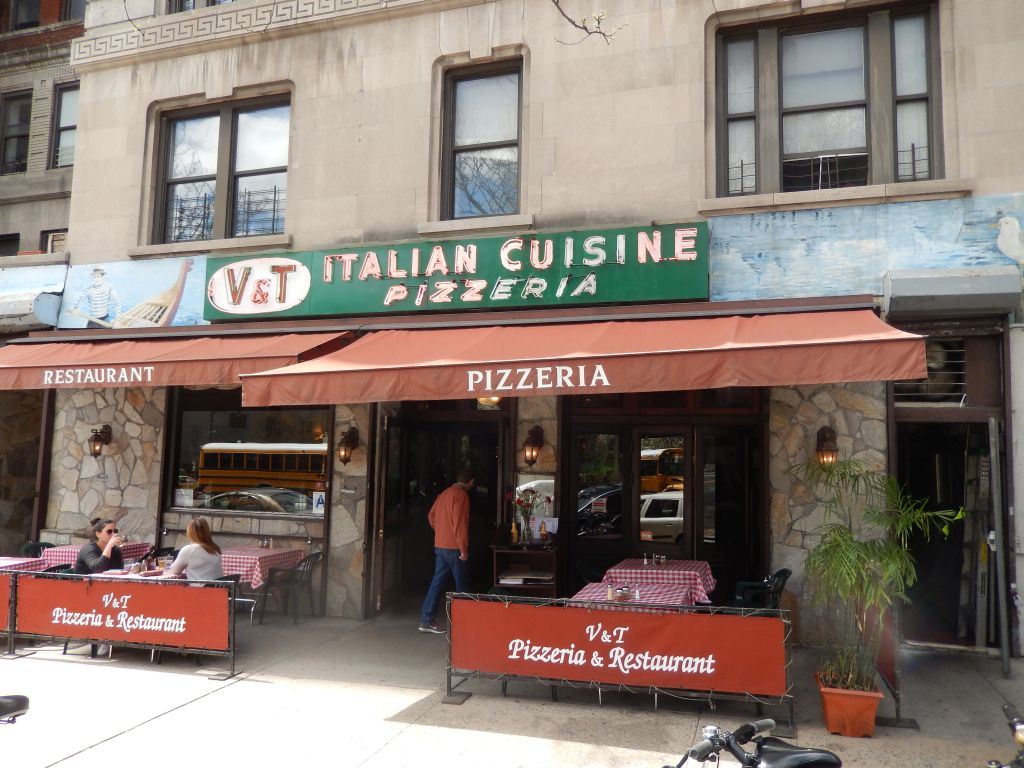
Image result for v&t pizza
The fourth or fifth best pizza in New York.
Finally, way over on Amsterdam between 110th and 111th, there were two more places. One was Green Kitchen, an Hungarian restaurant with tilted tables, linoleum floors, big-forearmed waitresses and the best chicken paprikash this side of either Buda or Pest. V&Ts, just down the street was ancient even back then. It’s still there, still with prices that would have made more sense ten or 15 years earlier, and they still serve New York’s fourth or fifth best pizza. There’s is the thick crust variety, none of the coal-oven pretense for them, and you could walk home with a steaming pie, past a brick-filled abandoned lot, the home of assorted homeless men and junkies, for just $3.50.

V&T’s had, against the thieves and druggies and hold-up men of the day, a coat rack in the front of the place near the cash register. On the rack, they had invisibly wired a New York cop’s hat—the kind with the peaked front. This artifice (there were nine times out of ten no cops inside) kept the place safe from the encroachments of the criminal set.

I lived on 112th Street for one year until I got evicted for illegally subletting in Columbia housing and then found a one bedroom apartment in a nice building on 109th Street between Broadway and Riverside for $500 a month.


But more about that another time.

Thursday, December 21, 2017

Goodbye to all that.

Unless something horribly unforeseen happens, today is my last day in the office in 2017. On Saturday, I leave for Saltillo, Mexico, my annual sojourn to visit the aging Teresa, my surrogate mother and Gulliermo Sisto, who lives just down the block from Teresa, and who was my best friend when I played baseball in the Mexican League so many moons ago.

Since Hector died over winter break three years ago, I have, to my wife's displeasure, made it my practice to travel south to visit the family I never had.

To be sure, I have a brother in Chicago and a sister-in-law, and a niece and a nephew whom I love, and various Philadelphia cousins who have spread over the eastern seaboard, but Teresa and Sisto are two pillars of my life. Further, I can visit my blood-relatives anytime, but Mexican brethren are pushing 90 now--I knew them 43 seasons ago, and I like to spend some concentrated hours with them.

Of course my breathtakingly level-headed wife protests these trips, protests the long drives through the lonely desert from Monterrey to Saltillo, and protests the long hours Sisto and I sit on Teresa's front porch, playing toss the coin in the baseball cap, which from our days playing ball together we can play for five or seven hours at a clip.

Nevertheless, with Beverly Kenney playing on my iPod, blaring on repeating her surpassing single "Tampico," we make our slow sojourn south, to be stupid for some days and do nothing but live, and love, and most of all laugh.

We laugh at unheard jokes, or memories that are ghosts from long ago, or a shuffle of the foot, or a raised eye-brow, or the touch on a shoulder. We laugh the laugh of 43-years of togetherness, that only those who are spiritually blood-brothers and sister can share.

So, this is all to say, I will be writing, if at all, only sporadically while I am away, looking to resume my meanderings when I cease my meanderings south, sometime around the first, or if I persist, the second week in January.


This has been annus horribilis of sorts--with politics, with Trumpism, with the crushing of the middle-class and poor by the dominant and ascendent plutocratic class. On the other hand, it's been, also an annus mirabilis, too. I've had a good career run, I've had my health, and I've written in this space something approaching one-hundred-thousand words.

Once again, thank you for reading. And happy holidays to you. May you enjoy them with peace, love and the aforementioned laughter. 


Tuesday, December 19, 2017

FIVE MINUTES WITH OUR CIO.

AD AGED: So, you’re a CIO. I assume that means 
                   Chief Information Officer?

CIO:           Nothing could be more passe, or off the mark. We are post information.

AD AGED: Then what does CIO stand for?

CIO:           I am the Chief Invitation Officer.

AD AGED: Interesting.

CIO:           Not interesting. Invitation.

AD AGED: What exactly do you do as Chief Invitation Officer?

CIO:           I send out invitations. Just as you’re about to get some work done—to write a bit of copy, or sit with your partner, or even do some background reading, I make sure you’re invited to a meeting.

AD AGED: I see. And the reason for these invitations?

CIO:           Well as CIO, I like to make sure our conference rooms are always booked and nine or 14 people are in them discussing things that could have been covered by three people and a
six-minute phone call.

AD AGED: So, is it safe to say, as Chief Invitation Officer you make sure we spend our days in meetings?

CIO:           That’s right. Particularly meetings scheduled during lunch, when no lunch will be served.

AD AGED: I might be missing something, but what’s the purpose behind all these many meetings?

CIO:           Easy. If you’re in meetings all day, it means you have to work all night. That means more billable hours.

AD AGED: Well, thank you for your time today.

CIO:           Yes, I have to cut this short. 
                  Obviously, I have a meeting to go to.


-->

A year in writing.

Well, fuck a duck.

It's less than a week before Christmas, and it looks as if I've lasted another year.

To date, I've written 280 posts in this space, and along the way grown my readership to close to 20,000/week. I like to think of this particular endeavor like I am the editor of a small-town newspaper in 1930s America. 

I provide news, commentary and local color for the tiny coterie of people in our community, which happens to be the ad community. I don't make any money from any of this, but somehow writing every morning, and connecting with the handful of people who have reached out to me through the years has been good for my soul and, ahem ahem, my personal brand.

Say what you will about the quality of my output, no one can fault my consistency. I've written nearly every week-day since late May, 2007.

My blogging colleagues and I, Bob Hoffman, the Ad Contrarian, Rich Siegel of Round Seventeen, and Dave Trott and his two blogs, are most often dismissive of social media.

Speaking for myself, its over-hyped-ness, its almost weekly proclamations that it would change everything and dominate advertising came across to me as bombast. And I hate bombast.

That said, though we disparage social media, the four of us seem to have done well by it. I think for the aforementioned reason. Consistency.

Somehow I am having the best years of my career when many of my former colleagues are pushing up vocational daisies.

Some of that, excuse my bombast here, is that I never for a moment have believed that "nobody reads the copy." Or, to coin a phrase, that "the written word has been dethroned." And there's "a fundamental shift in how we consume information from textual to visual."

As those who read Ad Aged know, I read Homer's Odyssey serially, finishing it only to start over again. (If you want to stick your toe into Homer and the Odyssey, I recommend Emily Wilson's new, and widely heralded translation. Many people regard her work as one of the year's ten best books.)

I read Homer because his "story-telling" couldn't be more perfect. His characters couldn't be more vivid. His battles and struggles could scarcely be more well-wrought and, yes, bloody.

3,500 years ago these very chapters thrilled Greeks listening to the epic sung in a town plaza or in front of a fire at night. The very basic human need that the Odyssey fulfilled then, stories and words still fulfill today. There is a basic human need they fulfill.

In fact, if I were to go all anthropological on you, I'd say, in my best Desmond Morris impression, that the basic core of our humanity is our ability to maintain some memory of the past and project it onto the future. We do that more often than not in words and pictures, not just pictures alone.

Apes can't do that, nor can apricots, nor apps, nor APIs.

So, we've made it, nearly, I shouldn't jinx it, through another circuit around Old Sol.

I've got a deal for you:

If you keep reading, I'll keep writing.