Friday, March 18, 2022

Dear Aunt Crabby.

Crabbagail Van Buren
Photo credit: Mark Denton. coy-com.com


Dear Aunt Crabby,

I'm confused. Virtually every day I see virtually every agency blowing its horn about having been awarded Agency of the Year, or Most Creative Agency, or Network of the Year. But when I turn on TV or see ads online, everything sucks. What gives?

--Confused Off Madison Ave.

Dear Confused,

Silly child. Those awards you see aren't for work that moves a client's business. They're for work that convinces the head of the holding company not to fire agency chiefs for squandering millions on fake ads. Get with the program. Advertising isn't about ads that actually run. It's about ads we could have run if we didn't have those pesky things called clients.

---

Dear Aunt Crabby,

I just left a giant agency after decades working for them and other giant agencies like them. Now that I'm on my own, I feel I am getting back control over my life. Slowly my confidence and self-esteem are returning. How long does this healing process generally take?

--Walking Wounded

Dear Walking,

Fear not. In most cases, your non-gender-specific scrotum will return to its original size in about six months.

---

Dear Crabby,

I'm a Chief Marketing Officer and I'm currently looking for a new agency. Every agency seems exactly the same to me: long on bombast, short on experience, hyping work that never even ran. How can I get people on my business who will actually understand my business? People I can build a relationship with whom I can trust to help guide my brand.

--Non-Compliant Client

Dear Non-Compliant,

Funny. But you do realize your note is a little early for April Fool's, yes?

---

Dear Crabby,

I'm new to the advertising business and over the past few months, I've averaged 80-hour workweeks. Is this par for the course or am I still getting my "sea legs"?

--Wobbly and Wondering

Dear Wobbly,

Fear not. Once you get used to your sea legs, the 120-hour weeks will begin--that's roughly one hour of work for every time you hear upper-management utter the phrase "work-life balance."

---

Dear Crabby,

These days so many brands seem to be talking about finding their authentic voice and acting authentically. If brands really cared about the environment, why for instance, is it taking Starbucks three years to phase-out single-use cups, especially since over 40 percent of the millions of tons of waste Starbucks produces every year is made up of cups and lids?

--Cup Runneth Empty

Dear Cup,

You know what they say. "Authenticity is everything. Once you can fake that, you've got it made."

Thursday, March 17, 2022

The great not resignation.

As a person who makes a living with words, you'd expect that I would think a lot about how they're chosen, how they're manipulated, how they're co-opted and sullied to, often, carry the day.

[The definitive book on the subject, here.]

A good example of this is our semantics around abortion rights. 

The right-wing has used language well. They frame the debate on terms where they seem holier than thou. They are pro-life. Meaning if you believe in the right to choose, you are anti-life. Once you've established the phrase pro-life, it's really hard to lose a discussion. The pro-choice person has his foot in a bucket.

Today, the phrase "Great Resignation" seems to be all over the news and in many many conversations. It even has its own Wikipedia page--a sure sign of having your own Wikipedia page.

I fear that this too is a victory for the right-wing because it puts the person quitting into the position of quitting--of being, somehow, anti-success, anti-capital, anti-work, so they've resigned. That Great Resignation Generation somehow refuses to work.

It exculpates the corporate world and assigns, semantically, the onus on the worker for giving up.

Better to my mind, the Great Resignation could be called the Great Betrayal. 

I get about three calls a week from people who have left their "big agency" jobs or are getting dangerously close to it. They're not resigning because they've got a pitcher of lemonade and a sisal hammock waiting for them. They're resigning because of years of broken corporate promises, years of betrayal.


Some of this is the betrayal that comes from a smaller and smaller percentage of people taking a greater and greater share of a decreasing pool of revenue. 

The behaviors that allow those discrepancies are betrayals as well.

  • Raises don't happen.
  • We work too many hours with too little support.
  • Our offices are gone.
  • Our perks are non-existent.
  • There is no "governor." We are expected to work and be on call virtually 24/7.
  • Baroque systems make even simple tasks like getting expenses paid difficult.
  • Very few people have administrative help.
  • Our business is run by people who don't even understand what our business is. I would guess that nine out of ten Holding Company employees have never been involved in creating an ad.

It seems to me that most relationships are based on bargains. Even in Elizabeth Kubler Ross' "On Death and Dying," "Bargaining" is the third stage of 'making a deal' with the intractable: death.

But the bargain of working in advertising has been Betrayed.

We are still expected to put in long hours but we no longer get commensurate money, perks, rewards or even downtime in return.

We are expected to show our loyalty but have seen our friends and colleagues thrown out like a wet nap at a clambake when day is done. 

I could go on.

But it's easier just to say the little people have been giving more and more of themselves and getting nothing back from the big people. 

They've been quidding without any pro quoing back.

Sorry.

If people leave, they're not resigning.

They've finally wised up and gotten sick of being betrayed.

They've realized, finally, the difference between loyalty and malignant loyalty.


Wednesday, March 16, 2022

A lot of math.


When you're older, somewhat hidebound, and when you have a long memory things that were once easy become more difficult. The changes in the world are of such magnitude that it becomes nearly impossible to adjust to them.


For instance, when I was a boy, the toll to use the Henry Hudson Bridge was ten cents. Today, if you don't have EZ-Pass, the toll is $7.80. It's hard to bring yourself to pay 7800-percent more for something than you grew up paying.

Likewise, it's hard for me to go to restaurants. 

In my first copywriting job in Manhattan, way back in 1980, I earned $225/week. In those days, I would never have entertained the slightest notion to go to Smith & Wollensky for dinner and I can hardly bring myself to do it today. Especially not when a Bone-In Rib Steak costs $74--just about one-third of my original New York salary.

It's not a money thing, really. It's a mental thing.

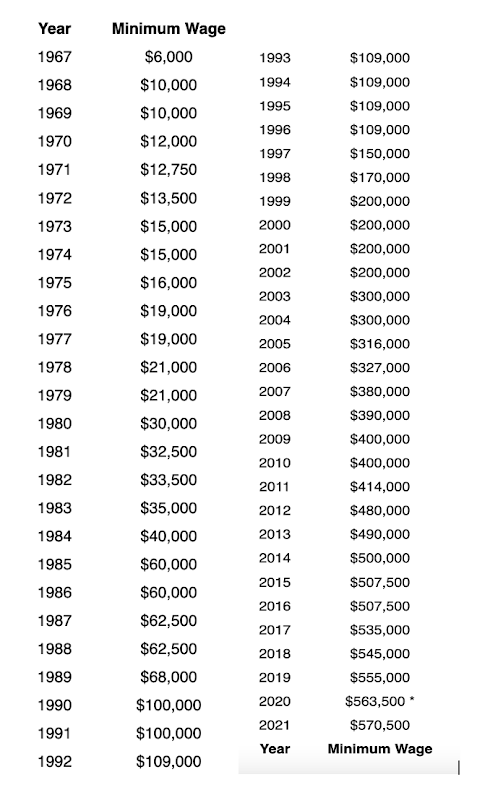
Just a few days ago, I heard on the radio that in the recent baseball strike, the Major League minimum salary was raised from about $570,000 to $700,000. Back in the early 90s, when I was "hot" as a copywriter, I got my salary pegged to the Major League minimum. That was potentially the smartest financial move I ever made--except the agency went out of business before I could benefit.

Despite the long overture, the point of my opera is simple. It's hard to adjust, really, to some of the new ways of the world, particularly the agency business.

Coincidentally, one of the things I struggle with within the agency world also concerns inflation--the inflation of titles. 

I just went on the website of what was once a huge agency. While it's probably half the size it was ten years ago, the agency still seems to have executive staff commensurate to what it would take if they were running the entire world. They seem to make the Vatican look like a flat organization.

I counted 23 Chiefs on their roster. Not counting the new Chief People Officer they announced Tuesday morning, and not counting half a dozen or more Presidents and Global Client Leads, who aren't technically Chiefs. 

Like many creative people--and probably like many people of the Vietnam-'question-authority' generation--I have a hard time figuring out what all these people do. The idea, for instance of a Chief People Officer baffles me.

I went to about a dozen websites to try to find a definition I could understand. Just as I ask my wife every time we go out to dinner, 'who could possibly pay $74 for a Bone-In Rib Steak.' Naturally, I could make no sense of any of this.

An article in Forbes said, "Never before has HR been called upon to help their employees effectively deal with serious issues, such as the fast-growing mental health crisis, and relied upon to help team members deal with their emotional well-being, feelings of isolation, depression and burnout. These folks had to develop empathetic, employee-friendly benefits and other inducements to entice job seekers to join their firm and keep the current employees from quitting in the Great Resignation movement."  

My guess is agencies are seeing 25-percent attrition rates, so no one's keeping employees from quitting. And I've never worked at an agency that did more for isolation, depression and burnout than provide an 800-number for counseling services. 

Another site said, cryptically, "The chief people officer (CPO) is the head of this more multifaceted HR department. Their job is to create the strategy and vision that help the company achieve long-term success." As opposed, I suppose, to long-term stasis or failure. 

  • Then duties and responsibilities are enumerated. 

    -Think strategically about employee recruiting, hiring, and retention (as opposed to thinking non-strategically)
    -Optimize the use of people analytics software to manage talent (Good thing they're optimizing the use. Way better than pessimising it.)
  • -Lead benefits and retirement plan administration (No one in a modern agency gets benefits and no one's voluntarily retired from advertising for 20 years.)
    -Develop and implement compensation strategy and planning 
    (Holding Company compensation strategy is to pay less for more hours.)
From my old man's POV, there's something else going on with all this inflation. In basic economics, the standard measure of inequality is called the Gini coefficient. A Gini of 1.0 would mean one person has all the wealth. The closer to one, the more unequal the industry. 


In our industry, home of all those chiefs, things are much much worse. Generally speaking, depending on your politics, a Gini of .4 to .5 indicates a big income gap. Above .5, a severe income gap.  

In TMT (Tech, Media, Telecom) the picture is dire. If the Ad Industry were a nation, its Gini of .76--its measure of unequal distribution--would be higher than Iceland's, one of the most equal countries in the world. It would also be higher than South Africa's--the least equal country in the world.

I know I'm out of my mind, but if Chief People Officers are really worried about any of the bulleted points above, they'd consider these charts below.

The industry will continue to lose people and its people will continue to suffer isolation, depression and burnout until the real economic issues of the industry are addressed and addressed substantively.

Nah. 

It’s way easier just to do nothing.



Tuesday, March 15, 2022

Advertising economics: A tragedy.


Of all the strange economic quirks and corporate edicts of the Holding Company era in advertising, the strangest and most troubling is this: Agencies get paid when they concept and re-concept, vise and revise. They get paid when they present, when they produce 82-page decks, when they spin yarns about what the work will do when it finally runs.

When the work runs, however, they stop making money.

The industry, in its wisdom, has decided that the journey is more important than the destination. That the creating and internal selling of the work is more important than the work that actually airs. 

In other words--in sad words--the current structure of the business pays agencies for process and not for product.

This is a regimen that loves bureaucracy, meetings, staffing bloat, overthink, over-test, over-perseverate more than making something and running it. 

This is a regimen that gains profitability and success on the assumption of 17-rounds (thanks, Rich Siegel) of revisions, on democratizing and incorporating hundreds of gnat-stings of commentary, over the intensity of an original idea that moves, motivates and means something to people.


Years ago I read something about the Gallo wine account and the San Francisco ad community. Everybody wanted the Gallo business because it was just about the biggest-spending account based in San Francisco.

Ernest and Julio Gallo were notorious clients. They believed in the full 15% commission way of paying agencies and knew that until they bought something, they could keep the San Francisco ad community working for free. No media expenditure, no commission.

Here's the story from Hal Riney himself:

"When I was just getting started in advertising, Ernest Gallo was already providing some lessons about the business that would become my career. It was the ’50s. I was a junior art director at BBDO, and Gallo was one of our clients.

"At least twice a week, the account men would stuff their portfolios thick with layouts and make the four-hour round trip to Modesto, only to return rejected and dejected, with orders to start all over again.

"Approvals, which seemed to occur only once or twice a year, were a cause for celebration. Not only did an approval mean that something might actually appear in print or on the air, but now the agency would finally get paid."

Under these circumstances, no sleep till Brooklyn, no pay till it runs, Riney and cohorts set out to learn more about the wine business and the Gallo business than anyone else in the world.

They weren't paid to do that learning. 

But all that learning made possible a series of spots that ran for years. And they built something more important. Trust.

According to Riney, Ernest Gallo told him, "In just three months, you’ve learned more about us and our wines and our business than any agency who ever worked for us."


"Eventually," Riney said, "we found a direction Ernest liked. I wrote some spots about Gallo wines, most of which dealt with Gallo’s (surprising) success in international wine competitions. And we offered the winery a theme: 'All the Best.' Within a year, Ernest dismissed his other advertising agencies, and gave us all his business."

If Gallo spent $500 million on media during those years, Riney's agency would have earned $75 million. For spots that both ran and changed Gallo's business.

My point is simple. 

Riney had an incentive to learn, to create and to sell. If he didn't, he wouldn't get paid.

Today, the industry no longer has an A.I.--No Accomplishment Incentive. The more the industry spins, the more it earns. The more it produces, the less it earns.

At the risk of giving too much information away, GeorgeCo., LLC, a Delaware Company has a system that allows me to happify clients and myself and to create a scope of work in about 15 minutes.

I call it "3-6-3." 

I learn for three days; create for six days; revise for three days. After 12 days my clients get work they can use that we both believe will work for them. They're also rid of me in a jiffy which works too. From my point of view, I intensify my work. And I get paid. 

More often than not, one 3-6-3 leads to another. And another.

Despite the financial sleight of hand being perpetrated by the Holding Companies, getting paid for work is the basis of all business. We are not in arbitrage, futures speculation of selling vapor.

We're not supposed to run around on an advertising hamster wheel and speculate and prevaricate.

We're supposed to do work that drives business--in the real world. And get paid for it. Real work. Not deckage or meeting about work.

Call me old-fashioned.

Real work you get paid for.

That's the point.

Not good meetings. 

Not beautiful decks.


Monday, March 14, 2022

Bravely being brave.


About 39 times a day I hear someone, a client banging his own timpani, an agency chieftain trying to banal his way to unique, or a lowly creative person exhorting someone somewhere in advertising to "be brave."

I think that that's little more than spiritual cotton candy. Be brave. 

It’s bad for your teeth and soul. Fluff.

If an advertiser is brave, what's a test-pilot, or a fire-fighter, or even a single mother trying to juggle career, a kid's homework, attending recorder recitals while paying dental bills, the mortgage and trying to put something other than processed mac and cheese on the table. 

If what we do is brave, what people who cure disease or heal the sick or respond to 911 calls is positively Herculean. No, we have jobs to do. And very little of our jobs entail any of the behaviors listed above.

Let's downshift for a second to get closer to what I mean. Starting with George Orwell. Always a good place to start.

Orwell said, "In a time of universal deceit, telling the truth is a revolutionary act."

Let's start there.

Let's make ads that tell the truth--and by the very act of truth-telling zig when everyone else has spent their millions and billions on zagging.

Let's tell the truth.

At a time when our entire industry is talking about saving the world, teaching dolphins braille, and saving democracy by closing their non-revenue producing offices in Russia, let's tell the truth.

Truth-telling is not bravery.

It's human-ness. It should be the rule. Not the exception.

So, if I worked for Verizon: 

"How to decipher a 16-page bill made to confuse you."

"We say our network's reliable. Yet we seem to drop three calls in ten: some answers."

"We cut corners, planes crashed, hundreds died. What we're doing about it."

"Our cars sucked for 40 years. Here's how we're going to win you back." 

"We over-prescribed deadly opiates. We're spending $15 billion to start the healing.”

"We don't answer our phones and leave you without internet for days. Here are 15 things we're doing to fix that."

I'm tired of our industry doing things they should have been doing all along--treating people with respect, being honest--and calling it bravery.

I'm tired of the way our industry usurps perfectly good words and overuses them to the point where their very meaning is corrupt and sullied. Robust. Agile. Brave.

How about rather than saying, we start showing.

Show we're good by our actions and behaviors and our reporting of them. Let's tell the whole truth, not the Pangloss truth.

Maybe if we spoke more honestly, we could speak more quietly and with less bombast.

That would be brave.


Friday, March 11, 2022

The Mis-Answer Man is Back!


The Mis-Answer Man is here to mangle your pressing questions. Today's topic, "Are Lemon Squares a Passe Dessert?"

1. You fired me at the start of the pandemic. Can I assume you've forgotten by now and just start showing up?

Yes. We never paid you anyway. And your presence will save us from renting temps so prospective clients think our offices are occupied.

2. My boss calls meetings for no apparent reason other than he likes having people around so he can act important. Do I have to show up just to massage his fragile ego?

Yes. That is the very definition of your job.

3. The agency refrigerator hasn't been cleaned since before the pandemic. Should I still store my lunch in it?

No. Current holding company strictures no longer allow for employees to take lunch breaks. 

4. My agency has a "hot desk" arrangement and people are reserving places by leaving their masks as placeholders. What can I do?

Be happy your agency has hot desks. Most agencies are economizing by providing only room-temperature desks.

5. What about the psychological effects working at home has had on people? Loneliness. Burnout. Isolation.

We'll be having a smoothie bar in the office every fifth and seventh Tuesday of the month.

6. My agency wants us back three-days-week but that means I have to find full-time childcare what can I do?

You should get a part-time child.

7. Now that we're returning to the office, can I re-establish work/home balance by refusing to take late-night phone calls or respond to after-hours emails?

No.

8. I'm a perma-lancer and have been working exclusively remote, so no one knows how old I am. I'm afraid they'll cut me loose when they see I'm in my 60s. What can I do?

File for unemployment.

9. Now that we are together again, I'm worried about highly-charged face-to-face confrontations. How can I lower the tension level?

If someone confronts you just repeat, "that's not a best practice."

10. Since the beginning of the pandemic, I've heard a lot about the great resignation. What can management do to ease its effects?

Hire a raft of new C-level workers who have figurehead jobs and don't show up anyway.


Thursday, March 10, 2022

A story about stories.


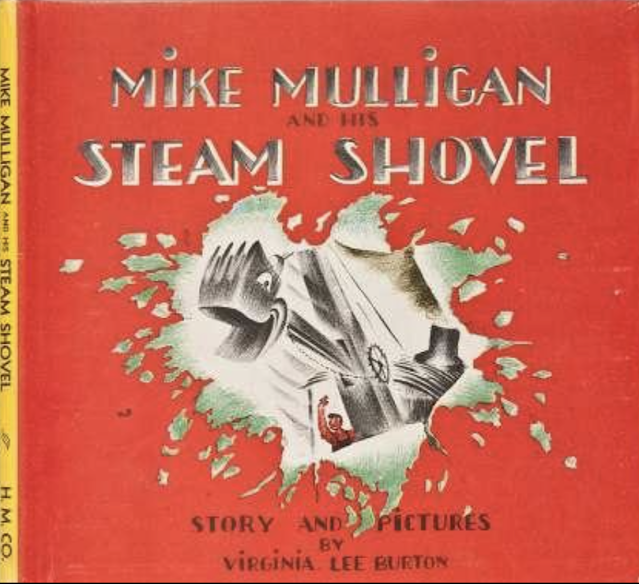
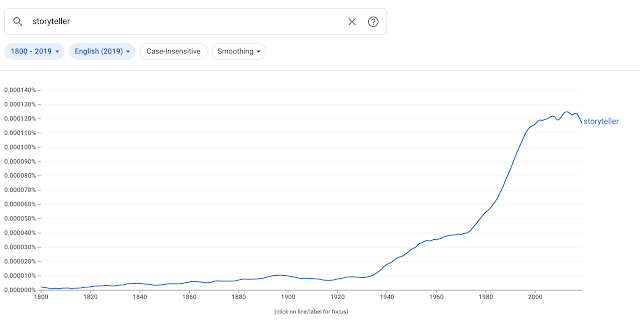
For 98.7 percent of my professional life, I never heard the phrase storyteller. In fact, I never heard it at all, except from maybe when I was in nursery school or my kids were and we'd have storytellers come in to tell us about Mike Mulligan and His Steam Shovel.


The explosion of the word Storyteller. (From Google nGram.)

But for about the last four or six years or so, everyone and everything has become all about storytelling. I think if you took every putative advertising person on LinkedIn and chose just the ones who described themselves as storytellers, you could quickly outstrip the population of China or India or both put together. Everyone is a storyteller and everything is about storytelling and great brands tell great stories and so on and so forth.

To my jaded ears, it all sounds like the next generation of teenagers who, almost invariably, think they're the first ones to discover sex. Well, the fact is, like sex storytelling has been around for as long as humans--approximately 200,000 years. And like sex, not everyone can do it and even fewer people are good at it.

I've heard UX people say they're storytellers. I've heard package designers say it. Even people designing signage in theme parks. It's a bit like advertising pompuspeople who call their commercials "films." No, my friends, Citizen Kane is a film. Shane is a film. Bad Day at Black Rock is a film. You make commercials.

OK. Enough of that.


About three months ago, as I do, I read a book review in The Wall Street Journal on a new translation and annotation of the centuries-old book of stories "The Annotated Arabian Nights: Tales from 1001 Nights," edited by Paulo Lemos Horta and translated by Yasmine Seale.

Here are the first two paragraphs of the review--the reasons why I immediately dropped lucrative client business and ordered the eleven-pound book. I've underscored bits from the review because I have some points to make.

"In an empire long ago there lived a king who discovered his wife sleeping with a palace slave. Crazed by jealousy he vowed that henceforth he would marry only for the length of a night and each morning his new bride would be killed. 

After he had carried out his wicked agenda for some time, Scheherazade, the brave daughter of the king’s vizier, demanded that she be the next in line to the royal bedchamber. 

During the first night she beguiled the time with a fantastic story, breaking off at a moment of high suspense as morning arrived. The king agreed to delay her execution so long as she took up the tale the following night—and the reprieve was extended again, and again, until, after one thousand and one nights, the king saw the error of his ways.

That is the premise of what may be the greatest treasury of stories in all of world literature, which have now been newly translated by Yasmine Seale in a gorgeous illustrated volume, edited by Paulo Lemos Horta, entitled “The Annotated Arabian Nights.” 

On display again is the spectacular panoply of storytelling, from tales of magic and wonder to murder mysteries to instructional fables to sexual burlesques. 

I began reading "1001" Monday night, starting with its almost 100-page forward by Omar El Akkad. According to both the Journal and El Akkad, 1001 is a story that is really about the importance of telling stories. After all, as in the review above, for Scheherazade, storytelling is quite literally a matter of life and death. 

If she is interesting, she lives. And thousands after her live.

If she is boring, she dies. And thousands after her die.

Booker Prize-winner A.S. Byatt says in the forward about 1001, “This story has everything a tale should have. Sex, death, treachery, vengeance, magic, humor, warmth, wit, surprise and a happy ending. ”

Like most writers--even those of us who toil in advertising--I believe in the power of stories. I've searched a lifetime and read and re-read foundation stories and the oldest and most seminal tales of Western literature, from the Iliad and Odyssey, to Gilgamesh, to Greek and Hebrew and Christian creation myths. 

I've scoured the Canterbury Tales, the Compleat Works of Shakespeare, Cervantes, Dante, Petrarch, Plutarch and more. I've looked at and thought about what makes a story over-arching and important.

And, after all that, I'm annoyed by so many people in the business who co-opt and thereby sully the notion of story when what they're really doing is slinging a spiel. Usually for a BOGO sale. Or a Pontiac Door Buster Sale.

I'm all for storytelling in advertising. Brands like Nike, Apple, even IBM, have established creation myths and every additional message they produce--when they're on brand--adds to that myth. Nike has created "You. The Athlete." Apple, "You. The creator." IBM, "You. The Thinker."

But not everything is a story. And not everyone is a storyteller.

With GeorgeCo., LLC, a Delaware Company, I'm running something more than just an agency. I'm helping brands find their story and even more important, helping them stay true to that story.

As above, in advertising we can learn from the great books. At the very least we can learn as Scheherazade learned.

Storytelling, whether you're a Vizier's daughter laying next to a psychotic king or someone guiding the fortunes of a brand in a dangerous and competitive world, storytelling is a matter of life and death.

Tell good, true, honest stories and you and your brands win.

As A.S. Byatt said, tell stories with "sex, death, treachery, vengeance, magic, humor, warmth, wit, surprise and a happy ending," and you won't have to shout at people, re-target them and cookie their every move.

Tell stories that are interesting and we live.

Don't and we die.


Wednesday, March 9, 2022

A numbers game.

Once again, she visits quite often, Dame Insomnia dropped by my queen-sized bed last night. Rather than toss about like a beluga whale in a tempest, to shunt her away, I opened up my Kindle app and plowed through to the finish of yet another book I was reading.

Reading for me is many things. When I'm on my high, hoity-toity horse, I call it my "restorative niche." I shut off the world--whatever is annoying me or oppressing me or chasing me like a Crusader after a heretic--and I escape to second century Rome, or a pirate ship laden with chopped chicken liver, or into the protozoa that eventually grew into life, as we know it, on this dying planet. 

Reading is also a competitive edge. I'm averaging, during these benighted Dark Ages 2.0 days, more than a book a week. And despite the pointed allegations of my wife that I read the non-fiction equivalent of an Archie Double Digest, or the barbs from other friends that I read the same book about the Holocaust over and again, I read eclectically and somehow--whether I'm reading about Josiah Wedgewood, "the Radical Potter," or life when the world was lit only by fire, I find lessons and guidance for life today. 

Reading is like carrying around various geniuses as friends. I have discussions, glean perspectives and I am given prismatic lenses that allow me a view of the world that lets me look at everything through little refracted bugs' eyes. I don't accept anything. I try to look at things in as many ways as my brain can. And if that's not the definition of training yourself to be a creative thinker, I don't know what is.

Five decades ago when I was a sullen teenager, as opposed to a sullen old man, my father phlegmed to me, "the world's smartest people read The New York Times' book reviews." That got me into a habit that abides to this day--when there are no bookstores. Adding to it, along the way, The Wall Street Journal's excellent book section, and the dozen or so reviews a week friends from around the world send me. 

In fact, I challenge you to do the same. Try it for a week. If you're not, after a week, a more thoughtful, less compliant, more subversive and interesting person, I'll refund all the money you spent for this advice.


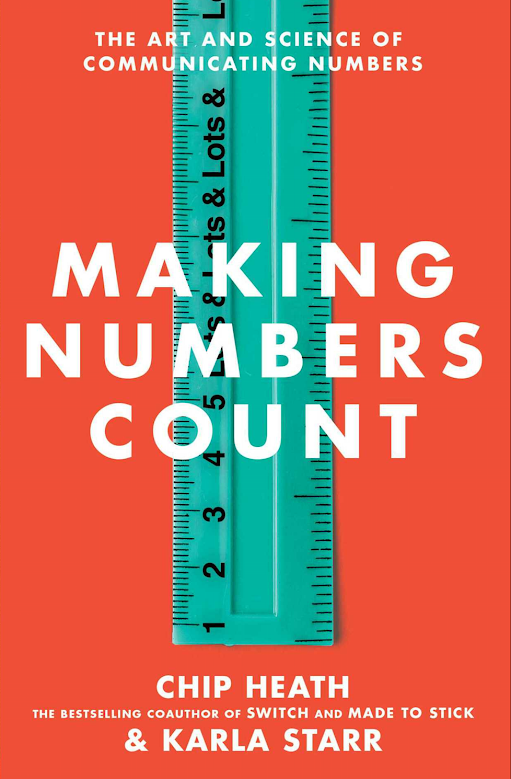
The book I read last night was "Making Numbers Count: The Art and Science of Communicating Numbers," by Chip Heath and Karla Starr. You can read, if you can elude the pay-wall police, a review from The Wall Street Journal here.

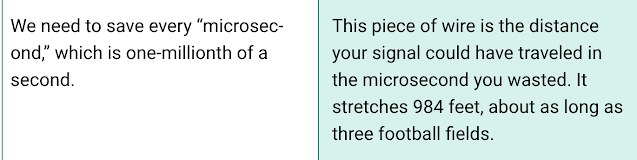
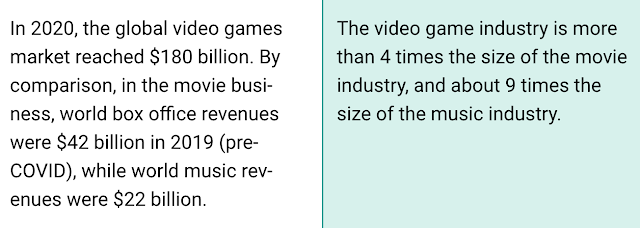
Here are just five simple examples from a book filled with dozens. Each one is about making information interesting, exciting, memorable and usable.


I'm glad I read Heath and Starr's book. But I'm sorry it was 200 pages, not just a 12-page article in the Atlantic, the New Yorker or Highlights for Kids.

I'm sorry that we have to have entire books that essentially say something we should have running through our veins. Especially the veins of those of us in the advertising and marketing and sales or any customer-facing pursuit. Like I said, I read the book in one sitting, but I can rewrite it in two words. Two words I think the entire communications world has fundamentally forgotten.

1. Be.
2. Interesting.

I remember back when Volkswagen's advertising was the best in the world going to the New York Auto Show at New York's piss-stench hulking Colosseum--where a pre-fab, day-light blocking trumpmerkinmallhighrise intrudes today. It must have been 1973 or 4 because it was the year the "Super Beetle" was introduced to America and the first time I saw amber turn signals.

A spokesman was showing a small crowd the turn signal. "It shines amber to stand out," he said. "And it has a special relay so the signal turns on the moment you flick it on."

OK. Big deal.

"You might not think that's important, but a conventional turn signal can delay turning on for a second. At 60 miles per hour a car moves 88 feet in a second. So our turn signal can turn on 88 feet earlier."

I don't know why that's stayed with me almost 50 years. And I don't know why we no longer, in our industry or anywhere else, work hard and respect readers and their intelligence enough to do that sort of elementary mathematics.

When you think of how many times you hear from verizon how reliable their network is and how little it registers--it's because no one at that giant company or its affiliated agencies is thinking about making a claim that's memorable. So, they cut and paste one for the billionth time.

When I worked on IBM servers, they often claimed to be reliable to an industry measure called five-9s. That means their servers were up and running 99.999-percent of the time.

OK. But what does that mean?

It means out of the 31,536,000 seconds in a year, your server will perform flawlessly for 31,535,684 seconds. It will need attention just 316 seconds a year, about 8/10ths of a second a day--roughly six blinks of your eyes.

You don't have to be a double-dome to do this math. It wasn't that long ago Hal Riney for Alamo said, instead of free miles, "there are over eight million miles of roads in Alamo country, and all those miles are free."

Or Dave Dye created this one. Nothing about awards, borderless creativity, working at the intersection of bull and shit and the seamless interplay of 9200 offices in 348 solar systems.

Just a focus on a compelling fact presented in a compelling manner.

i.e. be interesting.


Tuesday, March 8, 2022

Some writer shit.

Not too many years ago the great writer, Robert Caro, took a break from writing volume five of his giant biography on Lyndon Baines Johnson to publish a book called "Working." Like virtually everything Caro does these days, the publication of something by Caro gets almost as much attention--at least in some rarefied circles--as Kim Kardashian getting a new ass-injection.

As you'd guess, "Working" was about how the famously precise and thorough Caro (winner of two Pulitzer Prizes and two National Book Awards) works. Not only did I read the book the moment I could get my hands on it, I twice went to hear Caro speak about his book, his career and his discipline.

I'm an advertising writer who has an antiquated view of what advertising can do. That view is based on having been raised on the work of Doyle Dane Bernbach, Ally & Gargano, Ammirati & Puris and Scali, McCabe, Sloves. The best work of those great agencies was based on facts. Their work wasn't adjectival or about flourishes, filigree, decoration and style for style's sake. There was no room for any sparring or dancing. The best of it was a punch between the eyes that you felt in your heart.

As he did so often, Carl Ally said it best, this time whenhe coined the mission for his agency: "To impart useful consumer information in an executionally brilliant way." Bill Bernbach had his spin on essentially the same notion. He believed that the best advertising was "based on simple, timeless, human truths."

[My list above, by the way, is very American--because though I'm a great fan of the greats of English advertising, Hegarty, Abbott, CDP, Trott, I don't have very good recall of their wisdom. Bernbach was the progenitor of all this, so of course I've memorized his words. I worked at Ally & Gargano, and hold words emanating from that agency as a shibboleth.]

Back to Caro.

An ad written by David Fowler.


I read this from his book working. While at Ogilvy, I published it in this space, and my great co-worker David Fowler ran over to my desk to give me a spiritual hug. 

It's a good feeling when you discover you're not alone. 

Caro's line is this, it comes from his first journalistic experience, when he was working on his school paper at the Horace Mann School in the Bronx: 
“I always had this desire, and I don’t know where it comes from, to find out how things work and explain them to people.”

To find out how things work and explain them to people.

On first blush, this belief may work better for technologies or cars or banking products. Complicated things that are more rational and thoughtful than, say, M&Ms or frozen pizza or hair gel.

That caveat is fine, if that's the way you want to be. But I think that interpretation is parochial. The best candy advertising, for instance, Starburst or Snickers, really talks about what those silly multi-billion brands do for people.

The line is relevant to almost all communication. Not just Quantum computers, the hybrid cloud or a braking system.

My guess is if you respect people, you'll find out how things work--everything from diapers to the soul of a company--you'll take the time and do the work and explain why.

Every day--yes, every day--I hear about 90 million voices seemingly in unison swearing to make everything from Swiffer to room-freshener part of culture. 

It might cost me business to say this aloud, but I don't even know what becoming part of culture means. My culture isn't your culture and I've yet to buy a car, tv, computer or a pair of jeans that's a part of culture. Or spent $500 for a pair of tickets to view the culture of Tropicana orange juice in a special performance at Lincoln Center.

I run an agency now.

I'll leave integration with culture to someone else.

If you have a garden tool, a shelving system, a security technology, I'll explain them to people. Not so they become engineers. But so they want your product.

That's what this is about.

Convincing the mind so you love with your heart.


Monday, March 7, 2022

Thinking about doing


The freelance world--the agency world--is competitive. And when something is competitive, I aim to win.

The good people in advertising, or any other walk of life, are like that: they want to win. The best people go a step further. They want to win without being assholes.

Since I entered the freelancer/independent agency market I had a simple theory. To succeed against all the hundreds of other freelancers out there, I had to do something to stand out. I realized with my large LinkedIn network, I could create little ads for myself. I wouldn't exactly be selling off the page, but if I were lucky, I'd make myself known and be one of the people people thought of when they needed help.

I've been running these little ads with some regularity. It's been 778 days since I was fired at five in the afternoon, eight hours after everyone else in my "firing class" was canned. In those 778 days, I've probably run 200 ads.

That means I wrote 200 ads.

That means I wrote 200 ads that I considered good enough to show me off. Which means, I wrote 1,000 or more that sucked.

That's 200 ads in addition to my not inconsiderable client work these very ads have helped me get. And the rewriting, the billing, the chasing, the hondling, the hocking and the haranguing that comes from running a business. That's 200 ads in addition to having written approximately 550 posts during that time in this space.

Recently, I decided to take about 81 of my 200 ads and make a  book out of them. It's free if you have the temerity to ask for it.


It's either a coffee table book or a book you spill coffee on. Whichever comes second.

I sent a copy to my old Ogilvy boss by email with a subject line that read: 81 ads.

He quickly wrote back.

"I"m slacking. I've written only ten headlines today. How do you do it?"

I've been thinking about agencies and their lack of productivity, or surfeit of cobwebs since I've been a senior creative. So for about the last 25 years.

When I was the head of a giant beige monolith in Boston, I had a radical idea. I noticed that my highest paid creative people--presumably my best creative people--had no time to actually create. They were in meetings from early in the morning until fairly late into the evening.

I tried to designate Friday as a meeting-free day and I was almost booted out of the building. Can you imagine? I wanted my best creatives to spend 20-percent of their time creating. That got me regarded as a radical, the John L. Lewis of ad game.

When I worked with the boss I mentioned above, I'll call him Steve, we had a relationship based on mutual respect. I'd say further that we shared an understanding of our essential strengths. When I gave copy to Steve, I would always print it out so he could carry it around and read it like a PhD. student might read a manuscript.

In a short while, Steve would come down to my table with my copy marked up. There'd be a question or two. A comment. A reordering of words. But all the mark-ups were only suggestions. Thoughts, not edicts, that I could accept, think about, improve upon or reject as I saw fit.

I'm getting, eventually, to Steve's question, "How do you do it?"

Since I've been out on my own--two years and two months, I've done more work than I've done in any previous twenty-two years.

I don't have meetings about work.

I don't have meetings about meetings.

Then meetings about the effectiveness of meetings about meetings.

As odd as it sounds to even to my cauliflowered ears, GeorgeCo., LLC, a Delaware Company has been based basically on two things.

1. Deep self-appreciation. Be kind to yourself, to the people you work with and the work you're asked to do. If you bring deep self-appreciation to the table, you abide by your standards--even raise them.

And, 

2. Trust. Trust that you've done right by the job, the client, your craft, and yourself.

Trust cuts down on nit-picking, perseveration and second-guessing.

That gives you the time you need.

To do a lot of work.

That's how I do it.