Friday, April 1, 2022

Copywriting advice. From a chicken.

If you think about communication, any sort of communication, whether it's a bit of marketing, asking someone if they want to go to the movies, or getting your kid to take out the trash, it involves three things.

You should watch this video from Dave Trott if you want to learn it from the same person I learned it from. It's so simple and honest and logical, it's no wonder no one realizes how brilliant it is.

Step one is IMPACT. If no one notices your message, you've wasted your time and your money.

Step two is COMMUNICATION. What do you want to tell people?

Step three is PERSUASION. Why should they believe you?

You might have 40 years in the business, or have worked at a giant marketing company, or bought all of Seth Godin's books and heard a trillion Ted Talks, but you won't do better than my Trott-inspired summation, above.

Since I got kicked out of Ogilvy for being so old I still believed in the power of advertising, I've run probably 250 ads for my business. On average, these ads get about 20,000 views from my own LinkedIn network. I guess if I were hip, I mumble something about earned-media.

I won't say here how much money I've earned through these simple little messages. But I will say I'm making the kind of money the advertising industry no longer pays anyone but its technocrats. And I don't know what technocrats do. I'm not sure anyone does.

People stop me and say, "How do you do it?" "How do you write so many ads that are so intrusive and responsive?" "They're the best things in my feed."

I realized that some of it has to do with being a second child. Second kids have to be noisy to be noticed--especially if they're being raised by drunk, drugged and otherwise comatose parents. That's why second children often make the best ad people. We'd never get the last porkchop if we didn't learn to be aggressive.

No one taught me this. 

But I did watch a giant cartoon chicken on Saturday mornings when cartoons were aired on just about all of New York's TV stations. Foghorn Leghorn, below, just about never said anything normal. 

He was just a bird with an endocrine problem. He had to do more to get his.

So everything Foghorn did say, you perked up and listened to. Different, in short, gets noticed.

Don't take Trott's word for it.

And certainly don't listen to me.

Learn from a chicken.


Now, some lines from the great foul. Speaking of foul, some of Foghorn's remarks ain't quite politically correct in today's sanitized cesspool of a world. If you're offended, remember it's a 70-year-old animated chicken talking. He was of a period. And he was a cartoon. So unruffle your bird-hair.


She remi…, I say, she reminds me of Paul Revere’s ride, a little light in the belfry.

Hmmm, bare, I say, bare as a cooch dancer’s midriff.

That, I say, that boy’s just like a tattoo, gets under your skin.

Stop, I say, stop it boy, you’re doin’ a lot of choppin’ but no chips are flyin’.

I got, I say, I got this boy as fidgety as a bubble dancer with a slow leak.

That woman’s as cold as a nudist on an iceberg.

His muscles are as soggy as a used teabag.

Kid don’t quit talkin’ so much he’ll get his tongue sunburned.

The snow, I say, the snow’s so deep the farmers have to jack up the cows so they can milk’em.

This is going to cause more confusion than a mouse in a burlesque show.

That dog’s like taxes, he just don’t know when to stop. 

That dog, I say, that dog is lower than a snake full of buckshot.

That dog’s as subtle as a hand grenade in a barrel of oatmeal.

That boy’s about as sharp as a bowling ball.

That boy’s as timid as a canary at a cat show.

That boy’s as strong as an ox, and just about as smart.

That boy’s more mixed up than a feather in a whirlwind.

Oh, that woman got a mouth like an outboard motor.

I say that dog’s busier than a centipede at a toe countin’ contest.

Gal reminds me of a highway between Forth Worth and Dallas – no curves.

That kid’s about as sharp as a pound of wet liver.

I say it’s sure quiet around here, you could hear a caterpillar sneakin’ across a moss bed in tennis shoes

And, for you ad folks out there,
one from Mark Read, CEO of WPP. 

"We're a creative transformation company which has transformed from a business with 175,000 employees in 2013, to 98,000 employees today."

He's a little light in the belfry.

Wednesday, March 30, 2022

Not impressed.


Since I was impressed into suburbia like a drunk in a waterfront bar by a cadre of redcoated Dragoons with the onset of the Plague about 25 months ago, I've noticed a few things I really never saw while in the city.

For one people in the country hang flags outside their homes. Many even have full-fledged flagpoles. 

There were flags in the city, of course. The most prevalent being the plastic yellow and orange ones announcing the presence of cerveza at a neighborhood bodega. Second to those were the American flags, found outside of post offices, public schools, the occasional museum and the Mayor's mansion which is just six blocks from my apartment.

When American flags outside of those institutions were half-mast, I never really questioned what they had been lowered for. More likely or not, they hadn't been raise since the Maine was sunk in Havana harbor or the SS Edmund Fitzgerald was lost or Alex Trebek died. 

In the city, the efficiency of public works is dilatory at best. As a lifelong resident, you learn to accept things as they are. Even when a waiter has his calloused thumb in your mashed-potatoes, why complain. He's probably helping you build up some sort of immunity to something.

Up here in the burbs, however, people take their flags with the gravity of a lieutenant colonel hoping to impress the big brass. And all the dozens of flags seem in synch. When one is lowered, they all are.

My wife and I read a couple newspapers and stay in touch with world events. But when we go out for a walk in the morning and flags are lowered--which is about half the time, we almost never know why.

I suppose they're lowered now for Madeleine Albright. But they way things are going they could be half-mast because the drummer of the Foo Fighters died or perhaps, somewhere, there's a memorial service for Bert Convy or some-other non-luminous luminary.

If I had to find a point from this prosaic observation, I'd say that not only are we lowering our flags more often than in the past, we've lowered our standards along with our standards.

Funny enough, when I go over to LinkedIn, I see pretty much the same thing, pretty much every day, and pretty much with the same lowering of standards.

Of course, I'm exaggerating. But it seems that literally every day some agency or network has been named Agency of the Year by some governing body I've never considered, like the Amalgamated Dry Cleaners of America. 

Along with that, there's a similar number of Networks of the Year. Content Providers of the Year. Animation of the Year. Media Plan of the Year, and more. Then there are individual awards that seem even more plentiful.

Project Manager of the Year. Creative Director of the Year. CEO of the Year. Copywriter of the Year. Sound Designer of the Year. Team of the Year. A 30 Under 30. A 40 Under 40. A 50 Under 50. 

The lists and the awards and the flag-waving are oppressively ubiquitous. Once many years ago when I was working on commercials for IBM's ThinkPad, the client was trying to make me say in the Voice Over, "Winner of over 700 Awards." I refused to do it. If you've won that many awards, awards no longer have any meaning.

But my real point is not that there are too many awards.

It's worse than that.

It's that all these awards are awarded and the work I see still sucks. I rarely see a commercial that I feel isn't shouting at me, that connects on an emotional level and that provides me with the useful information I need to bring me closer to a purchase.

The last one I was was the Apple Underdogs long-form piece. And that was probably a month ago and I haven't seen anything close since.

It all feels like a sham to me.

People being celebrated because we need people to celebrate to get clicks. Meanwhile, I see no real-world evidence of what they're being lauded for.

It's like winning Salesman of the Year.

But you've faked all the receipts and the warehouse is still full.

It's bound to catch up to you.


Tuesday, March 29, 2022

Cinderella and me.


The secret to growing in life and in business is to hang out with people who are smarter, wiser and more accomplished than you.

I hang out with a lot of them in real life, my wife, my therapist, a few friends, a few business associates. But I hang out with many more in non-real-life.

In other words, to steal from Langston Hughes, I wonder as I wander. I look at things like a prospector might look for valuable ore. And when I find something worth keeping, I find a way to remember it and keep it handy. Don't spend what you know all in one place. You never know when you need it.

Reading provides me with a lot. It's made me who I am. As I've taken to saying, I spend an hour a day with one genius or another. Of course, there's so much genius in our benighted world--that despite the myriad horrors all around us, and despite my chemical liabilities, I remain optimistic. Like Faulkner, I believe humankind will not only endure, we will prevail.

But enough of that.

For the last couple of weeks, the story of Cinderella has been on my mind. That's because the Peacock Five from tiny St. Peter's College in Jersey City, have become a Cinderella story as they moved, quickly, from obscurity to the fringes of the college basketball Pantheon.


The Jersey City five were murderlized this weekend by a much more talented set of cagers representing the University of North Carolina. That defeat by the oddly nicknamed Tar Heels, led every living and breathing sportswriter to proclaim that St. Peter's "Cinderella story is over."

On hearing that tired metaphor, I immediately re-watched the Vonnegut clip pasted above from a lecture he gave called "The Shape of Stories."

And that is exactly what I mean when I write down the importance of learning from geniuses.

I only ever took two writing courses in my life. One in college when I was 20 and one 40 years later at an esteemed writer's workshop on Cape Cod. And I only ever took one advertising course--back in 1982.

Even so, I can't imagine any course teaching me more than Vonnegut does in the 4:27 above. In fact of all the things I store in my hard drive and my hard head, I think this is the one I share most often.

Story arc--whether you're writing 32 words of copy for an ad, significantly more for a website, or putting together a presentation for a client is crucial.

I am right now engaged in a fairly massive project for a fairly massive client. 

I had to write for them a brand book.

No easy task.

I broke it down into seven chapters or eight.

The client asked me--how do you know the order is right?

Fair enough question.

I said, a story should be like a roller coaster ride. It should get you excited. Then there's a portion of calm--to recover, to reflect, to catch your breath, then the highest hill and the steepest drop and the most excitement.

I'm not sure they got it.

That's ok.

Maybe they never saw Cinderella.

Or watched college hoops last weekend.

Monday, March 28, 2022

Same old.

Thanks to friend and partner, Sid Tomkins for making this beautiful.


About 15 years ago I was leading creative for a giant bank and after six months and 397 rounds of creative, it was time to send storyboards out to directors.

We had a good budget and I was working for a good brand and I was working at a reputable agency. So we asked some of the biggest directors in the business to submit treatments.

Treatments remind me a bit of catching a glimpse of a Playboy magazine when you're just twelve or thirteen. You can't believe anything on god's green earth could be so lusciously perfect and so perfectly fake.

The stock photos in treatments ok'd by the directors are of Ansel Adams quality. The sunlight is just right. There's always an elk standing in the distance not noticing what's going on around him. And the talent is about 72-percent more perfect than talent has any right to be.

It's easy to be seduced by images like these. Whether you're a frothing thirteen-year-old or a similarly hetted-up 53 years old. All that beauty...for me.

The treatments came in from the usual suspects and it was hard not to gush. It was hard not to think of awards. It was hard not to get wrapped up in the fantasy of what was going on.

Then at the end of the day, I got a ping in my email box. A treatment from Joe Pytka.

It was like no other treatment I ever got because it had no gorgeous shots and no flowery language.

In fact, it was two single-spaced typewritten pages essentially of being berated by Pytka. I could feel him towering over me. I shook a bit. But not so he could see it.

I've looked all afternoon for the note--because I'm sure I've saved it. But it's probably on a computer I haven't turned on since before my arthritic shoulder turned arthritic.

But I remember the opening and I've been yelled at enough by Pytka to remember the feeling he created.

"I don't know," he began (and possibly the only time he ever used those three particular words) "when the industry started demanding a treatment from a director on how they would shoot something. We fell into this trap of using stock photographs to show how we would approach something differently. You can't begin with someone else's work to show how you would work."

Just found the actual email. My memory ain't half bad.


Fuck, I said to myself. He's right.

I think about that observation from Pytka today and I worry. 

So much of the work I see--not just in commercials, but movies, TV shows, music and more--seems imitative of something else I've seen. In fact, if I were a historian I'd be inclined to write my history of these years or decades "The American Sequelization."

Nothing is considered valid unless it looks like something else. 

As a person attuned to words, I am often dumbfounded by the shrinkerization of our language. In agencies more buzzwords are uttered and more jargon jargonated than non-buzzy words and non-jargon. Orwell created "Newspeak," his language with very few words. It reflected his belief that fewer words would lead to fewer thoughts.

Is there no way to describe internet speed other than "blazing fast"? Is there no way to describe a collective offering than a bundle? Is there no way to describe being different than to say zigging in a world of zags?

Some years ago, the women and men of Chiat\Day gave the entire world a two-word brief.

It seems the entire world has forgotten it.

Think different.

Because I'm an asshole, I'll add to that, see art above. I'm not one-hundred percent sure what all this means.

But that doesn't mean I think it's wrong.

I remember in the early days of Macs at work there was a horrible whimsical typeface that had a self-consciously wacky "e" with dots and accents all around it. Around the same time people would emphasize a word or a logo with a "brush stroke" underscore. And I remember when everyone started using Microsoft's pallette of colors.

I called those examples, "the things everyone uses to be different."

Another reason, I suppose, that since I have found my voice, I have been so frequently fired.

But it's been worth it.

And I'm not stopping.

Different different.


Friday, March 25, 2022

My tools.

For about the last 35 years or so, virtually without fail during those years, I've found a way to read for about an hour a night. 

My therapist of all those years calls reading "my restorative niche." It puts back into my brain and soul what the vicissitudes of daily living take out.

I call my reading a long nightly walk with a genius. Because most of the things I read are writ by people with the genius of experience, observation, wisdom, writing or, in rare cases, all four of those evanescent virtues. These reading sessions remind me of work at its best. When I would sit kneecap to kneecap with a Hayden, a Pytka, a Wall, a Tesch or an Errol Morris.

You don't speak during these sessions. You clean your ears with a tunnel-drilling Q-tip and listen.

For the last few years, I've been reading a lot of books by paleontologists, pre-historians and anthropologists. I'm trying to look past trends and wars and quotidian banalities and get at the core of what it means to be a human. I'm more interested in what HASN'T changed in the 200,000 years of our species than in what has changed.

I'm not Einstein but he looked for a Unified Field Theory of life and I am looking for the same. Who are we anyway? What is living? What's right? What's wrong?

The ad above is the essential reason why I'm on this quest. I want to be better at life and better at making a living.  


Somehow I think looking at Clovis points will make me a better copywriter. Clovis points--above--date from about 14,000 years ago, give or take a timesheet. They're some of the oldest bits of evidence of human habitation in the Americas. Clovis points were first discovered by modern anthropologists about 100 years ago outside of a tiny town in New Mexico called Clovis.

As a creative person, I trade in Clovis points.

Except my tool isn't a sharp implement for killing beasts. My tool is words.

But like the first peoples so long ago, I lean on my tool. 

When the first peoples had an animal to hunt, they had a Clovis point. 

When the first peoples had a fish to spear, they turned to their Clovis point.

When they had to fell a tree,
dig for water,
butcher a mammoth,
cut a skin,
kill an enemy,
trade, 
they had a Clovis point.

They were small. Once you gained the knack, they were easy to make. They were multi-purpose.

That's how I feel about words.

When a client has a need or a problem, I have a tool that works. I hear myself telling myself ten times a day or eight or two-dozen, "I'll write my way through that." 

Meaning I'll use the tools that I know and make them work for the job at hand.


There's a book out now that I haven't read. It's on my Schmindle, and I'll read it soon. It's about writing and it's called 
"The Greatest Invention." You can order it here. If you can get past the Wall Street Journal's paywall, you can read a review here. 

My point in all this is simple.

There have been a lot of technologies designed and invented to help us get through to others, so we can reach them.

Virtually all of them are cooler, fresher and newer than letters and words.

But as Einstein said, "I do not know with what weapons  World War III will be fought, but World War IV will be fought with sticks and stones." 

In other words, when things are really bad, when we've blown through all the promise of progress, when nothing is left but ashes and cockroaches, the hominid who can make a Clovis point will be prized.

I feel the same way about my personal Clovis point.

And I wrote this to prove it.


Thursday, March 24, 2022

Who are you?

One of the amazing, or dispiriting, things about being as ancient as a California redwood is that you can clearly see things that are happening every day with the distance of age. Because others often don't have your decades of perspective, they sometimes miss what's going on right in front of their eyes,

One such thing is the blanderation of language. Or the bandwagonization of thought.

These phenomena are especially virulent in the ad industry (what's left of it) where agencies and the people who inhabit them lurch from one fad to another. They latch onto a word or a phrase to define themselves at roughly the same time everyone else in the industry latches onto the same word or phrase. 

Not only is such thinking antipodal to the very notion of creativity--aka "Think Different"--it's actually untethered from reality because the words or phrases being used to guide agencies are never, ever defined.

So we lurched from storytelling to data-driven to design-thinking to agile to flat hierarchies to something else to something else. WPP is currently trying to make "borderless creativity" a thing. Though I haven't any idea what it means or how it works or how it's different from the "long hallways" Ogilvy talked about 30 years ago.

I remember about a decade ago sitting in a big conference room at a big agency with fifteen other big wigs who were nominally in charge of the biggest source of revenue in the entire bigness of the holding company.

A new big person (whom I had known from another agency) was introduced as the person who was going to drive our team into a new way of working...an agile way.

I had the temerity to speak. 

One of the reasons I was consistently able to lose a good job roughly every five years. Temerity.

"Elyse," I said, "I have to tell you, the teams that work on this account are the hardest-working, fastest teams I've ever worked with. As you know, I am probably the world's fastest copywriter."

Elyse nodded.

"Elyse, I don't know what agile means. If you're using it as a proxy for fast, you're misguided. We can't work any faster."

Elyse turned as white as an ad agency or a prep school. She started stammering.

"It's not the speed of the work, it's making the process more agile."

Like a dog with a soup bone, I didn't relent. But the meeting broke up without any conclusive answer as to what was wrong or as to how things should change. Or what agile means.

I think the modren world has not adjusted--not to word processing--but to the processing of words. Like processed food has all the nutrition removed, processed words are words with all their meaning removed. 

The great breadth and ubiquity of media and communication has led in many respects to the homogenization of language which, as any Noam Chomsky-acolyte would tell you--leads to the homogenization of thoughts and ideas.

In other words, we all hear the same things, use the same words and think the same way because that's all we hear and read in the "real" world. 

The mass in mass media should really, today, be written MASS. When a capital offense is committed, use capital letters.

The giant networks, TV or web, have control of everything from word choice to thought. 

And agencies run along with their tongues hanging down to their knees so as not to miss a trend--which is really, sorry Andy, 15-seconds, not minutes, of limelight.

Many years ago, before worldwide networks and worldwide ovine-thinking took over the world, there were people, like the great pitcher Dizzy Dean who spoke a language that was unique to him and to the region he grew up in. 

He had no exposure to "the Queens English" or the midwestern newscaster non-accent. He didn't go to Dartmouth and wear argyle socks. He just was.

He said things like this:

“I ain’t what I used to be, but who the hell is?”


When Dean became a broadcaster, he was lambasted for saying 'ain't.' He replied, “Let the teachers teach English, and I will teach baseball. There is a lot of people in the United States who say isn’t, and they ain’t eating.”

When wartime restrictions prohibited announcers from giving details about the weather, Dean said, “I can’t tell you why there’s a delay, but stick your head out of the window, and you’ll know why.”

The point today is the point every day.

Don't be everyone else.

Don't dress like everyone else.

Don't think like everyone else.

Don't create like everyone else.

Don't speak like everyone else.

Be you.

And no one else.

Wednesday, March 23, 2022

10 words I will never use.

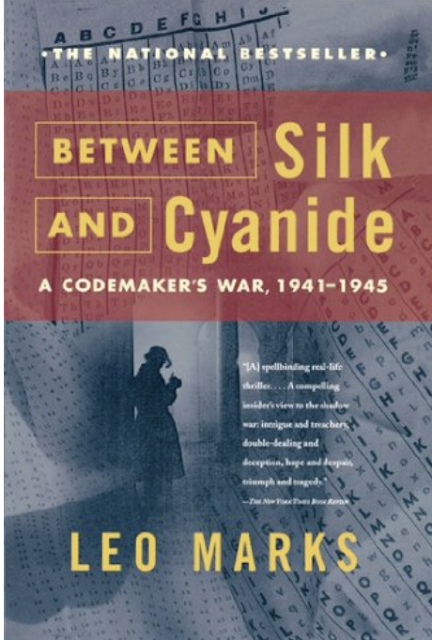
Some years ago, I read a book by an English World War II codebreaker who worked at the famous Bletchley Park complex. His name was Leo Marks and you can order his book here.


Marks was a prodigy when he went to work for 
Bletchley Park. I think he was barely out of high school or whatever they call it in England--bangers and mash or something. And like a lot of prodigies, Marks was a both polymath--brilliant at many things--and disruptive to normative behavior.

When Marks interviewed at Bletchley Park and was asked what his interests were, he replied "Incunabula and fornication." In my mind that is perhaps the greatest reply to perhaps any question ever asked.

A confession: when I read "Between Silk and Cyanide" I didn't know what incunabula was. (The printing of books and/or pamphlets before 1500.) But I quickly learned and remembered it. In fact, I use it today on my Linked In profile.

The point of this post is not, sadly, incunabula. 

It's about using language unusually so that you stand out and get noticed. Marks wasn't using incunabula to confuse people. He was using a rare word to show what a rare bird he was. 

That's a lot of what we're supposed to be doing when we write--whether it's for ourselves or the brands we represent. We're supposed to be different, original, unlike the ordinary. That's how you, and brands, can stand out in a crowded world. 

That's why, unless tortured, I will never use any of the words or phrases below.

1. Target. Please no. We are people and unless you're planning to assassinate someone, please no targetting.

2. Transparency. I'm 64-years old and never heard the word with regards to anything but Saran Wrap until I was 58. I prefer the word "honesty." Because it's on/off. Meaning you're either honest or not. Whereas you can be transparent and still be a lying motherfucker.

3. Robust. Find a different word: potent, deep, strong. People use robust so often it's lost all meaning.

4. Agile. Same as above. Unless you're a Romanian gymnast, you're not agile.

5. Creator. I had that reserved--regardless of religion--for deities. Us mortals aren't creators, we create and tinker. And we're wrong as often as we're right--if we're lucky.

6. Any discussion of the Oxford comma. I couldn't care less.

7. Metaverse. Right now, the whateververse is a castle in the sky. It ain't built and it probably never will be. I'll refrain talking about it until it's real.

BTW, the Metaverse reminds me of the advertising joke about a 72-year-old woman who dies and goes before St. Peter. He looks over her papers and says "I see you were married for 44 years and are still a virgin. How can that be?" And she replies, "Well, my husband was in advertising. Every night he'd sit on the side of the bed and tell me how great it was going to be."

8. Bandwith and scope. I am a human and those are machine words. I prefer to embrace, not deny, my humanness.

9. Call to Action. Would any words impel you to do anything if the entirety of the communication didn't make you want to act? No one in the history of the world has clicked a "learn more" button because of the "call" of those words.

10. Soft Launch. A soft launch is no launch. Can you imagine Robert Goddard or Werner Von Braun or Kim Jong Il soft- launching a missile? 

There are many more.

But that's all I have right now.

I'm all out of bandwidth.


Tuesday, March 22, 2022

Bullies vs. Strength.


There was an op-ed in The New York Times on Saturday by illustrious writer Maureen Dowd. Dowd is as famous for her sharp wit as she is for her sharp tongue. This article put both her acutenesses on vivid display.

What I found most salient about the piece--though it was at its most-macro about Putin (bullies) and Zelensky (strong) I found easy links to the dynamics of our business--indeed, any business.

The article is called "While Putin Shrinks, Zelensky Soars." You can read it here. By the way, when trump was president he had taken to attacking the Times. As bullies do, he began with name-calling, hoping one of his maladroit monikers would stick. 

He took to calling the Times, "the failing New York Times." Meanwhile, the Times' readership is soaring. It is fast-approaching its stated goal of having ten-million digital subscribers which is five-times its greatest readership when it was an ink-on-paper paper. So much for failing.

The line that hit me hardest in Dowd's article in the everlasting Manichean struggle between the forces of light and the forces of darkness was this one, "Stature is a physical quality, but, more important, it is a human and moral quality."

Dowd continues, "Putin was cocksure, dismissing Volodymyr Zelensky as a shrimp, a nothing. But Zelensky has shown the world what true stature is.  Putin has always had a Napoleon complex, puffing out his bare chest on horseback; fishing shirtless in Siberia; winning staged judo and hockey displays.

"But Zelensky understands that stature is not about phony macho photo shoots. 

"Our military leaders have lately been quoting Napoleon, who said, “The moral is to the physical as three to one.” We have seen this with the Ukrainians, who are not only courageously resisting the Russians, but also launching counteroffensive."

I suppose this hits me as I look back on my long agency career. Though I'm 6'2" and well-north of 200 pounds, I was often shoved into a corner and talked over by braggarts with no moral-compass or a malfunctioning one.

When I was a boy my friends and I would gather after school on whatever open dirt or asphalt we could find and play a rough and tumble, no-rules game of what Americans call football and what the civilized world calls brain-damage. 

With no supervision whatsoever, these games would often devolve into a Pier Six brawl with kids on each side shouting at each other about some infraction or another. It was all part of the controlled mayhem--and a good way to release the effects of some of our burgeoning testosterone. 

I was probably in fourth grade, so nine or ten, when I noticed that the side that won these silly, inconsequential yet all-important contests was not the side with the fastest runner or the kid with the most bruising physique. 

It was the side that had the kid with the loudest voice.

That's the question, now, I think that the world is facing--and maybe agencies should be thinking about. Who's making the rules, who's deciding who wins, who's crushing people and building up people.

The ones with the most bombast? The yellers?

Or the quiet ones with moral stature? Who have something to say?


Monday, March 21, 2022

For Cabell.


I'm writing this on Sunday morning.

It's as sunny outside as the planet Mercury.

And off the sea that's about twenty yards off from my arthritic left shoulder, there's a glistening like a thousand disco balls lit by ten thousand lasers.

It's the first day of Spring as you read this.

And for the change of seasons, I thought I'd try something different for a change.

A change for the change of seasons.

Despite the gloom that sits heavily on the world, I thought I would try today to smile in this space.

I thought I would try some optimism. Some love. Some laughter and some hope.

Even if it's feigned and ephemeral, a cosmic puppet show put on by holograms, let's give a glow a moment to shine.

What started me off this morning was an early conversation with a brilliant art partner of mine. We're working together and not trying to fill up the requisite rectangles everyone expects us to fill up.


Instead we're trying to act like kids in summer camp, swimming in a lake when the head lifeguard whistles "free swim." 

We're trying to make a mess, to splash each other with thoughts and challenges and ideas, to dunk each other in the cool water of the unexpected, to swallow a little of the brack, to laugh spitting it out and to keep going on. Going to the exhaustion at the end of the day, when we are as tired as an old leaf, but know that we gave our all to collect all the sunshine we could collect.

The last stanzas of the greatest poem ever written in American English reads,

Oh somewhere in this favored land,
The sun is shining bright.
The band is playing somewhere,
And somewhere hearts are light.

Somewhere men are laughing,
And somewhere children shout,
But there is no joy in Mudville,
Mighty Casey has struck out.

There's sadness in those words of course. 

But let's not forget the brightness of the sun, the playing of the band, the lightness in our hearts. Let's not forget the laughter and the sorry. The love, desire and hate. Of course they have a portion in us, after we pass the gate.

But let's, all of us, this Spring and a trillion Springs to come, look hard into our own eyes and find the joy that lives in our own private Mudvilles.

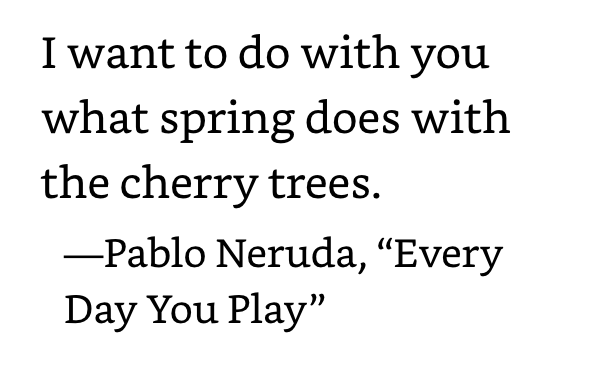
Let's find that joy and like Casey, even if we whiff, 99 times out of one-hundred, let's laugh it out and give to each other something of the words conjured by Neruda below.

Can we?

Can we?

Can we make cherry trees of life?

We can try.