Monday, February 14, 2022

An Open Letter from a Goldfish


Dear Humans:

Yes, we goldfish are addressing all of you.

Why?

Because we're fed up.

No. You didn't feed us too much. 

I meant fed up metaphorically. Dimwit.

We are so sick and tired of hearing how "so and so has the attention span of a goldfish."

Who are you, mere humans, to talk to us about attention spans?

You're the ones who can't watch television without flipping through two other screens at the same time. 

Talk about crappy attention spans.

Did you ever take a moment to think that maybe our attention spans appear short because life in a bowl ain't exactly riveting?

You try holding a meaningful conversation with a plastic scuba-diver blowing bubbles, endlessly blowing bubbles. Fuckwad. Those plastic scuba divers ain't exactly Noel Coward.

The plastic faux seaweed and the multi-colored stones ain't much better. It's not the Library of Congress down here in my freaking Petco one-gallon fishtank.

You try it.

You see if your mind wanders.

Before you blurt out some un-scientific proclamation about the relative brevity of a piscine attention span, let me ask you this, Mr. Big Shot Biped:
 
Have you given us anything worthwhile to pay attention to? I got news for you. We goldfish don't like being shouted at in commercials, being hit over our dorsals with copy points and third-rate jokes any better than hamsters do. 
And you know what they say about hamsters.

Not. Too. Bright.

I mean, what do they pay attention to? Running around a wheel. You'll find no atheists in foxholes and no Albert Schweitzers in hamster cages.

But the point is the same.

Give us goldfish something funny.

Something about us.

Something real.

Something interesting.

You'll see there's nothing wrong with our attention spans.

And there's plenty wrong with your "creative." And your cliches.


--


Friday, February 11, 2022

Do something daily.


One of the disciplines the modern world demands is: action.

Talk is cheap.

"I will" is cheaper.

And cheapest is all is theory.

Theory is usually expressed in the worst form ever: meetings. Or pompostifications. (pomposity + pontification.)

The modern world means doing something.

Now.

Today.

Or, even, this minute.

To me, the best thing about writing a blog comes when you write it every day. You don't get it right, every day. Some days, you miss like a Knick's shooting guard with the game on the line. You miss wide.

People comment. 

They might point out a dumbness. They might castigate you. They call you a fuck up. That comes with the territory.

But guess what? Tomorrow, something different is out there. 

Of course, you can't do ass-eating shit like Pabst Blue Ribbon
did.

But, you have to try every day. 

Be respectful every day.

Be good more often than not.

You can't expect to be perfect every day. No one is. 

But you shouldn't, either, be so hamstrung by an impossible notion of everyday perfection that, instead, you do things only on rare occasions.

It is better, as they say, to have loved and lost. It is better to have written and fucked up than to have never written at all. It's better to show up with good and plenty than castles in the sky.

I see a lot of people young and old in the business who perseverate over things that very few people outside of Cannes care about. 

That slows them down.

Before they know it, whatever window of opportunity was momentarily opened has slammed shut. 

Probably on your fingers.

Maybe not to open again for a long while.

Writing every day, and showing your work every day, gives you a chance to have a better hit rate. Your odds are better.

This makes sense for me.

When you work every day, you also improve your speed and your accuracy. You can show people what you're thinking rather than talk about what you're thinking. You get better because you're challenging yourself more. And practicing more.

Practice begets improvement. Creativity is a muscle that grows with exercise.


Just like a sprinter will get faster starts if she or he practices her starts. Like this, above.


To my mind, getting assignments, getting wins, getting accounts is like this sometimes. So I work at it. It gets me business and, believe it or not, friends.

Even though I suck sometimes.

As Scarlett O'Hara said, "tomorrow is another day."


Thursday, February 10, 2022

Agencies and the Roman Empire. A short history of Rise and Fall.

If you're running a business, an agency, an account or even a country, it probably makes some sense to think about Ancient Rome.

While the United States seems to be well on its way to dis-union and collapse after 260 years or so, Rome lasted 1,000 years. 

1,000 years.

Agencies seem to ride high for about a decade. Maybe two. Then they grow too large, or their charismatic founders leave, or they somehow lose their verve and gusto and become like everyone else. Boring and technocratic. 

Even agencies that seemed unstoppable back in the 80s, like Scali, Ammirati, Ally and Fallon, are all-but-unknown to people today. They have either been subsumed by a giant holding company or are a mere shadow of what they were.

But Rome lasted a thousand years. A millennium. Ruling roughly 25-percent of the globe's population and establishing, in large measure the legal system and the religious dogma many of us follow even today--2,700 after Rome's founding.

This is a blog about advertising. 

And I am not a historian (though I wish I were.) But is there anything I, someone who runs a one-person agency, or any other ad person can learn from Rome that can help us last longer?

I think the answer is yes.

And I think there are three things we should pay attention to.


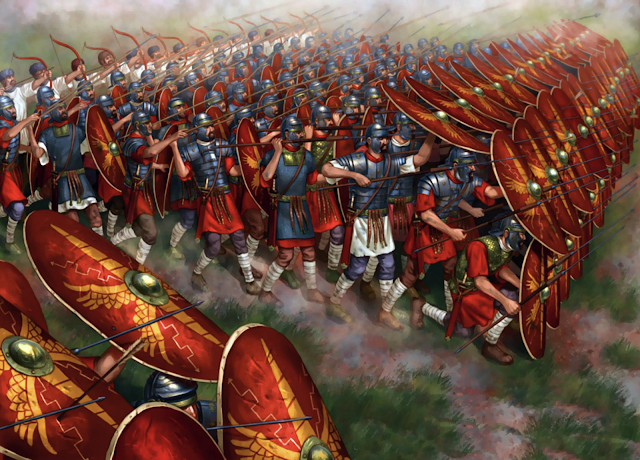
1. Offensive discipline and cutting-edge firepower. The Romans lasted largely on the strength of their legions. They figured out a way of organizing their soldiers to maximize both their offensive and defensive prowess. Their formations were rigid. Their technique replicable. And their discipline was formidable. 

The box formation, with each man protecting his neighbor and with each soldier given the ability to rotate out when he was tired, helped give the Romans supremacy. So did their short sword, the Gladius, that was designed to be deadly in close-quarter battle. And their long shields which gave even more protection.

In other words, their tools and their training made them better at their jobs. They had the human support to do their jobs. 

The Romans, of course, lost battles. A lot of battles. But they didn't lose wars. And they had institutionalized stubbornness, so they would return and vanquish anyone who defeated them. Also, though made up of thousands of people, they moved and thought as one integrated mechanism. 

These are all concepts that can be applied to agencies large and small.


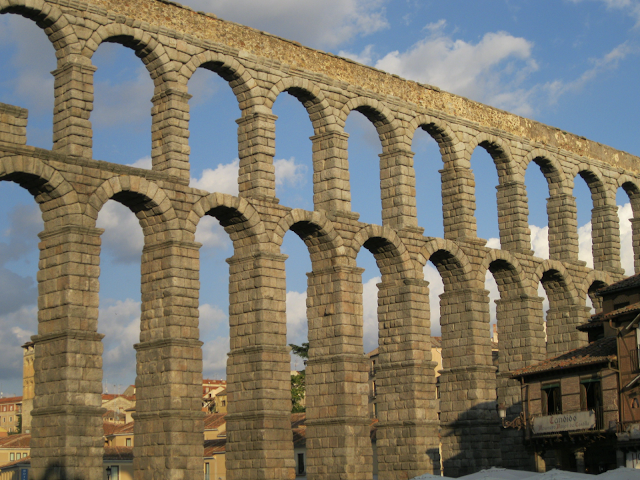
2. Sophisticated infrastructure. Wealthy Romans had hot running water roughly 1900 years before most people in the "modern" world did. They also built roads that sped communications and the movement of people and goods and troops. That made life better and selling things easier. That's what infrastructure is about. 

Rome lasted for one-thousand years because it was built to last. Today we use asinine language like "future proof." Nothing is ever fixed in time. The only way to future-proof anything is to commit to constant improvement and maintenance. 

It would pay for agencies to consider this as well.


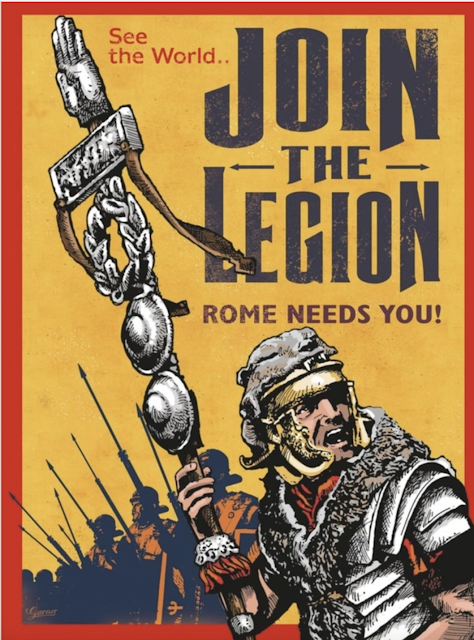
3. Rewarding foot-soldiers. As in point one above, Rome was built on its legions not its emperors. Just as, ostensibly, agencies are built on their workers not the holding company's c-suite. 

To attract, retain and reward its legions, Rome rewarded soldiers with citizenship and land. In other words, they could have decent lives in return for their service. 

I believe that's called a value exchange. A rare concept in the agency world where workers--those who create value--are often treated as costs. I'd wager attrition rates at most agencies today, voluntary or not, hover around 20-25-percent.

Take it from the Romans.

That's no way to build anything.

You have to give to get.

In sum, you need:

1. A philosophy, belief system and a disciplined approach.

2. The best tools. And ongoing improvement of those tools.

3. Rewards.

Class, that concludes today's lesson.

Pax vobiscum.


Wednesday, February 9, 2022

Guest post from Bill Bernbach.

Last night, my usual aches and pains decided to get together and have a house party in my carcass. 

Rather than staying in my feet like they often do, the pain party was a rager. It was too much for my feet alone. The aches and pains would not be confined. 

Before long, they were dancing in my knees. Then my back, which doesn't like to be left out of a good pain party. Then my right shoulder, the one with the torn rotator. Then my left, which is arthritic out of sympathy to the right.


The party was going like Louis Jordan's "Saturday Night Fish Fry," and even three large painkillers delivered by the great god, Lord Morpheus, himself didn't lead me to drowse. 

Suddenly, while I was tossing, I felt a knock on my sternum, followed by a lustier knock on my forehead.

"Who goes there?" said I.

"Bernbach," said in a too-many Chesterfield's and too much Chivas voice. "I'll take it from here."

He cleared his phlegmy throat and he did.

"George," he rasped.

"One lesson today. Give me the soapbox, Fatso."

He stepped up:

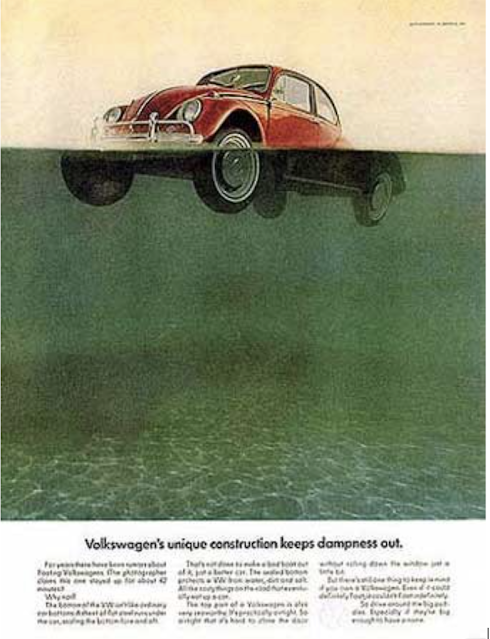
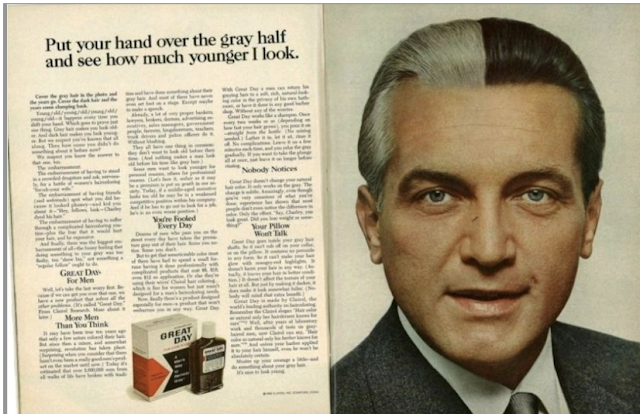
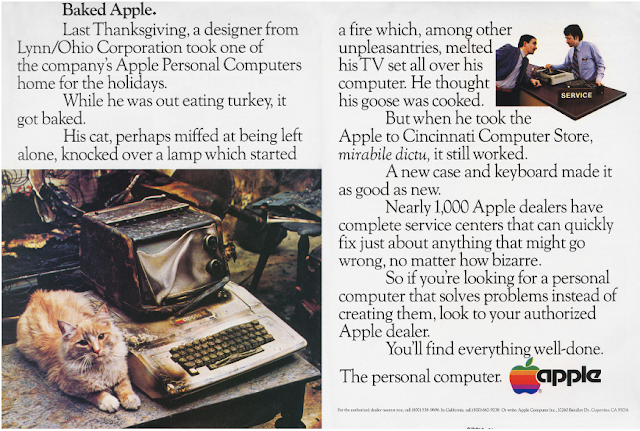
"Go to the essence of the product. State the product’s essence in the simplest terms of its basic advantage. And state this both tangibly and memorably."

Then he showed me these 9 ads.

"Thanks, Bill," I said. "I hope someone reads this."

But by then, the apparition had vanished. I had nothing left but pain. And the Fatso.

Fucker.


1. 


2.

3.


4.


5.


6.


7.


8.


9.


Tuesday, February 8, 2022

The case for optimism, Part Two.

I barely was able to write one post about optimism and the ad industry when I decided to push myself and write another one. 

Generally, I write my posts before I write my titles. And when I wrote yesterday's title, for whatever reason, I appended a Part One to it. That left me on the hook today to think through Part Two--more reasons for optimism.

Some of my reasons for optimism arise from having started GeorgeCo., LLC, a Delaware Company roughly 26 months ago. 

Since that time, I have improved upon my Ogilvy salary. Without bragging or alerting the IRS, who seem to take two dollars out of every $1.75 I make, I’m doing ok financially.

But my personal flirtation with Mammon is not why I am sanguine. I am hopeful because clients--and not necessarily only small clients--are waking up to the need for good advertising.

They need it because it works. 

That's why I get calls.

Almost every week.

I am making good money not because I charge a lot but because I deliver a lot of value. If my assortment of clients can see the value, the return, the energy good advertising can deliver, why should I not be optimistic that the currently stultified, committee-ized, technocraticized bulk of the industry won't soon awaken to the value of advertising, too.

Of course, waking up clients (and agencies) to the most powerful wealth-creation tool in the history of humanity will not happen simply. You can't set your watch by it like mosquitos in the summer. And there will be no colossal gong from an industry Big Ben stirring us into belief. It will take a thousand tiny clarions--you, your partners, your account team, your planners saying "good advertising works," to rouse the clients of the world. 

It will take a re-reading of Bill Bernbach. Imagine if we thought about and talked about Bernbach statements like this one with one-tenth the vigor we think about things like the metaverse. Imagine if your Twitter feed were filled with discussions about the statement in bold below, not the new new new thing. Imagine if we talked, instead, about the old, seminal things.

Imagine if we went into every meeting with every clients and said this from Bernbach: "Creativity is the last unfair advantage we're legally allowed to take over our competitors." Imagine if we believed that. And were inspired by winning marketshare and mindshare for our clients instead of some silly trophy.

If we had the balls and the ovaries to speak with that self-assuredness, maybe we can make a case for optimism. For every C-suite denizen and every client who says, there's nothing different about our ______, imagine if we, as people and as an industry responded with, "That's why you need creativity. To show the world in arresting, interesting and memorable ways who you are."

I am and will remain optimistic because against all odds when you tell clients about the power of creativity and show them real creativity, they listen. They don't buy it automatically. They don't do everything you want them to do. They don't always invest as they should and step boldly into the light, but they'll start.

And that's how we start bringing out industry back to the place it should be. We should say:

DO.
Advertise. It's the greatest creator and propagator of wealth and fame in the history of the world.

DO.
Advertise. After all, many of the world's most valuable brands became the world's most valuable brands through advertising.

DO. 
Advertise. And let us carve out, for you, a small portion of a person's brain where your brand can live. We can't do that just listing bullet points.

DO. 
Advertise. And demand that we make ads that are even better than the shows people are watching people so people will watch our ads, enjoy our ads and share our ads. (And buy our products.)

We shouldn't say:

DON'T.
1. Advertise. Instead chase people around the web and sell repeatedly their data.

DON'T.
2. Advertise. Accept instead incremental gains of between .025 and .033 a quarter.

DON'T.
3. Advertise.  Rather assert that you can do nothing more than announce a BOGO sale-bration and Raymour and Flanagan-a-thon.

DON'T.

Advertise. Let us do things cheaply without really understanding who you are.

I'm optimistic because I know a thousand people in and around the business who are good and are waiting--too long--but are waiting for a dormant industry to wake up to its capabilities. To wake up and lead clients. Not to stay asleep and be flagellated by procurement.

Sixty years ago, Bob Levenson at DDB wrote an ad about the power of advertising called "Do This Or Die." I won't repost it here, because I've talked about it so many times. You should have it on your hard drive. Or have it memorized.

In his last line, Levenson talked about "our own skilled hands."

I'll appropriate that here.

We have the hands.

We have the minds.

We have the skill.

My quandary about optimism comes down to this:

Do we have the will?


Monday, February 7, 2022

The case for optimism. Part One.


I recorded a podcast Friday night--I'll tell you when it's meant to air when I know. Toward the end of our time, the interviewers asked me a question about the advertising industry. 

As readers of Ad Aged know, I've been in the ad industry virtually my entire life. Not only have I made a living at it since 1980, but my father was also in the business, as was my Uncle Sid, who was half a generation older than my father. I can honestly say, I grew up and have spent my entire life hearing about the business, looking at ads, thinking about what makes an ad compelling and what might motivate people to pay attention.

The guys hosting the podcast asked me what I'm optimistic about when it comes to the ad industry.

I'll be honest. It stumped me. 

Asking me about optimism is like asking donald trump about ethics. Or his cranial merkin. Or asking my opinion about this year's super bowl. Optimism is something I know very little about.

It doesn't come naturally to me.

As JJ Hunsecker said to Sidney Falco in "The Sweet Smell of Success,"  "I wouldn't like to take a bite out of you; you're a cookie full of arsenic." 

I have been, maybe I'm a snowflake, somewhat tortured by life. The ancient Greeks described people like me as having heads full of scorpions. Not a pretty picture, believe me.

There are lots of reasons behind my tormented soul--they're best discussed every Thursday at eight with my therapist. But to steal another quip or to make one up (I'm not sure which): "I don't have many enemies, but all my friends hate me."

Like many people my age who have made their living writing ads, I have the gift of quip. My glibness and bon-mot-machine- gun semantic style often allow me to sidestep tension and throw out a joke instead of an answer. As Groucho might have proclaimed, I am deeply shallow.
But what am I optimistic about? That is the question. 

I could have said that I'm almost done. That makes me happy. I'm hoping to make it eight more years, to 2030.  I want to surpass my baseball hero Minnie Minoso, who played in five decades. I want to work in the ad business for six decades. At this point, I somewhat feel I can make it that long on fumes alone. After a moment's pause, however, I took the question seriously.

I'm lucky, I said.

I have an eidetic memory (that's a fancy-schmancy way of saying photographic) and I have been around and worked with dozens, if not scores, of many of the most notable people and brands the industry has ever produced.

What am I optimistic about?

I'll start with what I believe in. I side with what Shelly Lazurus, the CEO Emeritus of Ogilvy used to say when the agency was successful and she was leading it. I believe that her stated goal, "To be most valued by those who most value brands," is about as good a mission statement for me, or the business as we're likely to find. I believe if we could take a step backward and re-embrace that thinking rather than something pompous and vain like, "to make the world a better place," there would be cause for industry optimism. We can do this. 

I believe there's cause for optimism if we focus on the meat of our purpose--to create brand value--not the unproven bullshit all around us, like our ongoing meta-zuckurbation, we can actually make a difference.

Second, I'll switch to something I learned from Hall-of-Fame art director, Mike Tesch. Tesch and his partner Patrick Kelley practically put Federal Express on the map, with literally hundreds of commercials that still do a lot to define that brand (and good advertising today.) Tesch believed, rightfully I think, that there were few marketing problems that couldn't be solved by a great commercial. Clarity, wit, humor, human understanding matter. If we re-embrace that, I am optimistic.

I know that sentiment today is about as retrograde as a statement gets. But I believe that about 99-percent of all brands are without definition and stand for virtually nothing. 

However, and we've all seen it, felt it and maybe participated in it, we can create brand-likeability. We can make friends for brands. We can get brands noticed.

That's a lot.

If, in the words of TBWA\C\D NY CEO Rob Schwartz, you can own a piece of the consumers' brain, you've got cause for optimism. But that ownership takes years of great and consistent work. It isn't like making instant mashed potatoes--boil water, stir and presto. 

It takes work work and more work. Nike's done it. Apple's done it. And a few others. It's the world's most valuable real estate, a place in someone's brain, and we can own that--the metaverse be damned. 

Two or three more reasons. One, I learned from Steve Hayden. And barely a day goes by where I don't think of something wise he's said that I marked down in my memory. The power of simple, jargon-free language. The effort to always come back with a better ad. The fight to never give up. The act of being nice. All those things, give me hope. 

As do things I learned from Chris Wall. I remember him, all 6' 10" of him, standing up in front of a collection, or a gaggle of creatives, holding a New York Times in one mitt and The Wall Street Journal in his other giant paw. Chris reasoned if journalistic-creatives could fill those papers every day with quality, there's no reason we should ever complain about compressed schedules. 

Further, I find optimism because there's a need. Because in today's world there's so much that needs explaining and who's better at it than we are?

I'm optimistic about advertising because I think the business world needs advertising. I believe, and maybe this is naive, not optimistic, that when you make a good product, telling the world about it in an honest and compelling way can lead to riches--and can lead to growth and economic success. I'm optimistic because I believe if we take advertising seriously--as a tool and lever of growth and improvement--we can grow and improve. 

We have the power to do that.

The question is--will we take our jobs and our industry seriously? Will we fight our way back from what Sir John Hegarty called "the fringes." Small ads. Small ideas. Stunts. Datamania and technoblabber. And all the latest trends.

Will we continue to make fake ads and trumpet our own solipsistic success? Will care more about awards than helping clients? 

In brief, will we do our real jobs? Or will we continue our industry-wise dilettanteism?

If we do our work--and we break the modus operandi of the holding companies who act as if they're running an extractive-industry (and clients and agency people are the slag heaps) and start supporting what it is we can actually do beyond fattening the bank accounts of the few moguls at the top, then I'm optimistic.

But only just barely.

[More optimism tomorrow.]


Friday, February 4, 2022

Big and Small.

In a blink of an eye, I went from working at one of the very biggest agencies in the world to leading the very smallest.

One person. Me.

When a change of that magnitude happens, like when the temperature drops forty degrees in an hour, you ought to open your eyes and pay attention to the world around you. Because strange things often happen amid giant change. Or, at the very least, you can notice strange things when you're out looking for them.

Downsizing my agency cosmos, one thing I've noticed is kind of an ontological mind-fuck. Call it cognitive-dissonance on a grand scale.

Most small agencies try to pretend they're vast. They'll put Apple logos on their site, or Verizon, or P&G. They'll pretend they have international scope.

And most giant agencies try to position themselves as small. They describe themselves as nimble and new age and borderless.

It reminds me a bit of going to a frat party when you're eighteen. Everyone's pretending to be something they're not. 

Just about six months after I started GeorgeCo., LLC, a Delaware Company, I got a call from a pitch consultant. This was a very big deal for me.

My first call from a pitch consultant.

She asked me if I wanted to participate in a pitch for a large client against large global agencies, like FCB. Who in their right mind would say no? As the former CFO of Ogilvy once told me, "there's nothing bad you can say about revenue."

The pitch consultant told me that I should try to look big and established. 

I said I'd rather say who I am. And that as someone with perhaps one of the ten or eight best networks in the business, I can pull together the right people to handle anything from fast-growing tech brands to America's largest anchovy and caper retailer, a company I'm working with currently, called saltoftheearth.com

When I introduced myself and a planner to the client, I presented to them under the heading of the headline above. 

In brief terms, it told them how we work and why we work that way. I ultimately got turned down by them because they thought I couldn't handle their complicated email programs, with hundreds of letters a week. But I got hired anyway to create their brand campaign and brand positioning. Which was better for me anyway.

Rightly or wrong, I decided to say who I was as honestly as I could. I'm one guy who knows a lot of good people, who's a fair judge of talent and who can build an agency around a clients' needs. I think I probably said "at too many agencies availability is a capability." They laughed at that, as people do, but I think it registered. 

To plagiarize from Mae West: "It ain't the men in your life, it's the life in your men." Or something like that.

The behemoth agencies, of course, often do the opposite. "The people in this room are your team," they'll say. "We're as agile as a Romanian gymnast." "We deliver borderless creativity." Or some other Newspeak mumbo-jumbo that people can see through like a Victoria's Secret model's negligee. Oooh lala.

I think it would be so much better for the integrity of our business if everybody going after clients would just stay in their swim lanes.

So if anyone from one of the Holding Companies is reading this, or anyone from S4 Capital, I have a deal for you. 

Go after all the small accounts you like.

I'll take the huge ones you can't handle.


Thursday, February 3, 2022

Systems collapse Madison Avenue style.

Like many people today, I worry about the state of the world and the actual survival of our planet. This is not just pyrotechnics on my part, or paranoia, or panic. It's witnessing what seems like the collapse of belief, truth, facts, enlightenment and community.

It seems to be happening all over, not just in the United States. I have a fair number of friends in the UK who seem to curse Boris Johnson in every tweet, email and posting. With good reason.


Last night, I forged ahead in yet another giant history book, this one called "The Greeks: A Global History," by Roderick Beaton. It's work reading a book like this. It's no beach read. But if you have a mind--or cultivate your mind--so you can find parallels to the present, you can have a sense of today with thousands of years of examples to inform your current perspective. I don't read history, and a lot of it, to impress my wife with my Jeopardy! skills. I read about the past to learn more about the present and myself.

Last night I read about a mysterious time period that took place around 1200 BCE to 900 BCE. That's about 2900 to 3200 years ago. Older even than the Ogilvy people Mark Read got rid of for hearkening back.

Around that time, civilizations from Crete, to Greece, to Persia to the Levant and throughout the world essentially regressed. Where they had been building homes and temples and infrastructure for many centuries, humanity left the world of art and architecture and re-entered the world of mud and wattle huts. We left the world of artistry and craft and went backwards to a mere non-aesthetic functionality.

Beaton writes, "...the modern theory of ‘systems collapse’, that has been devised to explain how this and other world civilisations came to disappear, is one that we will encounter again, in the rise and fall of later civilisations in which Greek speakers had an important part to play."

Systems collapse is not Verizon introducing 5G Ultra with seven exclamation points and then dropping three calls in four. It's worse than that.

Beaton explains the "process" of systems collapse this way:

"A good example of how this might have worked in practice can be seen in the fortifications of the Mycenaean palaces. Up to a certain point, it must have made sense to the rulers to mobilise vast resources and command huge workforces in order to bring more of the palace’s essential functions and personnel within the area protected by the walls. 

"Later, when the perceived threat became more acute, it still seemed worth the effort and expense to enclose access to the water supply within the circuit. 

"But what do you do when the next threat appears, and this time the cost of meeting it is greater than the system can bear? 

"At this point, following the theory of systems collapse, competing sections within society begin to doubt that their own interest is best served by the system that supports all. The mechanism of collapse now sets in.... "

It's not a stretch, I fear to see the pattern above and apply it to America. You need only take a train from New York to Boston or to Philadelphia. It takes longer in 2022 to travel the distance than in did in 1852. That's if it doesn't snow. 

My guess is that "competing sections within society begin to doubt that their own interest is best served by the system that supports all." You can apply that definition to almost anything in the modern world. It seems, to be even darker than usual, another way of summarizing Charles Murray's thesis about the US "coming apart." We have a small elite society that wants nothing to do with those who aren't elite and works to not pay for anything that doesn't pay them back. They can call it Libertarian. But that's a kind word for un-Christian selfishness.


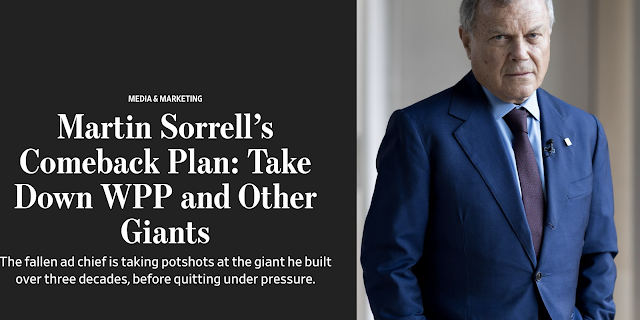
I just now read an article about Martin Sorrell and S4 Capital in the Wall Street Journal. It's behind a barb-wired paywall, but try anyway. My guess is that the greed that helped destroy the ad business (one year, Sorrell paid himself $100 million and allegedly used company funds at a whorehouse) is a form of systems collapse.

Looking at the Mycenaean wall example above, it's all too easy to find an advertising/holding company parallel. The area covered by holding companies has expanded and expanded--like the area cover by walls. Then, of course, the value of many of the new agencies within holding companies' walls was found to be shaky. But we own them, so let's adjust. So agencies were consolidated, torn-apart and thousands of people were axed. The trouble, however, too many providing too spurious a service remains.

Of course, the moguls will keep supporting the system as long as they benefit. When the revenue spigot dries up because the essence of what they're selling has been so devalued, they will move on to the next fatted calf.

Though the ad industry has no trade-press to monitor its decline and fall, my guess is that many of the large conglomerate agencies have much-reduced payrolls in order to hold onto ever decreasing margins.  When there's no more payroll to cut, our well-tailored whore-mongers will be gone like a fart in a hurricane.

The system--giant holding companies squeezing every dime from their dwindling number of clients and low-wage employees--will perish.

Something new will come.

But we'll be in the dark a long time.


Wednesday, February 2, 2022

I get notes.

As you may or may not expect, having written almost 6500 posts in this space, and having earned a considerable readership, including a small legion of people who check in with me every day, I get notes now and again.

Some of these are notes from people I know--or knew--in the long-ago past. Some are from people I share 32,000 or so connections with, so even though I might not know them, we have so many overlapping spheres, we might as well be friends. And I don't have many friends.

Some are from people out of the blue. From lands and places and people I've never heard of and will likely never visit or meet. 

That's the beauty of tele (faraway) communications. And it's also a lesson about being in the communications business.

Work--no matter if it's a novel, a banner ad, a tweet, or a blog like this one--isn't just designed to rattle around cyberspace, knocking against photons until it gets sucked into a black hole.

When we do our work, as much as we have to think about what we think good is, we also have to think about "what's in it for our readers?" What can I do, show, say, tell, allude to that helps to give them a perspective on the world that they might not have had before.

In ancient Knossos, long before the rise of Greece, there were temples made with giant blocks of stone that weighed upwards of six-tons. Later Greeks and Italians believed that one-eyed giants--the Cyclops--built these structures. Cyclopean, they called them. How, possibly, could humans achieve such feats?

All of us in the communications business--all of us writers, and talkers and thinkers and designers and directors and voice-over artists, need to think about this. 

How can we build things, create things and present things that excite people, intrigue people and make people wonder? How can we cause a reaction? Get a head to shake? Wake a viewer up at night?

How can we be provocative? Upsetting? Comforting? Funny? Annoying? Soothing? Timely? Or untimely?

To be unacceptable to those who rule our lives, HR, how can we touch people? 

Of course, we have information to deliver. We have mandatories and checklists and briefs as heavy as the aforementioned temple blocks. But how do we make things memorable, and full of life, hope and even love?

There's an atomization in the world now that says everyone is different and entire unto themselves. The antipode to No Man being an island and interconnectedness.

But communication starts with empathy. With understanding what Bernbach (perfectly) called SIMPLE, TIMELESS HUMAN TRUTHS.

As I writer, and I write this specifically to Darlene and Michael and Alison and John who have written to me in the past week or so, I have an acronym for you: WITT.

WITT should be on the walls of every agency and every client marketing organization. It stands for We're In This Together. In other words, you're not alone. I'm here for you. As you are here for me. To lend an ear, a should to cry on, a helping hand. Or, only, to serve as an example. 

Someone who writes every day--not because I'm necessarily good at it or have something to say--but because I believe, as Willy Loman believed that attention must be paid. 

We're In This Together.

Trying to make sense of a world that was shaved by a drunken barber and is bleeding, profusely, from twelve different, or fourteen different nicks and cuts.

That's all we can do.

Put one stone on top of another. And hopefully do it well enough so people stop and ask themselves, "how'd he do that?"


Tuesday, February 1, 2022

Two days in the life.

1. IN THE CHAIN DRUGSTORE.

CUSTOMER: Hi. Do you have safety pins?

CLERK: (NOT LOOKING UP. ASKS COWORKER) Do we have safety pins?

COWORKER: (TURNING PAGE OF MAGAZINE SHE'S READING.) Aisle ten.

CUSTOMER: Aisle ten? Where? It's a big aisle.

COWORKER: On the right side.

CUSTOMER: The right side facing the front of the store or the right side facing the back of the store?

COWORKER: In the back.

CUSTOMER: (FIVE MINUTES LATER) I can't find them.

CLERK: We must be out.

--


2. IN THE CHAIN HOLDING COMPANY AGENCY.

CLIENT: No one knows what our brand does. Who we are or what we stand for.

ACCOUNT: Let's have a zoom. 

ASS'T ACCOUNT: I'll set up a call for Thursday next.

PLANNER: Let's make sure we talk about NFTs on that call.

PM: Are we scoped for that?

INTERN: Ocean plastic.

TECHNOLOGIST: We need to add some hours for Blockchain.

SR. CREATIVE: We'll have an anthem, some directors' reels and a ton of print.

ACCOUNT: The client hasn't run print since 2002.

SR. CREATIVE: But it will help define them.

MEDIA: We have some sponsorships with value-added quarter pages.

INTERN: The refugee crisis.

JR. CREATIVE: Metaverse. We'll build a storefront.

TECHNOLOGIST: They're on Drupal.

PM: Scrum.

ACCOUNT: We're running hot.

SR. CREATIVE: The CCO wants everyone involved. We have to make something we can enter in Cannes.

JR. CREATIVE: (LAUGHING) Look! This is Ann as an avatar!

SR. CREATIVE: That's fucking great.

INTERN: Systemic racism.

PRODUCER: Just spoke to Smuggler! They want in.

SR. CREATIVE: What about Noam?

ACCOUNT: We can afford Noam, or Lance.

JR. CREATIVE: Even if we choose a song by the Stones?

PLANNING: No one's used the Stones for an NFT yet.

PM: This is coming together.

ACCOUNT: But we're still running a little hot.

CCO: We've got some boards coming in from the offices in Mumbai and Singapore.

SR. CREATIVE: Fuckin' awesome.

TECHNOLOGIST: We're working on a CMS. We'll be ready three months after the TV breaks.

MEDIA: It needs to work in six seconds.

INTERN: Global warming.

PRODUCER: We'll shoot anamorphically and one to one.

SR. CREATIVE: We need a really good DP.

PRODUCER: We've got the guy who did the Betty White tribute.

HR: We need to make sure we bid diverse production talent. And that the shoot is carbon-neutral.

PRODUCER: Why don't you just handcuff me from the start?

ACCOUNT: Cool it. There's no "i" in team.

PLANNING: Actually, we'll be dubbing this in French. The French word for team is "equipe." That has an "i." In Finnish, the word team is "tiimi."

JR. PLANNER: That's three "i's" in team.

SR. CREATIVE: Fuck a duck.

SR. ACCOUNT: Lunch!