Friday, March 4, 2022

Jane Brody and us.


My wife of almost 38 years and I have been voracious readers of The New York Times for well over half a century. That's not an exaggeration. In many New York households like the ones we grew up in, The New York Times was ever-present. In some, like the one I grew up in, the "paper" paper, which arrived at our front-door every morning, was literally fought over. 

God forbid someone wanted the Sports while someone else was doing the crossword. Or someone was reading a theatre review while someone else was reading the business section. The Times and its legendary writers became part of our lives.

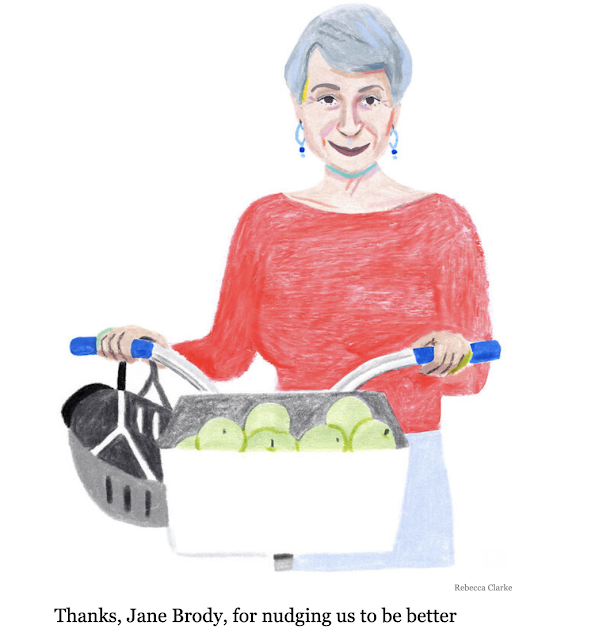
One of those legendary writers was Jane Brody. Brody started writing the Health column in the Times way back when Gerald Ford was president, in 1976. My math says that means she wrote the column for 46 years and for the Times for 57 years.

Late last month, Brody retired. You can and should her last column here. If you're interested in really good writing, you owe it to yourself to read it and maybe save it.

Late last month, another Times writer, Tara Parker-Pope wrote a farewell tribute to Brody. There was a bit in it that made me think of the advertising industry--and what our real purpose is as advertising practitioners. 

Parker-Pope writes, "Jane was among the first journalists to recognize that better health doesn't happen in the doctor's office--it's rooted in the small decisions we make every day....

"In fact, when Jane first interviewed at The Times in 1965, she told managing editor, Clifton Daniel, that she thought the paper's science coverage fell short of serving its readers.

"It doesn't go far enough," she told him. "It doesn't help people live better lives."

Over the last 12 years or so, I've compiled a list of newspaper articles where complicated things are dissected and then explained, simply and entertainingly, to readers. 

Newspapers do this. But agencies don't, can't or won't. We don't have the expertise, the time or the talent. And I think the line I underscored above makes all the difference.

Our business has demeaned itself and destroyed any trust/esteem it once had by selling--only selling--to people, and usually shouting while doing it.

It's led me to conclude that newspaper journalists are ahead of advertising creatives in serving their readers. 

Simply because they hold to the belief that they are helping people live better lives.

By that I don't mean the bushwa purpose so many advertisers engage in to assuage their egos and whitewash or greenwash their iniquities. 

I mean, it's time for us--the ad industry--to recognize that what we sell is important to people, and therefore, even something as dopey as a hamburger or a credit card should be presented as something that actually serves you in some way.

If it's a burger, it's made out of better meat.

If it's a car, it's safer, or lasts longer.

If it's a telco, it's more reliable and attentive.

If it's a cloud, it provides better tools, access and security.

If you offer nothing better, and you're not helping people live better lives, what's the point?

Find something better. Then advertise.


Thursday, March 3, 2022

Milestones.


As I enter my third year running GeorgeCo., LLC,  Delaware Company, even though I started GeorgeCo. after more than forty years in the advertising business, I've learned a few things. In fact, I think it's honest to report that I've learned more about advertising in the two years I've been a soul and sole proprietor than I did in the forty years I was working for others.

You have to learn. The same way I'd have to learn if I were to survive Armageddon. I'd have to learn things I'd never learned because they had always been done for me. As I like to say, working on your own is like walking a tightrope without a Net 30.

Along the way, I've hit some milestones. Some I've bounded over. More where I stubbed my toe and wound up with some gnarly nails. The trick is trying to learn no matter what.

The first milestone I passed is how important it is to slog. I had no years where everything I touched turned to gold pencils or gold heads or gold lions. I had many more years where I worked and worked and worked. Where I did the hard work of making work, of listening to clients and helping them build their business. Work can be joy. But it is also work. And anyone who thinks success can come without sweat was either born a billionaire or delusional or both.

For me, my dedication to the slog reaffirmed my belief that agencies are agents. That we stay behind the spotlight and work for the greater good of our clients not for our own glorification and aggrandizement. I don't care what's au courant. I work for my clients today--I guide them and I push them and I challenge them. But I never forget I do it for them. 

I promote myself, you have to. But I spend 98.7-percent of my brain muscle working for my clients.

Early on, I disappointed a client. That was milestone number two. They were pleased with my first round of work but felt the second round made the work worse, not better. I learned that sometimes you fuck up and fucking up is ok. I redid the work for the client, without extra charge, and I made them happy. I still work with that client today.

Once I heard Steve Hayden say to a client, "If we hadn't had that failure, we might not have this hit." 

I passed my third milestone when I had a prospective client bark at me. He wanted me to evaluate his website and give him feedback on how I would re-write it. 

After all my years in the business, I gave that task the time it deserved--ten minutes. (I wasn't being paid.) The prospective client accused me of 'phoning it in.' I barked back. "Just as a realtor can look at your house and immediately evaluate why it's not selling, I can do the same with your site. It doesn't take a professional a long time to size up a problem." 

Thank goodness we decided not to work together. Milestone three--is easy. It's having enough respect for yourself to allow yourself to work only with people who love you and trust you.

Milestone four came for me when I encountered a dickweed of a client who decided to try to stiff me out of $54,000. It's not unusual for clients to act as if they're Goliath and you're lowly David. They're big and you're small and therefore they have the right to push you around.

This is where you learn the importance of impeccable record-keeping and airtight contracts. Oh, and also having a brother who's one of the world's top attorneys. 

Of course, they had no cause for not paying me, except somebody probably spent my money on an illicit girlfriend or at the racetrack. Or just because they wanted to throw their weight around. Or because they could. And of course, there was no apology. But there was a lesson underscored. And a lesson learned. If you get the gut feeling that a client is an ass, go with your gut.

Oh, and maybe I learned this from my Bronx roots. When shoved, shove back harder.

Milestone number five came when I learned to go not only with my gut but with my sinew, as well. A lot of times you get assignments that seem obtuse and ill-defined. 

When you're working in an agency, nominally, there's an infrastructure of people around who can make things clear. Or clearer. Planners to clarify. Account people to calm you. Cohorts to defibrillate your synapse. When you work for yourself it's just you, your brains and your typing fingers. Work and work and work and work until you work the problem out. 

Labor omnia vincit, the Romans said. Work conquers all.


Milestone six came when I began to learn how to charge. If you've spent your life in the ad industry, you've seen the agency's sense of its own worth crumble. We compete on price, like a used car dealer, and to my old eyes it sometimes seems that the holding companies are in a race to the bottom.

You've lived through layoffs, salary freezes and a greater and greater share of agency revenues dedicated to supporting higher-ups who have somehow convinced themselves, shareholders, the Internal Revenue Service and most of the agencies they control that their shit don't stink. Their pay has gone up. If you're old like me, yours, at least in real dollars, has probably gone down. 

Learn your worth. Not with a sense of entitlement or aggrandizement or hued by an over-inflated ego, but according to the value you--and only you--can provide. In Manglehattan, where I've lived for most of my life, plumbers charge $450/hour, an Ivy-League lawyer $1,000/hour, and a top McKinsey consultant about the same, and one of trump's hookers, considerably more.

This is the biggest, most important milestone of all. Not just learning your self-worth, having the composure to demand it. When someone balks, take a breath, turn on your heels and say, "I'm sure you can find someone at the price you're willing to pay."

Now:

To the couple of dozen of clients and handful of colleagues who have helped me learn these things over the past two years, and to a friend, far-away, who is thinking of going freelance and who, thereby inspired this reflection, thank you. 

Thank you for teaching me.

Even more, thank you for trusting me. 

And for letting me come through for you.


Wednesday, March 2, 2022

The practice of theory.


I have to believe most people, even people as old as the oceans like me, don't know who Thorsten Veblen was. Nor do they know of his important book, "The Theory of the Leisure Class."

Way back in 1899, the Norwegian-born University of Chicago professor Thorstein Veblen wrote that ground-breaking study and critique of "consumerism" and capitalism. I don't know how academia regards Veblen today or his book. But I'd imagine it's just one more of those many volumes that people cite and never quite get around to reading. Like the Magna Carta or the agency handbook or the constitution if you're a republican.

Just a few moments ago I read, as I frequently do, an obituary in The New York Times. To my field of synapses, it never fails to amaze me how frequently you just happen to find something major when you're not looking. It's the openness of your mind that matters, not your hunting ability. Things actually find you. That's why, I think, so many special people have messy desks. The art of searching leads to the epiphany of finding.

The obituary I'm talking about, which you can read here, tells of the life of David Boggs, 71, whom the Times calls "The Co-Inventor of the Ethernet."

I'm not a tech guy, but the ethernet, to my humble brain, makes much of what we call "digital" possible. The way I understand it, Boggs' ethernet makes it so we could transfer data across networks. It helps parse data into packets and transmits those packets either through wires or wirelessly. The ethernet assumed that some packets would be lost along the way, but somehow--don't ask me based on my cursory reading to explain this--because of redundancy, the show and the internet would go on.

If you're reading this now (how's that for stupid) chances are Mr. Boggs' technology ideas have something to do with that. The ethernet essentially made the word legible.

Here's the thing in the obituary that really got me. The life lesson I got from reading about someone elses' life. 

In the early 1980s, Mr. Boggs took the stage at a California computing conference, to discuss the future of networking. A

technologist from a rival company to Boggs' questioned the mathematical theory behind ethernet. He claimed it would never work with a large number of machines.


You get a lot of that kind of aggressive doubt in advertising and marketing today. You'll be told something you wrote isn't emotional. Or it's too emotional.


Someone will rap your knuckles and say that there isn't a logo in the first four seconds. Or the URL isn't up long enough. Or the Kars 4 Kids pink guitars are the wrong shade of fuchsia. Or it won't get 'engagement.'


There are plenty of theorists who theorize about how to create work and where to propagate marketing messages. They'll produce decks as numerous as leaves on the trees and swear up and down those trees that if marketers only would only follow their baroque theories success would be theirs. They, almost tautologically, reject the marketing things that work and have worked for marketers since time began. That is impactful, artful,

intelligent, persuasive and ubiquitous work is really the only thing that works. In sum, make something good and run it.


But creativity--in practice--is almost always trumped by theory.


I call that, apologies to Mr. Veblen, the Leisure of the Theory Class. It's borne by people who criticize, but they don't make anything. They are the gurus of our industry who seem to preside over people like me, a g(u)runt.  

And somehow, someone at volume will question whatever you're proposing. And they'll have the theory to assert it won't work. Theory is always right because it has nothing to prove and is always right--look, I've proved it on paper. If a theory is wrong, you merely amend it and propose a 2.0. Or in the case of the Web itself, a 3.0. Which will be built with no more privacy, security or acuity than any previous version. 


When Boggs was told his ethernet wouldn't work, he had the perfect, unequivocal response. A response we should all store for further use.

"Seems the ethernet does not work in theory,” Boggs said, “only in practice.”

-


About 100 years ago, I wrote two ads a week for a large retail bank in New York. An industry friend often talks about how he did the same for a group of restaurants.


There were no theorists around in those days. 

There was something smarter: people with experience, judgment and taste.


They would say, "run that ad. And that one."


Then when the ads ran, you either saw a lot of people in a lot of bank branches or restaurants or you didn't.


We wrote ads. We didn't theorize.

We weren't smart enough for that. 


Tuesday, March 1, 2022

Embracing science.


I finished a book on Friday evening that, like most books I devour, got a good review in either "The New York Times" or the neo-fascist "Wall Street Journal." For all the darkness that has descended upon our planet--from the death of liberal democracy, to the destruction of our planet, to the dilution of the very meaning of the word truth, we are in the midst of a flowering of really great books.

Each month, the aforementioned newspapers publish index-card length reviews of a dozen or two dozen new books that I can't wait to get my mitts on. While many of these books have absolutely no bearing on my life--they won't help me save 32-cents a week heating my home, or find peace and tranquility in a world that seems arrayed against me, or find a way to have a comfortable retirement on the coast of Portugal fo $13,750/a year, I read them because they massage my brain. 

That is, they make me think.

I was taught algebra in the 1970s by Mr. Adolph Nelson, who was already two or three hundred years old when sullen, teenage George slouched his hypotenuse off in his hormone rife classroom.

This being the early 70s, Mr. Nelson said things to his students--repeatedly--that would have him canceled and gutted and kicked out of the teaching profession, and probably the state, today. I remember him dressing down a kid called Joey Flashner for being a painful combination of lazy and dim.

"Joey," Mr. Nelson would croak, "Scientists say your brain gets creases when you think a lot." (98-percent of New Yorkers have good comic timing. It's in the water and Mr. Nelson was no exception. Therefore, he paused.) "If that's the case, your brain must look like a cue ball."

The class calmed down about twenty minutes after that and we went ahead, as most humans do, solving for X.


I read "Origin: A Genetic History of the Americas" based on just a handful of words from the New York Times review: "The Kelp Highway hypothesis." Kelp Highway. I had never heard of that. And since the lord kelps those who kelp themselves, I was intrigued. The hypothesis is the idea that the first peoples of the Americas dated not from about 15,000 years ago--as has been believed for at least a century--but from 30,000+ years ago, and spread from Alaska to Chile to Greenland by small boats along the life-sustaining kelp highway.

I know the kelp highway has nothing to do with advertising, but it does get my brain crevicing.

But here's the advertising point today, since according to my membership in Local 1232, Bloggers, Cranks and Crackpots, I'm required to have an advertising point.

Here it is: If science isn't careful it works like this: "We used to think, but now we know." Advertising, when it's not careful, works similarly. How many meetings start with, "that's the way it was, now it's like this?" Whether they're talking about digital trends, changing consumers, media, creativity or process.

We used to think, but now we know.

What science, advertising and life are really about is this statement: "We used to think, but now we think."

In other words, life is about constant learning. It's about challenging your perceptions. Finding different ways. Trying. Experimenting.

Just as there is no one true god, there is no one true way. There are very few--if any--if-then propositions in life, and very little genuine causality.

That's why I read books that make no sense.

They help me find new ways of looking at things.

They help remind me of the importance of questioning everything. Especially know-it-alls and the bombastic.

At least that's what I think. 

Right now.


Monday, February 28, 2022

For some friends I don't even know.


For about ten years, I've asked some of my clients to do something I think is very simple and very telling. They just about all of them light up when I mention it. They nod their heads. They might stick to it for a day or a week. But then it falls by the wayside.

I ask clients--especially clients who claim to be innovative or who are building new products or fixing some old ones--to mark down with a time-stamp a tweet-length statement of everything they're doing.

We do a surprising amount of this in some bits of our lives. For instance, sports. 
  • Fernando winds and delivers a 92-mph fastball up and in.
  • Leonard leads off of first two steps.
  • Heinrick, takes the pitch.
  • Called strike, count 0 and 1.
The Wall Street Journal is doing something of the same in its reporting of the Russian invasion of Ukraine.


When I worked for a brief time on a major aircraft manufacturer whose dereliction and dishonesty caused planes to crash, I wanted them to annotate everything--everything--they were doing to fix the situation. I didn't want them to run asinine ads that said, "We're making things better." I wanted them to show how they were making things better. 

An ad, at least as I conceived it, might have read "Fixing the Max. 98 things we did yesterday, including 14 torture tests."

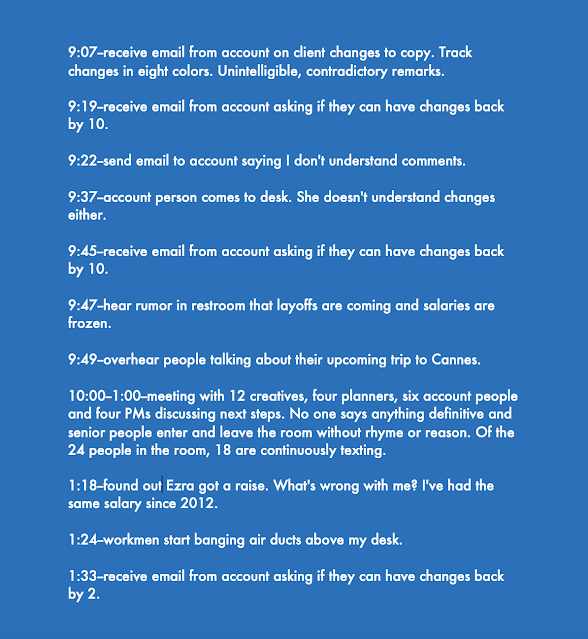
In my current role as the ad industry's resident Rabbi, I get a lot of calls from a lot of people who spend a lot of their days and a lot of their nights fighting back either tears, temper tantrums, or the urge to pour themselves three too-many drinks.

I say, "I want you to create a chronology of your day--a minute-by-minute account of your feelings from the moment you get up to the moment you fall asleep, including your dreams, if possible."

I suggest people do this because I think so many people in the industry have gotten used to the industry's mind-fucking that we accept it as ok. I think we have to become more mindful of what the ad business is doing to us. How it's insulting our souls, misusing our brains, and tearing apart our egos and our confidence.


I have no data to support this and the advertising trade press no longer engages in investigation, or even reporting, but I would guess that most agencies are seeing attrition rates of around  20 percent. That means that an entire agency, in effect, turns over every five years. That makes it nearly impossible to have either a "culture," knowledge of a client's business or any institutional wisdom.

I would imagine that most people's days are comprised of something like my scenario above. They're a combination of having your time wasted, fulfilling demands you don't agree with, being demeaned, and being misled.

As a relatively successful and high-profile freelancer, a lot of people come to me for advice. "Should I stay in the business or go freelance like you did?" They ask.

Keep a diary of your days, I say.

Freelance is far from perfect.

There's no sure thing, you have to hustle every minute and who knows when the work will dry up.

But if you consider for a moment that the Four Horsemen of the Advertising Apocalypse are these 

1. Tedium.
2. Banality.
3. Mean-ness.
4. Insecurity

And during how much of your day you hear the galloping of those hooves, it gives you a perspective and maybe some pause.

It's sad to me that I think most agency people would agree with what I've written here. And that most agency Chief People Officers wouldn't--wouldn't even recognize it.

The disconnect between the people doing the work and the people profiting from the work has never been greater. 

Friday, February 25, 2022

A journey home from the gods.


It was the end of the long season down in Saltillo, Mexico, where I played my one year for the Seraperos and where I became mi hijo Americano of Hector Quetzacoatl Padilla, whom my tongue, unable to wrap its American-backwardness around the melody of those words, renamed Hector Quesadilla.

Hector was a Hall-of-Fame outfielder in the Mexican Leagues. He began his professional career early, playing in the Mexican scrubs at the age of 14 and worked his way up to Mexico's highest level (AA at the time) in just two years. From 1941 to 1972, Hector smashed lined drives, broke up double-plays, snared dying quails and, generally won more than he lost. He won one batting crown, led the league in triples three times and in doubles four more times, and even in the short Mexican League season of just 140 games, at the end of his 32 years of playing a boy's game, he had amassed almost 3,300 hits.

Hector was dark, not Indio dark, even darker. He might have had the sinew to go to El Norte and play like other Mexican Leaguers were doing. But major league baseball wasn't open to dark people like Hector until 1947 and by that time--though only twenty years old--he had settled into the league and his place in the world he had created for himself.

Like me, and maybe that's why Hector had all-but adopted me, Hector wasn't born into this world. He wasn't born into a home or a town or a state or an anything where he was wanted. He was born into a world where he was of no more significance than a straw that fell out of a roughly-made broom. To find his place, he had to find it, and build it, and fight for it every day.

When you're born, as Hector was born, and I was born, as an accident, more a cosmic collection of dust mites than a human, your nothingness, no matter how well you can smite a ball with a bat, never disappears. Once a galactic orphan, always a super-dense mistake, with--even in an ever-expanding or ever-collapsing universe, no place called home and no place that's safe.

No wonder when Hector saw me that day I arrived at Estadio de Beisbol de Francesco I. Maduro, all lanky and American, with a note from my baseball coach, Babich, translated by my Spanish teacher, Senor Cowan, into proper Castillian Spanish, he gave me a chance to appear. 

So many people who were born like us, falling through the skies into an endless, bottomless, eternal tumble, never appear. They're invisible through life and the world as a pixeled hologram of nothingness. No one sees them, no one hears them, no one spells their name right, or laughs at their jokes or can hear their songs. They were born as dust and to dust they shall return. So many people were born like us.

But now the season was over and though I was, almost every game, the first to arrive in the dripping-pipe locker room, this afternoon I was about the last to clear my belongings from my cubby and leave the environs.  Green-painted like a medical clinic, dusty and spider-webbed and stinking of 25-men's worth of sweat and tears and blood and scabs and farts and sadness for the last time.

Andrade, a speedy backup outfielder was combing his long black hair across the room from me. 

"You come for a cerveza?" he asked, knowing I would shake my head but not enough to rattle my diffidence. "You come for a cerveza? All of the fellows will be there." 

I remember thinking how strange the word fellows was, as if we were mortar-boarded scholars at Oxford--fellows all--and having something mulled and effete.

The fellows had packed before me. Loaded up their rusty station wagons with their gear and their blue-smoke exhausts. They  would return to their small villages where they were heroes among the men and boys. They would spend the off-season looking for a way to make some extra money or for a way to find some extra girls, until they would load their rusty station wagons again and head out to play another season of sprained-ankle baseball.

Before I had to answer, Hector called out to me from his cinder-blocked office. His posters and charts and announcements from management were taken down from the walls and his bulletin board. You could see the darker outline behind where the posters had been. Extra baseball equipment was piled near his one filing cabinet where he kept a book on every player he ever saw to help him the next season. Who could hit a curve. Who hated fastballs in.

I had been living with Hector and his wife Teresa, me and my love, Karmen, since early in the season. Hector had stopped me just a few games in from the call of my father, telling me he was sick and he needed me home.

"You no go," he said to me. "You no go."

As words happen, they weren't much. But somehow they were the right words at the right time said with the right conviction, and I understood they had the depth of the oceans in them and were woven with a love I had never before felt.

Again, he said to me, "Jorge. You no go. You stay with Karmen, with Teresa and me. You play next season."

But this time, I could not stay.

I knew it was time to go. It was time to put away childish things and to outdemon a world of demons.

I thought about the brutality I would be returning to. Not a brutality of smacks and ugly put-downs, though there were those. But, worse, a world of cosmic meanness, where the universe as it was defined by the universe itself had accorded me a worth of worthlessness.

"You no go," he said again.

We were not people who hugged.

But we hugged. We stayed hugged. And then the hug broke.

We left the locker room together and walked beyond his green Datsun. We walked through the empty parking lot, down the broad monoxide choked avenues against the anger of a trillion broken car horns. We walked down the too straight asphalt until the stores lining the streets grew sparser and the street became more pothole than street.

We walked without speaking, seeing, though saying nothing, the first star in the wispy pink clouds of night. We walked through the desert. First into the scrub of dried grass near suburbia, and then into the cattle-skulled terrain and the sky closed further its eyes against the dark of night.

We walked in the endless walk of prisoners. A dull shuffling walk where the only movement from our mouths was to moisten our lips cracked by the dry air.

We walked into the deep deepness until we heard the roar of bickering cicadas in the dark, like the screams of Scylla and Charybdis.

We walked past the entrance to the cities of sacred caves we could not see, past entrances to Xibalba--the place of fear. We walked to ancient underworld cities, cities deep below the surface mere humans inhabit, places of fear ruled by those who rule us all, even if we do not know they do--the lords of death. The lords of death, as we were told in the Popol Vuh, the words from the unwritten book older than time itself. The book of the ancient people desert people who still live and breathe both here and after, both never and forever. Words from a land, like our lands, a land crowded with trials where there is no acquittal, but all is indictment and doom and sadness and gloom.

We stopped. There was no reason to go on.

"You no go," Hector said again.

But I went. 

Sometimes you have to.

Xibalba be damned.

Thursday, February 24, 2022

Writing made Georgish.


Since I was fired from an agency I loved, a client I loved and an industry I loved, I had to concoct a way to keep doing what I loved. 

Like an ant at a picnic, if you shoo me away from your ham sandwich, I'll travel over hill and dale, through grasses fifty times my height, through the terrors of giant pedal extremities looking to stomp me, until I find another tartan blanket and another set of crumbs to feast upon.

We are wired, all of us to do what we love. We'll go through hell and hot water to keep doing it.

For the same reason sea turtles or salmon swim thousands of miles to lay their eggs where they were birthed, we pursue our essence. That's why we lesser creatures, humans, come back to doing what we love. It's in our veins and there's nothing much we can do about it.

Since my forced exile from Madison Avenue, I've had to find my bearings all over again. Virtually everything changed after I was deemed too costly to work on a big agency's biggest account. But the one thing that didn't change was this space.

This blog became my hallowed ground.

This blog became the one thing I could count on.

This blog became who I am and what I do, regardless if anyone reads it or likes it or even knows it exists.

This blog became me being me.

These days, running GeorgeCo., LLC, a Delaware Company is like having four jobs or six. I am part planner. Part account guy. Part project manager. Part consultant. Part writer and re-writer. Part talent coordinator. Part producer. Part billing coordinator. Part collection agent. And part new business lead.

But no matter how weary my soul has grown, no matter if my mood is deep like the river, I return to my blog.

And return and return and return.

When I was fired the time before this, in 2013, I stared down the barrel of never working again. I said to myself, "what can I do to get myself a good job?" I answered that simply: Make myself the best writer I can possibly be. Work at my writing every day, getting sharper, faster, a better listener and funnier.

I do a lot of that work here. Sometimes I feel like my mother back in black and white shtetl days, darning socks. It takes a lot of work just to keep from falling behind.

I darn my socks publicly. This is a little, I guess, like lifting weights with my shirt off at Venice Beach. There's a little exhibitionism involved..

But a lot of what I do and how I wrote is unseen. 

Between the time I dope a post out and the time I press the grandiosely-titled "publish" button, I return to my posts ten times or twenty. I snip and nip and re-write and hone. I try to make what I put out there as good as I can given my time and schedule and considering I'm on deadline every day.

That's how we do it.

We work at it.

Not some of the time but all of the time.

And then we hope.

Hope what we wrote doesn't suck.

But even if it does, we're back the next day.


Wednesday, February 23, 2022

Humans. Truth. Breaking News.

When I was growing up in the advertising business, there was an unwritten, unspoken rule. It was never carved in marble or engraved in bronze. It just was. It just was based on the thousands of great ads we'd read and studied by the people who made the modern ad business the modern ad business.

The writers of DDB, PKL, Carl Ally and more. When you read their ads in the awards annuals (ads that actually ran, by the way) their last lines always contained a smile or a poke. They were always warm and surprising and often funny or witty. 

We labored over last lines. The saying went, "last lines are a reward for the reader for reading your ad." 

It was a pretty good way of thinking about what we do.

In today's industry--and by today, I really mean most of the last thirty years, we've forgotten this. 

I am not just being semantic.

But in my lifetime, we've gone from calling people people, or readers, or viewers, or customers, or audiences to calling them targets. Targets we put in buckets.

Calling someone a target is no way to engender trust. 

The very basis of humanity--this is going back to the Torah, which is just about the first foundational text ever written--is treating people as you wish to be treated. 

Not as a target.

This is something we need to think about as an industry. 

Are our ads to besiege people or are they to serve people?

Are our ads to pound away at people until we wear them down, or are we to soothe, comfort and support them?

Are our ads to insult people with bait and switch tactics or are our ads showing them honesty and respect?

Are we verizoning people to mince meat, or are we showing kindness?

If you take a moment a read a novel from the early days of the English novel, say something by Laurence Sterne or Henry Fielding, they often talk directly to their readers and use the phrase "dear reader." 

In the great Bob Levenson's obituary in The New York Times, when he was asked how he wrote copy for so many Volkswagen ads, Levenson said: "I always started by writing Dear Charlie, like writing to a friend. And then I would say what I had to say, and at the end I would cross out Dear Charlie, and I was all right.”

Let me underscore something for you: like writing to a friend.

The highly-controversial sociologist, Charles Murray, wrote a book a few years back called "Coming Apart." The Times' op-ed columnist David Brooks wrote about it here, in a column called "The Great Divorce." Let me pick out a piece or two of Brooks' column for you to think about--not toss aside.

1.
His story starts in 1963. There was a gap between rich and poor then, but it wasn’t that big. A house in an upper-crust suburb cost only twice as much as the average new American home.

2.
Today, Murray demonstrates, there is an archipelago of affluent enclaves clustered around the coastal cities, Chicago, Dallas and so on. If you’re born into one of them, you will probably go to college with people from one of the enclaves; you’ll marry someone from one of the enclaves; you’ll go off and live in one of the enclaves.

Ah, I'm being abstruse again. 

Here's some clarity: 

I think the advertising industry has forgotten about the humanity of humans. I think we are guilty of not getting out of our enclaves. We think the world ends in Williamsburg and anyone outside of our little circle is less than human.

So we treat people like cattle. I think we think that if we show people dancing because they have a new Swiffer dry mop, or gushing over their unreliable-and-extortionate cable service, or being impressed by the balloons in a Hyundai showroom, sooner or later people will believe it. Because deep-down we don't know our "target" and/or we believe they're dumb. Or at least easily gulled.


It might be worse than that. We might just be creating those images because they make our clients feel good as they rip people off.

Back to Murray, we in advertising, it sadly seems to me, are living in a world largely estranged from the reality of everyday life. The vectors of DEI efforts have not dented this hermetically-sealed cocoon. We've just brought more diversity to our industry-wide estrangement and myopia.

We don't know real people. We know archetypes, targets and victims of powerpoint.

The question is, are we bringing understanding, kindness, warmth and empathy to our work? Or are we making expensive films of models and gleaming smiles that are as human as a manikin? 


When we, as an industry, create a thousand messages a day with which to assault our target like Gulliver stung by ten-thousand Lilliputian arrows--are we treating people as people or as targets?

We used to talk about issues like this in advertising. How we're treating people. What we're doing for people. How we're making them feel. How we're comforting the afflicted and afflicting the comfortable.

But now our conversations are on tracking people like escaped convicts except we use data and cookies and technology rather than feral bloodhounds. Now our conversations are about our $4000/night Cannescommodations and who's won 700 awards when there haven't been seven good commercials done in the last seven years. Now we talk about NFTs and metaverses and which celebrities' artificial ass implants look the most genuine.

To paraphrase David Ogilvy, we are once again treating the consumer like morons. 

We are forgetting that ever since time began--when the first hominids took their first step into bi-pedalism--humans are humans.

We like to laugh, love, learn, lust, labor.

We don't like to be yelled at and demeaned.

--

About four times a week, I get a message from someone I don't know asking me to mentor them or, at least, to teach an advertising class. 

With some wise friends, we are planning in the fall to launch a school called "Working Class." It will aim not to teach the "how" of advertising--it ain't about last year's awards or some photoshop technique or how to tik a tok. 

It will be about some things that are much more important: the "whys" of advertising.

Why do we advertise? Why is it important? Why does our work matter? Why has advertising created more wealth than perhaps any industry other than prostitution?

It will be, as it should be, expensive. But you can save yourself a boat-load of money on the course. Just read the Volvo ad above by Ed McCabe. 

Think about how we don't talk about payment books today. Or how long cars last. Or how people drive. Think about how that Volvo ad is about real people who live with sweat and who work hard and who have hopes and dreams. Think about ads written by humans for humans.

That's the course.

Right there.

Tuesday, February 22, 2022

Wilbur Wood and Honore de Balzac.

To steal and rewrite a phrase from a turgid 1970s best-seller (if that's not redundant) being a freelancer is never having to say you're busy.


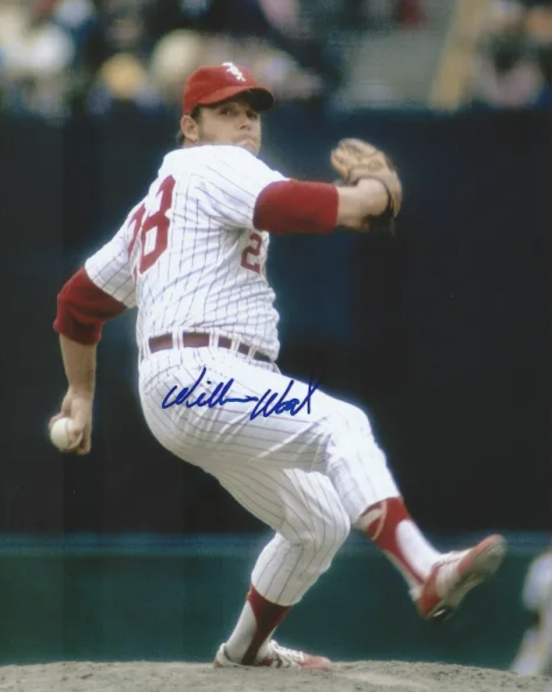
When I was a kid, there was a great pitcher for the Chicago White Sox called Wilbur Wood. Wood was one of the best pitchers in the league and one of the busiest. Pitchers pitched more games and more innings in those days but Wood was way off the bell curve.

In an era when a great pitcher would toss 250 innings, Wood threw half again as many--throwing almost 1400 innings in just four seasons.

I have a feeling I'm wired--and so are a lot of other creatives--a lot like Wood. We might know we don't have the greatest stuff in the league. Consequently, we're afraid if we turn down a start, that might be the beginning of our end.*

There's something of an oxymoron that goes along with Wood, I think, and freelancers like myself. While we're disparaging our own abilities, we also have an aggrieved sense of our own importance. Often I believe that when the game's on the line--when there's a big ugly project, there's no one who can handle it better than I. 

A lot of clients feel that way, too. I get a lot of "oh, shit" calls. "George, we need you." 

When someone says they need you, I think a lot of old-fashioned people like me hearken back to the Middle Ages, specifically the thirteenth and fourteenth centuries. The medieval knight is somewhat of an archetype in Western culture and that's when Knights were in ascendance. I think a lot of freelancers and workhorse pitchers understand the Knightly code at a limbic level.

When we're given the ball or the lance, we come through. Or die trying.

I think the best agencies and the best agency CEOs are like that, too. As I so often say, a lot of us were bred that way. We'll run through hell in a gasoline suit to get the job done.

There was a C-suiter at Ogilvy I met during my first stint there. It must have been around 2001. In those days we still had big meetings with creative people invited and we'd all fly to Paris for them. 

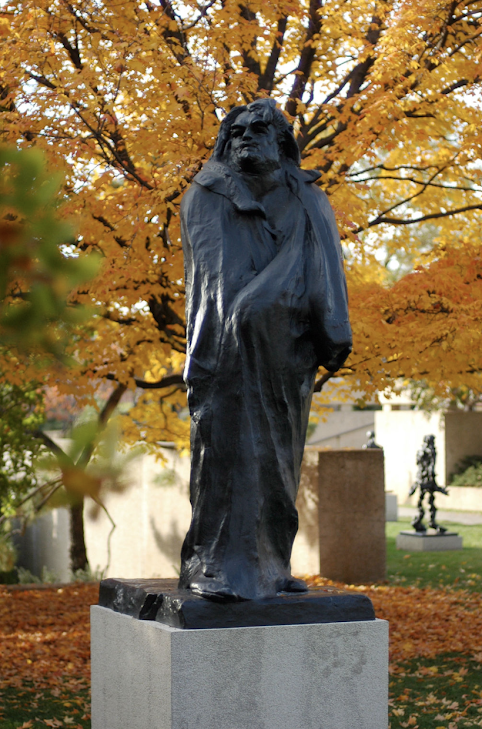
This guy said a dozen or so words the entire meeting and they're all I remember from that time in Paris. His words and seeing a statue of Honore de Balzac and thinking how hard it must have been to go through life with that last name. This Chief said, "Clients don't care how much you know until they know how much you care."

Most successful lefties, CEOs and freelancers get this.

They know that their success doesn't stem from being tanned and fit and rested. They know that coming through regardless of the situation, regardless of the unreasonableness of the assignment, regardless of its inconvenience is a big part of the job. And, if it's a big part of the job, it's a big part of your reputation. And a big part of why you get the next job. The next ten jobs.

That's why, often "We Try Harder."

It's Friday afternoon as I write this--Monday's post, or Tuesday's, depending on whether or not I decide to post on the American holiday honoring the three-day mattress sale, President's Day. I just came back from a mile-long restorative walk along the seaside. After a week of about 37 meetings. Like Wilbur Wood about half again as many meetings as I should allow myself. I must have written ten-thousand words this week.

There's nothing I'd like to do more than lay down for half an hour. Talk to my wife. Read about the Middle Ages. Or hold Whiskey's paw and listen to something by Bruckner, Billie, or Mahler.

But I know my weekend will be filled with work. Writing more words. And creating proposals. And writing some more.

As Malcolm Cowley once wrote, "I worked at the writer's trade."

It is a trade. We measure twice and cut once. We throw out a lot of false starts. We get a lot of advice and have to empty our trash bins often. We work at it.

So I'm writing my Monday or Tuesday or Wednesday post now. Watching the sunset as I do it. Re-submitting bills for the ninety-first time because of some asinine stipulation the client's accounts un-payable person is demanding.

That's life.

That said:

Give me the ball, coach.

--

*There's an esoteric baseball verb: "to be Pipped." Back in 1925, Wally Pipp, the New York Yankees regular first-baseman had a headache. He asked for the day off and Miller Huggins, his manager, said fine. Huggins put 22-year-old Lou Gehrig in at first for Pipp. Gehrig went on to play 2,130 straight games--nearly 14 seasons, from 1925 to 1939 without taking a rest. We're all a bit afraid of being Pipped.


Monday, February 21, 2022

A Presidents' Day ramble with Mark Twain.

Since my wife and I Covided out of Manhattan nearly two years ago and bought our broken-down little cottage on the sea in Old Saybrook, Connecticut, we have taken to spending about two weekends in three exploring what there is to see in our transplanted environs.

If the New York metro area were an independent country (and with the state of America today, I wish it were) it would be about number 60 by population of the 237 countries counted by the Central Intelligence Agency's World Fact Book. Putting greater- New York's population at an even 20 million, it would be just behind Mali and just atop Kazakstan.

That's a round-about way of saying there was so much to see and do when we were living in New York, we seldom took day trips out of our immediate area. Why would we?


We could take a four-mile walk to the Bronx and see Edgar Allen Poe's cottage or a forty-minute drive to White Plains and see old anti-Soviet surface-to-air missile sites when we were staring eyeball-to-eyeball with Russia, like we still are.


In any event, on Saturday, I filled my 1966 Simca 1500 up with a precise mixture of aviation fuel, kerosene and leaded gasoline and we drove north about an hour to the capital of Connecticut, a benighted small city called Hartford.

In my long lifetime, Hartford has tumbled from the richest city in the United States (it's still, somewhat, the seat of the American insurance industry) to the absolute poorest. Today, a full one in three of its residents lives under the poverty line. Hartford is a near-perfect example of discriminatory policies that have wreaked havoc on so many people of color.

With neighborhoods redlined by color, no mass transit, schools supported by plummeting property valuations and jobs fleeing the once-industrialized northeast, Hartford's crime rate is nearly sixty-percent higher than the US average and fewer than seven kids in ten graduate from high school.

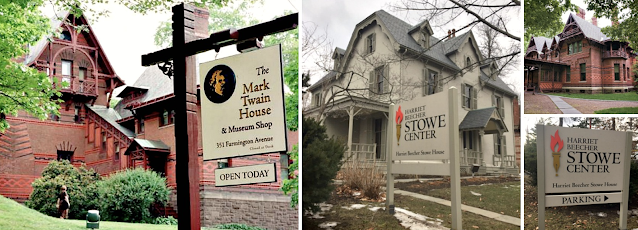
140 years ago, Twain and Stowe were next-door neighbors.
Today much of the surrounding neighborhood is abandoned.

However, the Hartford my wife and I drove to was the Hartford of about 130 years ago. On one block, currently surrounded by moderate blight, are the well-preserved homes of America's two most-popular and acclaimed authors: Harriet Beecher Stowe, who wrote Uncle Tom's Cabin (19th Century America's second best-selling book, after the Bible) and Mark Twain.

Twain was of more interest to me--mostly because despite being, in the words of Abraham Lincoln, the "woman whose book started the Civil War," Stowe and her writing haven't aged well. The less said here, the better. 

While in Hartford, and surrounded by his wife and three daughters, the peripatetic Twain settled down and wrote. Really wrote. 

He lived there for 17 years, between 1874 and 1891 and wrote in 1876, "The Adventures of Tom Sawyer," in 1881, "The Prince and the Pauper, followed "Life on the Mississippi," in 1883, culminating in "The Adventures of Huckleberry Finn," in 1884. That's four major novels in eight years. While having children running around. All while Twain himself toured the nation imitating Hal Holbrooke.

Twice while touring Twain's house I thought of advertising. Both times involved the lock-step adoption of open-plan workspaces by nearly every agency in the space of just three or four years. If agencies brought as much action and unanimity to their DEI efforts as they had to cutting their rent, our business might be today in a different place.

Twain's first office was adjacent to the nursery where his daughters played, were schooled and slept. Twain wanted to see them--he had traveled so widely and adored them so much. But he couldn't focus with that sort of open plan. Too much distraction.

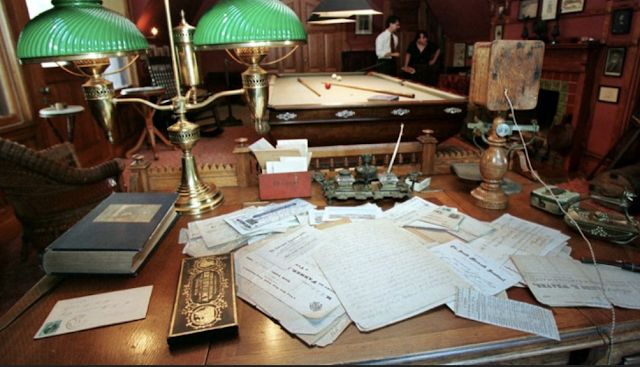
Twain's billiards' room. 

So, Twain moved up to the third floor, to his billiards room. Again Twain tried to write, but snooker was too great a distraction. Finally, against the tumult of that open plan, he wedged his desk into a tight corner and got down to business.

Twain's desk was a mess. A good sign of a fertile mind.

The quiet he found worked.

As I said, four major works in just eight years.

Quiet work works.